9 Best TP-Link Smart Managed Network Switches, Compared
As an Amazon Associate we earn from qualifying purchases. Links on this page are affiliate links.
Choosing a TP-Link smart managed network switch gives you traffic control using VLAN segmentation and Quality of Service prioritization. This comparison evaluates 9 models based on the specifications published on the listings. The TP-Link 24-Port Gigabit Smart Managed Switch leads the ranking because its 24 gigabit ports provide essential VLAN, QoS, and diagnostic controls for high-density wired setups without PoE needs.
This guide helps you determine the right port count, PoE budget, and uplink speed for your network setup.
Quick picks
The best fit for you
- You need many wired gigabit ports without PoE hardware TP-Link 24-Port Gigabit Smart Managed Switch It delivers 24 gigabit ports with smart management controls for setups without PoE requirements.
- You want a compact switch mounted to a wall TP-Link 8-Port Smart Managed Gigabit Switch This model features eight gigabit ports and includes built-in wall-mount support for flexible placement.
- You need 2.5G multi-gigabit speeds with PoE TP-Link 24-Port 2.5G Managed PoE Switch It features 24 ports running at 2.5G speeds paired with PoE support for high-bandwidth hardware.
- You want a minimal desktop switch with five ports TP-Link 5-Port Gigabit Smart Managed Switch The compact desktop chassis provides five gigabit ports with essential smart management capabilities.
Our 9 picks

TP-Link 24-Port Gigabit Smart Managed Switch
Best for: high-density wired setups without PoE needs
- Management Type
- Smart Managed (what this guide is about)
- Port Count
- 24
- Port Speed
- Gigabit
- Number of Ports
- 24 Ports
- Dimensions
- 11.6 × 7.1 × 1.7 inches
- Weight
- 3.75 pounds
View on Amazon: TP-Link 24-Port Gigabit Smart Managed Switch
This TP-Link unit gives you 24 gigabit Ethernet ports alongside essential smart management tools. You can organize local traffic using port-based and tag-based VLAN features, loop prevention, and 9K jumbo frame support. It also includes IGMP snooping and quality of service prioritization for latency-sensitive streams. This switch suits you if you need to wire numerous clients across a single switch without requiring Power over Ethernet.
Pros
- 24 gigabit RJ45 ports for high-density wired connections
- 9K jumbo frame support to improve large file transfer efficiency
- Traffic management via VLAN segmentation, IGMP snooping, and QoS
- Monitoring tools including cable diagnostics, loop prevention, and port mirroring
Cons
- Does not supply Power over Ethernet (PoE)
- Limited to standard gigabit speeds without 2.5GbE or 10GbE uplink ports
Good fit if
- You need to connect up to 24 wired gigabit devices to a central switch.
- You want basic traffic management such as VLANs and QoS without complex enterprise software.
- You already power your networked devices with dedicated adapters.
Skip if
- You need Power over Ethernet to run access points or security cameras directly.
- You require multi-gigabit throughput or SFP optical ports for faster uplinks.
Verdict: TP-Link 24-Port Gigabit Smart Managed Switch provides 24 gigabit ports with essential VLAN, QoS, and diagnostic controls for wired networks. It is a solid core hub when you do not need Power over Ethernet or multi-gigabit uplinks.
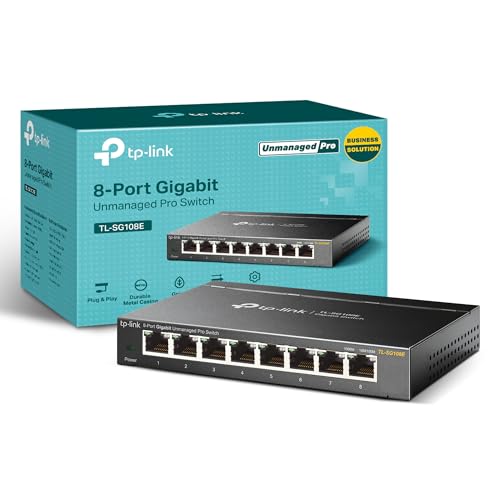
TP-Link 8-Port Smart Managed Gigabit Switch
Best for: wall-mounted small office and home network setups
- Management Type
- Smart Managed (what this guide is about)
- Port Count
- 8
- Port Speed
- Gigabit
- Mounting Type
- Desktop/Wall-Mount
- Number of Ports
- 8 Ports
- Dimensions
- 6.2 × 4 × 1 inches
This TP-Link switch provides eight Gigabit Ethernet ports with Easy Smart management in a compact metal chassis. You can mount it directly to a wall or set it on a desk. The device supports Layer 2 features including 32 VLANs, QoS, link aggregation, and IGMP snooping via a web interface. You will find it suits small networks requiring basic traffic segmentation and monitoring without the footprint of rackmount gear.
Pros
- Eight Gigabit Ethernet ports with shielded connectors
- Desktop and wall-mount installation options
- Layer 2 management with 32 VLANs, QoS, and link aggregation
- Sturdy metal housing measuring 6.2 by 4 by 1 inches
Cons
- No Power over Ethernet (PoE) support
- Limited to eight total network ports
Good fit if
- You need wall-mounting capabilities for an eight-port setup.
- You want network management tools like VLANs, QoS, and port mirroring.
Skip if
- You require Power over Ethernet to supply power to connected hardware.
- You need more than eight wired Gigabit connections.
Verdict: TP-Link 8-Port Wall-Mount Smart Switch provides compact, wall-mountable Gigabit connectivity with core Layer 2 traffic management tools. It offers practical network segmentation for smaller setups that do not require PoE hardware.

TP-Link 16-Port Smart Managed Gigabit Switch
Best for: mid-sized wired networks needing traffic management
- Management Type
- Smart Managed (what this guide is about)
- Port Count
- 16
- Port Speed
- Gigabit
- Number of Ports
- 16 Ports
- Dimensions
- 15.8 × 9.84 × 3.15 inches
- Weight
- 2 pounds
View on Amazon: TP-Link 16-Port Smart Managed Gigabit Switch
This TP-Link switch delivers 16 Gigabit Ethernet ports with Easy Smart management tools for your wired setup. You get essential traffic management features, including port and tag-based QoS, VLAN segmentation, and IGMP snooping to streamline multicast data. It also includes port mirroring, loop prevention, and cable diagnostics for troubleshooting. This switch suits you if you need a mid-sized wired network backbone with managed traffic controls without complex enterprise configurations.
Pros
- 16 Gigabit Ethernet ports
- Port and tag-based QoS plus VLAN traffic segmentation
- Integrated cable diagnostics, loop prevention, and port mirroring
- Supports 9K jumbo frames for large file transfers
Cons
- Does not support Power over Ethernet (PoE)
- Lacks 2.5Gbps or faster uplink ports
Good fit if
- You need 16 Gigabit ports to connect wired network hardware.
- You want basic traffic segmentation with VLANs and QoS priority.
- You require network monitoring features like loop prevention and cable diagnostics.
Skip if
- You need Power over Ethernet to run access points or security cameras.
- You require multi-gigabit speeds higher than 1Gbps.
Verdict: TP-Link 16-Port Gigabit Easy Smart Switch provides reliable 16-port Gigabit connectivity with practical network management and diagnostic tools. It serves as an effective wired foundation when you need traffic controls without requiring PoE power.

TP-Link 5-Port Gigabit Smart Managed Switch
Best for: small desktop setups needing managed gigabit ports
- Management Type
- Smart Managed (what this guide is about)
- Port Count
- 5
- Port Speed
- 10/100/1000 Mbps
- Mounting Type
- Desktop
- Number of Ports
- 5 Ports
- Dimensions
- 6.7 × 4.1 × 4.5 inches
This compact switch provides five gigabit RJ45 ports for expanding your wired setup. You get smart management tools through a web-based interface, including VLAN support, QoS traffic prioritization, IGMP snooping, and port mirroring. Its metal casing with shielded ports sits directly on your desk or shelf. This model suits you if you need entry-level network segmentation and traffic control across a handful of local wired devices without complex enterprise hardware.
Pros
- Five gigabit Ethernet ports supporting 10/100/1000 Mbps speeds
- Smart management features including VLAN, QoS, and port mirroring
- Durable metal casing with shielded RJ45 ports
- Plug-and-play functionality with optional web interface configuration
Cons
- Offers only five total network ports
- No Power over Ethernet support listed in specifications
- Desktop design does not include rackmount options
Good fit if
- You need a compact switch for five or fewer wired gigabit connections.
- You want traffic segmentation and QoS features configured through a browser.
- You prefer a sturdy metal chassis for a desk or shelf.
Skip if
- You need more than five ports to connect all your wired hardware.
- You require Power over Ethernet to run access points or security cameras.
- You plan to mount your networking gear into a standard server rack.
Verdict: TP-Link 5-Port Gigabit Smart Switch delivers core managed networking tools like VLANs and QoS in a space-saving desktop footprint. It gives you essential traffic management across five ports without extra bulk or complexity.

TP-Link 8-Port Gigabit Smart Managed PoE Switch
Best for: small setups needing four basic PoE ports
- Management Type
- Smart Managed (what this guide is about)
- Port Count
- 8
- Port Speed
- Gigabit
- PoE Support
- PoE (802.3af)
- PoE Power Budget
- 57W
- Number of Ports
- 8 Ports
View on Amazon: TP-Link 8-Port Gigabit Smart Managed PoE Switch
This compact TP-Link smart managed switch provides eight gigabit Ethernet ports, including four 802.3af PoE ports backed by a 57W power budget. You get web-based management tools alongside traffic prioritization, port-based QoS, and VLAN segmentation. It suits you if you need to run a handful of powered devices like access points or IP cameras alongside standard wired gear on a compact desktop network.
Pros
- Four 802.3af PoE ports with a dedicated 57W power budget
- Web-based management interface and smart configuration utility
- Supports VLAN segmentation, IGMP snooping, and 802.1p/DSCP QoS
- Compact footprint measuring 6.22 by 3.98 inches
Cons
- PoE is limited to four ports rather than all eight
- Provides standard 802.3af PoE up to 15.4W per port instead of higher-power PoE+
- Total PoE power budget caps at 57W
Good fit if
- You need to power up to four PoE devices without adding separate injectors.
- You want basic VLAN segmentation and traffic prioritization on a desktop network.
- You manage your switch using a standard web interface or configuration utility.
Skip if
- You need high-draw PoE+ devices that exceed 15.4W per port.
- You require more than four PoE ports or over 57W of total PoE capacity.
- You need more than eight total Ethernet connections on one switch.
Verdict: TP-Link 8-Port Gigabit Smart Switch with 4 PoE Ports delivers essential smart management and reliable power for up to four 802.3af devices. It is a practical, space-saving choice for small wired networks needing basic traffic controls and compact PoE delivery.

TP-Link 16-Port Smart Managed Gigabit PoE+ Switch
Best for: high-capacity PoE+ deployments needing SFP uplinks
- Management Type
- Smart Managed (what this guide is about)
- Port Count
- 16
- Port Speed
- 10/100/1000 Mbps
- PoE Support
- PoE+ (802.3at/af)
- PoE Power Budget
- 250W
- Uplink Ports
- 2 x Gigabit, 2 x Combo SFP
View on Amazon: TP-Link 16-Port Smart Managed Gigabit PoE+ Switch
This TP-Link smart switch gives you 16 Gigabit PoE+ ports with a 250W total power budget, alongside two non-PoE Gigabit ports and two combo SFP slots for high-speed connections. You get Easy Smart web management, VLAN segmentation, and PoE Auto Recovery to reboot unresponsive devices automatically. It suits you if you need to power numerous access points or cameras while keeping basic management control over your local network.
Pros
- 16 PoE+ Gigabit ports with 250W total power budget
- Two non-PoE Gigabit RJ45 ports and two combo SFP slots
- PoE Auto Recovery automatically detects and reboots dropped devices
- Overload protection disables lower priority ports when power reaches 250W
Cons
- Port speeds are limited to 10/100/1000 Mbps with no multi-gigabit support
- Physical footprint is large at 17.3 inches long and 5.34 pounds
Good fit if
- You need to power multiple PoE+ devices under a 250W budget.
- You want combo SFP slots for high-speed uplink connections.
- You want automated detection and rebooting of unresponsive PoE hardware.
Skip if
- You require network speeds faster than 1000 Mbps.
- You need a compact switch for a small desktop space.
Verdict: TP-Link 16-Port PoE+ Easy Smart Switch delivers a 250W power budget and flexible uplink options for powering multiple network devices. It offers practical traffic management and automated recovery tools without requiring complex setup.

TP-Link 24-Port Smart Managed PoE+ Switch
Best for: high-density PoE+ setups requiring fiber uplinks
- Management Type
- Smart Managed (what this guide is about)
- Port Count
- 28
- Port Speed
- 10/100/1000 Mbps
- PoE Support
- PoE+ (802.3at/af)
- PoE Power Budget
- 250W
- Uplink Ports
- 2 SFP Slot
This TP-Link smart managed switch provides 28 total ports to expand your wired network. You get 24 gigabit PoE+ ports delivering up to 250W across connected hardware, alongside two dedicated non-PoE gigabit ports and two SFP slots for uplinks. It includes Easy Smart web management, VLAN segmentation, and PoE auto recovery. This unit suits you if you need to run dozens of powered devices from a single central switch.
Pros
- 24 Gigabit PoE+ ports with 250W total power budget
- Two dedicated Gigabit RJ45 ports and two SFP slots
- PoE Auto Recovery reboots unresponsive powered devices automatically
- Web-based Easy Smart management interface with VLAN support
Cons
- Maximum port speed limited to 1 Gbps without multi-gigabit support
- SFP uplink slots operate at 1 Gbps rather than 10 Gbps
- Easy Smart tier lacks advanced L2+ enterprise routing controls
Good fit if
- You need to power up to 24 PoE+ devices with a total draw under 250W.
- You want SFP slots for fiber uplinks alongside standard copper connections.
- You require automated detection and rebooting of unresponsive PoE hardware.
Skip if
- You require multi-gigabit speeds like 2.5 Gbps or 10 Gbps for your devices.
- You need full L2+ managed switch features instead of Easy Smart controls.
Verdict: TP-Link 28-Port Smart Managed PoE+ Switch provides extensive PoE+ capacity and a 250W power pool for high-density setups. It delivers dependable traffic segmentation and fiber uplink capability through an accessible web interface.

TP-Link Omada 24-Port Gigabit Switch with 10G SFP+
Best for: 10G fiber uplinks without PoE needs
- Management Type
- Smart Managed (what this guide is about)
- Port Count
- 24
- Port Speed
- 10/100/1000 Mbps
- Uplink Ports
- 4 x 10G SFP+
- Number of Ports
- 24 Ports
- Dimensions
- 17.3 × 7.09 × 1.73 inches
View on Amazon: TP-Link Omada 24-Port Gigabit Switch with 10G SFP+
The switch combines 24 Gigabit RJ45 ports with four 10 Gbps SFP+ uplink slots to deliver high-capacity connectivity across your network. It integrates into the Omada SDN platform for centralized cloud or standalone management and includes L2+ static routing to direct internal traffic. It is built for you if you need fast fiber uplinks for servers or switches without Power over Ethernet requirements.
Pros
- Four 10 Gbps SFP+ uplink slots
- 24 Gigabit RJ45 Ethernet ports
- Omada SDN controller and standalone management options
- L2+ static routing and 802.1Q VLAN support
Cons
- No Power over Ethernet support
- RJ45 ports capped at 1 Gbps
- Cloud-based controller requires additional fees
Good fit if
- You need 10G SFP+ uplink slots for servers or network backbones.
- You manage infrastructure using the TP-Link Omada SDN system.
- You require L2+ static routing without needing PoE capabilities.
Skip if
- You need PoE to power access points or cameras.
- You want 2.5 Gbps or faster RJ45 client ports.
Verdict: TP-Link Omada 24-Port Gigabit Switch with 10G Uplinks provides high-bandwidth fiber connectivity and L2+ routing for networks that do not require PoE power. It integrates cleanly into standalone setups or managed Omada SDN architectures.

TP-Link 24-Port 2.5G Managed PoE Switch
Best for: 2.5G multi-gigabit networks with high-wattage PoE
- Management Type
- Smart Managed (what this guide is about)
- Port Count
- 24
- Port Speed
- 2.5 Gbps
- PoE Support
- PoE+ (802.3at/af), PoE++ (802.3bt)
- PoE Power Budget
- 500W
- Uplink Ports
- 4 x 10G SFP+
This TP-Link smart managed switch provides 24 multi-gigabit Ethernet ports running at 2.5 Gbps, paired with 4 high-speed 10G SFP+ uplink slots. It delivers a 500W total power budget, split between 16 PoE+ ports and 8 high-output PoE++ ports delivering up to 60W each. It suits you if you deploy high-throughput access points, multi-gigabit hardware, or power-hungry network gear needing centralized Omada cloud or standalone L2+ management.
Pros
- 24 multi-gigabit ports supporting 2.5 Gbps speeds
- Four 10G SFP+ uplink slots for high-bandwidth backbones
- 500W total PoE budget with 8 PoE++ ports up to 60W each
- Centralized Omada SDN cloud management plus standalone L2+ mode
Cons
- Substantial 11.2-pound weight and full rack-depth chassis
- PoE++ output is limited to 8 of the 24 ports
Good fit if
- You need 2.5 Gbps speeds across 24 Ethernet connections.
- You operate high-draw hardware requiring PoE++ up to 60W per port.
- You want 10G SFP+ uplinks tied into an Omada SDN management setup.
Skip if
- You only require standard 1 Gbps networking speeds.
- You do not need Power over Ethernet capabilities.
Verdict: TP-Link Omada 24-Port 2.5G PoE Switch delivers dedicated 2.5 Gbps port speeds, 10G uplinks, and a 500W PoE budget for demanding multi-gigabit networks. It provides comprehensive Omada SDN integration and L2+ security controls without settling for standard gigabit bottlenecks.
Specifications side by side
| Spec | TP-Link 24-Port Gigabit Smart Managed Switch | TP-Link 8-Port Smart Managed Gigabit Switch | TP-Link 16-Port Smart Managed Gigabit Switch | TP-Link 5-Port Gigabit Smart Managed Switch | TP-Link 8-Port Gigabit Smart Managed PoE Switch | TP-Link 16-Port Smart Managed Gigabit PoE+ Switch | TP-Link 24-Port Smart Managed PoE+ Switch | TP-Link Omada 24-Port Gigabit Switch with 10G SFP+ | TP-Link 24-Port 2.5G Managed PoE Switch |
|---|---|---|---|---|---|---|---|---|---|
| Port Count | 24 | 8 | 16 | 5 | 8 | 16 | 28 | 24 | 24 |
| Port Speed | Gigabit | Gigabit | Gigabit | 10/100/1000 Mbps | Gigabit | 10/100/1000 Mbps | 10/100/1000 Mbps | 10/100/1000 Mbps | 2.5 Gbps |
| Management Type | Easy Smart Managed | Easy Smart | Easy Smart Managed | Easy Smart | Easy Smart | Easy Smart | Easy Smart | Smart Managed | L2+ Smart Managed |
| PoE Support | not specified | not specified | not specified | not specified | PoE (802.3af) | PoE+ (802.3at/af) | PoE+ (802.3at/af) | not specified | PoE+ (802.3at/af), PoE++ (802.3bt) |
| PoE Power Budget | not specified | not specified | not specified | not specified | 57W | 250W | 250W | not specified | 500W |
| Uplink Ports | not specified | not specified | not specified | not specified | not specified | 2 x Gigabit, 2 x Combo SFP | 2 SFP Slot | 4 x 10G SFP+ | 4 x 10G SFP+ |
| Mounting Type | not specified | Desktop/Wall-Mount | not specified | Desktop | not specified | not specified | not specified | not specified | not specified |
| Number of Ports | 24 Ports | 8 Ports | 16 Ports | 5 Ports | 8 Ports | 16 Ports | 24 Ports | 24 Ports | 24 Ports |
| Uplink Port Type | not specified | not specified | not specified | not specified | not specified | SFP | not specified | SFP | not specified |
| Dimensions | 11.6 × 7.1 × 1.7 inches | 6.2 × 4 × 1 inches | 15.8 × 9.84 × 3.15 inches | 6.7 × 4.1 × 4.5 inches | 6.22 × 3.98 × 0.98 inches | 17.3 × 7.09 × 1.73 inches | 17.3 × 8.66 × 1.73 inches | 17.3 × 7.09 × 1.73 inches | 17.3 × 13 × 1.73 inches |
| Weight | 3.75 pounds | 1.12 pounds | 2 pounds | 15.2 ounces | 1 pounds | 5.34 pounds | 6.83 pounds | 4.3 pounds | 11.2 pounds |
| Size | 24 Port | Enhanced Features | 8 Port (Pack of 1) | 16 Port | Enhanced Features | 5 Port w/ Enhanced Features | Easy Smart Managed, 8 Port w/ 4 PoE+ Port | 18 Port w/ 16-Port PoE+ | 28 Port w/ 24 PoE+ Port | 24 Port + 4 10GE SFP+ | 24 Port, 2.5 Gigabit |
| Color | Black | Black | Black | Black | Black | Black | black or gray | black | black |
| Model | TL-SG1024DE | TL-SG108E | TL-SG1016DE | TL-SG105E | TL-SG108PE | TL-SG1218MPE | TL-SG1428PE | TL-SG3428X | TL-SG3428XPP-M2 |
Choosing the Right TP-Link Smart Switch
-
Check Uplink Port Types
Check whether you need dedicated optical uplinks between switches or network cabinets. Standard models rely exclusively on copper RJ45 ports. If you must span long distances or connect to a high-speed core, look for dedicated SFP or 10G SFP+ slots. The TP-Link Omada 24-Port Gigabit Switch with 10G SFP+ includes four 10GE SFP+ fiber ports for high-bandwidth backbone connections. Choose SFP cages when you run fiber transceivers across rooms or floors, and stick to standard copper RJ45 ports if all equipment shares a single rack.
-
Calculate PoE Power Budgets
Review the total PoE wattage budget if you plan to power access points, IP cameras, or VoIP phones. Switches with PoE ports supply a fixed power pool across all active connections. Exceeding this budget causes connected devices to shut down or fail to boot. The TP-Link 16-Port Smart Managed Gigabit PoE+ Switch provides a 250W power budget, which supplies ample wattage for multiple hardware units simultaneously. Sum the maximum wattage requirements of all your planned PoE client devices before selecting a switch to ensure the supply meets your total power draw.
-
Verify PoE Standard Requirements
Check whether your endpoints require standard 802.3af PoE or higher-output 802.3at PoE+ power delivery. Standard PoE delivers up to 15.4 watts per port, suitable for basic IP phones or entry-level sensors. Advanced hardware, such as pan-tilt-zoom security cameras or high-performance access points, requires PoE+ delivery of up to 30 watts per port. The TP-Link 8-Port Gigabit Smart Managed PoE Switch offers four 802.3af PoE ports, making it suitable for lower-draw gear. Match the PoE generation on the switch spec sheet to the exact power requirements listed by your powered hardware.
-
Choose Management Architecture Level
Determine whether you want local standalone configuration or centralized cloud control across multiple network nodes. TP-Link Easy Smart switches feature an onboard web interface for local port monitoring, VLANs, and cable diagnostics on a single unit. In contrast, enterprise setups benefit from Omada SDN software integration and L2+ routing controls. The TP-Link 24-Port 2.5G Managed PoE Switch supports Omada SDN architecture alongside standalone web management. If you manage multiple switches and access points from one unified platform, choose Omada-capable hardware. For a single self-contained switch, standard Easy Smart management is sufficient.
-
Match Form Factor to Space
Examine the physical dimensions, weight, and mounting options to confirm the switch fits your installation area. Compact units suit desktop placement or tight wiring closets. The TP-Link 8-Port Smart Managed Gigabit Switch measures 6.2 inches long, weighs 1.12 pounds, and includes integrated wall-mount slots. Full-size 16-port and 24-port switches reach up to 17.3 inches in length and weigh over 11 pounds when equipped with internal power supplies. Check your cabinet depth and verify whether you need wall slots, desk rubber feet, or rack ears before finalizing your physical switch layout.
Frequently asked questions
What is the difference between an unmanaged and a TP-Link smart managed switch?
A TP-Link smart managed switch provides configurable controls for your local network, whereas an unmanaged switch operates strictly as a plug-and-play splitter without user settings. Smart managed models let you configure VLANs for network segmentation, apply Quality of Service (QoS) priorities to critical traffic, and run basic port diagnostics to troubleshoot physical link issues across your connected devices.
Which TP-Link smart managed switches provide Power over Ethernet?
Four models in this guide supply Power over Ethernet to connected hardware. The TL-SG108PE provides power across four ports for compact 802.3af setups. For larger installations, the TL-SG1218MPE offers 16 PoE+ ports, the TL-SG1428PE delivers 24 PoE+ ports, and the TL-SG3428XPP-M2 powers devices across its 24 ports. Other listed models strictly provide data connectivity without PoE power capabilities.
Can you mount TP-Link smart managed switches on a wall?
Yes, select models support wall mounting depending on your installation requirements. The TL-SG108E specifically lists desktop and wall mount configurations in its published specifications, making it suitable for compact spaces. Other desktop units like the TL-SG105E use a small footprint, while larger 16-port and 24-port switches feature wider physical chassis dimensions designed for flat surfaces or standard equipment racks.
Which TP-Link smart managed switch supports multi-gigabit speeds?
The TP-Link TL-SG3428XPP-M2 is the only switch in this lineup that supports 2.5G multi-gigabit port speeds. While standard models in the guide operate at 1 Gbps Gigabit speeds, this switch provides dedicated 2.5 Gbps Ethernet connectivity alongside 10G uplink ports. You can use it to avoid standard gigabit bottlenecks when deploying fast access points or high-bandwidth storage systems.
Which TP-Link smart managed switches include dedicated SFP uplink ports?
Three switches in this comparison include dedicated SFP slots for fiber connectivity. The TL-SG1218MPE and TL-SG3428X both list SFP uplink capability in their hardware specifications. Specifically, the TL-SG3428X features four 10GE SFP+ ports for high-bandwidth uplinks, and the TL-SG3428XPP-M2 provides matching 10G uplink options. These ports let you connect switches over long distances using optical transceivers rather than standard copper cables.
What is the highest PoE power budget available among these switches?
The highest power pool belongs to the TP-Link TL-SG3428XPP-M2, which delivers a 500W total PoE budget. If you require mid-range power distribution, both the TL-SG1218MPE and the TL-SG1428PE provide 250W power pools to run multiple PoE+ access points and security hardware. For smaller desk installations requiring minimal power, the compact TL-SG108PE supports basic 802.3af devices across four powered ports.
What port counts are available across these TP-Link switches?
You can choose TP-Link smart managed switches ranging from 5 ports up to 24 primary ports. Compact models like the TL-SG105E and TL-SG108E offer 5 and 8 ports for personal workspaces. Mid-tier setups use 16-port switches such as the TL-SG1016DE or TL-SG1218MPE. High-density networks can deploy 24-port models like the TL-SG1024DE, TL-SG1428PE, TL-SG3428X, or the multi-gigabit TL-SG3428XPP-M2.