The Best TP-Link Network Switches in 2026: 15 Picks
As an Amazon Associate we earn from qualifying purchases. Links on this page are affiliate links.
A TP-Link network switch gives you a simple way to expand your wired setup at home or in an office. The brand offers unmanaged and smart managed hardware ranging from 5 to 48 ports in desktop, wall-mount, and rackmount form factors. The TP-Link 5-Port Gigabit Unmanaged Switch leads the list because it delivers five auto-negotiating Gigabit ports and silent, fanless operation for basic wired home network expansion.
This guide compares 15 models for 2026 based strictly on the specifications published on their listings. Available options include Fast Ethernet, Gigabit, and 2.5G speeds, alongside PoE+ support and 10G SFP+ uplink ports.
Quick picks
Our 15 picks

TP-Link 5-Port Gigabit Unmanaged Switch
Best for: basic wired home network expansion
- Port Count
- 5
- Port Speed
- 10/100/1000 Mbps
- Management Type
- Unmanaged
- Mounting Type
- Desktop, Wall-Mount
- Number of Ports
- 5 Ports
- Dimensions
- 1.1 × 6.5 × 4.3 inches
The TP-Link 5-Port Gigabit Desktop Switch expands your wired home network with five auto-negotiating Gigabit RJ45 ports. It is an unmanaged, plug-and-play device requiring zero software configuration. The fanless design ensures silent desktop operation, while integrated wall-mount slots offer flexible placement. It suits you if you need to connect a gaming console, printer, or PC to your router without managing network settings.
Pros
- Five Gigabit RJ45 ports with auto-negotiation and Auto-MDI/MDIX
- Fanless design for quiet operation
- Unmanaged plug-and-play setup requires no software configuration
- Supports both desktop and wall-mount installation
Cons
- Plastic casing instead of metal
- Unmanaged switch with no traffic management or VLAN configuration
- No Power over Ethernet support
Good fit if
- You need a basic plug-and-play expansion with five Gigabit ports.
- You want silent operation for a desktop or wall-mounted setup.
Skip if
- You need Power over Ethernet to run access points or security cameras.
- You require managed switch features like VLANs or traffic control.
Verdict: TP-Link 5-Port Gigabit Desktop Switch delivers straightforward wired expansion with five auto-negotiating ports and a silent, fanless design. It provides a simple unmanaged solution for basic home or office network setups.

TP-Link 5-Port Gigabit Metal Switch
Best for: quiet desktop or wall-mounted Gigabit expansion
- Port Count
- 5
- Port Speed
- 10/100/1000 Mbps
- Management Type
- Unmanaged
- Mounting Type
- Desktop or wall-mounting
- Number of Ports
- 5 Ports
- Dimensions
- 3.9 × 3.9 × 1 inches
This TP-Link unmanaged switch adds five Gigabit Ethernet ports to your home setup. Each auto-negotiating port supports speeds up to 1000 Mbps for connected devices like consoles, printers, or PCs. The compact 3.9-inch metal casing supports desktop placement or wall mounting while operating silently without internal fans. It suits you if you need a sturdy, plug-and-play wired splitter to expand a single network drop without software configuration.
Pros
- Five 10/100/1000 Mbps Gigabit auto-negotiation RJ45 ports
- Fanless, silent operation
- Sturdy metal housing with shielded ports
- Desktop or wall-mount placement options
- Plug-and-play setup with zero configuration
Cons
- Unmanaged switch with no traffic management software
- No Power over Ethernet support listed
- Limited to five total network ports
Good fit if
- You need five Gigabit Ethernet ports to connect nearby gear like PCs and consoles.
- You want a silent, fanless metal enclosure for a desk or wall.
- You prefer simple plug-and-play installation without configuring software.
Skip if
- You require more than five wired Ethernet connections.
- You need managed switch features or network traffic configuration.
- You need to power network hardware using Power over Ethernet.
Verdict: TP-Link 5-Port Gigabit Metal Switch delivers plug-and-play Gigabit expansion in a silent, durable metal enclosure. It provides simple, zero-configuration wired connectivity for up to five local devices.

TP-Link 5-Port Fast Ethernet Switch
Best for: basic low-bandwidth wired device expansion
- Port Count
- 5
- Port Speed
- 10/100 Mbps
- Management Type
- Unmanaged
- Mounting Type
- Desktop
- Number of Ports
- 5 Ports
- PoE Support
- PoE
This TP-Link 5-Port Fast Ethernet Switch adds wired connections to your desktop setup. It provides five 10/100 Mbps auto-negotiation RJ45 ports for devices like printers or laptops. The unmanaged hardware requires zero configuration and includes Auto-MDI/MDIX to eliminate crossover cables. Its compact, fanless design ensures silent operation on your desk. This unit suits you if you need basic, low-bandwidth wired expansion without requiring Gigabit data transfer speeds.
Pros
- Five 10/100 Mbps Fast Ethernet RJ45 ports
- Fanless design for silent desktop operation
- Plug-and-play setup requires no software configuration
- Auto-MDI/MDIX removes need for crossover cables
Cons
- Maximum throughput is 10/100 Mbps rather than Gigabit
- Unmanaged design provides no network management controls
Good fit if
- You need wired ports for lower-bandwidth devices like printers or laptops.
- You want a silent, compact switch that works immediately without setup.
Skip if
- You need Gigabit data transfer rates for high-speed local file sharing.
- You require managed switch software features to configure your local network.
Verdict: TP-Link 5-Port Fast Ethernet Switch delivers simple, silent wired expansion for everyday desktop devices. It reliably connects basic hardware as long as you do not require Gigabit bandwidth.

TP-Link 16-Port Gigabit Unmanaged Switch
Best for: unmanaged 16-port wired home network expansion
- Port Count
- 16
- Port Speed
- Gigabit
- Management Type
- Unmanaged
- Switching Capacity
- 32Gbps
- Number of Ports
- 16 Ports
- Dimensions
- 17.3 × 7.1 × 1.7 inches
This TP-Link switch expands your wired home network with 16 Gigabit Ethernet ports and a 32Gbps switching capacity. Its non-blocking architecture forwards packets at full wire speed, while plug-and-play setup requires no software configuration. You connect your devices directly using standard Ethernet cables without crossover wiring thanks to auto MDI/MDIX. It suits you if you need reliable wired connections for multiple devices across your home.
Pros
- 16 Gigabit Ethernet ports with 32Gbps switching capacity
- Non-blocking wire-speed forwarding architecture
- Auto MDI/MDIX eliminates crossover cable requirements
- Plug and play installation requires no software setup
Cons
- Unmanaged design provides no VLAN or network configuration controls
- Does not supply Power over Ethernet to connected hardware
- Large 17.3-inch width requires dedicated shelf or rack space
Good fit if
- You need 16 dedicated Gigabit Ethernet ports for wired devices.
- You want simple plug-and-play operation without software setup.
- You have space for a 17.3-inch wide network switch.
Skip if
- You need Power over Ethernet to power access points or cameras.
- You require managed switch software features like traffic control or VLANs.
Verdict: TP-Link 16-Port Gigabit Unmanaged Switch provides high-capacity wired networking with 16 Gigabit ports and plug-and-play simplicity. It is an ideal addition to your home network when you need straightforward wired expansion without software setup.

TP-Link 48-Port Gigabit Unmanaged Switch
Best for: large, silent unmanaged wired network expansions
- Port Count
- 48
- Port Speed
- 10/100/1000 Mbps
- Management Type
- Unmanaged
- Switching Capacity
- 96 Gbps
- Mounting Type
- Rackmount
- Number of Ports
- 48 Ports
This is a rackmount unmanaged switch designed to expand your wired network. You get 48 Gigabit Ethernet ports with 96Gbps of switching capacity and an 8K MAC address table. Its fanless metal chassis operates silently despite the high port count. It suits you if you need plug-and-play wired connectivity for dozens of devices across your network without complex software setup.
Pros
- 48 Gigabit RJ45 ports with auto-negotiation and auto MDI/MDIX
- 96Gbps switching capacity with non-blocking wire-speed architecture
- Fanless metal design provides silent operation
- Plug-and-play setup requires no software configuration
Cons
- Unmanaged operation offers no traffic shaping or VLAN controls
- Port speeds max out at 1Gbps with no multi-gigabit uplinks
- Substantial rackmount footprint measuring over 17 inches wide and weighing over 9 pounds
Good fit if
- You need to connect up to 48 wired Gigabit devices on a single switch.
- You want silent operation in a rackmount installation without cooling fan noise.
- You prefer a simple plug-and-play setup that requires zero network configuration.
Skip if
- You need managed switch features like VLANs, QoS, or remote web management.
- You require 2.5Gbps or 10Gbps high-speed network connections.
- You have limited space and need a compact desktop switch.
Verdict: TP-Link 48-Port Fanless Gigabit Switch delivers extensive 48-port capacity with quiet, unmanaged simplicity for large wired deployments. It provides dependable 96Gbps switching throughput without the noise of active cooling fans.

TP-Link 8-Port Gigabit Switch with 4 PoE+ Ports
Best for: powering a few PoE devices silently
- Port Count
- 8
- Port Speed
- 10/100/1000 Mbps
- Management Type
- Unmanaged
- PoE Support
- PoE+ (802.3at/af)
- PoE Power Budget
- 64 W
- Mounting Type
- Desktop, Wall-Mount
View on Amazon: TP-Link 8-Port Gigabit Switch with 4 PoE+ Ports
This TP-Link switch provides eight gigabit Ethernet ports, including four PoE+ ports that deliver up to 30 watts each with a 64-watt total budget. Built with a fanless metal enclosure, it operates silently on a desk or mounted to a wall. It suits you if you need to run power and data to access points or cameras without configuring software.
Pros
- Four PoE+ ports with 64W total power budget
- Fanless metal chassis for silent operation
- Plug-and-play setup without software configuration
- Supports 802.1p/DSCP QoS and IGMP snooping
Cons
- Unmanaged switch without web management interface
- PoE capability restricted to four ports
- Total PoE budget limited to 64W
Good fit if
- You need to power up to four PoE devices like access points or cameras.
- You want a silent, unmanaged switch for a desktop or wall setup.
Skip if
- You need PoE delivery on all eight network ports.
- You require managed switch capabilities like VLAN configuration.
Verdict: TP-Link 8-Port Gigabit Switch with 4 PoE+ Ports provides silent plug-and-play connectivity with 64W of power across four ports. It offers a straightforward hardware solution when you do not need network management features.

TP-Link 24-Port Gigabit Smart Managed Switch
Best for: expanded wired setups needing basic VLAN controls
- Port Count
- 24
- Port Speed
- Gigabit
- Management Type
- Easy Smart Managed
- Number of Ports
- 24 Ports
- Dimensions
- 11.6 × 7.1 × 1.7 inches
- Weight
- 3.75 pounds
View on Amazon: TP-Link 24-Port Gigabit Smart Managed Switch
This switch gives you 24 Gigabit Ethernet ports with Easy Smart management capabilities. You can configure VLANs for traffic segmentation, prioritize packets using port-based or tag-based QoS, and run cable diagnostics to check wire integrity. It supports 9K jumbo frames for data transfers across your local network. It fits your setup if you need high wired capacity and basic traffic control without moving up to a fully managed enterprise switch.
Pros
- 24 Gigabit RJ45 ports
- VLAN support, QoS, and IGMP snooping
- 9K jumbo frame support
- Network monitoring via port mirroring and cable diagnostics
Cons
- No Power over Ethernet (PoE) ports
- No multi-gigabit or 10G uplink ports
Good fit if
- You need 24 wired Gigabit connections in one central location.
- You want traffic segmentation and QoS without complex command-line setup.
Skip if
- You need Power over Ethernet to run access points or cameras.
- You require connection speeds above 1 Gbps.
Verdict: TP-Link 24-Port Gigabit Smart Managed Switch delivers high port density alongside practical traffic segmentation and diagnostic tools. It provides essential network management features for busy Gigabit home or office backbones.
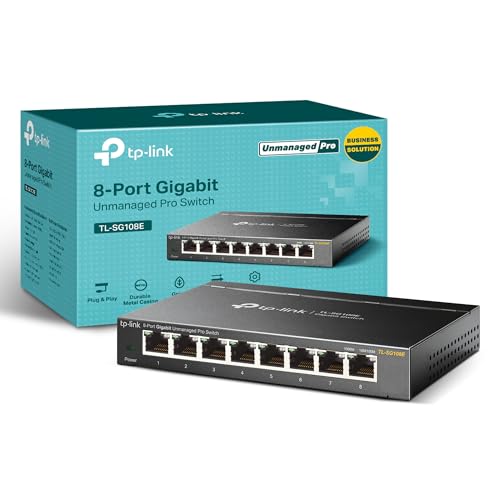
TP-Link 8-Port Smart Managed Gigabit Switch
Best for: small networks needing VLANs and traffic prioritization
- Port Count
- 8
- Port Speed
- Gigabit
- Management Type
- Easy Smart Managed
- Mounting Type
- Desktop/Wall-Mount
- Number of Ports
- 8 Ports
- Dimensions
- 6.2 × 4 × 1 inches
This TP-Link compact switch gives you eight Gigabit Ethernet ports with Easy Smart management inside a metal chassis. You gain control over local traffic using VLAN tagging, Quality of Service prioritization, and IGMP snooping. It fits your setup if you need more oversight than an unmanaged switch provides without deploying complex enterprise hardware.
Pros
- 8 Gigabit Ethernet ports with metal shielding
- Layer 2 features including VLANs, QoS, and link aggregation
- Web interface and utility software management options
- Compact metal casing suitable for desktop or wall mounting
Cons
- Lacks Power over Ethernet capability
- Maximum port speeds capped at 1 Gbps
- VLAN capacity limited to 32 simultaneous IDs
Good fit if
- You need basic Layer 2 traffic controls like VLAN tagging and QoS across eight wired connections.
- You prefer configuring network settings through a web browser or management utility.
- You want a compact metal switch that supports wall mounting.
Skip if
- You need Power over Ethernet to power cameras or access points directly.
- You require multi-gigabit transfer speeds beyond standard Gigabit Ethernet.
Verdict: TP-Link 8-Port Easy Smart Gigabit Switch delivers practical Layer 2 management tools and traffic segmentation in a compact metal body. It provides the necessary controls for small wired networks without enterprise complexity.

TP-Link 16-Port Smart Managed Gigabit Switch
Best for: expanding wired networks needing VLAN traffic control
- Port Count
- 16
- Port Speed
- Gigabit
- Management Type
- Easy Smart Managed
- Number of Ports
- 16 Ports
- Dimensions
- 15.8 × 9.84 × 3.15 inches
- Weight
- 2 pounds
View on Amazon: TP-Link 16-Port Smart Managed Gigabit Switch
The TP-Link 16-Port Gigabit Smart Managed Switch gives you sixteen gigabit ports with basic network configuration tools. You can segment traffic using VLANs, prioritize sensitive data with QoS, and monitor connections through port mirroring. It also includes 9K jumbo frame support and cable diagnostics. This model fits you if you require managed traffic control for expanding wired home setups.
Pros
- 16 gigabit Ethernet ports
- VLAN support for network traffic segmentation
- Port-based and tag-based QoS prioritization
- 9K jumbo frame support for large data transfers
- Port mirroring, loop prevention, and cable diagnostics
Cons
- No Power over Ethernet support listed
- Port speeds max out at standard gigabit
- Wide 15.75-inch chassis requires dedicated shelf space
Good fit if
- You need 16 wired gigabit connections in one location.
- You want VLAN segmentation and QoS controls for your local network.
- You want network troubleshooting features like cable diagnostics.
Skip if
- You need Power over Ethernet to power cameras or access points directly.
- You require multi-gigabit speeds above 1 Gbps.
Verdict: TP-Link 16-Port Gigabit Smart Managed Switch delivers sixteen reliable gigabit connections paired with foundational Layer 2 traffic controls. It offers practical network management tools for busy wired environments.

TP-Link 5-Port Gigabit Smart Managed Switch
Best for: managed traffic control on compact desktop setups
- Port Count
- 5
- Port Speed
- 10/100/1000 Mbps
- Management Type
- Easy Smart
- Mounting Type
- Desktop
- Number of Ports
- 5 Ports
- Dimensions
- 6.7 × 4.1 × 4.5 inches
This TP-Link switch gives you five 10/100/1000 Mbps Gigabit ports inside a compact metal desktop casing. Unlike standard unmanaged splitters, it includes smart management tools like VLAN support, QoS traffic prioritization, and IGMP snooping configured through a web interface. It suits you if you need basic traffic control and network segmentation for a few wired devices in a small office or home workspace without complex setups.
Pros
- Smart management features including VLAN, QoS, and IGMP snooping
- Five 10/100/1000 Mbps Gigabit RJ45 ports with shielding
- Durable metal desktop housing
- Web-based interface for configuration alongside plug-and-play capability
Cons
- No PoE ports to power connected network gear
- Only five ports, leaving limited room for network expansion
Good fit if
- You need network traffic management like VLAN and QoS on a compact desktop setup.
- You want shielded Gigabit ports inside a durable metal enclosure.
Skip if
- You require Power over Ethernet (PoE) to power access points or cameras.
- You need more than five Ethernet ports for your wired devices.
Verdict: TP-Link 5-Port Smart Managed Gigabit Switch delivers essential network configuration tools like VLANs and QoS in a sturdy, five-port desktop footprint. It gives you targeted traffic management without the bulk of larger enterprise hardware.

TP-Link 8-Port Gigabit Smart Managed PoE Switch
Best for: powering small setups with four PoE devices
- Port Count
- 8
- Port Speed
- Gigabit
- Management Type
- Easy Smart
- PoE Support
- PoE (802.3af)
- PoE Power Budget
- 57W
- Number of Ports
- 8 Ports
View on Amazon: TP-Link 8-Port Gigabit Smart Managed PoE Switch
This compact eight-port Gigabit switch gives you four 802.3af PoE ports with a 57W power budget alongside four standard Gigabit connections. It features Easy Smart web management, providing VLAN traffic segmentation, rate limiting, and QoS traffic prioritization. You get straightforward control over your local network without running separate power cables to connected devices. It suits you if you run a small office or home network needing powered access points.
Pros
- Four 802.3af PoE ports delivering up to 15.4W each with a 57W total budget
- Web-based management interface and smart configuration utility
- Supports VLAN traffic segmentation, QoS prioritization, and IGMP snooping
- Compact dimensions at 6.22 by 3.98 by 0.98 inches
Cons
- Only four of the eight ports provide PoE power
- Total PoE power is limited to 57W across all four PoE ports
Good fit if
- You need to power up to four PoE devices like access points or IP cameras.
- You want basic traffic management tools like VLANs and QoS without complex enterprise software.
Skip if
- You require PoE delivery across all eight ports.
- You connect hardware requiring more than 15.4W per port or exceeding a 57W total draw.
Verdict: TP-Link 8-Port Gigabit Smart Managed PoE Switch delivers four PoE ports and smart management controls for small wired networks. It provides essential traffic segmentation and device power in a compact desktop format.

TP-Link 5-Port Fast Ethernet PoE Switch
Best for: powering low-bandwidth IP cameras over long distances
- Port Count
- 5
- Port Speed
- 10/100 Mbps
- PoE Support
- PoE+ (802.3at/af)
- PoE Power Budget
- 67W
- Mounting Type
- Desktop, Wall-Mount
- Number of Ports
- 5 Ports
This is a plug-and-play desktop switch equipped with four 10/100 Mbps PoE+ ports and one standard uplink port. It provides a 67W power budget with up to 30W per port, alongside an Extend Mode for transmissions up to 250 meters at 10 Mbps. Housed in a fanless metal casing, it suits you if you need to power IP cameras or low-bandwidth hardware without complex configuration.
Pros
- Four PoE+ ports with a 67W total power budget (up to 30W per port)
- Extend Mode reaches up to 250 meters for surveillance setups
- PoE Auto Recovery automatically detects and reboots unresponsive devices
- Fanless metal chassis provides silent desktop or wall-mounted operation
Cons
- Maximum throughput is limited to 10/100 Mbps Fast Ethernet
- Extend Mode reduces transmission speed to 10 Mbps
- Provides only one non-PoE port for uplink connections
Good fit if
- You need to power up to four PoE devices such as IP surveillance cameras.
- You run cabling up to 250 meters and can accept 10 Mbps speeds.
- You want an unmanaged, silent metal switch with hardware auto-recovery.
Skip if
- You need Gigabit speeds for high-bandwidth local file transfers.
- You require more than four PoE-enabled ports for your network gear.
Verdict: TP-Link 5-Port Fast Ethernet PoE Switch delivers 67W of power and extended range for basic surveillance installations. Its 10/100 Mbps throughput limits its usefulness for high-speed network backbones.

TP-Link 16-Port PoE+ Gigabit Switch
Best for: powering multiple PoE devices without complex setup
- Port Count
- 16
- Port Speed
- 10/100/1000 Mbps
- PoE Support
- PoE+ (802.3at/af)
- PoE Power Budget
- 250W
- Uplink Ports
- 2 x Gigabit, 2 x Combo SFP
- Number of Ports
- 16 Ports
This unmanaged switch gives you 16 Gigabit PoE+ ports backed by a 250W power budget, alongside two standard Gigabit ports and two combo SFP slots for uplinks. It delivers up to 30W per port for access points or cameras without requiring software configuration. Hardware-level QoS and IGMP snooping help handle traffic. It suits you if you need reliable PoE power across many wired devices.
Pros
- 250W total PoE power budget across 16 PoE+ ports
- Delivers up to 30W output per port using 802.3at/af standards
- Two non-PoE Gigabit ports and two combo SFP slots for uplinks
- Plug-and-play installation with no software configuration needed
Cons
- Lacks a web management interface for advanced network controls
- Maximum port transmission speed is limited to 1 Gbps
Good fit if
- You need to run multiple high-draw PoE access points or cameras under a 250W ceiling.
- You prefer unmanaged hardware that functions directly without software setup.
- You require SFP fiber slots alongside standard copper Ethernet ports.
Skip if
- You need software-managed VLANs or remote cloud network controls.
- You require multi-gigabit Ethernet speeds greater than 1 Gbps.
Verdict: TP-Link 16-Port Gigabit PoE+ Switch provides robust power delivery and 18 total network ports for simple expansion without setup headaches. It serves as a dependable high-capacity power hub for unmanaged wired hardware.

TP-Link Omada 24-Port Gigabit Switch with 10G SFP+
Best for: 10 Gbps fiber uplinks and Omada management
- Port Count
- 24
- Port Speed
- 10/100/1000 Mbps
- Management Type
- Smart Managed
- Uplink Ports
- 4 x 10G SFP+
- Number of Ports
- 24 Ports
- Dimensions
- 17.3 × 7.09 × 1.73 inches
View on Amazon: TP-Link Omada 24-Port Gigabit Switch with 10G SFP+
This TP-Link smart managed switch provides 24 gigabit Ethernet ports alongside four 10 Gbps SFP+ uplink slots for high-speed fiber or DAC links. It supports L2+ features like static routing and integrates with the Omada SDN platform for centralized management. You get advanced security options, including 802.1Q VLANs and ACLs. It suits you if you need high-capacity uplinks and centralized network management across multiple wired devices.
Pros
- Four 10 Gbps SFP+ uplink slots
- 24 gigabit RJ45 Ethernet ports
- Omada SDN support for cloud, software, or standalone management
- L2+ static routing and enterprise security features
- Five-year manufacturer warranty
Cons
- No Power over Ethernet support
- Cloud-based controller requires additional fees
Good fit if
- You need 10 Gbps SFP+ uplinks to connect to high-speed storage or core switches.
- You run or plan to deploy a TP-Link Omada SDN network.
- You require L2+ static routing and VLAN segmentation.
Skip if
- You need to power access points or cameras via PoE directly from the switch.
- You prefer an unmanaged plug-and-play setup without software configuration.
Verdict: TP-Link Omada 24-Port Switch with 10G SFP+ delivers enterprise-grade 10 Gbps uplinks and Omada SDN management to handle high-bandwidth backbones across 24 gigabit connections.

TP-Link 8-Port 2.5G Multi-Gigabit Switch
Best for: unmanaged 2.5 Gbps multi-gig wired networks
- Port Count
- 8
- Port Speed
- 2.5 Gbps
- Management Type
- Unmanaged
- Switching Capacity
- 40 Gbps
- Mounting Type
- Desktop, Wall-Mount
- Number of Ports
- 8 Ports
This unmanaged switch gives you eight 2.5 Gbps Ethernet ports with a total switching capacity of 40 Gbps. It supports auto-negotiation across three speeds, letting you connect multi-gig devices like NAS units, servers, and access points without complex configuration. The fanless metal enclosure keeps operation silent on a desk or wall. It suits you if you need straightforward multi-gigabit throughput across wired hardware without needing software setup or Power over Ethernet.
Pros
- Eight 2.5 Gbps ports with 40 Gbps switching capacity
- Fanless design for silent desktop or wall-mounted operation
- Auto-negotiation supports 100 Mbps, 1 Gbps, and 2.5 Gbps speeds
- Durable metal casing with plug-and-play setup
Cons
- Unmanaged with no software configuration options
- Does not provide Power over Ethernet
- Ethernet cables are not included
Good fit if
- You need 2.5 Gbps wired speeds for devices like a NAS, server, or PC.
- You want silent, fanless operation in your workspace.
- You prefer plug-and-play hardware without software configuration.
Skip if
- You need Power over Ethernet to run access points or cameras.
- You require managed switch features like VLANs or traffic control.
Verdict: TP-Link 8-Port 2.5G Multi-Gigabit Switch delivers high-speed multi-gigabit connectivity across eight ports in a quiet, fanless metal housing. It is a solid unmanaged solution when you want faster transfers without managing network settings.
Specifications side by side
| Spec | TP-Link 5-Port Gigabit Unmanaged Switch | TP-Link 5-Port Gigabit Metal Switch | TP-Link 5-Port Fast Ethernet Switch | TP-Link 16-Port Gigabit Unmanaged Switch | TP-Link 48-Port Gigabit Unmanaged Switch | TP-Link 8-Port Gigabit Switch with 4 PoE+ Ports | TP-Link 24-Port Gigabit Smart Managed Switch | TP-Link 8-Port Smart Managed Gigabit Switch | TP-Link 16-Port Smart Managed Gigabit Switch | TP-Link 5-Port Gigabit Smart Managed Switch | TP-Link 8-Port Gigabit Smart Managed PoE Switch | TP-Link 5-Port Fast Ethernet PoE Switch | TP-Link 16-Port PoE+ Gigabit Switch | TP-Link Omada 24-Port Gigabit Switch with 10G SFP+ | TP-Link 8-Port 2.5G Multi-Gigabit Switch |
|---|---|---|---|---|---|---|---|---|---|---|---|---|---|---|---|
| Port Count | 5 | 5 | 5 | 16 | 48 | 8 | 24 | 8 | 16 | 5 | 8 | 5 | 16 | 24 | 8 |
| Port Speed | 10/100/1000 Mbps | 10/100/1000 Mbps | 10/100 Mbps | Gigabit | 10/100/1000 Mbps | 10/100/1000 Mbps | Gigabit | Gigabit | Gigabit | 10/100/1000 Mbps | Gigabit | 10/100 Mbps | 10/100/1000 Mbps | 10/100/1000 Mbps | 2.5 Gbps |
| Management Type | Unmanaged | Unmanaged | Unmanaged | Unmanaged | Unmanaged | Unmanaged | Easy Smart Managed | Easy Smart Managed | Easy Smart Managed | Easy Smart | Easy Smart | not specified | not specified | Smart Managed | Unmanaged |
| PoE Support | not specified | not specified | not specified | not specified | not specified | PoE+ (802.3at/af) | not specified | not specified | not specified | not specified | PoE (802.3af) | PoE+ (802.3at/af) | PoE+ (802.3at/af) | not specified | not specified |
| PoE Power Budget | not specified | not specified | not specified | not specified | not specified | 64 W | not specified | not specified | not specified | not specified | 57W | 67W | 250W | not specified | not specified |
| Uplink Ports | not specified | not specified | not specified | not specified | not specified | not specified | not specified | not specified | not specified | not specified | not specified | not specified | 2 x Gigabit, 2 x Combo SFP | 4 x 10G SFP+ | not specified |
| Switching Capacity | not specified | not specified | not specified | 32Gbps | 96 Gbps | not specified | not specified | not specified | not specified | not specified | not specified | not specified | not specified | not specified | 40 Gbps |
| Mounting Type | Desktop, Wall-Mount | Desktop or wall-mounting | Desktop | not specified | Rackmount | Desktop, Wall-Mount | not specified | Desktop/Wall-Mount | not specified | Desktop | not specified | Desktop, Wall-Mount | not specified | not specified | Desktop, Wall-Mount |
| Number of Ports | 5 Ports | 5 Ports | 5 Ports | 16 Ports | 48 Ports | 8 Ports | 24 Ports | 8 Ports | 16 Ports | 5 Ports | 8 Ports | 5 Ports | 16 Ports | 24 Ports | 8 Ports |
| Uplink Port Type | not specified | not specified | not specified | not specified | not specified | not specified | not specified | not specified | not specified | not specified | not specified | not specified | not specified | SFP | not specified |
| Dimensions | 1.1 × 6.5 × 4.3 inches | 3.9 × 3.9 × 1 inches | 4.07 × 2.74 × 0.87 inches | 17.3 × 7.1 × 1.7 inches | 17.3 × 8.66 × 1.73 inches | 3.9 × 6.7 × 1.1 inches | 11.6 × 7.1 × 1.7 inches | 6.2 × 4 × 1 inches | 15.8 × 9.84 × 3.15 inches | 6.7 × 4.1 × 4.5 inches | 6.22 × 3.98 × 0.98 inches | 3.93 × 3.86 × 0.98 inches | 17.3 × 7.09 × 1.73 inches | 17.3 × 7.09 × 1.73 inches | 8.9 × 5.2 × 1.38 inches |
| Weight | 4.23 ounces | 7.76 ounces | 3.53 ounces | 4.41 pounds | 9.22 pounds | 1.15 pounds | 3.75 pounds | 1.12 pounds | 2 pounds | 15.2 ounces | 1 pounds | 8.47 ounces | 5.2 pounds | 4.3 pounds | 2.05 pounds |
| Size | 5 Port Gigabit | 5-Port Gigabit | 5 Port | 16 Port | 48 Port, 1 Gigabit | 8 Port w/ 4-Port PoE+ | 24 Port | Enhanced Features | 8 Port | 16 Port | Enhanced Features | 5 Port w/ Enhanced Features | Easy Smart Managed, 8 Port w/ 4 PoE+ Port | 5 Port w/ 4-Port PoE+ | 18 Port w/ 16 PoE+ Port | 24 Port + 4 10GE SFP+ | 8 Port 2.5G |
| Color | Black | Black | 5 | Black | Black | Black | Black | Black | Black | Black | Black | 5-Port | black | black | 8 Port, 2,5G |
| Model | TL-SG1005D | TL-SG105 | TL-SF1005D | TL-SG1016 | TL-SG1048 | TL-SG1008P | TL-SG1024DE | TL-SG108E | TL-SG1016DE | TL-SG105E | TL-SG108PE | TL-SF1005P | TL-SG1218MP | TL-SG3428X | TL-SG108-M2 |
Understanding the TP-Link Switch Lineup
TP-Link separates its switches by management level and port count. Unmanaged models like the TP-Link 5-Port Gigabit Unmanaged Switch require zero configuration and suit simple wired expansion. If you need VLAN traffic segmentation or QoS controls, smart managed units such as the TP-Link 8-Port Smart Managed Gigabit Switch give you direct software administration across 5 to 24 ports.
Port speed and PoE support separate the remaining options. Hardware like the TP-Link 8-Port Gigabit Switch with 4 PoE+ Ports supplies power over network cables to connected gear. For faster data transfer rates beyond standard 1 Gbps connections, the TP-Link 8-Port 2.5G Multi-Gigabit Switch provides high-speed multi-gigabit ports.
Where TP-Link Network Switches Fit
TP-Link suits setups needing between 5 and 48 ports. You can select compact desktop enclosures measuring under four inches wide or full-width 17-inch rackmount hardware. Speeds span basic Fast Ethernet up to 2.5 Gbps multi-gigabit connections, with select models adding 10 Gbps SFP+ optical uplinks. Power-over-Ethernet models support PoE+, delivering power alongside data for connected devices. The lineup leaves noticeable gaps. You will not find multi-gigabit speeds above 2.5 Gbps on RJ45 ports, and multi-gigabit models lack PoE support. The catalog also omits outdoor-rated housings and advanced Layer 3 enterprise routing hardware.
If you need smart home controls rather than wired networking hardware, specs for the best smart switches with tuya focus on wireless automation.
How to Choose the Right TP-Link Switch
-
Choosing the Right Port Count
Count the wired devices you need to connect before choosing a switch. Models in this lineup provide options ranging from 5 ports up to 48 ports. A compact five-port model handles basic setups like a computer, printer, and local storage drive. Larger homes or structured wiring panels require higher capacity. The TP-Link 16-Port Gigabit Unmanaged Switch gives you 16 connections for expansive setups without requiring configuration. Always reserve at least one port for your incoming router connection.
-
Selecting Port Speeds
Check the port speed specifications to match your data transfer needs. Fast Ethernet provides 10/100 Mbps, which works fine for low-bandwidth hardware like smart home hubs or basic surveillance cameras. Gigabit ports deliver standard 1000 Mbps throughput for reliable everyday home streaming and office computing. If your devices handle high-speed transfers or local backups, look for multi-gigabit hardware. The TP-Link 8-Port 2.5G Multi-Gigabit Switch supplies 2.5 Gbps across all eight ports to prevent bottlenecks between compatible computers and network storage.
-
Assessing Power Requirements
Power over Ethernet passes electrical current and data through one Ethernet cable. This eliminates external power bricks for access points and IP cameras. Check both the number of powered ports and the total wattage budget. The TP-Link 8-Port Gigabit Switch with 4 PoE+ Ports delivers 64W of power distributed across four dedicated ports, leaving four regular Ethernet ports for standard network devices. Calculate the individual power draw of each connected device to verify the total wattage stays within the switch power limit.
-
Evaluating Management Needs
Decide whether your network requires active traffic management or simple plug-and-play operation. Unmanaged switches pass data automatically without any software settings. Smart managed switches provide administrative interfaces to configure VLANs, quality of service priorities, and port monitoring. The TP-Link 8-Port Smart Managed Gigabit Switch gives you Layer 2 controls to separate sensitive traffic or isolate guest devices without enterprise network complexity. Choose unmanaged models if you simply want immediate wired connections, and pick smart managed options if you need segmentation.
-
Checking Mounting Form Factor
Review the physical dimensions and mounting specifications before installation. Small units with widths under four inches fit easily on crowded desks or inside compact media cabinets. Some models support screw slots for wall mounting to keep cables organized off work surfaces. Larger switches measuring over 17 inches wide are designed for standard equipment racks. The TP-Link 48-Port Gigabit Unmanaged Switch features a rackmount metal chassis and fanless cooling, delivering high capacity while operating silently in open office areas or home server closets.
-
Considering SFP Uplink Ports
When connecting multiple switches together across a property or linking to a central server, standard RJ45 ports may introduce bandwidth restrictions. Switches with dedicated SFP or SFP+ uplink ports accommodate fiber optic modules or direct-attach copper cables. The TP-Link Omada 24-Port Gigabit Switch with 10G SFP+ includes four 10 Gbps SFP+ slots alongside its 24 gigabit Ethernet ports. These high-speed uplink interfaces preserve full data throughput for demanding network backbones and Omada centralized management systems without sacrificing any of your primary access ports.
Frequently asked questions
What is the difference between the TP-Link TL-SG1005D and TL-SG105?
You get different housing materials and physical dimensions between these two five-port Gigabit switches. The TL-SG1005D features a lighter body measuring 6.5 inches wide and weighing about 0.26 pounds with wall-mounting support. The TL-SG105 uses a metal enclosure measuring 3.9 inches wide and weighing roughly 0.48 pounds. Both units offer five unmanaged Gigabit ports without software configuration.
Which TP-Link switches support Power over Ethernet?
Several TP-Link switches in this lineup provide PoE capabilities for connected hardware. The TL-SG1008P supplies 64W across four PoE+ ports, while the TL-SF1005P provides 67W across four ports at Fast Ethernet speeds. If you need managed power distribution, the TL-SG108PE includes four PoE ports. For high-density power requirements, the TL-SG1218MP delivers PoE+ across sixteen ports.
Does TP-Link offer multi-gigabit speeds on unmanaged switches?
Yes, you can get multi-gigabit performance with the TP-Link TL-SG108-M2 switch. This unmanaged model features eight network ports that support 2.5 Gbps and standard Gigabit speeds. It uses a fanless metal housing that measures roughly 8.9 inches long and operates silently. You do not need any software setup or configuration menus to run these 2.5G ports.
What features do TP-Link smart managed switches provide?
TP-Link smart managed models provide foundational Layer 2 network controls such as VLAN traffic segmentation and QoS traffic prioritization. Switches like the TL-SG105E, TL-SG108E, TL-SG1016DE, and TL-SG1024DE let you monitor ports and diagnose network traffic. These models bridge the gap between basic plug-and-play unmanaged units and complex enterprise gear, giving you targeted administrative oversight for small to medium networks.
Which TP-Link switch includes 10G SFP+ uplink ports?
The TP-Link TL-SG3428X includes four 10G SFP+ uplink ports alongside its 24 Gigabit Ethernet ports. This model integrates with the Omada SDN platform to provide smart managed network control. It measures 17.32 inches in length and 1.73 inches in height, fitting standard rack installations. You can use its high-speed fiber uplinks to prevent bottlenecks across your wired backbone.
Can you mount TP-Link switches in an equipment rack?
Yes, several higher-port TP-Link switches are designed for rackmount installation. Models like the 48-port TL-SG1048 and the 16-port TL-SG1218MP measure roughly 17.3 inches long and 1.73 inches high, matching standard rack dimensions. The TL-SG1048 also operates fanless while providing 96Gbps of switching throughput. If you manage a large wiring closet, these units consolidate multiple Ethernet runs into one chassis.
What is the difference between Fast Ethernet and Gigabit TP-Link switches?
Fast Ethernet switches like the TL-SF1005D operate at speeds up to 100 Mbps, whereas Gigabit models reach 1,000 Mbps. You should select Gigabit switches like the TL-SG1005D or TL-SG105 for high-bandwidth local file transfers and fast internet connections. Fast Ethernet models such as the TL-SF1005P work best for low-bandwidth tasks, including connecting IP cameras that do not saturate high-speed links.