11 Best TP-Link Network Switches with 8 Ports, Compared
As an Amazon Associate we earn from qualifying purchases. Links on this page are affiliate links.
Adding a TP-Link network switch with 8 Ports expands your wired home setup when your router runs out of Ethernet jacks. The TP-Link Litewave 8-Port Gigabit Switch leads the list because it delivers eight unmanaged Gigabit ports in a compact, fanless chassis for silent operation.
We compared 11 models strictly using the specifications published on their product listings. This guide helps you decide between unmanaged and smart managed hardware, standard Gigabit or multi-gigabit speeds, and whether you need PoE support for powered devices.
Quick picks
The best fit for you
- You need simple plug-and-play Gigabit Ethernet port expansion TP-Link Litewave 8-Port Gigabit Switch This unmanaged switch provides eight Gigabit ports in a compact, fanless design for silent connectivity.
- You want faster multi-gigabit speeds for local network devices TP-Link 8-Port 2.5G Multi-Gigabit Switch All eight ports deliver unmanaged 2.5 Gbps transfer rates without requiring software setup.
- You need to power a few PoE devices directly TP-Link 8-Port Gigabit Switch with 4 PoE+ Ports It features four Gigabit PoE+ ports alongside four standard Gigabit ports in a desktop form factor.
- You want wall mounting and smart network traffic management TP-Link 8-Port Smart Managed Gigabit Switch This switch supports wall-mounted installation and includes Smart Managed Layer 2 features like VLAN and QoS.
Our 11 picks

TP-Link Litewave 8-Port Gigabit Switch
Best for: silent, simple home network port expansion
- Number of Ports
- 8 Ports (what this guide is about)
- Port Count
- 8
- Port Speed
- 10/100/1000 Mbps
- Management Type
- Unmanaged
- Dimensions
- 5 × 2.62 × 0.91 inches
- Weight
- 3.88 ounces
The TP-Link 8-Port Gigabit Unmanaged Switch gives you an easy way to expand your wired home network. It features eight auto-negotiating Gigabit Ethernet ports that support speeds up to 1000 Mbps, alongside IEEE 802.3X flow control for stable transfers. Its compact, fanless design keeps operation silent on your desk. This unmanaged switch suits you if you need instant plug-and-play wired connections for consoles, computers, and printers without managing complex software settings.
Pros
- Eight 10/100/1000 Mbps Gigabit RJ45 ports
- Fanless design for silent operation
- Plug-and-play setup requires no software configuration
- Supports Auto-Negotiation and Auto MDI/MDIX
- Compact footprint measuring roughly 5 by 2.6 inches
Cons
- Unmanaged switch with no traffic control or VLAN configuration options
- Lacks Power over Ethernet (PoE) support for connected devices
Good fit if
- You need eight standard Gigabit Ethernet ports for basic desktop devices.
- You prefer a silent, fanless unit that works immediately without configuration.
- You want to expand your router wired ports using minimal desk space.
Skip if
- You need Power over Ethernet (PoE) to power access points or cameras.
- You require managed switch capabilities like VLANs or QoS controls.
- You need multi-gigabit transfer speeds exceeding 1000 Mbps.
Verdict: TP-Link 8-Port Gigabit Unmanaged Switch delivers reliable, plug-and-play wired connectivity in a compact, fanless body. It provides a simple, silent solution for expanding Ethernet connections across your home or office.

TP-Link 8-Port Fast Ethernet Switch
Best for: basic low-bandwidth wired home connections
- Number of Ports
- 8 Ports (what this guide is about)
- Port Count
- 8
- Port Speed
- 10/100 Mbps
- Management Type
- Unmanaged
- Mounting Type
- Desktop
- PoE Support
- PoE
This TP-Link unmanaged desktop switch expands your wired local network with eight 10/100 Mbps Fast Ethernet RJ45 ports. You get a plug-and-play setup with no configuration required, alongside a fanless design for silent operation on a desk. It automatically adjusts power consumption based on link status and cable length. This switch suits basic setups where you need extra wired connections for devices without Gigabit demands.
Pros
- Eight 10/100 Mbps auto-negotiation RJ45 ports
- Fanless design for quiet desktop placement
- Plug-and-play setup with no software configuration
- Auto-MDI/MDIX support eliminates crossover cables
Cons
- Maximum throughput limited to 100 Mbps Fast Ethernet
- Unmanaged architecture lacks VLAN and network traffic controls
Good fit if
- You need wired connectivity for low-bandwidth devices like printers.
- You want a silent, fanless desktop switch that requires zero setup.
Skip if
- You require Gigabit or multi-gigabit transfer speeds for your devices.
- You need managed software controls to configure network settings.
Verdict: TP-Link 8-Port Fast Ethernet Desktop Switch provides eight plug-and-play 10/100 Mbps ports in a silent, fanless desktop form factor. It delivers simple wired expansion for low-bandwidth hardware without configuration.

TP-Link 8-Port Gigabit Metal Switch
Best for: silent desktop Gigabit wired network expansion
- Number of Ports
- 8 Ports (what this guide is about)
- Port Count
- 8
- Port Speed
- 10/100/1000 Mbps
- Management Type
- Unmanaged
- PoE Support
- PoE
- Dimensions
- 6.22 × 3.94 × 0.98 inches
This TP-Link switch expands your wired local network with eight 10/100/1000 Mbps RJ45 Ethernet ports. It features a fanless metal housing for silent heat dissipation and shielded ports to reduce electromagnetic interference. Operation is unmanaged and plug-and-play with no software configuration required. It suits you if you need a sturdy, silent desktop switch to connect computers, gaming consoles, and printers at standard Gigabit speeds without managing network settings.
Pros
- Eight 10/100/1000 Mbps Gigabit RJ45 ports
- Fanless design for silent desktop or workspace operation
- Durable metal housing with shielded ports
- Plug-and-play setup without software configuration
Cons
- Unmanaged operation lacks VLAN and network configuration settings
- Port bandwidth caps at standard 1 Gbps rather than multi-gigabit speeds
Good fit if
- You need eight Gigabit Ethernet ports in a noise-sensitive workspace.
- You want a plug-and-play switch in a durable metal chassis.
Skip if
- You require managed switch features like VLANs and traffic control.
- You need multi-gigabit transfer rates beyond 1000 Mbps.
Verdict: TP-Link 8-Port Gigabit Metal Switch provides straightforward wired connectivity with a quiet fanless design and rugged metal casing. It delivers reliable unmanaged Gigabit expansion for any home or office desk.

TP-Link 8-Port Gigabit Switch with 4 PoE+ Ports
Best for: small networks needing four PoE+ connections
- Number of Ports
- 8 Ports (what this guide is about)
- Port Count
- 8
- Port Speed
- 10/100/1000 Mbps
- Management Type
- Unmanaged
- PoE Support
- PoE+ (802.3at/af)
- PoE Power Budget
- 64 W
View on Amazon: TP-Link 8-Port Gigabit Switch with 4 PoE+ Ports
This TP-Link unmanaged desktop switch provides eight Gigabit Ethernet ports, including four PoE+ ports delivering up to 64 watts of total power. You get plug-and-play setup without any software configuration, along with a fanless metal enclosure for silent operation. It suits you if you need to connect both standard wired devices and up to four powered endpoints like access points or cameras.
Pros
- Four PoE+ ports with a 64W total power budget (up to 30W per port)
- Fanless metal chassis for silent desktop or wall-mounted operation
- Unmanaged plug-and-play setup requiring no configuration
- Traffic prioritization via 802.1p/DSCP QoS and IGMP Snooping
Cons
- Only four of the eight ports supply PoE power
- Lacks managed switch capabilities such as VLANs or web configuration
Good fit if
- You need to power up to four PoE devices without separate injectors.
- You want a quiet, zero-configuration metal switch for a desktop or wall.
Skip if
- You require PoE power on all eight ports.
- You need network management software to configure VLANs or port settings.
Verdict: TP-Link 8-Port Gigabit Switch with 4 PoE+ Ports delivers reliable plug-and-play connectivity and silent operation for mixed wired and PoE setups. It provides a simple hardware solution when you only need to power a few network devices.
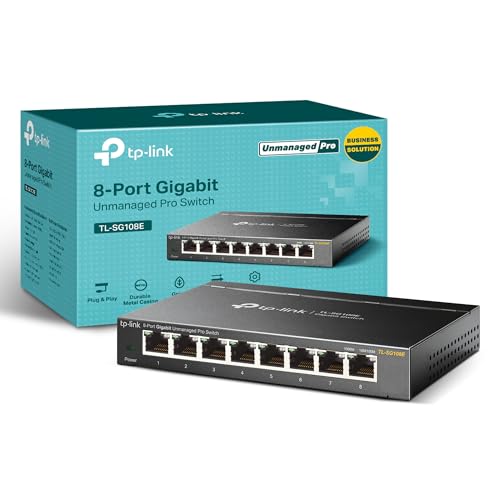
TP-Link 8-Port Smart Managed Gigabit Switch
Best for: wall-mounted home and office network setups
- Number of Ports
- 8 Ports (what this guide is about)
- Port Count
- 8
- Port Speed
- Gigabit
- Management Type
- Easy Smart
- Mounting Type
- Desktop/Wall-Mount
- Dimensions
- 6.2 × 4 × 1 inches
This TP-Link switch gives you eight Gigabit Ethernet ports inside a compact, 1-inch-thick metal housing designed for wall or desktop mounting. It features Easy Smart management, allowing you to configure traffic priority with QoS and segment your network using up to 32 VLANs. It suits you if you need a sturdy, wall-mountable wired hub that provides basic Layer 2 traffic controls and diagnostic tools without complex enterprise setup.
Pros
- Wall-mount and desktop installation options in a sturdy metal chassis
- Eight Gigabit Ethernet ports with metal shielding
- Easy Smart management supporting up to 32 VLANs simultaneously
- Diagnostic tools including cable diagnostics, loop prevention, and port mirroring
Cons
- No Power over Ethernet support for powering connected network devices
- Port speeds are limited to standard 1 Gbps Gigabit
Good fit if
- You want to mount an 8-port metal switch securely to a wall or desk.
- You need VLAN segmentation, QoS traffic optimization, and cable diagnostics.
- You prefer configuring network settings through a web interface or utility software.
Skip if
- You need PoE ports to deliver power to access points or cameras.
- You require multi-gigabit speeds exceeding 1 Gbps.
Verdict: TP-Link 8-Port Smart Managed Gigabit Switch provides wall-mountable metal construction and straightforward Layer 2 management for small wired networks. It delivers essential VLAN and QoS tools across eight Gigabit ports without unneeded enterprise complexity.

TP-Link 8-Port Gigabit Smart Managed PoE Switch
Best for: small managed networks needing PoE power
- Number of Ports
- 8 Ports (what this guide is about)
- Port Count
- 8
- Port Speed
- Gigabit
- Management Type
- Easy Smart
- PoE Support
- PoE (802.3af)
- PoE Power Budget
- 57W
View on Amazon: TP-Link 8-Port Gigabit Smart Managed PoE Switch
This TP-Link switch pairs eight Gigabit Ethernet ports with Easy Smart web management. Four ports supply 802.3af PoE power up to 15.4W each, backed by a 57W total budget. You also get network segmentation through VLAN features, plus traffic prioritization via 802.1p QoS and IGMP snooping. It fits your setup if you want managed control over connected devices alongside dedicated power delivery for gear like access points.
Pros
- Four 802.3af PoE ports with a 57W total power budget
- Web-based Easy Smart management interface and configuration utility
- VLAN support, 802.1p QoS, rate limiting, and IGMP snooping
- Limited lifetime warranty with free 24/7 technical support
Cons
- PoE delivery is limited to four of the eight ports
- 802.3af standard caps individual port output at 15.4W
Good fit if
- You need web-based management tools like VLAN segmentation and QoS prioritization.
- You run up to four PoE devices that fit within a 57W total power envelope.
Skip if
- You need PoE power across all eight ports.
- You require multi-gigabit speeds beyond standard 1 Gbps connections.
Verdict: TP-Link 8-Port Gigabit Smart Managed PoE Switch gives you essential network segmentation tools and 57W of PoE power across four ports. It provides reliable control for small networks needing managed Gigabit connectivity.

TP-Link 8-Port 2.5G Multi-Gigabit Switch
Best for: multi-gigabit home networks needing unmanaged 2.5G connectivity
- Number of Ports
- 8 Ports (what this guide is about)
- Port Count
- 8
- Port Speed
- 2.5 Gbps
- Management Type
- Unmanaged
- Switching Capacity
- 40 Gbps
- Mounting Type
- Desktop, Wall-Mount
This is an unmanaged network switch equipped with eight 2.5-Gigabit Ethernet ports and a 40 Gbps switching capacity. Each port auto-negotiates between 100 Mbps, 1 Gbps, and 2.5 Gbps speeds. The fanless metal enclosure supports desktop or wall mounting without generating noise. It suits you if you need multi-gigabit wired speeds for hardware like network-attached storage, gaming systems, or WiFi 6 access points without configuring complex management software.
Pros
- Eight 2.5 Gbps Ethernet ports delivering up to 40 Gbps switching capacity
- Auto-negotiates between 100 Mbps, 1 Gbps, and 2.5 Gbps
- Fanless design for silent operation
- Durable metal casing supporting desktop or wall-mount placement
- Three-year warranty with technical support
Cons
- Unmanaged with no configuration or VLAN support
- Does not supply Power over Ethernet (PoE)
- Ethernet cables are not included
Good fit if
- You need multi-gigabit 2.5G wired connections for NAS units, servers, or gaming PCs.
- You want silent, fanless operation in a durable metal chassis.
- You prefer plug-and-play setup without managing network software or settings.
Skip if
- You require Power over Ethernet (PoE) to power connected hardware.
- You need smart or managed switch capabilities such as VLAN configuration.
Verdict: TP-Link 8-Port 2.5G Unmanaged Switch provides full 2.5 Gbps transfer rates across all eight ports with silent, plug-and-play operation. It delivers high-speed local data transfer for multi-gigabit hardware without requiring software setup.

TP-Link 8-Port Gigabit Smart Managed Switch
Best for: Omada networks requiring SFP uplinks and routing
- Number of Ports
- 8 Ports (what this guide is about)
- Port Count
- 8
- Port Speed
- 10/100/1000 Mbps
- Management Type
- Smart Managed
- Uplink Ports
- 2 x Gigabit SFP
- Dimensions
- 11.6 × 7.09 × 1.73 inches
This switch expands your wired setup with eight Gigabit RJ45 ports and two dedicated Gigabit SFP slots for fiber uplinks. It supports L2+ management features including static routing, 802.1Q VLAN support, and access control lists. You can run it standalone or adopt it into the Omada SDN platform for centralized control. It suits you if you need managed traffic routing and fiber uplinks for an Omada network.
Pros
- Eight Gigabit RJ45 ports plus two dedicated Gigabit SFP slots
- Supports Omada SDN centralized cloud management and standalone mode
- L2+ static routing and 802.1Q VLAN traffic management
- Security features include 802.1X, ACL, and IP-MAC-Port binding
Cons
- Does not provide PoE output
- SFP uplink slots support up to 1 Gbps instead of 10 Gbps
Good fit if
- You need dedicated Gigabit SFP slots for fiber uplinks.
- You manage your hardware using the TP-Link Omada SDN platform.
- You require L2+ features like static routing and VLAN segmentation.
Skip if
- You need PoE to power access points or cameras directly.
- You prefer an unmanaged switch with no configuration settings.
- You require 10G uplink speeds.
Verdict: TP-Link Omada 8-Port Gigabit Smart Switch with SFP delivers managed L2+ routing, dual SFP fiber slots, and Omada SDN integration for structured wired setups. It works well when you need enterprise-style traffic management without PoE hardware.

TP-Link 8-Port PoE+ Switch with Gigabit Uplinks
Best for: powering IP surveillance cameras over long distances
- Number of Ports
- 8 Ports (what this guide is about)
- Port Count
- 11
- Port Speed
- 10/100 Mbps
- Management Type
- Unmanaged
- PoE Support
- PoE+ (802.3at/af)
- PoE Power Budget
- 124W
View on Amazon: TP-Link 8-Port PoE+ Switch with Gigabit Uplinks
This unmanaged switch gives you eight 10/100 Mbps PoE+ ports alongside two Gigabit Ethernet uplinks and one Gigabit SFP port. With a 124W total power budget and up to 30W per port, you can run multiple powered devices like IP cameras or access points. An extend mode transmits power up to 250 meters at 10 Mbps, while the fanless design ensures silent operation across your network setup.
Pros
- 124W total PoE power budget with up to 30W per port
- Dedicated uplinks: two Gigabit RJ45 ports and one Gigabit SFP slot
- Extend Mode enables power and data delivery up to 250 meters
- Fanless construction for silent operation
Cons
- Eight PoE+ ports are limited to 10/100 Mbps Fast Ethernet speeds
- Unmanaged design lacks VLAN and QoS configuration software
Good fit if
- You need a 124W PoE budget across eight surveillance cameras or low-bandwidth hardware.
- You require long cable runs up to 250 meters using Extend Mode.
- You want Gigabit copper and fiber uplinks without sacrificing any PoE ports.
Skip if
- You need Gigabit connection speeds on every individual PoE port.
- You require managed switch options such as web interface control or traffic monitoring.
Verdict: TP-Link 8-Port PoE+ Switch with Gigabit Uplinks provides a high 124W power budget alongside dedicated high-speed uplinks for surveillance hardware. It works best when 10/100 Mbps client speeds are acceptable but extended transmission distance and heavy PoE wattage are needed.

TP-Link 8-Port 10G SFP+ Managed Switch
Best for: high-speed 10G SFP+ fiber aggregation networks
- Number of Ports
- 8 Ports (what this guide is about)
- Port Count
- 8
- Port Speed
- 10 Gbps
- Management Type
- Managed
- Uplink Port Type
- SFP
- Dimensions
- 17.3 × 7.09 × 1.73 inches
This TP-Link switch delivers high-speed networking with eight dedicated 10 Gbps SFP+ fiber slots. You get full Layer 2+ management features alongside Omada Software Defined Networking integration, which supports standalone operation as well as hardware, software, or cloud controllers. It suits your setup if you require non-blocking 10G aggregation, centralized remote cloud control, and robust security tools like 802.1Q VLAN, access control lists, and port binding across your high-bandwidth fiber connections.
Pros
- Eight 10 Gbps SFP+ ports for high-bandwidth aggregation
- Integrates with Omada SDN hardware, software, and cloud controllers
- Supports standalone management mode alongside centralized SDN options
- Enterprise L2+ security including 802.1Q VLAN, ACL, and 802.1X authentication
Cons
- Equipped only with SFP+ slots and lacks native RJ45 copper ports
- Centralized SDN features require compatible Omada controllers and firmware
Good fit if
- You need eight dedicated 10 Gbps SFP+ ports for high-bandwidth fiber or DAC links.
- You manage your network centrally through the TP-Link Omada SDN controller ecosystem.
- You require advanced Layer 2+ management and access control security features.
Skip if
- You need standard RJ45 Ethernet ports without purchasing separate SFP+ transceivers.
- You prefer a basic unmanaged switch that requires zero configuration.
Verdict: TP-Link Omada 8-Port 10G SFP+ Managed Switch provides dedicated 10 Gbps SFP+ connectivity with comprehensive Layer 2+ management and Omada SDN platform support. It is the fitting choice when your local network demands high-bandwidth aggregation across multiple high-speed fiber links.

TP-Link Omada 8-Port Gigabit PoE+ Switch
Best for: multi-device PoE+ setups needing SFP uplinks
- Number of Ports
- 8 Ports (what this guide is about)
- Port Count
- 8
- Port Speed
- Gigabit
- Management Type
- Easy Managed
- PoE Support
- PoE+
- PoE Power Budget
- 123W
This TP-Link Omada switch gives you eight Gigabit 802.3at/af PoE+ RJ45 ports alongside dedicated uplinks, including one Gigabit RJ45 port and one Gigabit SFP/RJ45 combo port. With a 123W total power budget offering up to 30W per port, it easily powers access points and cameras across your network. It delivers managed switch features with plug-and-play setup, making it ideal if you need centralized power delivery and fiber uplink options.
Pros
- Eight Gigabit 802.3at/af PoE+ ports
- Total PoE power budget of 123W with up to 30W per port
- One dedicated Gigabit RJ45 port and one Gigabit SFP/RJ45 combo port
- Easy managed network configuration with plug-and-play capability
Cons
- Port speeds capped at 1 Gbps without multi-gigabit support
- PoE output limited to 30W per port without PoE++ support
Good fit if
- You need eight PoE+ ports with up to 123W of total power.
- You require an SFP combo port for fiber uplink connectivity.
- You want an easy managed switch for local network control.
Skip if
- You need multi-gigabit speeds such as 2.5 Gbps or 10 Gbps.
- You require high-power PoE++ hardware drawing over 30W per port.
Verdict: TP-Link Omada 8-Port Gigabit PoE+ Switch delivers 123W of power across eight PoE+ ports along with versatile SFP uplink connectivity. It is a capable choice if you need managed network control and robust power delivery for connected hardware.
Specifications side by side
| Spec | TP-Link Litewave 8-Port Gigabit Switch | TP-Link 8-Port Fast Ethernet Switch | TP-Link 8-Port Gigabit Metal Switch | TP-Link 8-Port Gigabit Switch with 4 PoE+ Ports | TP-Link 8-Port Smart Managed Gigabit Switch | TP-Link 8-Port Gigabit Smart Managed PoE Switch | TP-Link 8-Port 2.5G Multi-Gigabit Switch | TP-Link 8-Port Gigabit Smart Managed Switch | TP-Link 8-Port PoE+ Switch with Gigabit Uplinks | TP-Link 8-Port 10G SFP+ Managed Switch | TP-Link Omada 8-Port Gigabit PoE+ Switch |
|---|---|---|---|---|---|---|---|---|---|---|---|
| Port Count | 8 | 8 | 8 | 8 | 8 | 8 | 8 | 8 | 11 | 8 | 8 |
| Port Speed | 10/100/1000 Mbps | 10/100 Mbps | 10/100/1000 Mbps | 10/100/1000 Mbps | Gigabit | Gigabit | 2.5 Gbps | 10/100/1000 Mbps | 10/100 Mbps | 10 Gbps | Gigabit |
| Management Type | Unmanaged | Unmanaged | Unmanaged | Unmanaged | Easy Smart | Easy Smart | Unmanaged | Smart Managed | Unmanaged | Managed | Easy Managed |
| PoE Support | not specified | not specified | not specified | PoE+ (802.3at/af) | not specified | PoE (802.3af) | not specified | not specified | PoE+ (802.3at/af) | not specified | PoE+ |
| PoE Power Budget | not specified | not specified | not specified | 64 W | not specified | 57W | not specified | not specified | 124W | not specified | 123W |
| Uplink Ports | not specified | not specified | not specified | not specified | not specified | not specified | not specified | 2 x Gigabit SFP | 2 x Gigabit RJ45, 1 x Gigabit SFP | not specified | not specified |
| Switching Capacity | not specified | not specified | not specified | not specified | not specified | not specified | 40 Gbps | not specified | not specified | not specified | not specified |
| Mounting Type | not specified | Desktop | not specified | Desktop, Wall-Mount | Desktop/Wall-Mount | not specified | Desktop, Wall-Mount | not specified | not specified | not specified | not specified |
| Number of Ports | 8 Ports | 8 Ports | 8 Ports | 8 Ports | 8 Ports | 8 Ports | 8 Ports | 8 Ports | 8 Ports | 8 Ports | 8 Ports |
| Uplink Port Type | not specified | not specified | not specified | not specified | not specified | not specified | not specified | SFP | not specified | SFP | not specified |
| Dimensions | 5 × 2.62 × 0.91 inches | 8.03 × 2.56 × 6.5 inches | 6.22 × 3.94 × 0.98 inches | 3.9 × 6.7 × 1.1 inches | 6.2 × 4 × 1 inches | 6.22 × 3.98 × 0.98 inches | 8.9 × 5.2 × 1.38 inches | 11.6 × 7.09 × 1.73 inches | 8.23 × 4.96 × 1.02 inches | 17.3 × 7.09 × 1.73 inches | 8.23 × 4.96 × 1.02 inches |
| Weight | 3.88 ounces | 13.8 ounces | 13.8 ounces | 1.15 pounds | 1.12 pounds | 1 pounds | 2.05 pounds | 2.65 pounds | 1.32 pounds | 3.64 pounds | 1.34 pounds |
| Color | black | White | Black | Black | Black | Black | 8 Port, 2,5G | black | 11 Port w/ 8-Port PoE+ | black | multicolor |
| Model | LS1008G | TL-SF1008D | TL-SG108 | TL-SG1008P | TL-SG108E | TL-SG108PE | TL-SG108-M2 | SG3210 V3 | TL-SL1311MP | SX3008F | ES210GMP |
| Size | not specified | 8 Port | 8 Port, 1 Gigabit | 8 Port w/ 4-Port PoE+ | 8 Port (Pack of 1) | Easy Smart Managed, 8 Port w/ 4 PoE+ Port | 8 Port | 8 Port + 2 SFP Slots | 11 Port w/ 8-Port PoE+ | 8 Port | 8 Port |
If you need smart lighting control instead, see our guide to the best enbrighten smart switches for your home.
Choosing the Right TP-Link 8-Port Switch
-
Select Your Management Level
Unmanaged switches require zero configuration out of the box, forwarding traffic immediately upon connection. Smart managed options provide web interfaces to configure Layer 2 network controls like VLAN segmentation and QoS traffic priority. Fully managed switches add advanced Layer 2+ routing tools and centralized command options. If you simply want more Ethernet jacks for client devices, an unmanaged switch suits your network. If you need isolated subnets for security cameras or guest devices, choose a smart managed model like the TP-Link 8-Port Smart Managed Gigabit Switch.
-
Calculate Total PoE Wattage
Power over Ethernet eliminates separate power supplies for compatible hardware, but you must match switch wattage to your connected gear. Switches differ significantly in their total power pool. You should sum the power requirements of your access points, VoIP phones, or security cameras before choosing hardware. A unit like the TP-Link 8-Port PoE+ Switch with Gigabit Uplinks supplies a 124W power budget. Ensuring your connected load stays well within that switch power threshold prevents sudden device reboots, brownouts, and dropped connections across your wired local network.
-
Evaluate Dedicated SFP Uplinks
Uplink ports connect your switch back to a main router or core switch without sacrificing client ports. Standard RJ45 copper ports handle typical runs, but dedicated SFP slots allow fiber connections over longer distances without electrical interference. This distinction matters when bridging detached buildings, separate floors, or remote network cabinets. If your network design requires direct fiber trunk lines while preserving all eight standard copper ports for local equipment, select a model equipped with dedicated fiber uplinks, such as the TP-Link 8-Port Gigabit Smart Managed Switch.
-
Verify Centralized Controller Integration
Standalone switches require you to log into separate web interfaces to adjust settings on each individual unit. In contrast, TP-Link Omada switches integrate into a centralized software-defined networking platform. This allows you to deploy VLAN settings, update firmware, and view connection status across multiple locations from one dashboard. If you operate access points alongside your switch, unified management saves ongoing maintenance time. Consider an Omada-compatible option like the TP-Link Omada 8-Port Gigabit PoE+ Switch if you intend to expand into a cohesive, centrally managed infrastructure.
-
Check Dimensions and Enclosure
Physical installation constraints dictate whether you need a compact lightweight enclosure or a wall-mountable metal switch. Compact units weighing under a quarter of a pound tuck behind media centers or sit on crowded desktops where space is limited. Heavier metal models often support wall mounting using rear keyhole slots, keeping Ethernet cables off your workspace and structured cabling organized. If you have minimal desk clearance and need a featherweight footprint, look at the TP-Link Litewave 8-Port Gigabit Switch, which measures five inches long and weighs under a quarter pound.
Frequently asked questions
Which TP-Link 8-port switches provide PoE power?
Multiple models supply power over Ethernet for connected hardware. The TL-SG1008P and TL-SG108PE provide power across four PoE+ ports, with the TL-SG108PE offering a 57W power budget. For higher demands, the ES210GMP features eight PoE+ ports with a 123W budget, while the TL-SL1311MP supplies a 124W budget across eight PoE+ ports.
Which TP-Link 8-port switch can you mount to a wall?
The TP-Link TL-SG108E specifically lists wall mounting support alongside standard desktop placement. Its metal casing measures 6.2 inches long by 4 inches wide and 1 inch high, making it easy to secure against vertical surfaces. Other models like the TL-SG1008P list only desktop placement in their specifications.
What is the difference between the TP-Link LS1008G and TL-SG108?
The primary difference is the physical build and footprint. The TL-SG108 uses a rugged metal casing and weighs 0.86 pounds, measuring 6.22 inches long. The Litewave LS1008G is a more compact alternative weighing just 0.24 pounds with a length of 4.99 inches. Both provide eight unmanaged, fanless Gigabit Ethernet ports.
Does TP-Link offer an 8-port switch with 2.5G speeds?
Yes, the TP-Link TL-SG108-M2 delivers 2.5 Gbps transfer rates across all eight ports. It is an unmanaged, plug-and-play switch that requires no software configuration. The device features silent, fanless operation and measures 8.89 inches long by 5.19 inches wide, weighing approximately 2.05 pounds in a desktop form factor.
Which TP-Link 8-port switches include SFP uplink ports?
Three switches in the lineup incorporate SFP connectivity. The SG3210 V3 includes two dedicated SFP slots alongside its eight Gigabit ports. The ES210GMP also provides SFP uplink connectivity paired with eight PoE+ ports. For pure optical fiber environments, the SX3008F provides eight dedicated 10G SFP+ ports with managed Layer 2+ routing.
Why choose a Gigabit switch over a Fast Ethernet switch?
Gigabit switches offer ten times the theoretical speed of Fast Ethernet switches. Models like the TP-Link TL-SF1008D operate at 10/100 Mbps, which suits basic, low-bandwidth connected hardware. Gigabit models such as the LS1008G or TL-SG108 support 1000 Mbps speeds, allowing faster local data transfers across your wired home or office network.
Which TP-Link 8-port switches support Omada SDN management?
The SG3210 V3, SX3008F, and ES210GMP integrate with TP-Link Omada software-defined networking. The SG3210 V3 and SX3008F support Layer 2+ routing features and centralized network control. The ES210GMP combines Omada managed control with PoE+ power delivery across eight ports, while unmanaged models like the LS1008G operate without any management interface.