Best TP-Link Network Switches with 16 Ports: 9 Spec-Based Picks
As an Amazon Associate we earn from qualifying purchases. Links on this page are affiliate links.
Finding the right TP-Link network switch with 16 Ports helps you cleanly expand wired capacity across your network. We evaluated 9 models strictly by the specifications published on their listings. The TP-Link 16-Port Gigabit Unmanaged Switch takes the top spot because its 32Gbps switching capacity delivers full wire-speed Gigabit performance with plug-and-play simplicity.
This guide helps you decide between simple unmanaged models, smart managed options with VLAN traffic controls, and switches offering PoE+ power delivery for your hardware.
Quick picks
The best fit for you
- You need simple plug and play Gigabit network expansion TP-Link 16-Port Gigabit Unmanaged Switch It delivers sixteen unmanaged Gigabit ports with a 32Gbps switching capacity.
- You need traffic control using VLANs and cable diagnostics TP-Link 16-Port Smart Managed Gigabit Switch It provides smart management features including VLAN segmentation, QoS traffic control, and cable diagnostics.
- You need high power PoE delivery with SFP uplinks TP-Link 16-Port Smart Managed Gigabit PoE+ Switch It provides sixteen Gigabit PoE+ ports with a 250W power capacity and SFP uplinks.
- You want a compact desktop or wall mounted switch TP-Link 16-Port Smart Managed Switch It features a compact metal chassis designed for desktop or wall mount installation.
Our 9 picks

TP-Link 16-Port Gigabit Unmanaged Switch
Best for: simple plug-and-play high-capacity wired networking
- Number of Ports
- 16 Ports (what this guide is about)
- Port Count
- 16
- Port Speed
- Gigabit
- Management Type
- Unmanaged
- Switching Capacity
- 32Gbps
- Dimensions
- 17.3 × 7.1 × 1.7 inches
This switch gives you 16 Gigabit Ethernet ports to expand your wired home network. It features a 32Gbps switching capacity with a non-blocking architecture to maintain wire-speed throughput across all connected hardware. You get standard plug-and-play operation with auto MDI/MDIX, removing any setup steps or cable matching. This hardware suits you if you need a straightforward, high-capacity wired backbone for multiple devices without managing network software or configuring virtual networks.
Pros
- 16 Gigabit Ethernet ports for full wire-speed transfers
- 32Gbps switching capacity with non-blocking architecture
- Auto MDI/MDIX eliminates the need for crossover cables
- Supports IEEE 802.3x flow control for full duplex mode
Cons
- Unmanaged design provides no traffic management or VLAN configuration
- No Power over Ethernet support listed
Good fit if
- You need 16 Gigabit ports with plug-and-play operation.
- You want full duplex wired speeds with a 32Gbps switching capacity.
- You prefer an unmanaged switch that requires no software configuration.
Skip if
- You need Power over Ethernet to power connected equipment.
- You require managed switch capabilities like traffic monitoring.
Verdict: TP-Link 16-Port Gigabit Unmanaged Switch delivers reliable plug-and-play wire-speed performance with a 32Gbps switching capacity. It is a solid choice if you need simple, high-bandwidth wired expansion without management software.

TP-Link 16-Port Fast Ethernet Switch
Best for: silent basic 100Mbps multi-device home networking
- Number of Ports
- 16 Ports (what this guide is about)
- Port Count
- 16
- Port Speed
- 10Mbps, 100Mbps
- Management Type
- Unmanaged
- Switching Capacity
- 3.2Gbps
- PoE Support
- PoE
This switch expands your wired local network with 16 auto-negotiating Fast Ethernet ports supporting 10Mbps and 100Mbps hardware. It offers a 3.2Gbps switching capacity with non-blocking wire-speed forwarding and 9K jumbo frame support. The unmanaged, plug-and-play design requires no setup, while fanless cooling ensures silent operation. It suits you if you need straightforward network expansion for standard internet tasks and basic smart home devices without requiring Gigabit transfer rates.
Pros
- Fanless design delivers completely silent operation
- 3.2Gbps switching capacity with non-blocking wire-speed forwarding
- Supports 9K jumbo frames for large data transfers
- Auto-negotiating ports automatically match 10Mbps and 100Mbps hardware
Cons
- Maximum port speed tops out at 100Mbps Fast Ethernet rather than Gigabit
- Unmanaged design provides no management settings or traffic controls
Good fit if
- You need to connect up to 16 devices that only require 100Mbps Fast Ethernet bandwidth.
- You want a silent, fanless switch with simple plug-and-play installation.
- You do not require network configuration, VLANs, or management software.
Skip if
- You need Gigabit transfer speeds for high-speed local data transfers or gigabit internet.
- You want managed features like port monitoring, QoS, or traffic segmentation.
Verdict: TP-Link 16-Port Fast Ethernet Switch delivers reliable, fanless plug-and-play connectivity for setups that only require 100Mbps speeds. It is a practical choice if you need basic multi-device expansion without configuration overhead.

TP-Link 16-Port Smart Managed Gigabit Switch
Best for: VLAN segmentation and smart network monitoring
- Number of Ports
- 16 Ports (what this guide is about)
- Port Count
- 16
- Port Speed
- Gigabit
- Management Type
- Easy Smart Managed
- Dimensions
- 15.8 × 9.84 × 3.15 inches
- Weight
- 2 pounds
View on Amazon: TP-Link 16-Port Smart Managed Gigabit Switch
This TP-Link switch provides 16 Gigabit Ethernet ports with smart management capabilities for your wired setup. You get traffic segmentation through VLAN features, network monitoring via port mirroring and cable diagnostics, and 9K Jumbo frame support for large data transfers. It suits you if you need traffic prioritization with QoS, multicast optimization via IGMP snooping, and built-in loop prevention.
Pros
- 16 Gigabit ports with 9K Jumbo frame support
- Smart management including VLAN features, QoS, and IGMP Snooping
- Monitoring tools including Port Mirroring, Loop Prevention, and Cable Diagnostics
- Three-year warranty with weekday technical support
Cons
- No Power over Ethernet (PoE) capabilities listed
- No SFP fiber uplink ports included
Good fit if
- You need 16 Gigabit ports with VLAN support to segment local network traffic.
- You want traffic prioritization using port-based or tag-based QoS.
- You require network diagnostics such as loop prevention and cable testing.
Skip if
- You need PoE ports to deliver power to cameras or access points.
- You require dedicated SFP ports for fiber uplinks.
Verdict: TP-Link 16-Port Smart Managed Gigabit Switch delivers 16 Gigabit connections alongside practical management tools like VLAN segmentation, QoS, and cable diagnostics. It gives your wired network structured traffic control and monitoring without complex enterprise hardware.
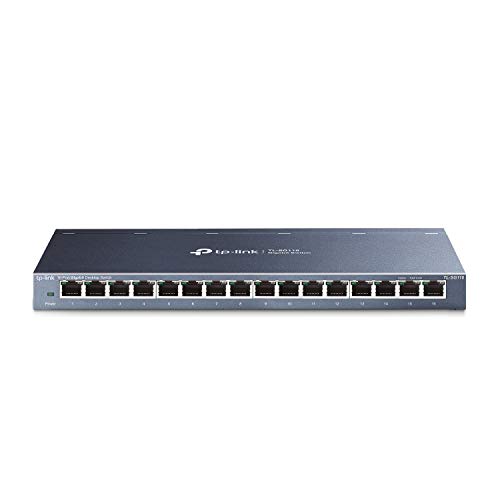
TP-Link 16-Port Gigabit Unmanaged Switch
Best for: silent plug-and-play Gigabit network expansion
- Number of Ports
- 16 Ports (what this guide is about)
- Port Count
- 16
- Port Speed
- 10/100/1000Mbps
- Management Type
- Unmanaged
- Mounting Type
- Desktop or Wall-mounting
- PoE Support
- PoE
This TP-Link 16-port Gigabit switch expands your wired local network without setup. You get sixteen auto-negotiating 10/100/1000 Mbps RJ45 ports inside a fanless metal housing designed for desktop or wall mounting. It includes port-based 802.1p traffic prioritization and IGMP snooping. This unit suits you if you need a silent, plug-and-play wired hub for connected rooms, office equipment, or media streamers without managing software configurations.
Pros
- Sixteen 10/100/1000 Mbps RJ45 ports with auto-negotiation and auto MDI/MDIX
- Fanless design for silent desktop or wall-mounted operation
- Port-based 802.1p/DSCP QoS and IGMP snooping for traffic prioritization
- Compact metal casing measuring 11.3 by 4.4 by 1 inches
Cons
- Unmanaged design provides no web interface or custom VLAN controls
- Desktop and wall-mount form factor lacks standard rack-mount hardware
Good fit if
- You need 16 Gigabit ports with plug-and-play setup and no configuration.
- You require silent, fanless operation for an office desk or wall installation.
- You want automated traffic prioritization through 802.1p QoS and IGMP snooping.
Skip if
- You need managed switch features to configure individual ports or VLANs.
- You require a full-width rack-mountable chassis for a server cabinet.
Verdict: TP-Link 16-Port Gigabit Unmanaged Switch provides sixteen silent, plug-and-play Gigabit connections in a compact metal enclosure. It offers reliable wired expansion when you do not need manual network management.

TP-Link 16-Port Smart Managed Switch
Best for: desktop networks needing basic smart management
- Number of Ports
- 16 Ports (what this guide is about)
- Port Count
- 16
- Port Speed
- 10/100/1000Mbps
- Management Type
- Easy Smart
- Mounting Type
- Desktop/Wall-Mount
- Dimensions
- 11.3 × 4.4 × 1 inches
This 16-port Gigabit switch adds smart management features to a compact footprint. You get 16 RJ45 Gigabit ports housed in a durable metal casing designed for desktop or wall mounting. It supports plug-and-play setup alongside configuration options through a web interface or utility software. You can manage basic network traffic and save energy via green technology. It suits you if you need traffic control on a home or office work surface.
Pros
- 16 Gigabit (10/100/1000 Mbps) RJ45 Ethernet ports
- Easy smart management via web browser interface and utility
- Compact metal casing suitable for desktop or wall mounting
- Plug-and-play operation with optional configuration
- Green technology designed to lower power consumption
Cons
- No Power over Ethernet (PoE) capabilities
- Lacks SFP slots for fiber uplinks
- No rackmount hardware included
Good fit if
- You want a compact switch that sits on a desk or mounts to a wall.
- You need smart management tools like a web UI without complex setup.
- You connect only standard Ethernet devices that do not require PoE.
Skip if
- You need to power access points or cameras over Ethernet cables.
- You require fiber connections using SFP ports.
- You intend to install your switch in a standard server rack.
Verdict: TP-Link 16-Port Gigabit Smart Switch delivers basic managed networking in a compact metal chassis built for a desk or wall. It gives you 16 Gigabit ports with web-based configuration while keeping power use low.

TP-Link 16-Port Unmanaged PoE+ Switch
Best for: Long-range PoE camera and surveillance setups
- Number of Ports
- 16 Ports (what this guide is about)
- Port Speed
- 10/100 Mbps
- Management Type
- Unmanaged
- PoE Support
- PoE+ (802.3at/af)
- PoE Power Budget
- 250W
- Uplink Ports
- 2 × Gigabit SFP
If you need to power network hardware across extended runs, this unmanaged TP-Link switch provides 16 Fast Ethernet PoE+ ports with a 250W total power budget. Each PoE+ port supplies up to 30W. For uplink connections, you get two Gigabit RJ45 ports and two Gigabit SFP slots. Built-in toggles enable Extend Mode up to 250 meters, one-click port isolation, and Priority Mode on ports 1 through 8.
Pros
- 250W total PoE+ power budget with up to 30W per port
- Two Gigabit RJ45 uplink ports and two Gigabit SFP slots
- Extend Mode supports transmission up to 250 meters at 10 Mbps
- Hardware switches for one-click port isolation and priority traffic
Cons
- Downlink ports run at 10/100 Mbps Fast Ethernet rather than Gigabit speeds
- Unmanaged architecture does not support software or web configuration
Good fit if
- You need to power multiple PoE+ devices under a high 250W total budget.
- You run surveillance equipment over long distances up to 250 meters.
- You want plug-and-play setup without software management.
Skip if
- You need Gigabit data speeds across all 16 client ports.
- You require managed networking features configured through software.
Verdict: TP-Link 16-Port Fast Ethernet PoE+ Switch delivers substantial power and extended cable reach for equipment that does not require Gigabit connections. It keeps setup simple with zero software configuration and provides Gigabit RJ45 and SFP uplink options.

TP-Link 16-Port Smart Managed Gigabit PoE+ Switch
Best for: powering high-capacity PoE networks with traffic management
- Number of Ports
- 16 Ports (what this guide is about)
- Port Count
- 16
- Port Speed
- 10/100/1000 Mbps
- Management Type
- Easy Smart
- PoE Support
- PoE+ (802.3at/af)
- PoE Power Budget
- 250W
View on Amazon: TP-Link 16-Port Smart Managed Gigabit PoE+ Switch
This TP-Link switch delivers 16 Gigabit PoE+ ports alongside two dedicated non-PoE Gigabit ports and two combo SFP slots. You get a 250W total power budget with up to 30W per port, which powers multiple access points or IP cameras. Web-based Easy Smart management provides VLAN segmentation, QoS traffic prioritization, and automated PoE recovery. It suits you if you need centralized power delivery with managed traffic control across an expanding wired network.
Pros
- 250W total PoE power budget with up to 30W per PoE+ port
- Two dedicated non-PoE Gigabit ports and two combo SFP slots
- PoE Auto Recovery automatically reboots unresponsive connected devices
- Easy Smart utility and web interface support VLAN, QoS, and IGMP snooping
Cons
- Disables lower-priority ports automatically when power demand reaches 250W
- Provides Easy Smart configuration rather than fully managed enterprise controls
Good fit if
- You need to power high-draw PoE+ devices up to a 250W combined budget.
- You want automatic reboots for unresponsive gear via PoE Auto Recovery.
- You need SFP uplink capability alongside standard copper Gigabit ports.
Skip if
- You want a basic unmanaged switch without software management features.
- You do not require PoE power delivery for any connected network equipment.
Verdict: TP-Link 16-Port Gigabit Smart Managed PoE+ Switch provides reliable power and essential traffic management for high-demand hardware setups. Its 250W capacity and PoE Auto Recovery make it a dependable hub for your powered endpoints.

TP-Link 16-Port PoE+ Gigabit Switch
Best for: plug-and-play high-budget PoE setups
- Number of Ports
- 16 Ports (what this guide is about)
- Port Count
- 16
- Port Speed
- 10/100/1000 Mbps
- PoE Support
- PoE+ (802.3at/af)
- PoE Power Budget
- 250W
- Uplink Ports
- 2 x Gigabit, 2 x Combo SFP
This TP-Link unmanaged switch provides 16 gigabit PoE+ ports delivering up to 30 watts per port with a 250-watt total power budget. You also get two standard gigabit uplink ports and two combo SFP slots for fiber connections. With plug-and-play installation requiring no configuration, this metal-cased unit suits your setup if you need direct power for access points or cameras without managing network settings.
Pros
- 250W total PoE budget with up to 30W per port
- Two non-PoE gigabit ports plus two combo SFP slots
- Plug-and-play design requiring no software configuration
- Durable metal casing with built-in heat dissipation
Cons
- No web or smart management interface
- No Ethernet speeds beyond 1 Gbps
Good fit if
- You need to power multiple PoE+ devices up to a 250W total draw.
- You want an unmanaged, plug-and-play switch without setup steps.
- You require combo SFP slots for fiber uplink connections.
Skip if
- You need managed networking controls such as VLAN configuration.
- You need multi-gigabit port speeds faster than 1000 Mbps.
Verdict: TP-Link 16-Port Gigabit PoE+ Switch delivers 250W of power across 16 gigabit ports with zero software configuration needed. It provides a straightforward hardware setup with added SFP and gigabit uplink options.

TP-Link Omada 16-Port Gigabit Managed PoE+ Switch
Best for: cloud-managed networks needing high-budget PoE+ power
- Number of Ports
- 16 Ports (what this guide is about)
- Port Count
- 16
- Port Speed
- Gigabit
- Management Type
- Easy Managed
- PoE Support
- 802.3af/at PoE+
- PoE Power Budget
- 250W
View on Amazon: TP-Link Omada 16-Port Gigabit Managed PoE+ Switch
This 16-port gigabit switch pairs full Omada Cloud Essentials remote management with a 250W PoE+ power budget. You get 16 PoE+ ports supplying up to 30W each, alongside 802.1Q VLAN support, loop detection, and extended power delivery up to 800 feet. PoE auto-recovery reboots frozen hardware automatically. It suits you if you need centralized cloud control over multiple powered access points, IP cameras, or VoIP hardware.
Pros
- 250W total PoE+ power budget across all 16 gigabit ports
- Omada Cloud Essentials remote management with zero-touch provisioning
- PoE auto-recovery automatically reboots unresponsive connected devices
- Extended PoE mode transmits data and power up to 800 feet
Cons
- No dedicated SFP or multi-gigabit uplink ports
- 17.3-inch width requires substantial mounting or shelf space
Good fit if
- You need centralized cloud management and remote VLAN configuration across 16 ports.
- You deploy PoE-powered hardware requiring up to a 250W total power budget.
- You want automated power cycling for unresponsive endpoints.
Skip if
- You need multi-gigabit speeds or fiber SFP uplink ports.
- You prefer an unmanaged switch without cloud or web configuration.
Verdict: TP-Link Omada 16-Port Gigabit Managed PoE+ Switch delivers comprehensive remote cloud control and 250W of power across all ports for demanding network setups. It is ideal if you manage powered endpoints across large spaces and require automated troubleshooting tools like PoE recovery.
Specifications side by side
| Spec | TP-Link 16-Port Gigabit Unmanaged Switch | TP-Link 16-Port Fast Ethernet Switch | TP-Link 16-Port Smart Managed Gigabit Switch | TP-Link 16-Port Gigabit Unmanaged Switch | TP-Link 16-Port Smart Managed Switch | TP-Link 16-Port Unmanaged PoE+ Switch | TP-Link 16-Port Smart Managed Gigabit PoE+ Switch | TP-Link 16-Port PoE+ Gigabit Switch | TP-Link Omada 16-Port Gigabit Managed PoE+ Switch |
|---|---|---|---|---|---|---|---|---|---|
| Port Count | 16 | 16 | 16 | 16 | 16 | not specified | 16 | 16 | 16 |
| Port Speed | Gigabit | 10Mbps, 100Mbps | Gigabit | 10/100/1000Mbps | 10/100/1000Mbps | 10/100 Mbps | 10/100/1000 Mbps | 10/100/1000 Mbps | Gigabit |
| Management Type | Unmanaged | Unmanaged | Easy Smart Managed | Unmanaged | Easy Smart | Unmanaged | Easy Smart | not specified | Easy Managed |
| PoE Support | not specified | not specified | not specified | not specified | not specified | PoE+ (802.3at/af) | PoE+ (802.3at/af) | PoE+ (802.3at/af) | 802.3af/at PoE+ |
| PoE Power Budget | not specified | not specified | not specified | not specified | not specified | 250W | 250W | 250W | 250W |
| Uplink Ports | not specified | not specified | not specified | not specified | not specified | 2 × Gigabit SFP | 2 x Gigabit, 2 x Combo SFP | 2 x Gigabit, 2 x Combo SFP | not specified |
| Switching Capacity | 32Gbps | 3.2Gbps | not specified | not specified | not specified | not specified | not specified | not specified | not specified |
| Mounting Type | not specified | not specified | not specified | Desktop or Wall-mounting | Desktop/Wall-Mount | not specified | not specified | not specified | not specified |
| Number of Ports | 16 Ports | 16 Ports | 16 Ports | 16 Ports | 16 Ports | 16 Ports | 16 Ports | 16 Ports | 16 Ports |
| Uplink Port Type | not specified | not specified | not specified | not specified | not specified | SFP | SFP | not specified | not specified |
| Dimensions | 17.3 × 7.1 × 1.7 inches | 7.87 × 5.59 × 1.57 inches | 15.8 × 9.84 × 3.15 inches | 11.3 × 4.4 × 1 inches | 11.3 × 4.4 × 1 inches | 17.3 × 7.09 × 1.73 inches | 17.3 × 7.09 × 1.73 inches | 17.3 × 7.09 × 1.73 inches | 17.3 × 7.1 × 1.7 inches |
| Weight | 4.41 pounds | 8 ounces | 2 pounds | 2.1 pounds | 2.07 pounds | 2 pounds | 5.34 pounds | 5.2 pounds | not specified |
| Size | 16 Port | 16 Port | 16 Port | Enhanced Features | 16 Port, 1 Gigabit | 16 Port (Pack of 1) | 18 Port w/ 16-Port PoE+ | 18 Port w/ 16-Port PoE+ | 18 Port w/ 16 PoE+ Port | 16 Port |
| Color | Black | 16 | Black | Black | Black | Black | Black | black | Black |
| Model | TL-SG1016 | TL-SF1016D | TL-SG1016DE | TL-SG116 | TL-SG116E | TL-SL1218MP | TL-SG1218MPE | TL-SG1218MP | ES220GMP |
If you need home automation hardware instead of Ethernet gear, compare specifications for the best SONOFF smart switches.
Choosing the Right TP-Link 16-Port Switch
-
Choose Your Management Level
Management levels determine how much control you have over local network traffic. Unmanaged models require zero setup and operate straight out of the box. Smart managed models provide essential tools like traffic control and port isolation through a local web utility. Fully managed models, such as the TP-Link ES220GMP, integrate remote cloud access for central monitoring across larger installations. If you only need to connect standard wired devices, choose unmanaged hardware. If your environment requires network oversight, choose smart or cloud-managed switches.
-
Check Chassis Dimensions and Mounting
Physical installation space dictates which chassis design fits your workspace. Compact models like the TP-Link TL-SG116E measure 11.3 inches long by 4.4 inches wide, making them ideal for desktop or wall-mount placement in small utility closets. In contrast, standard rack-mount designs measure 17.3 inches long and 1.7 inches high to fit directly into standard equipment racks. Measure your available shelf depth or rack space before choosing. Selecting the right physical footprint ensures clean cable routing and keeps your hardware properly situated.
-
Identify Dedicated SFP Uplinks
Standard 16-port models require you to sacrifice a client port to connect back to your main router or upstream distribution switch. Several high-capacity units, including the TP-Link TL-SL1218MP, feature an 18-port total configuration that includes dedicated Gigabit RJ45 and SFP fiber uplinks alongside the sixteen primary ports. SFP slots accept fiber modules for longer transmission runs across separate buildings or floors. Check whether your network architecture demands dedicated uplinks so you keep all sixteen primary access ports available for endpoints.
-
Inspect PoE Auto Recovery Support
When you power surveillance cameras or access points over Ethernet, equipment can occasionally freeze or drop offline. Switches equipped with PoE Auto Recovery, such as the TP-Link TL-SG1218MPE, continuously monitor the status of connected powered devices. If a camera or access point stops responding, the switch automatically power cycles the specific port to reboot the endpoint. This automated self-healing function maintains system reliability and prevents you from having to visit equipment closets to perform physical power resets.
-
Match Switching Capacity to Throughput
Switching capacity measures the total volume of traffic a switch processes without dropping data packets. A 16-port Gigabit switch requires a 32Gbps switching fabric, which the TP-Link TL-SG1016 provides, to deliver full two-way Gigabit throughput across all sixteen connections simultaneously. Fast Ethernet hardware provides lower internal capacity suited solely for lightweight 100Mbps data streams. Compare the internal backplane capacity against your device bandwidth demands to ensure internal hardware performance keeps pace when multiple connected clients transfer large files concurrently.
Frequently asked questions
Can you mount a 16-port TP-Link switch on a wall?
Yes, specific models support wall mounting. The TP-Link TL-SG116E explicitly includes desktop and wall mount specifications in its design. Its compact metal enclosure measures 11.3 inches long, 4.4 inches wide, and 1 inch high, making it suitable for placement against a wall or flat surface without requiring standard equipment rack hardware.
What is the difference between the TP-Link TL-SG116 and TL-SG116E?
The main difference is the management type. The TL-SG116 is an unmanaged switch that functions with zero setup, while the TL-SG116E is a smart managed model. Both share the same physical dimensions of 11.3 by 4.4 by 1 inches and provide 16 Gigabit ports, but the TL-SG116E adds web-based configuration for local network traffic control.
Which TP-Link 16-port switches include SFP uplink ports?
Several TP-Link 16-port PoE+ models include dedicated SFP uplink ports alongside standard Ethernet connections. Models such as the TL-SL1218MP, TL-SG1218MPE, and TL-SG1218MP feature SFP slots. These 18-port hardware chassis give you 16 PoE+ ports for endpoint devices while reserving the additional uplink ports for connecting to core network hardware or fiber modules.
How much total PoE power do TP-Link 16-port PoE+ switches provide?
TP-Link 16-port PoE+ models like the TL-SG1218MPE, TL-SG1218MP, and Omada ES220GMP provide a 250W total power budget. This power is shared across the 16 PoE+ ports to run powered hardware like surveillance cameras and access points. Some models, such as the TL-SG1218MPE and ES220GMP, also feature PoE Auto Recovery to automatically reboot unresponsive connected devices.
What is the difference between Fast Ethernet and Gigabit TP-Link switches?
Fast Ethernet switches limit network throughput to 100Mbps per port, whereas Gigabit models provide up to 1000Mbps. For instance, the unmanaged TL-SF1016D caps port speeds at Fast Ethernet, making it suited for lightweight data needs. In contrast, models like the TL-SG1016 offer 16 Gigabit connections with a total switching capacity of 32Gbps for high-bandwidth data transfers across local clients.
What management features do TP-Link smart managed switches provide?
TP-Link smart managed models like the TL-SG1016DE provide traffic monitoring and network segmentation tools without requiring complex enterprise platforms. You gain access to VLAN configuration to isolate client groups, Quality of Service controls to prioritize critical traffic streams, and integrated cable diagnostics to check physical connection integrity. These options are configured through an onboard web-based interface.
Can TP-Link Omada switches be managed through the cloud?
Yes, TP-Link Omada series hardware supports remote cloud management. The Omada ES220GMP is a fully managed switch that provides comprehensive cloud control, allowing you to monitor 16 Gigabit PoE+ ports and execute automated troubleshooting from any location. It also supplies a 250W power budget and automated tools such as PoE recovery to keep remote powered endpoints operational.