15 Best TP-Link Dual-Band Wifi Routers, Compared
As an Amazon Associate we earn from qualifying purchases. Links on this page are affiliate links.
A TP-Link dual band wifi router balances your household traffic across separate frequencies to maintain stable everyday connections. The TP-Link AX3000 Dual-Band Wi-Fi 6 Router leads the lineup because its AX3000 speed rating and Gigabit Ethernet ports deliver balanced wireless performance for standard homes.
We evaluated 15 models strictly by the specifications published on their official product listings. This guide helps you decide which hardware configuration best matches your wired port needs, coverage footprint, and home networking demands.
Quick picks
The best fit for you
- You need reliable Wi-Fi 6 coverage for typical home use. TP-Link AX3000 Dual-Band Wi-Fi 6 Router An AX3000 rating and gigabit ports deliver steady bandwidth for household devices.
- You want to build an expandable multi-gigabit mesh network. TP-Link Deco Dual-Band Wi-Fi 7 Mesh Router The Deco unit pairs dual-band Wi-Fi 7 throughput with dual 2.5 Gbps Ethernet ports.
- You want a simple router for a smaller space. TP-Link Archer Dual-Band AC1200 Router Its dual-band AC1200 rating handles basic wireless tasks in a compact footprint.
- You need a pocket-sized dual-band router for travel. TP-Link Roam 6 AX3000 Travel Router At 0.33 pounds, it provides AX3000 Wi-Fi 6 speeds and VPN encryption.
Our 15 picks

TP-Link AX3000 Dual-Band Wi-Fi 6 Router
Best for: everyday homes needing reliable dual-band gigabit performance
- Frequency Band
- Dual-Band (what this guide is about)
- Wi-Fi Standard
- Wi-Fi 6
- Speed Rating
- AX3000
- Frequency Bands
- Dual-Band
- Max Port Speed
- Gigabit
- Intended Use
- Home
This TP-Link router delivers dual-band Wi-Fi 6 connectivity across your home network. You get maximum transfer rates of 2402 Mbps on the 5 GHz band and 574 Mbps on the 2.4 GHz band, backed by four external antennas and beamforming. It suits households needing steady wireless connections for simultaneous streaming and gaming through OFDMA support. Built-in gigabit ports handle your wired equipment, while integrated VPN tools let you manage secure remote network traffic directly.
Pros
- Up to 2402 Mbps on 5 GHz and 574 Mbps on 2.4 GHz
- Four high-gain external antennas with beamforming
- Integrated VPN client and VPN server functionality
- OFDMA support for efficient multi-device data transmission
Cons
- Wired Ethernet ports are limited to 1 Gbps speeds
- Free HomeShield plan includes only basic security features
Good fit if
- You need dual-band Wi-Fi 6 speeds up to 2402 Mbps on the 5 GHz band.
- You run simultaneous streams and want OFDMA to minimize latency.
- You need built-in VPN server and client functionality on your local network.
Skip if
- You have an internet plan that requires multi-gigabit Ethernet ports.
- You require tri-band Wi-Fi with dedicated access to the 6 GHz band.
Verdict: TP-Link AX3000 Wi-Fi 6 Router provides balanced dual-band throughput and four-antenna coverage for standard household networking. It delivers reliable Wi-Fi 6 performance alongside gigabit wired connectivity and integrated VPN support.

TP-Link Archer Dual-Band Wi-Fi 7 Router
Best for: multi-gigabit internet connections in mid-sized homes
- Frequency Band
- Dual-Band (what this guide is about)
- Wi-Fi Standard
- Wi-Fi 7
- Speed Rating
- BE3600
- Frequency Bands
- Dual-Band
- Coverage Area
- Up to 2,000 sq. ft.
- Device Capacity
- Up to 60 devices
This Wi-Fi 7 dual-band router delivers combined speeds up to 3600 Mbps, splitting 2882 Mbps on the 5 GHz band and 688 Mbps on 2.4 GHz. It features two 2.5 Gbps ports alongside three 1 Gbps LAN connections and a 2.0 GHz quad-core processor. With coverage for up to 2,000 square feet and 60 devices, you get EasyMesh support to expand coverage.
Pros
- Two 2.5 Gbps Ethernet ports for multi-gigabit setups
- Wi-Fi 7 speeds up to 2882 Mbps on 5 GHz and 688 Mbps on 2.4 GHz
- EasyMesh compatibility for whole-home network expansion
- 2.0 GHz quad-core processor to manage data throughput
Cons
- Dual-band design lacks the 6 GHz Wi-Fi band
- Connection limit capped at 60 devices
- Requires a separate standalone modem
Good fit if
- You have multi-gigabit internet plans requiring 2.5 Gbps wired ports.
- You live in a home up to 2,000 square feet with 60 or fewer connected devices.
- You plan to build a mesh network using EasyMesh compatible hardware.
Skip if
- You need access to the 6 GHz frequency band.
- You need to connect more than 60 devices simultaneously.
Verdict: TP-Link Dual-Band Wi-Fi 7 Router provides modern multi-gigabit wired connectivity and EasyMesh expandability without moving to a tri-band system. It serves homes up to 2,000 square feet that need fast wired ports and Wi-Fi 7 protocol benefits.

TP-Link Archer Dual-Band WiFi 7 Router
Best for: multi-gigabit internet connections and Wi-Fi 7 devices
- Frequency Band
- Dual-Band (what this guide is about)
- Wi-Fi Standard
- Wi-Fi 7
- Speed Rating
- BE6500
- Frequency Bands
- Dual-Band
- Coverage Area
- Up to 2,400 sq. ft.
- Device Capacity
- Up to 90 devices
This dual-band Wi-Fi 7 router delivers up to 6.5 Gbps across six streams, providing up to 5764 Mbps on 5 GHz and 688 Mbps on 2.4 GHz. It includes two 2.5 Gbps ports, three 1 Gbps LAN ports, and six antennas covering up to 2,400 square feet. It suits you if you have a multi-gigabit plan and want Wi-Fi 7 features like MLO for up to 90 devices.
Pros
- Two 2.5 Gbps Ethernet ports for multi-gigabit WAN and LAN
- Wi-Fi 7 speeds reaching 5764 Mbps on 5 GHz and 688 Mbps on 2.4 GHz
- Multi-Link Operation (MLO) for concurrent multi-band data transfer
- Six high-performance antennas covering up to 2,400 square feet
Cons
- Incompatible with TP-Link Deco mesh systems
- Dual-band architecture does not include a 6 GHz band
Good fit if
- You have multi-gigabit internet service requiring 2.5 Gbps wired ports.
- You use Wi-Fi 7 client devices that support Multi-Link Operation.
Skip if
- You plan to integrate the router into an existing Deco mesh setup.
- You require access to the 6 GHz wireless frequency band.
Verdict: TP-Link Archer Dual-Band Wi-Fi 7 Router provides multi-gigabit wired ports and high-bandwidth wireless capability for homes up to 2,400 square feet. It operates as a high-throughput dual-band base, though it cannot pair with Deco mesh hardware.

TP-Link Deco Dual-Band Wi-Fi 7 Mesh Router
Best for: multi-gigabit dual-band mesh home networks
- Frequency Band
- Dual-Band (what this guide is about)
- Wi-Fi Standard
- WiFi 7
- Speed Rating
- BE3600
- Frequency Bands
- Dual-Band
- Coverage Area
- 2,500 sq. ft
- Device Capacity
- 150 devices
The TP-Link Deco Dual-Band WiFi 7 Mesh Router operates as a single-node mesh unit delivering up to 3.6 Gbps across two bands. It provides coverage up to 2,500 square feet and connects up to 150 devices. Two 2.5 Gbps WAN/LAN ports handle multi-gig wired inputs. You get Wi-Fi 7 features like Multi-Link Operation alongside built-in VPN support. This unit suits you if you need multi-gigabit wired speeds and mesh expansion capability.
Pros
- Two 2.5 Gbps WAN/LAN Ethernet ports
- Wi-Fi 7 speeds up to 2882 Mbps on 5 GHz and 688 Mbps on 2.4 GHz
- Coverage up to 2,500 square feet for up to 150 devices
- Built-in VPN client and server support
Cons
- Only two wired Ethernet ports
- Dual-band design lacks access to the 6 GHz band
- Single-node pack requires buying additional units for multi-room coverage
Good fit if
- You have an internet plan above 1 Gbps and need 2.5 Gbps ports.
- You want a Wi-Fi 7 mesh system that supports up to 150 devices.
- You need built-in VPN client and server capabilities on the router.
Skip if
- You require tri-band connectivity with access to the 6 GHz band.
- You need more than two wired Ethernet connections without adding a switch.
Verdict: TP-Link Deco Dual-Band WiFi 7 Mesh Router delivers solid Wi-Fi 7 throughput and dual 2.5 Gbps wired ports in an expandable mesh format.

TP-Link Archer Dual-Band AC1200 Router
Best for: small homes and basic internet setups
- Frequency Band
- Dual-Band (what this guide is about)
- Speed Rating
- AC1200
- Frequency Bands
- Dual-band
- Coverage Area
- up to 1,000 sq. ft.
- Dimensions
- 5.7 × 9.1 × 1.5 inches
- Weight
- 1.45 pounds
The TP-Link AC1200 Dual-Band Router provides up to 1,200 Mbps total throughput across two bands, reaching 867 Mbps on 5 GHz and 300 Mbps on 2.4 GHz. Four external antennas offer up to 1,000 square feet of coverage. It also includes WPA3 security and EasyMesh support. If you need straightforward Wi-Fi coverage for a smaller apartment or home network without advanced multigigabit hardware, this router fits your core networking needs.
Pros
- Supports speeds up to 867 Mbps on 5 GHz and 300 Mbps on 2.4 GHz
- EasyMesh compatibility for adding range extenders
- Built-in WPA3 network security protocol
- Covers up to 1,000 square feet with four external antennas
Cons
- Caps wireless throughput at Wi-Fi 5 AC1200 levels
- Coverage limited to 1,000 square feet without add-on mesh nodes
- Lacks a 6 GHz frequency band
Good fit if
- You live in a space up to 1,000 square feet
- You want basic dual-band wireless with WPA3 protection
- You plan to expand coverage later using EasyMesh hardware
Skip if
- You need faster Wi-Fi 6 or Wi-Fi 7 connection speeds
- You have a home larger than 1,000 square feet without extenders
- You require access to the 6 GHz spectrum
Verdict: TP-Link AC1200 Dual-Band Router delivers essential AC1200 speeds, WPA3 encryption, and EasyMesh expansion in a compact footprint. It serves smaller spaces that do not need multi-gigabit hardware.

TP-Link AC1900 Dual-Band Router
Best for: compact homes needing basic dual-band Wi-Fi
- Frequency Band
- Dual-Band (what this guide is about)
- Wi-Fi Standard
- Wi-Fi 5
- Speed Rating
- AC1900
- Frequency Bands
- Dual Band
- Coverage Area
- 1,200 sq. ft.
- Max Port Speed
- Gigabit
This dual-band router delivers Wi-Fi 5 connectivity with speeds up to 1300 Mbps on the 5 GHz band and 600 Mbps on 2.4 GHz. It covers up to 1,200 square feet with beamforming and includes four Gigabit LAN ports for wired gear. You can pair it with OneMesh extenders or manage parental controls via an app. It suits you if you need reliable baseline wireless for everyday streaming and browsing.
Pros
- Up to 1300 Mbps on 5 GHz and 600 Mbps on 2.4 GHz
- Four Gigabit LAN ports and one Gigabit WAN port
- 3-stream MU-MIMO for efficient simultaneous device transmission
- OneMesh compatibility for pairing with compatible range extenders
Cons
- No USB port for network storage or accessories
- Wireless coverage rated to 1,200 square feet
- Uses Wi-Fi 5 without support for 6 GHz or Wi-Fi 6
Good fit if
- You need coverage for spaces up to 1,200 square feet.
- You want four Gigabit LAN ports for wired consoles or PCs.
- You plan to build a mesh network using OneMesh extenders.
Skip if
- You require a USB port for shared network storage.
- You want newer Wi-Fi 6 or Wi-Fi 7 wireless standards.
- You need standalone wireless coverage beyond 1,200 square feet.
Verdict: TP-Link AC1900 Dual-Band Wi-Fi 5 Router provides solid legacy speeds and four Gigabit Ethernet ports for compact spaces. It remains a straightforward option if you want reliable dual-band performance without newer wireless protocols.

TP-Link Archer Dual-Band WiFi 6 Router
Best for: everyday dual-band Wi-Fi 6 home setups
- Frequency Band
- Dual-Band (what this guide is about)
- Wi-Fi Standard
- Wi-Fi 6
- Frequency Bands
- Dual-Band
- Max Port Speed
- Gigabit
- Ethernet Ports
- 4
- Dimensions
- 10.2 × 4.96 × 1.3 inches
This dual-band Wi-Fi 6 router gives you up to 1201 Mbps on the 5 GHz band and 300 Mbps on the 2.4 GHz band. It features a 900MHz dual-core processor, four Gigabit LAN ports, and OneMesh compatibility for pairing with mesh extenders. You get OFDMA and MU-MIMO to handle multiple devices simultaneously. It suits you if you need a standard Wi-Fi 6 home router for basic streaming, browsing, and wired Ethernet connections.
Pros
- Delivers up to 1201 Mbps on the 5 GHz band via Wi-Fi 6
- Four Gigabit LAN ports provide wired connections for local devices
- OneMesh compatibility enables pairing with compatible extenders
- Dual-core 900MHz processor handles simultaneous device traffic
Cons
- 2.4 GHz band operates on older 802.11n standard at 300 Mbps
- Lacks multi-gigabit Ethernet ports
- No USB ports listed for network storage sharing
Good fit if
- You want Wi-Fi 6 connectivity up to 1201 Mbps on your 5 GHz devices.
- You need four dedicated Gigabit LAN ports for wired hardware.
- You plan to expand coverage using TP-Link OneMesh extenders.
Skip if
- You need Wi-Fi 6 speeds on the 2.4 GHz band instead of legacy 802.11n.
- You require Ethernet port speeds faster than 1 Gbps.
Verdict: TP-Link Archer Dual-Band Wi-Fi 6 Router provides entry-level Wi-Fi 6 speeds and four Gigabit LAN ports for everyday home networking. It works well if you want OneMesh support without needing multi-gigabit hardware.

TP-Link Roam 6 Portable Wi-Fi 6 Router
Best for: portable dual-band travel and remote work
- Frequency Band
- Dual-Band (what this guide is about)
- Wi-Fi Standard
- Wi-Fi 6
- Speed Rating
- AX1500
- Frequency Bands
- Dual-Band
- Device Capacity
- Up to 60 devices
- Max Port Speed
- 1 Gbps
The TP-Link Roam 6 AX1500 Travel Router is a pocket-sized dual-band Wi-Fi 6 router designed for mobile network setups. It delivers wireless speeds up to 1,201 Mbps on 5 GHz and 300 Mbps on 2.4 GHz, supporting up to 60 devices. You get two 1 Gbps ports, USB-C power support, and built-in WireGuard and OpenVPN. This suits you if you need secure networking on trips.
Pros
- Dual-band Wi-Fi 6 speeds up to 1,201 Mbps on 5 GHz and 300 Mbps on 2.4 GHz
- Built-in OpenVPN and WireGuard encryption support
- Powers via USB-C from the included adapter or a 5V/3A PD power bank
- Compact form factor measuring 4.09 inches long and weighing 0.42 pounds
Cons
- Only provides two total 1 Gbps Ethernet ports
- 2.4 GHz wireless transfer rate is limited to 300 Mbps
Good fit if
- You want a portable dual-band router powered by USB-C or power banks.
- You need native WireGuard or OpenVPN protocols on public networks.
- You use multiple operation setups including router, access point, range extender, and client modes.
Skip if
- You need more than two wired Ethernet connections for home hardware.
- You require multi-gigabit WAN or LAN networking ports.
Verdict: TP-Link Roam 6 AX1500 Travel Router delivers portable Wi-Fi 6 connectivity with built-in VPN encryption and flexible USB-C power options. It provides an efficient dual-band configuration whenever you need a private local network on the go.

TP-Link Omada 10-Gigabit VPN Router
Best for: enterprise networks needing multi-WAN 10G VPN
- Frequency Band
- Dual-Band (what this guide is about)
- Frequency Bands
- Dual-Band
- Device Capacity
- 1000+
- Max Port Speed
- 10G
- Features
- VPN
- Dimensions
- 17.3 × 8.66 × 1.73 inches
This wired enterprise router offers dual 10G SFP+ ports alongside eight Gigabit RJ45 ports and dual-band network integration. It accommodates up to ten WAN ports with load balancing and supports over 1,000 clients across 2,300,000 concurrent sessions. You can configure integrated VPN features and manage the hardware via Omada SDN controllers or standalone mode. It suits you if you require high-capacity wired routing.
Pros
- Two 10G SFP+ ports and eight Gigabit RJ45 ports
- Up to 10 WAN ports with multi-WAN load balancing
- Supports 2,300,000 concurrent sessions and 1,000+ clients
- Centralized Omada SDN cloud management and app control
Cons
- No integrated Wi-Fi antennas for direct wireless broadcast
- Large enterprise rack footprint weighing over 6.2 pounds
Good fit if
- You need 10G SFP+ throughput and multi-WAN connection failover.
- You manage an Omada SDN network serving more than 1,000 clients.
- You require hardware-based VPN features and firewall policies.
Skip if
- You want an all-in-one wireless unit that broadcasts Wi-Fi directly.
- You need a compact router for a simple home desktop setup.
Verdict: TP-Link Omada 10G Dual-Band VPN Router delivers enterprise-tier routing with 10G SFP+ ports, massive session capacity, and Omada SDN management. It is designed for complex wired networks and multi-WAN configurations rather than standalone wireless setups.

TP-Link Roam 7 BE3600 Travel Router
Best for: portable multi-gigabit travel and VPN networking
- Frequency Band
- Dual-Band (what this guide is about)
- Wi-Fi Standard
- Wi-Fi 7
- Speed Rating
- BE3600
- Frequency Bands
- Dual-Band
- Device Capacity
- up to 90 devices
- Max Port Speed
- 2.5 Gbps
The TP-Link Roam 7 Portable Wi-Fi 7 Router is a compact travel router designed for mobile network security. It features a fast 2.5 Gbps WAN port alongside a gigabit LAN port, delivering dual-band Wi-Fi 7 speeds up to 2,882 Mbps on 5 GHz and 688 Mbps on 2.4 GHz. You get built-in WireGuard and OpenVPN support, making it ideal if you need secure, high-speed wired and wireless connections in hotels, public venues, or remote workplaces.
Pros
- Dedicated 2.5 Gbps WAN port and 1 Gbps LAN port
- Dual-band Wi-Fi 7 speeds reaching 2,882 Mbps on 5 GHz
- Built-in WireGuard and OpenVPN client and server support
- Powered via USB-C using standard 5V power banks or adapters
Cons
- Lacks support for the 6 GHz Wi-Fi band
- Does not support OpenWrt custom firmware
- Offers only a single Ethernet LAN port
Good fit if
- You need a fast 2.5 Gbps WAN connection in a portable pocket-sized router.
- You frequently travel and want hardware WireGuard or OpenVPN encryption on public networks.
- You want to power your network hardware using a standard USB-C power bank.
Skip if
- You require the 6 GHz spectrum provided by tri-band Wi-Fi 7 devices.
- You want to install OpenWrt or third-party open-source router firmware.
- You need multiple local Ethernet ports for wired client devices.
Verdict: TP-Link Roam 7 Portable Wi-Fi 7 Router delivers multi-gigabit wired capability and modern dual-band speeds in a lightweight, travel-ready chassis. It gives you flexible VPN protocols and multiple operating modes without requiring a bulky dedicated power brick.

TP-Link Archer Dual-Band Wi-Fi 6 Router
Best for: everyday dual-band Wi-Fi 6 home networking
- Frequency Band
- Dual-Band (what this guide is about)
- Wi-Fi Standard
- Wi-Fi 6
- Speed Rating
- AX1450
- Frequency Bands
- Dual-Band
- Weight
- 13.4 ounces
This renewed TP-Link dual-band router delivers Wi-Fi 6 connectivity with total network speeds reaching up to 1.45 Gbps. You get 1201 Mbps on the 5 GHz band and 250 Mbps on the 2.4 GHz band. Four antennas use Beamforming to direct signals toward connected equipment, while OFDMA handles simultaneous traffic. It suits you if you need entry-level Wi-Fi 6 speeds and app management for standard home network setups.
Pros
- Dual-band speeds up to 1201 Mbps on 5 GHz and 250 Mbps on 2.4 GHz
- Four antennas equipped with Beamforming technology
- OFDMA support to reduce network congestion across devices
- Target Wake Time to help lower device power consumption
Cons
- Renewed model rather than brand-new hardware
- Overall wireless speed capped at 1.45 Gbps
- No multi-gigabit network ports listed in specifications
Good fit if
- You want an entry-level Wi-Fi 6 router reaching up to 1.45 Gbps.
- You plan to configure your network using the TP-Link Tether App.
- You have mobile or IoT devices that benefit from Target Wake Time.
Skip if
- You prefer factory-new networking equipment over a renewed unit.
- You require high-throughput wireless speeds exceeding 1.45 Gbps.
Verdict: TP-Link Archer Dual-Band Wi-Fi 6 Router provides solid entry-level Wi-Fi 6 connectivity with dual-band speeds up to 1.45 Gbps and four beamforming antennas. It delivers straightforward wireless coverage for homes seeking essential modern networking features.
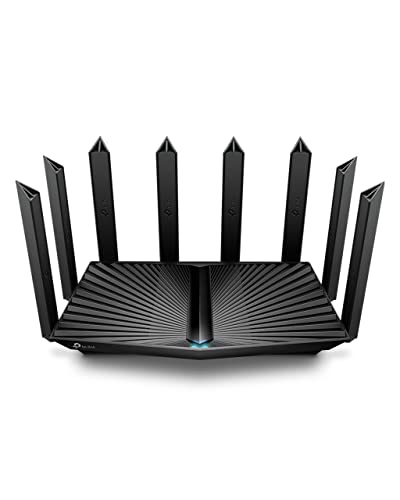
TP-Link AX6000 Dual-Band Wi-Fi 6 Router
Best for: multi-gigabit dual-band Wi-Fi 6 networks
- Frequency Band
- Dual-Band (what this guide is about)
- Wi-Fi Standard
- Wi-Fi 6
- Speed Rating
- AX6000
- Frequency Bands
- Dual Band
- Max Port Speed
- 2.5 Gbps
- Dimensions
- 9.84 × 7.87 × 3.15 inches
The TP-Link Dual-Band AX6000 Router provides dual-band Wi-Fi 6 coverage for high-bandwidth home networks. You get up to 4804 Mbps on the 5 GHz band and 1148 Mbps on the 2.4 GHz band, paired with eight high-gain antennas with beamforming. A built-in 2.5 Gbps multi-gigabit wired port prevents bottlenecks with fast internet connections. It fits your setup if you need high dual-band throughput, built-in VPN client support, and OneMesh range extension.
Pros
- 2.5 Gbps multi-gigabit wired port
- Up to 4804 Mbps on 5 GHz and 1148 Mbps on 2.4 GHz
- Eight high-gain antennas equipped with beamforming
- Built-in VPN client support
Cons
- Dual-band design lacks a 6 GHz frequency band
- Requires a standalone modem for most internet connections
Good fit if
- You subscribe to an internet plan that benefits from a 2.5G wired port.
- You need Wi-Fi 6 speeds up to 4804 Mbps on the 5 GHz band.
- You want router-level VPN client access for connected home devices.
Skip if
- You require tri-band connectivity or a 6 GHz band.
- You need an integrated modem unit rather than a separate router.
Verdict: TP-Link Dual-Band AX6000 Router delivers high Wi-Fi 6 throughput alongside a 2.5 Gbps multi-gigabit wired connection. It is a capable dual-band choice for multi-device households that do not require tri-band or 6 GHz hardware.

TP-Link 6-Stream Dual-Band Wi-Fi 6 Router
Best for: high-bandwidth dual-band streaming and local storage
- Frequency Band
- Dual-Band (what this guide is about)
- Wi-Fi Standard
- Wi-Fi 6
- Speed Rating
- AX4400
- Frequency Bands
- Dual Band
- Device Capacity
- 200+ Devices
- Dimensions
- 14 × 10 × 4 inches
This renewed TP-Link dual-band Wi-Fi 6 router delivers combined wireless speeds up to 4400 Mbps across six streams. Its 5 GHz band uses a 4T4R configuration with 160 MHz channel support to reach up to 3.8 Gbps. With six external antennas, beamforming, and an integrated USB 3.0 port for local storage, it suits you if you need reliable high-bandwidth coverage for multi-device streaming across your home.
Pros
- Up to 4400 Mbps total speed across six Wi-Fi 6 streams
- 5 GHz band supports 4T4R structure and 160 MHz channel width
- Six external antennas with beamforming coverage
- Includes one USB 3.0 port for local media sharing
Cons
- Renewed hardware rather than a factory-new unit
- Dual-band design lacks access to the 6 GHz band
- Large physical footprint measuring 14 by 10 inches
Good fit if
- You need 160 MHz channel width for 3.8 Gbps 5 GHz connections.
- You plan to share local drives across your network via USB 3.0.
- You need to handle dense device traffic using OFDMA and MU-MIMO.
Skip if
- You prefer brand-new factory-sealed equipment over renewed items.
- You want tri-band operation or newer Wi-Fi 7 features.
Verdict: TP-Link 6-Stream Dual-Band Wi-Fi 6 Router provides solid multi-device throughput using 4T4R architecture and HE160 channel bandwidth. It is a dependable choice for homes that require wide antenna coverage and USB network storage without paying for tri-band hardware.

TP-Link Roam 6 AX3000 Travel Router
Best for: secure dual-band Wi-Fi while traveling
- Frequency Band
- Dual-Band (what this guide is about)
- Wi-Fi Standard
- Wi-Fi 6
- Speed Rating
- AX3000
- Frequency Bands
- Dual-Band
- Max Port Speed
- 2.5 Gbps
- Ethernet Ports
- 2
The TP-Link Roam 6 AX3000 Travel Router is a compact dual-band Wi-Fi 6 router designed for mobile use. You get up to 2402 Mbps on 5 GHz and 574 Mbps on 2.4 GHz, backed by a 2.5 Gbps WAN/LAN port and a 1 Gbps LAN port. It runs on 5V USB-C power, supports WireGuard and OpenVPN, and includes a microSD slot. It fits you if you need secure networking on trips.
Pros
- 2.5 Gbps WAN/LAN port plus a 1 Gbps LAN port
- Built-in WireGuard and OpenVPN client and server support
- Powers via standard 5V USB-C or external power bank
- USB 3.0 port and microSD slot supporting up to 512GB
Cons
- Only two total Ethernet ports
- MicroSD card capacity limited to 512GB
Good fit if
- You need a pocket-sized router powered by USB-C power banks.
- You want hardware VPN client and server encryption when using public Wi-Fi.
- You need a fast 2.5 Gbps wired port for travel setups.
Skip if
- You need more than two wired Ethernet connections for local devices.
- You want a stationary home router designed for permanent multi-room coverage.
Verdict: TP-Link Roam 6 AX3000 Travel Router delivers fast dual-band Wi-Fi 6 speeds, 2.5 Gbps connectivity, and robust VPN encryption in a pocket-sized package. It is an exceptional pick for securing personal connections across public networks and hotels.
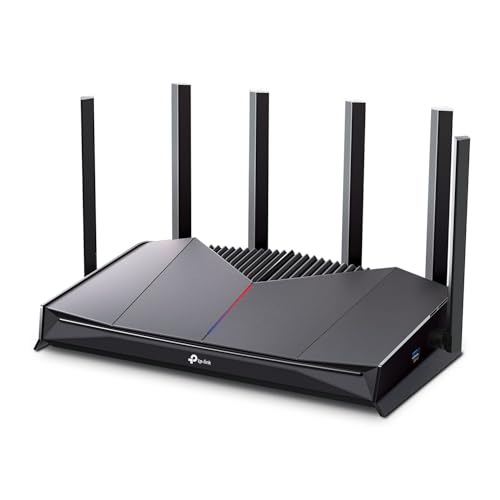
TP-Link Dual-Band Wi-Fi 7 Gaming Router
Best for: gamers needing multi-gigabit wired connections
- Frequency Band
- Dual-Band (what this guide is about)
- Wi-Fi Standard
- WiFi 7
- Speed Rating
- BE6500
- Frequency Bands
- Dual-Band
- Coverage Area
- 2,600 sq. ft.
- Device Capacity
- 90 devices
The TP-Link Dual-Band Wi-Fi 7 Gaming Router is a wireless router tailored for low-latency network setups. It delivers dual-band Wi-Fi 7 speeds reaching 5,765 Mbps on 5 GHz and 688 Mbps on 2.4 GHz across 2,600 square feet. With two 2.5 Gbps Ethernet ports, a dedicated gaming port, and built-in QoS traffic prioritization, it suits you if you want multi-gigabit wired performance and gaming traffic control.
Pros
- Two 2.5 Gbps multi-gigabit Ethernet ports
- Dedicated multi-gig gaming port with WTFast acceleration
- Wi-Fi 7 wireless speeds reaching up to 5,765 Mbps on 5 GHz
- Coverage up to 2,600 square feet for up to 90 devices
Cons
- Does not support the 6 GHz Wi-Fi band
- Incompatible with TP-Link Deco mesh systems
Good fit if
- You need 2.5 Gbps wired connections for a gaming PC or console.
- You want dedicated gaming QoS and WTFast server acceleration tools.
- You plan to expand coverage using EasyMesh-compatible hardware.
Skip if
- You want a tri-band router that includes the 6 GHz band.
- You already use a TP-Link Deco mesh network.
Verdict: TP-Link Dual-Band Wi-Fi 7 Gaming Router delivers high multi-gigabit throughput and targeted gaming optimization over dual-band connections. It is a capable choice if you want fast wired ports and traffic prioritization without stepping up to tri-band hardware.
Specifications side by side
| Spec | TP-Link AX3000 Dual-Band Wi-Fi 6 Router | TP-Link Archer Dual-Band Wi-Fi 7 Router | TP-Link Archer Dual-Band WiFi 7 Router | TP-Link Deco Dual-Band Wi-Fi 7 Mesh Router | TP-Link Archer Dual-Band AC1200 Router | TP-Link AC1900 Dual-Band Router | TP-Link Archer Dual-Band WiFi 6 Router | TP-Link Roam 6 Portable Wi-Fi 6 Router | TP-Link Omada 10-Gigabit VPN Router | TP-Link Roam 7 BE3600 Travel Router | TP-Link Archer Dual-Band Wi-Fi 6 Router | TP-Link AX6000 Dual-Band Wi-Fi 6 Router | TP-Link 6-Stream Dual-Band Wi-Fi 6 Router | TP-Link Roam 6 AX3000 Travel Router | TP-Link Dual-Band Wi-Fi 7 Gaming Router |
|---|---|---|---|---|---|---|---|---|---|---|---|---|---|---|---|
| Wi-Fi Standard | Wi-Fi 6 | Wi-Fi 7 | Wi-Fi 7 | WiFi 7 | not specified | Wi-Fi 5 | Wi-Fi 6 | Wi-Fi 6 | not specified | Wi-Fi 7 | Wi-Fi 6 | Wi-Fi 6 | Wi-Fi 6 | Wi-Fi 6 | WiFi 7 |
| Speed Rating | AX3000 | BE3600 | BE6500 | BE3600 | AC1200 | AC1900 | not specified | AX1500 | not specified | BE3600 | AX1450 | AX6000 | AX4400 | AX3000 | BE6500 |
| Frequency Bands | Dual-Band | Dual-Band | Dual-Band | Dual-Band | Dual-band | Dual Band | Dual-Band | Dual-Band | Dual-Band | Dual-Band | Dual-Band | Dual Band | Dual Band | Dual-Band | Dual-Band |
| Coverage Area | not specified | Up to 2,000 sq. ft. | Up to 2,400 sq. ft. | 2,500 sq. ft | up to 1,000 sq. ft. | 1,200 sq. ft. | not specified | not specified | not specified | not specified | not specified | not specified | not specified | not specified | 2,600 sq. ft. |
| Device Capacity | not specified | Up to 60 devices | Up to 90 devices | 150 devices | not specified | not specified | not specified | Up to 60 devices | 1000+ | up to 90 devices | not specified | not specified | 200+ Devices | not specified | 90 devices |
| Max Port Speed | Gigabit | 2.5 Gbps | 2.5 Gbps | 2.5 Gbps | not specified | Gigabit | Gigabit | 1 Gbps | 10G | 2.5 Gbps | not specified | 2.5 Gbps | not specified | 2.5 Gbps | 2.5 Gbps |
| Ethernet Ports | not specified | 5 | 5 | 2 | not specified | 5 | 4 | 2 | not specified | 2 | not specified | not specified | not specified | 2 | not specified |
| Frequency Band | Dual-Band | Dual-Band | Dual-Band | Dual-Band | Dual-Band | Dual-Band | Dual-Band | Dual-Band | Dual-Band | Dual-Band | Dual-Band | Dual-Band | Dual-Band | Dual-Band | Dual-Band |
| Use Case | not specified | not specified | not specified | not specified | not specified | not specified | not specified | Travel | not specified | Travel | not specified | not specified | not specified | Travel | Gaming |
| Features | not specified | not specified | not specified | not specified | not specified | not specified | not specified | not specified | VPN | not specified | not specified | not specified | not specified | not specified | not specified |
| Port Speed | Gigabit | not specified | not specified | not specified | not specified | not specified | Gigabit | not specified | Gigabit, 10G | 2.5G | not specified | not specified | not specified | not specified | not specified |
| Intended Use | Home | not specified | not specified | not specified | not specified | not specified | not specified | not specified | not specified | not specified | not specified | not specified | not specified | not specified | not specified |
| Dimensions | 13 × 9.45 × 2.87 inches | 13.5 × 10.7 × 1.6 inches | 4.72 × 1.57 × 7.09 inches | not specified | 5.7 × 9.1 × 1.5 inches | 9.57 × 6.32 × 1.28 inches | 10.2 × 4.96 × 1.3 inches | 4.09 × 1.1 × 3.54 inches | 17.3 × 8.66 × 1.73 inches | 4.96 × 3.68 × 1.5 inches | not specified | 9.84 × 7.87 × 3.15 inches | 14 × 10 × 4 inches | 3.6 × 1.18 × 4.13 inches | 10.6 × 6.02 × 2.31 inches |
| Weight | 1.66 pounds | 1.21 pounds | 1.37 pounds | not specified | 1.45 pounds | 14.6 ounces | 13.4 ounces | 6.72 ounces | 6.26 pounds | 8.8 ounces | 13.4 ounces | 2 pounds | not specified | 5.28 ounces | 1.43 pounds |
| Size | AX3000 | Compact | 10.6 x 6 x 1.9 inches | 1 - Pack | 5.7 x 9.1 x 1.5 inches | Wi-Fi 5 AC1900 | WiFi 6 Router | Portable | 10 Gigabit | Compact Design | not specified | 10.9 x 7.2 x 2.3 inches | not specified | Compact | 1 Count (Pack of 1) |
| Color | Black | Black | Black | White | white | Black | Black | Black | Black | Black | not specified | Black | black | Black | Black |
| Model | Archer AX55 | Archer BE230 | Archer BE400 | Deco BE23(1-Pack) | Archer A54 | Archer A8 | Archer AX10 | TL-WR1512X | ER8411 | TL-WR3602BE | not specified | Archer AX80 | TP-Link AX4400 | TL-WR3002X | Archer GE400 |
When you plan backup power for your networking gear during an outage, compare runtime specs across the best dual fuel generators.
How to Choose a TP-Link Router
-
Select the Wireless Standard
Check the Wi-Fi generation before you buy. TP-Link dual-band routers span Wi-Fi 5, Wi-Fi 6, and Wi-Fi 7 standards. Wi-Fi 5 models suit basic setups with older client hardware. Wi-Fi 6 adds efficiency improvements for modern household electronics. Wi-Fi 7 introduces updated protocol features for next-generation devices. If your household relies strictly on legacy phones and laptops, an older standard like the Archer A8 covers everyday browsing without extra protocol overhead. Matching the protocol to your client devices ensures you do not overspecify your network hardware.
-
Check Square Footage Coverage
Evaluate the physical dimensions of your living space against the manufacturer coverage rating. Single dual-band routers list specific area limits to help you determine if one access point covers your floor plan. For instance, the Archer BE400 covers spaces up to 2,400 square feet. If your layout features multiple stories or thick interior walls, placing a standalone router in a central location is critical. Choosing a model rated for your square footage prevents signal dropouts in distant rooms without requiring immediate network expansion hardware.
-
Verify Mesh Protocol Compatibility
Confirm which expansion standard the router uses if you plan to add nodes later. TP-Link maintains distinct ecosystems that do not always interoperate. Certain standalone units support EasyMesh or OneMesh to link compatible range extenders. However, standalone Archer models cannot pair directly into Deco mesh networks. If you plan to expand coverage later using Deco hardware, you must purchase a native Deco unit like the Deco BE23 rather than a standard Archer router. Always verify the mesh standard listed on the specification sheet before expanding.
-
Assess Portability and Power
Consider the chassis dimensions and power delivery if you need connectivity outside a permanent residence. Desktop dual-band routers require stationary placement and dedicated electrical adapters. Travel models feature lightweight enclosures, integrated VPN encryption, and flexible power options designed for mobile use. For example, the Roam 6 TL-WR1512X weighs 0.42 pounds and operates using standard USB-C power delivery. If you work from hotels or shared spaces, selecting a portable router with compact dimensions gives you private local routing without adding bulk to your travel pack.
-
Compare Bandwidth Speed Ratings
Review the combined speed rating on the box to match your concurrent wireless traffic. Dual-band ratings range from entry AC1200 tiers up to high-capacity AX6000 configurations. A higher class number reflects greater bandwidth across the 2.4 GHz and 5 GHz frequency bands simultaneously. A model like the Archer AX80 provides an AX6000 tier that handles heavy local wireless data transfers across multiple simultaneous clients. Choose a higher numeric rating if your household runs concurrent high-bandwidth tasks like file transfers and media streams across several devices.
-
Identify Business Routing Features
Check whether your network demands enterprise multi-WAN management instead of standard consumer firmware. Residential dual-band routers feature basic management software intended for a single internet connection. In contrast, specialized hardware like the Omada ER8411 provides Omada SDN integration, dual 10G SFP+ connectivity, and support for multi-WAN line balancing. If you manage an office network requiring continuous uptime across multiple service providers and extensive VPN capacity, choose an enterprise-grade router. Home users with a single internet plan should stay with conventional dual-band units.
Frequently asked questions
Can you use a TP-Link Archer router with Deco mesh units?
No, TP-Link Archer routers do not mesh directly with Deco hardware. Models like the Archer BE400 rely on standalone setups or EasyMesh technology. The Deco BE23 belongs to the Deco mesh ecosystem, which requires other Deco units to create a seamless network. You cannot combine Archer and Deco hardware into a single unified mesh system.
What is the difference between TP-Link OneMesh and EasyMesh?
OneMesh is TP-Link's proprietary mesh system, while EasyMesh is an open industry networking standard. Models like the Archer AX10 support OneMesh to pair with specific TP-Link range extenders. Modern units like the Archer BE230 and Archer A54 use EasyMesh, letting you create a unified mesh network using compatible devices across different brands and product lines.
Are TP-Link travel routers suitable for home network use?
Yes, you can run a TP-Link travel router as a primary home network device, but its range is limited. Models like the Roam 7 TL-WR3602BE and Roam 6 TL-WR3002X provide multi-gigabit 2.5 Gbps connectivity and VPN security in lightweight housings. However, their compact form factors are engineered for hotel rooms and small workspaces rather than multi-story properties.
What makes a TP-Link Omada router different from standard home routers?
TP-Link Omada routers are engineered for enterprise infrastructure rather than standalone residential Wi-Fi broadcasting. The Omada ER8411 features dual 10G SFP+ ports, Omada SDN centralized management, and multi-WAN routing capabilities for multi-gigabit business networks. It is built to manage heavy wired routing loads and requires dedicated access points if you need wide wireless coverage across your facility.
Do TP-Link dual-band Wi-Fi 7 routers support the 6 GHz band?
No, dual-band Wi-Fi 7 routers broadcast only on the 2.4 GHz and 5 GHz frequency bands. Units such as the Archer BE230, Archer BE400, and Archer GE400 provide Wi-Fi 7 protocol benefits, multi-gigabit wired speeds, and lower latency without transmitting over 6 GHz. If you require access to the 6 GHz spectrum, you must select a tri-band router instead.
Can you attach external storage to a TP-Link dual-band router?
Yes, certain TP-Link dual-band routers allow you to connect external hard drives for local file sharing. The TP-Link AX4400 provides USB network storage capability alongside its 6-stream 4T4R architecture and HE160 channel support. Connecting an external drive lets you store media and access documents across your local network without running a dedicated computer or separate network-attached storage unit.
How much coverage area does a TP-Link dual-band router provide?
A standalone TP-Link dual-band router generally covers between 2,000 and 2,400 square feet. For example, the Archer BE230 handles homes up to 2,000 square feet, whereas the Archer BE400 provides wireless coverage for properties up to 2,400 square feet. If you live in a larger house, you can extend coverage by adding compatible EasyMesh nodes to your system.