15 Best Network Switches Under $300, Compared
As an Amazon Associate we earn from qualifying purchases. Links on this page are affiliate links.
Finding the best network switches under $300 depends on your need for port density, Power over Ethernet, and managed control. We compared 15 models using only the specifications published on their product listings.
The NETGEAR 16-Port Gigabit Unmanaged PoE+ Switch takes the top spot by providing 16 Gigabit ports with a 183W PoE+ budget in a silent, fanless chassis. This guide helps you decide which switch fits your deployment based on total port count, PoE capacity, and uplink bandwidth.
Our top pick: NETGEAR 48-Port Unmanaged Gigabit Switch.
Quick picks
The best fit for you
- You need high port density without network management NETGEAR 48-Port Unmanaged Gigabit Switch It provides 48 unmanaged Gigabit ports for plug-and-play wired connections.
- You need high PoE wattage for many devices YuanLey 48-Port 800W Gigabit PoE+ Switch It supplies an 800W power budget across 48 Gigabit PoE+ ports.
- You want unmanaged multi-gigabit speeds on desktops TRENDnet 16-Port 2.5G Unmanaged Switch It delivers 16 unmanaged 2.5G ports in a desktop housing.
- You need managed all-fiber 10G network aggregation MokerLink 12-Port 10G SFP+ Managed Switch It features 12 dedicated 10G SFP+ ports with Layer 3 management.
Our 15 picks

NETGEAR 48-Port Unmanaged Gigabit Switch
Best for: silent, high-density unmanaged wired networks
- Port Count
- 48
- Port Speed
- 1.0Gbps
- Management Type
- Unmanaged
- Mounting Type
- Desktop, Rack-mount
- Number of Ports
- 48 Ports
- Dimensions
- 8 × 17.3 × 1.7 inches
This is an unmanaged network switch that gives you 48 auto-negotiating Gigabit Ethernet ports in a metal enclosure. It operates silently due to a fanless build and supports both desktop and rack-mount setups. Because it requires zero software configuration, you can expand a high-density wired network using standard Cat5e or Cat6 cables right away. It suits you if you need massive wired capacity without complex management.
Pros
- 48 Gigabit Ethernet auto-negotiating ports
- Silent fanless design
- Plug-and-play operation with no software configuration
- Supports desktop and rack-mount placement
Cons
- No Power over Ethernet (PoE) support
- No managed Layer 2 or Layer 3 network controls
- Regional compatibility limited to the US and Canada
Good fit if
- You need 48 Gigabit Ethernet ports for wired devices.
- You want a silent, fanless switch for desktop or rack mounting.
- You prefer an unmanaged plug-and-play setup without software configuration.
Skip if
- You need Power over Ethernet to run access points or cameras.
- You require managed switch features like VLANs or traffic controls.
- You live outside the US and Canada.
Verdict: NETGEAR 48-Port Unmanaged Gigabit Switch delivers silent, high-density wired connectivity with straightforward plug-and-play operation. It provides an expansive 48-port capacity for standard Gigabit setups that do not require PoE or managed software.

HP Aruba Instant On 8-Port PoE Switch
Best for: small smart-managed PoE networks with fiber uplinks
- Port Speed
- Gb Ethernet
- Management Type
- Smart
- PoE Support
- PoE
- PoE Power Budget
- 124W
- Uplink Ports
- 2X 1G SFP
- Number of Ports
- 8 Ports
The HP Aruba Instant On 8-Port PoE Smart Switch expands your local network with eight Gigabit Ethernet ports and two dedicated 1G SFP uplink slots. It provides a total PoE power budget of 124W to run connected hardware like access points or VoIP phones. With smart switch management capabilities built in, this unit suits you if you need reliable power delivery and fiber-ready uplinks for a compact office or home lab setup.
Pros
- 124W PoE power budget across eight Gigabit ports
- Two dedicated 1G SFP ports for fiber uplinks
- Smart management capabilities for network control
Cons
- Uplink speeds capped at 1G SFP instead of 10G
- Offers only eight RJ45 Ethernet ports
Good fit if
- You need up to 124W of PoE power across eight Gigabit devices.
- You want smart management features with dedicated SFP fiber uplinks.
Skip if
- You need more than eight copper Ethernet ports.
- You require 10G uplink speeds or multi-gigabit connections.
Verdict: HP Aruba Instant On 8-Port PoE Smart Switch delivers 124W of PoE power and dual 1G SFP uplinks in a smart-managed format. It offers a solid balance of power delivery and network control for small-scale deployments.

Ubiquiti UniFi Managed 10G Optical Fiber Switch
Best for: 10 Gigabit optical fiber rack aggregation
- Port Speed
- 10 Gigabit
- Mounting Type
- Rack-mountable
- Dimensions
- 4.7 × 17.4 × 1.7 inches
- Weight
- 5.84 pounds
View on Amazon: Ubiquiti UniFi Managed 10G Optical Fiber Switch
The Ubiquiti UniFi 10G Managed Aggregation Switch gives you high-speed 10 Gigabit Ethernet connectivity with optical fiber media support for your network. It operates as a managed Layer 2 switch with IGMP snooping, port mirroring, and spanning tree support. A built-in power supply sits inside its 1.7-inch by 17.4-inch rack-mountable chassis. This switch suits you if you need dedicated 10 Gigabit fiber links across your rack.
Pros
- 10 Gigabit Ethernet port speed
- Optical fiber media support
- Managed Layer 2 features including IGMP snooping, port mirroring, and spanning tree
- Built-in internal power supply
Cons
- Relies on optical fiber media rather than standard RJ45 copper ports
- Limited to Layer 2 management without Layer 3 routing features
- No Power over Ethernet output support
Good fit if
- You need 10 Gigabit optical fiber aggregation for high-bandwidth connections.
- You require managed Layer 2 network control including spanning tree and IGMP snooping.
- You use a standard rack mount for your network hardware.
Skip if
- You need standard copper RJ45 Ethernet ports directly on the switch.
- You require Power over Ethernet to run connected hardware.
- You need Layer 3 switching capabilities.
Verdict: Ubiquiti UniFi 10G Managed Aggregation Switch delivers managed 10 Gigabit Layer 2 switching with optical fiber support in a rack-mountable form factor. It provides dedicated high-bandwidth aggregation for rack-based fiber connections.

Ubiquiti UniFi Managed 10G Aggregation Switch
Best for: 10G SFP rack-mounted network aggregation
- Management Type
- Managed
- Mounting Type
- Rack mounting, 1U
- Port Speed
- 10G
- Uplink Port Type
- SFP
- Dimensions
- 4.72 × 17.4 × 1.72 inches
- Weight
- 2.2 pounds
View on Amazon: Ubiquiti UniFi Managed 10G Aggregation Switch
The Ubiquiti Networks UniFi 10G Managed Switch is a 1U rack-mountable Layer 2 switch designed for high-bandwidth central distribution. It delivers 10G port speeds with SFP uplink ports to aggregate your network connections. Managed capabilities give you direct control over your setup within a compact 4.72-inch depth and 2.2-pound chassis. This switch suits you if you need dedicated 10G fiber uplinks across your rack-mounted home or office infrastructure.
Pros
- Supports 10G port speeds
- Managed Layer 2 network control
- Standard 1U rack-mountable form factor with a 4.72-inch depth
- Three-year warranty against factory defects
Cons
- Relies on SFP ports with no standard RJ45 copper ports listed
- No Power over Ethernet support listed
- Limited to Layer 2 management without Layer 3 routing specifications
Good fit if
- You need 10G port speeds through SFP uplinks.
- You require a managed Layer 2 switch for a standard 1U rack.
- You prefer a compact chassis weighing only 2.2 pounds.
Skip if
- You require standard RJ45 Ethernet ports for twisted-pair copper cables.
- You need Power over Ethernet to run access points or cameras.
- You require Layer 3 hardware routing features.
Verdict: Ubiquiti Networks UniFi 10G Managed Switch provides managed Layer 2 performance and high-speed 10G SFP uplinks in a shallow 1U rack-mount chassis. It serves as a dedicated aggregation hub for high-throughput network backbones.

TP-Link Omada 24-Port Gigabit Switch with 10G SFP+
Best for: Gigabit networks needing 10G fiber uplinks
- Port Count
- 24
- Port Speed
- 10/100/1000 Mbps
- Management Type
- Smart Managed
- Uplink Ports
- 4 x 10G SFP+
- Number of Ports
- 24 Ports
- Dimensions
- 17.3 × 7.09 × 1.73 inches
View on Amazon: TP-Link Omada 24-Port Gigabit Switch with 10G SFP+
This TP-Link Omada managed switch gives you 24 Gigabit Ethernet ports and four 10G SFP+ uplink slots. It supports L2+ features like static routing alongside Omada SDN centralized cloud management or standalone operation. You get 802.1Q VLAN support and network security protocols built into the hardware. It suits your network if you need high-bandwidth 10-gigabit uplinks to servers or aggregation switches without requiring power over Ethernet.
Pros
- Four 10 Gbps SFP+ uplink slots for high-speed connections
- Omada SDN integration with cloud, controller, or standalone management
- L2+ static routing and 802.1Q VLAN support
- Five-year manufacturer warranty
Cons
- No Power over Ethernet (PoE) support on RJ45 ports
- Additional fees apply for cloud-based controller access
Good fit if
- You need four dedicated 10G SFP+ uplinks for storage or core switches.
- You manage your gear via TP-Link Omada SDN hardware or software controllers.
- You require L2+ static routing and advanced VLAN security controls.
Skip if
- You need PoE ports to power access points or cameras directly.
- You want multi-gigabit copper RJ45 ports instead of standard Gigabit.
Verdict: TP-Link Omada 24-Port Switch with 10G SFP+ delivers enterprise-level L2+ management and high-speed fiber uplinks for dense wired networks. It provides flexible Omada SDN control across 24 Gigabit ports when Power over Ethernet is not needed.

YuanLey 48-Port 800W Gigabit PoE+ Switch
Best for: high-density unmanaged PoE device deployments
- Port Count
- 50
- Port Speed
- 10/100/1000 Mbps
- Management Type
- Unmanaged
- PoE Support
- PoE+ (802.3af/at)
- PoE Power Budget
- 800W
- Uplink Ports
- 2 x Gigabit SFP
This unmanaged switch gives you 48 Gigabit PoE+ RJ45 ports alongside two dedicated Gigabit SFP uplinks. It delivers an 800W total PoE power budget supporting IEEE 802.3af and 802.3at devices up to 30W per port. With a 56 Gbps switching capacity and plug-and-play setup, it suits your high-density IP camera, access point, or IP phone deployments where you need extensive power delivery without network management overhead.
Pros
- 800W total PoE power budget across 48 PoE+ ports
- Two dedicated 1000Mbps SFP uplink ports
- 56 Gbps switching capacity with 8K MAC address table
- 4KV lightning protection and IP30-rated metal housing
Cons
- Unmanaged design provides no VLAN, QoS, or traffic control settings
- SFP uplink ports limited to 1 Gbps rather than 10 Gbps
- Chassis height of 3.54 inches takes up more rack space than standard 1U units
Good fit if
- You need to power dozens of PoE access points or security cameras from one chassis.
- You want a plug-and-play setup requiring no software configuration.
- You require Gigabit SFP ports for long-distance fiber connections.
Skip if
- You need managed Layer 2 features like VLAN segmentation or link aggregation.
- You require 10G uplinks for high-bandwidth core network traffic.
Verdict: YuanLey 48-Port Gigabit PoE+ Unmanaged Switch delivers high-capacity 800W power across 48 ports for straightforward, high-density hardware installations. It gives you expansive network reach without configuration complexity.

NICGIGA 48-Port Gigabit PoE+ Switch with 2 SFP
Best for: large unmanaged PoE camera and AP deployments
- Port Count
- 50
- Port Speed
- 10/100/1000 Mbps
- Management Type
- Unmanaged
- PoE Support
- PoE+ (IEEE 802.3af/at)
- PoE Power Budget
- 400W
- Uplink Ports
- 2 x 1G SFP
View on Amazon: NICGIGA 48-Port Gigabit PoE+ Switch with 2 SFP
This NICGIGA unit is an unmanaged 50-port network switch equipped with 48 Gigabit PoE+ ports and two 1G SFP uplinks. It provides up to 30W per port across an overall 400W power budget to run IP cameras, access points, and VoIP hardware. Plug-and-play setup requires no software configuration. This hardware suits you if you need high-density wired connectivity and centralized device power without managing complex virtual local area networks.
Pros
- 48 Gigabit PoE+ ports with a 400W total power budget
- Two dedicated 1G SFP uplink ports
- Metal enclosure with 4KV lightning protection
- Unmanaged plug-and-play design with auto MDI/MDIX
Cons
- Unmanaged architecture provides no VLAN or QoS configuration
- Does not support passive 24V PoE devices
- Internal cooling fan introduces acoustic noise
Good fit if
- You need to connect and power dozens of standard PoE+ cameras or access points.
- You prefer an unmanaged switch that functions without setup or software management.
- You require rack-mounted hardware with optical SFP uplinks.
Skip if
- You require managed Layer 2 features, VLAN routing, or remote configuration.
- You deploy proprietary hardware requiring passive PoE power.
Verdict: NICGIGA 48-Port Gigabit PoE Switch delivers high-density power and wired connections for large camera or access point installations. Its unmanaged configuration keeps deployment simple, though it trades off granular network management.

MokerLink 12-Port 10G SFP+ Managed Switch
Best for: all-fiber 10G network aggregation and routing
- Port Count
- 12
- Management Type
- L3 Managed
- Uplink Ports
- 12 x 10G SFP+
- Switching Capacity
- 240Gbps
- Port Speed
- Gigabit, 10G
- Weight
- 6.7 pounds
This MokerLink unit is a 12-port 10Gbps SFP+ switch with Layer 3 management. It delivers 240Gbps of non-blocking switching capacity across all ports, supporting both 1G and 10G optical modules. Management runs via a web interface or a command-line interface through the dedicated RJ45 console port. If you need dedicated high-bandwidth fiber links for local network aggregation without standard copper ports out of the box, this setup fits your rack.
Pros
- 12 SFP+ ports supporting 1Gbps and 10Gbps line speeds
- 240Gbps total non-blocking switching capacity
- Layer 3 management features including OSPF, DHCP server, and VLAN support
- Dedicated RJ45 console port alongside web management
Cons
- Does not include SFP modules in the package
- No built-in RJ45 network ports for standard Ethernet patches
- Uses an internal fan rather than a silent fanless design
Good fit if
- You need 12 dedicated 10G SFP+ fiber ports for high-bandwidth aggregation.
- You require Layer 3 routing features such as OSPF and DHCP server functionality.
- You manage switches through a dedicated RJ45 console CLI or web interface.
Skip if
- You need native RJ45 copper ports without purchasing separate transceiver modules.
- You prefer a silent, fanless switch for quiet desktop environments.
- You want a simple unmanaged switch that requires zero software setup.
Verdict: MokerLink 12-Port 10G SFP+ Managed Switch delivers 12 high-speed 10Gbps SFP+ interfaces and Layer 3 routing capability in a metal chassis. It is built for network setups centered entirely on high-capacity fiber uplinks.

MokerLink 8-Port 10G Managed Switch
Best for: managed all-copper 10-gigabit wired networks
- Port Count
- 8
- Port Speed
- 10 Gbps
- Management Type
- Managed
- Mounting Type
- Desktop, Wall-Mount, Rackmount
- Number of Ports
- 8 Ports
- Weight
- 4.01 pounds
The MokerLink 8-Port 10G Managed Switch provides eight multi-gigabit RJ45 Ethernet ports that auto-negotiate between 100M and 10Gbps speeds. You get Layer 3 routing capabilities, including IPv4 and IPv6 routes, paired with Layer 2 VLAN, QoS, and ACL controls. Management runs via Web interface, CLI, Telnet, SSH, or SNMP. It suits you if you need dedicated ten-gigabit copper switching and network segmentation across your high-speed workstations, servers, or storage devices.
Pros
- Eight 10Gbps Ethernet ports with auto-adaptive speed support down to 100Mbps
- Layer 3 management with IPv4 and IPv6 routing and ARP support
- Versatile management access including Web UI, CLI, Telnet, SSH, and SNMP
- Flexible deployment with desktop, wall-mount, and rackmount support
Cons
- No Power over Ethernet (PoE) support
- Uses an active cooling fan rather than a silent fanless design
- Lacks dedicated SFP+ fiber uplink ports
Good fit if
- You need full 10Gbps speeds over RJ45 copper cabling for multiple computers or servers.
- You want Layer 3 routing and Layer 2 management tools like VLANs, QoS, and ACLs.
- You prefer configuring switches through standard CLI, Web interfaces, or SSH.
Skip if
- You require Power over Ethernet to run access points or security cameras.
- You need a silent fanless switch for quiet desktop setups.
- You need dedicated SFP+ fiber ports for optical network connections.
Verdict: MokerLink 8-Port 10G Managed Switch delivers eight multi-gigabit copper ports with full Layer 3 and Layer 2 management. It provides robust 10Gbps wired connectivity for data-heavy setups that do not require PoE.

VIMIN 48-Port Gigabit PoE Switch
Best for: large plug-and-play PoE device networks
- Port Count
- 50
- Management Type
- Unmanaged
- PoE Support
- PoE+ (802.3af/at)
- PoE Power Budget
- 400 W
- Uplink Ports
- 2 x Gigabit SFP
- Number of Ports
- 48 Ports
This is an unmanaged 50-port switch built for large wired deployments. You get 48 Gigabit Ethernet ports with 802.3af/at PoE+ power, backed by a 400W total budget and up to 30W per port. Two dedicated Gigabit SFP slots handle uplink connections to your router or core network. It suits you if you need to power numerous IP cameras, access points, or VoIP phones without configuring VLANs or management settings.
Pros
- 48 Gigabit PoE+ ports with a 400W total power budget
- Two dedicated Gigabit SFP uplink ports
- Supports up to 30W per port via IEEE 802.3af/at
- Metal casing with 4KV lightning protection
Cons
- Unmanaged with no VLAN, QoS, or software controls
- Does not support passive PoE devices
- SFP uplink slots limited to 1 Gbps speeds
Good fit if
- You need to power dozens of standard PoE devices from a single unit.
- You want plug-and-play installation without managing network settings.
- You require fiber SFP uplinks to connect to your central network.
Skip if
- You require managed switch features like VLANs or traffic monitoring.
- You operate equipment that requires passive PoE power.
- You need 2.5G, 5G, or 10G uplink speeds.
Verdict: VIMIN 48-Port Gigabit PoE+ Unmanaged Switch provides high-density power delivery and 50 total ports for simple, large-scale hardware setups. It is an effective hardware choice when you need substantial PoE capacity without the overhead of managed network software.

YuanLey 28-Port L3 Managed PoE+ Switch
Best for: high-capacity PoE installations needing 10G uplinks
- Port Count
- 28
- Port Speed
- 10/100/1000 Mbps
- Management Type
- L3 Managed
- PoE Support
- PoE+ (802.3at/af)
- PoE Power Budget
- 400W
- Uplink Ports
- 4 x 10G SFP+
The YuanLey 28-Port L3 Managed PoE+ Switch expands your network setup with 24 Gigabit Ethernet PoE+ ports and four 10G SFP+ uplink slots. It provides a 400W total PoE power budget to run multiple access points and IP cameras simultaneously. With Layer 3 management and 128 Gbps switching capacity, this rackmount switch suits you if you need granular traffic control and high-bandwidth uplinks for a growing business network.
Pros
- 400W built-in PoE power budget across 24 PoE+ ports
- Four 10G SFP+ uplink slots for high-speed connections
- Layer 3 management with Web, CLI, and SNMP support
- 128 Gbps total switching capacity
Cons
- Relies on active fan cooling rather than silent fanless operation
- Lacks 2.5G or 5G multi-gigabit RJ45 copper ports
Good fit if
- You need to power dozens of PoE devices using a 400W budget.
- You require 10G SFP+ uplinks for network backbones or servers.
- You manage network traffic using Layer 3 routing and VLANs.
Skip if
- You want a completely silent, fanless switch for a desktop setup.
- You need 2.5G or faster RJ45 ports for high-speed client devices.
Verdict: YuanLey 28-Port L3 Managed PoE+ Switch delivers extensive PoE capacity alongside four 10G SFP+ uplinks for demanding network environments. It gives you comprehensive Layer 3 management controls in a standard rackmount chassis.

YuanLey 8-Port Multi-Gig PoE Switch
Best for: wall-mounted unmanaged multi-gigabit PoE+ networks
- Port Count
- 8
- Port Speed
- 10 Gbps
- Management Type
- Unmanaged
- PoE Support
- PoE+ (IEEE 802.3af/at)
- PoE Power Budget
- 110W
- Switching Capacity
- 160 Gbps
This unmanaged switch gives you eight 10Gbps RJ45 ports with IEEE 802.3af/at PoE+ support and a 110W total power budget. It delivers up to 160 Gbps of switching capacity without requiring software configuration. You can mount the metal chassis directly to a wall or install it in a standard 19-inch rack. It suits your setup if you need high-speed wired connections for multi-gig access points, servers, and storage devices.
Pros
- Eight 10Gbps RJ45 ports supporting 100M up to 10G auto-negotiation
- 160 Gbps total switching capacity
- 110W PoE+ power budget with up to 30W per port
- Supports both wall-mount and 19-inch rackmount placement
Cons
- Unmanaged design lacks VLAN, QoS, and software configuration tools
- Active cooling fan produces 24dB of audible noise
- 110W total budget cannot power eight maximum-draw 30W PoE+ devices at once
Good fit if
- You need eight copper 10Gbps ports with PoE+ power delivery.
- You want to mount a multi-gig switch directly onto a wall or inside a rack.
- You prefer plug-and-play operation without managing network settings.
Skip if
- You require managed switch features such as VLAN tagging or port trunking.
- You need a fanless device for completely silent operation in a living area.
- You plan to draw more than 110W of total PoE power across your connected gear.
Verdict: YuanLey 8-Port 10G PoE+ Switch delivers full 10Gbps speeds and PoE+ power across all eight ports in a wall-mountable metal housing. It is a capable choice when you want high multi-gig throughput without network management complexity.

TRENDnet 16-Port 2.5G Unmanaged Switch
Best for: silent multi-gigabit wired desktop networks
- Port Count
- 16
- Port Speed
- 2.5 Gbps
- Management Type
- Unmanaged
- Switching Capacity
- 80Gbps
- Mounting Type
- Desktop, Wall Mountable
- Number of Ports
- 16 Ports
The TRENDnet 16-Port 2.5G Unmanaged Switch expands your local network with sixteen dedicated 2.5Gbps Ethernet ports and an 80Gbps switching capacity. Its fanless metal chassis delivers completely silent operation whether you place it on a desk or mount it to a wall. You get multi-gigabit speeds using your existing Cat5e or better cabling. This unit suits you if you need straightforward high-speed bandwidth without complex configuration.
Pros
- Sixteen 2.5Gbps RJ-45 Ethernet ports
- 80Gbps total switching capacity
- Fanless design for silent operation
- Durable wall-mountable metal housing
Cons
- Unmanaged with no VLAN or Layer 2 management settings
- No Power over Ethernet (PoE) capability
- No 10G or SFP+ uplink ports
Good fit if
- You need 2.5Gbps connections across up to 16 wired network devices.
- You prefer a plug-and-play setup that requires no software configuration.
- You want silent, fanless operation for a desktop or wall-mounted space.
Skip if
- You require Power over Ethernet (PoE) to power access points or cameras.
- You need managed network controls such as VLAN segmentation or QoS.
- You need 10Gbps or fiber SFP+ uplink connectivity.
Verdict: TRENDnet 16-Port 2.5G Unmanaged Switch delivers high 2.5Gbps port density and silent operation in a plug-and-play metal housing. It provides straightforward multi-gigabit expansion when you do not need managed controls or PoE power.

TP-Link Omada 8-Port 2.5G PoE+ Switch
Best for: Multi-gigabit PoE networks with 10G fiber uplinks
- Port Count
- 8
- Port Speed
- 2.5 Gbps
- Management Type
- Cloud Managed
- PoE Support
- PoE+ (802.3at/af)
- PoE Power Budget
- 160 W
- Uplink Ports
- 2 x 10G SFP+
The TP-Link Omada 8-Port 2.5G PoE+ Switch gives you multi-gigabit connectivity with dedicated high-speed fiber uplinks. It features eight 2.5 Gbps Ethernet ports with 802.3at/af PoE+ output and a 160 W total power budget, supplying up to 30 W per port. Two 10G SFP+ slots handle fast aggregation backbones. You can configure it standalone or manage it centrally using the Omada cloud platform, making it suitable for multi-gigabit access points and network expansion.
Pros
- Eight 2.5 Gbps Ethernet ports with PoE+ support
- 160 W total PoE power budget with up to 30 W per port
- Two 10G SFP+ uplink slots for fiber connectivity
- Centralized Omada cloud and standalone management options
Cons
- Only eight copper Ethernet ports provided
- Requires SFP+ transceivers for 10G uplinks
Good fit if
- You need 2.5 Gbps PoE+ connections for multi-gigabit access points or devices.
- You want 10G SFP+ fiber uplinks to connect to a central core switch or NAS.
- You manage your home or small office network using the Omada cloud platform.
Skip if
- You need more than eight copper Ethernet ports in a single location.
- You require 10G RJ45 copper ports instead of 10G SFP+ fiber slots.
Verdict: TP-Link Omada 8-Port 2.5G PoE+ Switch delivers multi-gigabit speeds and 160 W of PoE+ power alongside dual 10G uplinks. It is an effective option if you want cloud-managed multi-gigabit switching without exceeding eight copper ports.
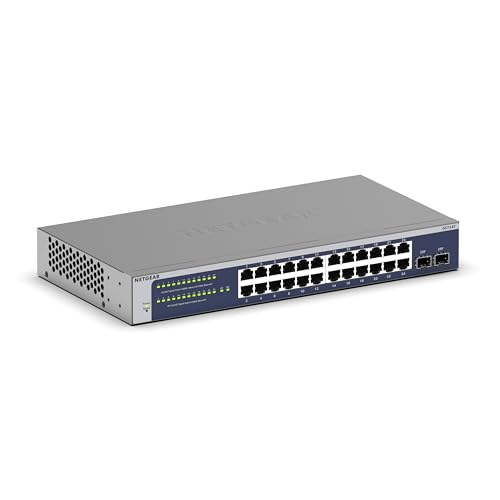
NETGEAR 24-Port Fanless Smart Managed Switch
Best for: quiet rack or desktop wired management
- Port Count
- 24
- Port Speed
- 1.0Gbps
- Management Type
- Smart Managed
- Uplink Ports
- 2 x 1G SFP
- Mounting Type
- Desktop, Rackmount
- Number of Ports
- 24 Ports
View on Amazon: NETGEAR 24-Port Fanless Smart Managed Switch
This NETGEAR switch gives you 24 Gigabit Ethernet ports alongside two dedicated 1G SFP fiber uplinks. It features smart management software with remote Insight support and SNMP monitoring, allowing you to configure network security and traffic directly. The fanless metal chassis ensures silent operation on a desk or inside an equipment rack. It suits you if you need reliable wired management without cooling noise.
Pros
- 24 auto-negotiating Gigabit Ethernet ports
- Fanless design for silent desktop or rack-mount operation
- Two dedicated 1G SFP ports for fiber uplinks
- Smart management software with one year of NETGEAR Insight
Cons
- No Power over Ethernet support listed
- SFP uplink ports limited to 1G speeds
Good fit if
- You need 24 Gigabit connections with completely silent operation.
- You want smart switch management with SNMP and remote cloud control.
Skip if
- You need Power over Ethernet to run access points or cameras.
- You require multi-gigabit connections or 10G SFP+ uplinks.
Verdict: NETGEAR 24-Port Smart Managed Fanless Switch delivers 24 Gigabit ports and dual 1G SFP slots with silent operation. It provides flexible smart management controls for standard desktop or rack installations.
Specifications side by side
| Spec | NETGEAR 48-Port Unmanaged Gigabit Switch | HP Aruba Instant On 8-Port PoE Switch | Ubiquiti UniFi Managed 10G Optical Fiber Switch | Ubiquiti UniFi Managed 10G Aggregation Switch | TP-Link Omada 24-Port Gigabit Switch with 10G SFP+ | YuanLey 48-Port 800W Gigabit PoE+ Switch | NICGIGA 48-Port Gigabit PoE+ Switch with 2 SFP | MokerLink 12-Port 10G SFP+ Managed Switch | MokerLink 8-Port 10G Managed Switch | VIMIN 48-Port Gigabit PoE Switch | YuanLey 28-Port L3 Managed PoE+ Switch | YuanLey 8-Port Multi-Gig PoE Switch | TRENDnet 16-Port 2.5G Unmanaged Switch | TP-Link Omada 8-Port 2.5G PoE+ Switch | NETGEAR 24-Port Fanless Smart Managed Switch |
|---|---|---|---|---|---|---|---|---|---|---|---|---|---|---|---|
| Port Count | 48 | not specified | not specified | not specified | 24 | 50 | 50 | 12 | 8 | 50 | 28 | 8 | 16 | 8 | 24 |
| Port Speed | 1.0Gbps | Gb Ethernet | 10 Gigabit | not specified | 10/100/1000 Mbps | 10/100/1000 Mbps | 10/100/1000 Mbps | not specified | 10 Gbps | not specified | 10/100/1000 Mbps | 10 Gbps | 2.5 Gbps | 2.5 Gbps | 1.0Gbps |
| Management Type | Unmanaged | Smart | not specified | Managed | Smart Managed | Unmanaged | Unmanaged | L3 Managed | Managed | Unmanaged | L3 Managed | Unmanaged | Unmanaged | Cloud Managed | Smart Managed |
| PoE Support | not specified | PoE | not specified | not specified | not specified | PoE+ (802.3af/at) | PoE+ (IEEE 802.3af/at) | not specified | not specified | PoE+ (802.3af/at) | PoE+ (802.3at/af) | PoE+ (IEEE 802.3af/at) | not specified | PoE+ (802.3at/af) | not specified |
| PoE Power Budget | not specified | 124W | not specified | not specified | not specified | 800W | 400W | not specified | not specified | 400 W | 400W | 110W | not specified | 160 W | not specified |
| Uplink Ports | not specified | 2X 1G SFP | not specified | not specified | 4 x 10G SFP+ | 2 x Gigabit SFP | 2 x 1G SFP | 12 x 10G SFP+ | not specified | 2 x Gigabit SFP | 4 x 10G SFP+ | not specified | not specified | 2 x 10G SFP+ | 2 x 1G SFP |
| Switching Capacity | not specified | not specified | not specified | not specified | not specified | 56Gbps | not specified | 240Gbps | not specified | not specified | 128 Gbps | 160 Gbps | 80Gbps | not specified | not specified |
| Mounting Type | Desktop, Rack-mount | not specified | Rack-mountable | Rack mounting, 1U | not specified | Desktop, Rackmount | Desktop, Rackmount | not specified | Desktop, Wall-Mount, Rackmount | not specified | Rackmount | Rackmount, Wall-Mount | Desktop, Wall Mountable | not specified | Desktop, Rackmount |
| Number of Ports | 48 Ports | 8 Ports | not specified | not specified | 24 Ports | 48 Ports | 48 Ports | not specified | 8 Ports | 48 Ports | not specified | 8 Ports | 16 Ports | 8 Ports | 24 Ports |
| Uplink Port Type | not specified | SFP | not specified | SFP | SFP | SFP | SFP | SFP | not specified | not specified | SFP | not specified | not specified | not specified | not specified |
| Dimensions | 8 × 17.3 × 1.7 inches | 21.3 × 14.2 × 5.5 inches | 4.7 × 17.4 × 1.7 inches | 4.72 × 17.4 × 1.72 inches | 17.3 × 7.09 × 1.73 inches | 22.4 × 14.2 × 3.54 inches | not specified | not specified | not specified | not specified | not specified | not specified | 11.3 × 5.02 × 1.06 inches | 8.9 × 8.9 × 3.5 inches | 16.2 × 10.7 × 4.6 inches |
| Weight | 8.6 pounds | 8.01 pounds | 5.84 pounds | 2.2 pounds | 4.3 pounds | 10.3 pounds | 9.81 pounds | 6.7 pounds | 4.01 pounds | not specified | not specified | not specified | 2.16 pounds | not specified | 5.54 pounds |
| Size | 48 Port | not specified | 1.7" x 17.4" x 4.7" | not specified | 24 Port + 4 10GE SFP+ | 50 Port | 48*PoE+ (1000Mbps)(800w) | not specified | not specified | not specified | 50 Port Gigabit PoE Switch | 28 Port PoE Switch(Managed) | not specified | 16-Port | 8 Port, 2.5 Gigabit | 24 Port |
| Color | Black | White | Information Not Available | White | black | Blue | Black | Black | Black | black | Blue | Black | Black | black | Gray |
| Model | GS348-100NAS | 1930 | USW-AGGREGATION | USW-Aggregation | TL-SG3428X | 50 Port | 48*PoE+ (1000Mbps) (800w) | 50 Port | 48xPoE+ 400W+2xSFP | 12*10G SFP Managed | 8x10G Eth Managed | 50 Port | 48xPoE+400W | 2xUPLink | 28 Port PoE Switch(Managed) | 8 Port 10G PoE Unmanaged Switch (110W) | TEG-S3160 | SG2210XMP-M2 | GS724T-600NAS |
If you place network switches in a damp basement, the comparison of best dehumidifiers under 300 details moisture removal capacities.
How to Choose the Best Network Switch
-
Choose Switch Management Level
Check whether your local network requires virtual LANs, quality of service rules, or remote traffic monitoring. Unmanaged switches pass traffic automatically without setup screens or configuration options. Smart-managed and fully managed models add browser consoles and centralized controllers to configure port isolation, link aggregation, and Layer 2 or Layer 3 routing. The TP-Link Omada 24-Port Gigabit Switch with 10G SFP+ provides centralized software-defined networking control. Choose an unmanaged switch for simple plug-and-play hardware, or select a managed switch if you must isolate subnets.
-
Calculate Total PoE Wattage
Review the cumulative wattage requirements of all connected powered hardware before you decide on a switch. Every powered device, including security cameras and wireless access points, draws a specific wattage from the internal power supply. The YuanLey 48-Port 800W Gigabit PoE+ Switch supplies an 800W overall power budget across its ports. Add up the maximum power draws of your equipment to make sure the total remains below the maximum rating. If your aggregate device consumption exceeds the switch limit, hardware will shut down unexpectedly during peak loads.
-
Check SFP Uplink Bandwidth
Identify whether your backbone link connects through standard copper cabling or fiber-optic transceiver modules. Standard SFP ports provide 1Gbps uplink capacity, whereas SFP+ ports run at 10Gbps to prevent bandwidth bottlenecks between switches. The HP Aruba Instant On 8-Port PoE Switch includes dedicated 1G SFP slots for long-distance runs to another switch or router. If you plan to link multiple high-traffic switches or a network-attached storage unit across fiber lines, verify whether the interfaces accept 1G SFP or 10G SFP+ transceivers.
-
Plan Wired Port Count
Count all wired clients you plan to connect immediately, then add extra ports for upcoming hardware additions. Typical switch sizes range from compact 8-port frames up to 24-port or 48-port units. The NICGIGA 48-Port Gigabit PoE+ Switch with 2 SFP delivers 48 device ports alongside two dedicated uplink ports for large installations. Uplink connections to your main gateway consume at least one port. Choosing a switch that matches your exact current count forces an early replacement as soon as you introduce another wired workstation or access point.
-
Match Chassis Mounting Style
Check the installation space and physical enclosure before you select a chassis size. Network switches come in desktop enclosures, wall-mountable casings, and standard 1U rackmount chassis widths. The YuanLey 8-Port Multi-Gig PoE Switch supports both wall mount and rackmount installation options. Desktop models fit flat surfaces without mounting hardware, while rackmount units require dedicated bracket spacing inside a server cabinet. Look at the published width, height, and depth measurements to confirm the switch clears surrounding cabling, airflow clearance zones, and wall-mounting anchors in your utility closet.
Frequently asked questions
What is the difference between an unmanaged switch and a smart-managed switch?
An unmanaged switch operates without manual configuration, while a smart-managed switch provides software controls for your local network. Unmanaged models like the NETGEAR GS348-100NAS offer plug-and-play wired expansion across 48 Gigabit ports. Smart-managed models, such as the NETGEAR GS724T-600NAS or TP-Link TL-SG3428X, let you manage traffic parameters and access controls through dedicated management interfaces.
What are SFP uplink ports used for on a network switch?
SFP uplink ports allow you to connect fiber optic cables or specialized high-speed transceivers directly between network switches. Switches like the Ubiquiti USW-AGGREGATION use dedicated 10G SFP interfaces to aggregate rack traffic over optical links. Other models, such as the TP-Link TL-SG3428X, pair standard Gigabit copper ports with four 10GE SFP+ uplinks to maintain high bandwidth between separate hardware nodes.
How do you determine the PoE wattage needed for your network switch?
You determine PoE requirements by calculating the combined power consumption of all connected devices on your local network. Compact setups with few hardware units can use the HP Aruba Instant On 1930, which provides 124W across eight ports. Dense installations requiring dozens of powered devices need larger supplies, such as the YuanLey 48-port switch with an 800W total power budget.
Can you connect standard Gigabit devices to a multi-gigabit switch?
Yes, multi-gigabit switch ports automatically negotiate speeds down to match standard Gigabit hardware. For example, the MokerLink 8-Port 10G switch supports Gigabit, 2.5G, and 10G connections on its copper ports. Similarly, the TRENDnet TEG-S3160 offers 2.5G ports that communicate with slower Gigabit clients without requiring configuration, ensuring your existing wired equipment functions normally alongside faster hardware.
What is the practical difference between Layer 2 and Layer 3 switches?
Layer 2 switches forward traffic using MAC addresses within a single local network, whereas Layer 3 switches handle IP routing directly on the hardware. The Ubiquiti USW-Aggregation provides Layer 2 switching for rack aggregation. If your deployment requires inter-VLAN routing without routing traffic through a separate firewall, switches like the MokerLink 12-Port 10G SFP+ or YuanLey 28-Port switch provide Layer 3 management.
When should you choose a fanless network switch?
You should choose a fanless network switch when installing network hardware in open offices, living areas, or quiet work environments. The NETGEAR GS724T-600NAS provides fanless smart management across 24 ports, while the TRENDnet TEG-S3160 offers silent 16-port multi-gigabit connectivity. High-density PoE models often produce acoustic noise due to cooling fans required to dissipate internal heat from integrated power supplies.
Can network switches be mounted on a wall instead of an equipment rack?
Yes, switch mounting depends on the chassis design and included mounting hardware. Models like the YuanLey 8-Port 10G PoE+ Switch explicitly support wall mounting alongside rack installation. In contrast, larger hardware such as the 17.4-inch wide Ubiquiti USW-AGGREGATION or the 10.3-pound YuanLey 48-port switch are designed specifically for standard server rack integration due to their dimensions and chassis weight.