Best Network Switches with 24 Ports: 15 Spec-Based Picks
As an Amazon Associate we earn from qualifying purchases. Links on this page are affiliate links.
Adding a network switch with 24 Ports expands your local network to handle high-density wired connections reliably. We evaluated 15 models based strictly on the specifications published on their listings.
The D-Link 24-Port Gigabit Unmanaged Switch takes top pick by delivering 24 Gigabit ports in a compact, fanless desktop metal chassis for silent operation. This guide helps you decide between unmanaged and smart managed architectures, standard and PoE power delivery, and dedicated fiber uplink configurations.
Quick picks
The best fit for you
- You need simple plug-and-play desktop gigabit distribution D-Link 24-Port Gigabit Unmanaged Switch The unmanaged design delivers 24 Gigabit ports in a metal desktop chassis without configuration.
- You need high power delivery for demanding PoE hardware NETGEAR 24-Port PoE+ and PoE++ Unmanaged Switch This unmanaged unit supplies a 480W budget across 24 Gigabit ports supporting PoE and PoE++ devices.
- You need traffic management features on standard gigabit ports TP-Link 24-Port Gigabit Smart Managed Switch Its smart managed design brings configurable network controls and diagnostics to 24 Gigabit ports.
- You need high-speed fiber uplinks for network aggregation TP-Link Omada 24-Port Gigabit Switch with 10G SFP+ Four dedicated 10G SFP+ uplink slots accompany 24 smart managed Gigabit ports.
Our 15 picks

D-Link 24-Port Gigabit Unmanaged Switch
Best for: silent plug-and-play high-capacity wired setups
- Number of Ports
- 24 Ports (what this guide is about)
- Port Count
- 24
- Port Speed
- 10/100/1000BASE-T
- Management Type
- Unmanaged
- Switching Capacity
- 48 Gbps
- Mounting Type
- Desktop, Rackmount, Wall-Mount
The D-Link 24-Port Gigabit Fanless Switch is an unmanaged layer-2 network switch designed for quiet desktop, rack, or wall setups. You get 24 dedicated 10/100/1000BASE-T ports inside a compact 11.1-inch metal chassis. It operates silently without internal fans and includes built-in traffic features like flow control and port isolation without needing configuration. This switch suits you if you want straightforward high-capacity wired networking for small business or home office gear.
Pros
- 24 Gigabit 10/100/1000BASE-T auto-sensing ports
- Fanless metal chassis for silent operation
- Built-in flow control, storm control, and port isolation
- Energy-Efficient Ethernet and link status detection to lower power use
Cons
- Unmanaged design offers no software or VLAN configuration
- No Power over Ethernet support listed
Good fit if
- You want plug-and-play Gigabit expansion across 24 wired devices without managing software.
- You need silent operation for an office or desktop environment.
Skip if
- You require Power over Ethernet to run access points or VoIP hardware.
- You need managed switch features to configure custom network settings.
Verdict: D-Link 24-Port Gigabit Fanless Switch delivers silent, maintenance-free high-density connectivity across 24 Gigabit ports in a durable metal chassis. It gives you reliable plug-and-play wired capacity without the complexity of managed networking.

Tenda 24-Port Gigabit Unmanaged Switch
Best for: silent plug-and-play gigabit network expansion
- Number of Ports
- 24 Ports (what this guide is about)
- Port Count
- 24
- Port Speed
- 10/100/1000Mbps
- Management Type
- Unmanaged
- Mounting Type
- Desktop, Rack Mount
- Dimensions
- 11.6 × 7.01 × 1.73 inches
This 24-port unmanaged switch expands your wired local network with 10/100/1000 Mbps speeds across every connection. It features a fanless metal casing measuring 1.73 inches tall, fitting either desktop placements or standard rack mounts. IEEE 802.3x flow control maintains stable data delivery across all ports without complex setup. It suits you if you need quiet, high-density plug-and-play Ethernet expansion for basic office or home networking.
Pros
- 24 Gigabit Ethernet ports supporting 10/100/1000 Mbps speeds
- Fanless design ensures completely silent operation
- Durable metal casing supports desktop or rackmount installation
- IEEE 802.3x flow control maintains reliable data transfers
Cons
- Unmanaged design provides no VLAN, QoS, or configuration controls
- Lacks Power over Ethernet (PoE) capabilities
Good fit if
- You need 24 full-speed Gigabit ports without any configuration overhead.
- You want a silent, fanless switch suitable for quiet desktop or rack environments.
- You require a durable metal enclosure with standard rackmount support.
Skip if
- You require Power over Ethernet (PoE) to power cameras or access points directly.
- You need managed switch features such as port mirroring or VLAN tagging.
Verdict: Tenda 24-Port Unmanaged Gigabit Switch delivers straightforward, silent Gigabit expansion inside a sturdy metal housing. It is a reliable plug-and-play choice if you do not require managed software features or PoE power.

TP-Link 24-Port Gigabit Unmanaged Switch
Best for: plug-and-play rackmount gigabit network expansion
- Number of Ports
- 24 Ports (what this guide is about)
- Port Count
- 24
- Port Speed
- 10/100/1000M
- Management Type
- Unmanaged
- Mounting Type
- Rack-mountable
- Dimensions
- 17.3 × 7.09 × 1.73 inches
This TP-Link unit is an unmanaged network switch built with 24 Gigabit Ethernet ports and a 19-inch rack-mountable steel chassis. Every RJ45 port supports automatic MDI/MDIX crossover detection and auto-negotiation up to full duplex gigabit speeds. It requires no configuration, making it suitable if you need straightforward, high-density wired expansion across office desks or server racks without managing VLANs, traffic priorities, or network settings.
Pros
- 24 Gigabit RJ45 ports supporting full duplex operation
- Standard 19-inch rack-mountable steel chassis
- Auto MDI/MDIX and MAC address self-learning support
- IEEE 802.3x flow control for full-duplex traffic
Cons
- Unmanaged design provides no VLAN or QoS configuration options
- No Power over Ethernet support for connected devices
- Lacks SFP or 10G uplink ports
Good fit if
- You need 24 dedicated gigabit Ethernet ports without setup or software management.
- You plan to mount your networking hardware in a standard 19-inch rack.
Skip if
- You require Power over Ethernet to power IP cameras or access points.
- You need managed switch features such as port mirroring or VLAN segmentation.
Verdict: TP-Link 24-Port Gigabit Unmanaged Switch delivers high-density wired connectivity in a durable steel housing without configuration overhead. It provides direct plug-and-play gigabit distribution for straightforward home or office networks.

TRENDnet 24-Port Unmanaged Gigabit Switch
Best for: silent desktop setups needing unmanaged Gigabit expansion
- Number of Ports
- 24 Ports (what this guide is about)
- Port Count
- 24
- Port Speed
- Gigabit
- Management Type
- Unmanaged
- Switching Capacity
- 48Gbps
- Mounting Type
- Desktop, Rack Mount
The TRENDnet 24-Port Fanless Gigabit Switch expands your wired setup with 24 Gigabit RJ-45 ports and a 48Gbps switching capacity. Its unmanaged plug-and-play architecture requires no software configuration. Built into a metal housing with a fanless design, it operates completely silently on your desktop. This switch suits you if you need a silent, basic high-density wired network connection with internal power and energy-saving features.
Pros
- 48Gbps switching capacity across 24 Gigabit ports
- Fanless design for silent desktop operation
- Built-in power supply inside a metal housing
- NDAA and TAA compliant
Cons
- Rack mount brackets sold separately
- Lacks Power over Ethernet support
- Unmanaged with no traffic configuration options
Good fit if
- You need silent 24-port Gigabit expansion for a quiet workspace.
- You want simple unmanaged plug-and-play installation without software setup.
- You require NDAA and TAA compliance for institutional deployments.
Skip if
- You need to power access points or cameras via PoE.
- You require managed networking features like VLANs or QoS.
- You want rack-mounting hardware included in the box.
Verdict: TRENDnet 24-Port Fanless Gigabit Switch provides dependable, quiet wired connectivity with 48Gbps switching capacity and silent operation. It delivers straightforward plug-and-play Gigabit performance without management complexity.

Zyxel 24-Port Gigabit Switch with SFP
Best for: silent workspaces needing long-distance fiber uplinks
- Number of Ports
- 24 Ports (what this guide is about)
- Port Count
- 24
- Port Speed
- Gigabit
- Management Type
- Unmanaged
- Uplink Ports
- 2 x SFP
- Dimensions
- 5.16 × 17.4 × 1.73 inches
This Zyxel unit is an unmanaged 24-port Gigabit switch designed for quiet workspaces and long-distance networking. You get 24 copper Gigabit ports alongside two dedicated SFP ports for fiber uplinks. Its fanless design ensures silent operation on a desk or rack. With non-blocking wire-speed transmission, auto MDI/MDI-X, and Green Ethernet energy saving, it suits you if you need silent, plug-and-play network expansion.
Pros
- Two dedicated SFP ports for long-distance connections
- Fanless design for silent operation
- Non-blocking wire-speed Gigabit performance
- Auto MDI/MDI-X support across all ports
- Built-in Green Ethernet power-saving feature
Cons
- Unmanaged with no web interface, VLANs, or software controls
- No Power over Ethernet support for connected devices
Good fit if
- You need silent, fanless Gigabit networking for a quiet office or work area.
- You require dedicated SFP ports for long-distance uplink connections.
- You want unmanaged, plug-and-play setup without any software configuration.
Skip if
- You need Power over Ethernet to power IP cameras or access points.
- You require managed switch capabilities like traffic shaping or VLAN tagging.
Verdict: Zyxel 24-Port Fanless Gigabit Switch with SFP delivers reliable wire-speed connectivity with two dedicated fiber slots for expanded reach. It provides straightforward, zero-configuration networking for noise-sensitive work environments.

TP-Link 24-Port Gigabit Smart Managed Switch
Best for: traffic management across 24 wired ports
- Number of Ports
- 24 Ports (what this guide is about)
- Port Count
- 24
- Port Speed
- Gigabit
- Management Type
- Easy Smart Managed
- Dimensions
- 11.6 × 7.1 × 1.7 inches
- Weight
- 3.75 pounds
View on Amazon: TP-Link 24-Port Gigabit Smart Managed Switch
This TP-Link hardware gives you 24 Gigabit Ethernet ports with Easy Smart managed capabilities. You get basic traffic control through VLAN segmentation, port-based QoS, and IGMP snooping. It supports 9K jumbo frames for data transfers, alongside cable diagnostics and loop prevention tools. This switch suits you if you need direct control over your wired local network traffic without stepping up to a fully managed enterprise rack system.
Pros
- 24 Gigabit Ethernet ports supporting 9K jumbo frames
- Smart management features including VLAN, QoS, and IGMP snooping
- Network monitoring tools including port mirroring, loop prevention, and cable diagnostics
- Three-year warranty with weekday technical support
Cons
- No Power over Ethernet support listed
- No SFP or multi-gigabit uplink ports included
Good fit if
- You need VLAN segmentation and QoS prioritization across 24 wired connections.
- You want built-in cable diagnostics and loop prevention to monitor network health.
Skip if
- You need Power over Ethernet to power access points or security cameras directly.
- You require fiber SFP slots for uplinks across your network.
Verdict: TP-Link 24-Port Smart Managed Gigabit Switch delivers essential traffic segmentation and network diagnostics across 24 wired ports. It gives you targeted management options when standard unmanaged switches lack sufficient control.
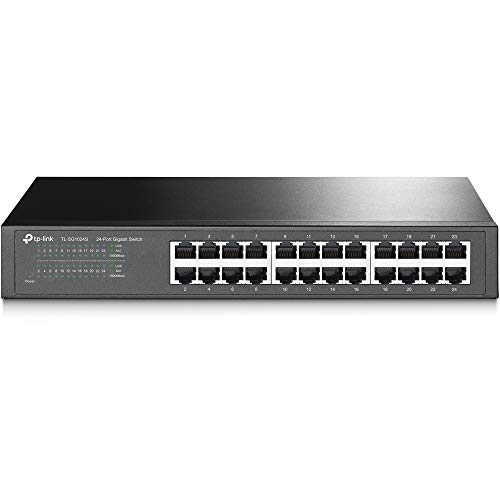
TP-Link 24-Port Fanless Gigabit Switch
Best for: silent plug-and-play 24-port desktop or rack expansion
- Number of Ports
- 24 Ports (what this guide is about)
- Port Count
- 24
- Port Speed
- 10/100/1000 Mbps
- Management Type
- Unmanaged
- Mounting Type
- Desktop, Rackmount
- PoE Support
- PoE
This TP-Link unmanaged switch provides 24 gigabit Ethernet ports with auto-negotiation and auto MDI/MDIX in a metal chassis. Its fanless design delivers silent cooling, while the 1U dimensions fit desktop placement or a standard equipment rack. The hardware operates without configuration or management software. You get full gigabit speeds across all connections, making it a reliable fit if you need silent network expansion for office desks or quiet server racks.
Pros
- Fanless design ensures silent operation
- 24 gigabit RJ45 ports with auto MDI/MDIX
- Sturdy metal housing fits desktop or 1U rackmount
- Plug-and-play setup requires no software configuration
Cons
- Unmanaged design provides no VLAN or traffic management controls
- Lacks 2.5G, 5G, or 10G uplink ports
Good fit if
- You need 24 plug-and-play gigabit connections without setup complexity.
- You require a silent, fanless switch for a desktop or quiet rack.
Skip if
- You need managed switch features like VLAN segmentation or traffic monitoring.
- You require multi-gigabit or 10G uplink speeds for higher throughput.
Verdict: TP-Link 24-Port Gigabit Fanless Switch provides straightforward plug-and-play gigabit connectivity inside a durable, silent metal enclosure. It is a solid choice for expanding wired capacity where managed features are unnecessary.

Real HD 24-Port Fast Ethernet PoE+ Switch
Best for: long-range PoE surveillance and camera networks
- Number of Ports
- 24 Ports (what this guide is about)
- Port Count
- 24
- Port Speed
- 10/100Mbps
- Management Type
- Unmanaged
- PoE Support
- PoE+ (IEEE 802.3af/at)
- PoE Power Budget
- 280W
The Real HD 24-Port PoE Switch is an unmanaged rackmount network switch designed for powering IP cameras and access points. It supplies 24 Fast Ethernet PoE+ ports with a 280W total power budget and up to 30W per port, alongside two Gigabit Ethernet uplink ports. You also get an extend mode that reaches up to 250 meters at 10Mbps. It suits you if you need bulk PoE power for lower-bandwidth hardware.
Pros
- 280W total PoE power budget with up to 30W per port
- Two dedicated Gigabit Ethernet uplink ports
- Port extend mode reaches up to 250 meters on ports 9 through 24
- Automatic PD detection protects non-PoE equipment from electrical damage
Cons
- Downlink ports run at 10/100Mbps Fast Ethernet rather than Gigabit
- Does not support 24V passive PoE hardware
- Transmission speeds reduce to 10Mbps when extend mode operates
Good fit if
- You need to power multiple 802.3af/at PoE devices from a single switch.
- You run surveillance cameras or hardware that operates well on Fast Ethernet speeds.
- You require long-distance cable runs up to 250 meters for remote hardware.
Skip if
- You need Gigabit data transfer speeds across all local connected devices.
- You deploy passive 24V PoE access points or equipment.
- You require smart managed switch features or software configuration.
Verdict: Real HD 24-Port Fast Ethernet PoE+ Switch delivers substantial PoE power and long-distance transmission for equipment that does not need Gigabit downlink rates. Dual Gigabit uplink ports keep your backbone connection fast while the switch remains simple and unmanaged.

Real HD 24-Port Gigabit PoE+ Switch
Best for: High-wattage unmanaged PoE installations
- Number of Ports
- 24 Ports (what this guide is about)
- Port Count
- 24
- Port Speed
- Gigabit
- Management Type
- Unmanaged
- PoE Support
- PoE+ (IEEE 802.3af/at)
- PoE Power Budget
- 400W
The Real HD 24-Port Gigabit PoE+ Switch provides twenty-four 802.3af/at Gigabit PoE ports backed by a 400W total power budget. You also get two dedicated Gigabit RJ45 ports and two 1G SFP slots for network uplinks. Setup requires zero configuration due to its unmanaged hardware design. It fits your setup if you need reliable PoE delivery across many devices without managing IP configurations or web interfaces.
Pros
- 400W total PoE power budget with up to 30W per port
- Two dedicated Gigabit RJ45 and two 1G SFP uplink ports
- Supports PoE extension up to 600 feet
- Durable metal housing compatible with desktop, wall, or rack mounting
Cons
- Unmanaged design lacks an IP address, web interface, or software controls
- Does not support passive 24V PoE hardware
- PoE extension mode reduces data transmission speeds to 10Mbps
Good fit if
- You need up to 400W of total PoE+ power across 24 Gigabit ports.
- You want dedicated RJ45 and SFP uplinks without sacrificing PoE ports.
- You prefer simple plug-and-play operation without network configuration.
Skip if
- You need managed switch features, VLAN support, or a web console.
- You deploy hardware requiring passive 24V PoE power.
Verdict: Real HD 24-Port Gigabit PoE+ Switch delivers a substantial 400W power budget alongside dedicated RJ45 and SFP uplink options. It provides dependable high-capacity PoE delivery if you do not need software management.

NETGEAR 24-Port Gigabit Unmanaged Switch with PoE+
Best for: silent desktop or rack-mounted PoE+ deployments
- Number of Ports
- 24 Ports (what this guide is about)
- Port Count
- 24
- Port Speed
- 1.0 Gbps
- Management Type
- Unmanaged
- PoE Support
- PoE+
- PoE Power Budget
- 190W
View on Amazon: NETGEAR 24-Port Gigabit Unmanaged Switch with PoE+
This NETGEAR 24-port unmanaged switch expands your wired network with gigabit connectivity across all 24 ports. It supplies 16 PoE+ ports backed by a 190W total power budget, powering devices without extra adapters. A fanless metal chassis ensures silent operation on a desktop or in a rack. It suits you if you need plug-and-play installation without managing software or configuration.
Pros
- 16 PoE+ ports with dynamic power allocation and a 190W budget
- Fanless metal chassis for silent operation
- Plug-and-play unmanaged setup with no software installation
- Flexible desktop and rack-mount installation options
Cons
- PoE+ power is limited to 16 of the 24 ports
- Unmanaged design offers no network configuration controls
Good fit if
- You need up to 16 PoE+ ports with a shared 190W power budget.
- You require completely silent operation in a desktop or rack environment.
- You want an unmanaged gigabit switch with simple plug-and-play setup.
Skip if
- You need PoE power across all 24 gigabit ports.
- You require managed switch capabilities and software configuration.
Verdict: NETGEAR 24-Port Gigabit Fanless PoE+ Switch pairs 16 PoE+ ports and a 190W budget with silent unmanaged operation. It is an effective option for powering multiple network devices without configuration hassles.

YuanLey 26-Port 400W PoE+ Switch
Best for: high-power IP camera and surveillance deployments
- Number of Ports
- 24 Ports (what this guide is about)
- Port Count
- 26
- Port Speed
- 10/100 Mbps
- Management Type
- Unmanaged
- PoE Support
- PoE+ (802.3af/at)
- PoE Power Budget
- 400W
The YuanLey 24-Port 400W PoE+ Switch gives you 24 Fast Ethernet PoE+ ports alongside two dedicated Gigabit uplinks. It provides a total power budget of 400W under 802.3af and 802.3at standards, delivering up to 30W per port. An extend mode offers 250-meter runs at 10Mbps with VLAN isolation. This unmanaged metal rackmount unit fits your setup if you deploy high-draw IP cameras, VoIP phones, and access points without complex configuration.
Pros
- 400W total PoE budget with up to 30W output per port
- Two dedicated 1000Mbps Gigabit uplink ports
- Extend mode supports 250-meter transmission at 10Mbps
- Hardware VLAN isolation toggle on ports 1 through 24
Cons
- Downlink PoE ports run at 10/100Mbps rather than Gigabit speeds
- Incompatible with passive PoE equipment
- Industrial cooling fan generates audible noise unlike fanless designs
Good fit if
- You need up to 400W of total PoE+ power for security cameras or phones.
- You run cabling up to 250 meters and need built-in port isolation.
- You prefer plug-and-play unmanaged hardware with Gigabit backhaul links.
Skip if
- You require Gigabit transfer rates across all 24 connected devices.
- You operate proprietary hardware that relies on passive PoE.
- You need silent fanless operation in an open work area.
Verdict: YuanLey 24-Port 400W PoE+ Switch delivers high power delivery and 250-meter range options for unmanaged security deployments. Its 10/100Mbps downlink ports cap local transfer speeds, but dual Gigabit uplinks prevent core network bottlenecks.

NETGEAR 24-Port PoE+ and PoE++ Unmanaged Switch
Best for: high-power silent PoE++ deployments
- Number of Ports
- 24 Ports (what this guide is about)
- Port Count
- 24
- Port Speed
- 1.0Gbps
- Management Type
- Unmanaged
- PoE Support
- PoE+, Ultra60 PoE++
- PoE Power Budget
- 480W
View on Amazon: NETGEAR 24-Port PoE+ and PoE++ Unmanaged Switch
This NETGEAR unit is an unmanaged 24-port Gigabit switch designed for high-power network devices. It delivers a 480W total power budget across 16 Ultra60 PoE++ ports and eight PoE+ ports. The fanless metal chassis operates silently and fits on a desktop or in a rack. If you need extensive PoE++ power for multiple access points or cameras without managing software settings, this switch fits your setup.
Pros
- 480W total power budget across 24 PoE ports
- 16 Ultra60 PoE++ ports and 8 PoE+ ports
- Fanless design for silent operation
- Desktop and rack-mount installation options
Cons
- Unmanaged with no VLAN, QoS, or traffic monitoring controls
- Gigabit maximum port speed without 2.5G or 10G uplinks
Good fit if
- You need high-wattage PoE++ power delivery up to 480W total.
- You want silent, fanless operation in a desktop or rack environment.
- You prefer plug-and-play installation without configuring management software.
Skip if
- You require managed switch features like VLANs or port configuration.
- You need multi-gigabit speeds or dedicated SFP uplink ports.
Verdict: NETGEAR 24-Port PoE+ and PoE++ Unmanaged Switch delivers high-capacity 480W power across 24 Gigabit ports in a completely silent, unmanaged format. It is a solid choice when you want plug-and-play hardware capable of powering heavy PoE++ loads.

TP-Link 24-Port Smart Managed PoE+ Switch
Best for: multi-device PoE deployments needing VLAN segmentation
- Number of Ports
- 24 Ports (what this guide is about)
- Port Count
- 28
- Port Speed
- 10/100/1000 Mbps
- Management Type
- Easy Smart
- PoE Support
- PoE+ (802.3at/af)
- PoE Power Budget
- 250W
This switch gives you 24 Gigabit PoE+ ports backed by a 250W power budget, alongside two standard Gigabit ports and two SFP slots for fiber uplinks. It provides web-based smart management tools, including VLAN traffic segmentation and automated PoE recovery for unresponsive gear. This unit suits you if you need to power multiple network devices, like access points or IP cameras, while retaining basic network control without full enterprise complexity.
Pros
- 24 PoE+ ports with a 250W total power budget (up to 30W per port)
- 2 dedicated Gigabit non-PoE ports plus 2 SFP uplink slots
- PoE Auto Recovery automatically detects and reboots unresponsive powered devices
- Web-based Easy Smart management interface supports VLAN network segmentation
Cons
- Total 250W budget averages roughly 10.4W per port if all 24 PoE ports draw power simultaneously
- SFP uplink slots operate at 1 Gbps rather than 10 Gbps speeds
- Advanced features like VLANs and PoE recovery require manual configuration rather than plug-and-play operation
Good fit if
- You need to power up to 24 PoE devices such as IP cameras, VoIP phones, or wireless access points.
- You want dedicated Gigabit SFP slots for fiber runs without sacrificing your standard copper ports.
- You require basic traffic isolation and network segmentation using VLAN features.
Skip if
- You require 10G uplink speeds rather than standard 1 Gbps SFP connectivity.
- You need an unmanaged switch with zero management software or configuration options.
- Your combined device power requirements exceed the 250W total PoE power ceiling.
Verdict: TP-Link 24-Port Smart Managed PoE+ Switch delivers high-density power delivery with 24 PoE+ ports and four dedicated uplink options. It provides essential VLAN control and automated device recovery for expanding wired networks.

NETGEAR 24-Port Unmanaged Gigabit Switch
Best for: silent plug-and-play Gigabit wired network expansion
- Number of Ports
- 24 Ports (what this guide is about)
- Port Count
- 24
- Port Speed
- 1.0Gbps
- Management Type
- Unmanaged
- Mounting Type
- Desktop, wall-mount, or rack-mount
- Dimensions
- 13.5 × 11.1 × 3.12 inches
The NETGEAR 24-Port Unmanaged Gigabit Switch gives you 24 auto-negotiating Gigabit Ethernet ports in a silent, fanless metal housing. It requires zero configuration, operating as a basic plug-and-play device right out of the box. You can install it on a desktop, mount it to a wall, or secure it in a rack. It suits your network if you need simple wired expansion without configuration.
Pros
- 24 auto-negotiating Gigabit Ethernet ports
- Fanless design for silent operation
- Flexible desktop, wall-mount, or rack-mount placement
- IEEE 802.3az Energy Efficient Ethernet support
Cons
- No Power over Ethernet support
- Unmanaged operation with no VLAN or traffic control options
- Restricted to US and Canada regional compatibility
Good fit if
- You need 24 Gigabit Ethernet connections with plug-and-play simplicity.
- You require silent, fanless operation for an office or workspace.
- You want versatile mounting options across a desk, wall, or equipment rack.
Skip if
- You need Power over Ethernet to power IP cameras or access points.
- You require managed switch features such as VLANs or bandwidth configuration.
Verdict: NETGEAR 24-Port Unmanaged Gigabit Switch delivers silent, plug-and-play Ethernet expansion across 24 ports in a durable metal chassis. It is a straightforward choice when you need wired connections without network configuration or noise.

TP-Link Omada 24-Port Gigabit Switch with 10G SFP+
Best for: managed networks needing 10G uplinks
- Number of Ports
- 24 Ports (what this guide is about)
- Port Count
- 24
- Port Speed
- 10/100/1000 Mbps
- Management Type
- Smart Managed
- Uplink Ports
- 4 x 10G SFP+
- Dimensions
- 17.3 × 7.09 × 1.73 inches
View on Amazon: TP-Link Omada 24-Port Gigabit Switch with 10G SFP+
The TP-Link 24-Port Smart Switch with 10G Uplinks combines 24 gigabit Ethernet ports with 4 dedicated 10 Gbps SFP+ slots. You get Layer 2+ smart management features including static routing, 802.1Q VLAN tagging, and centralized control via Omada SDN hardware, software, or cloud controllers. It suits your setup if you manage a high-traffic local network that demands high-bandwidth uplinks to servers or storage without needing integrated Power over Ethernet.
Pros
- 4 dedicated 10 Gbps SFP+ uplink slots
- Layer 2+ static routing and 802.1Q VLAN support
- Centralized management via Omada SDN or standalone mode
- 5-year manufacturer warranty
Cons
- No Power over Ethernet (PoE) output
- Cloud-based controller requires additional fees
Good fit if
- You need 10 Gbps SFP+ uplinks for network aggregation or NAS connections.
- You use the TP-Link Omada ecosystem for centralized multi-device control.
- You require Layer 2+ network features such as static routing and access control lists.
Skip if
- You need Power over Ethernet to power IP cameras or access points.
- You prefer an unmanaged plug-and-play switch with zero setup.
Verdict: TP-Link 24-Port Smart Switch with 10G Uplinks delivers robust L2+ management and high-bandwidth 10G SFP+ connectivity for demanding wired setups. It gives you advanced traffic control within the Omada platform when Power over Ethernet is not needed.
Specifications side by side
| Spec | D-Link 24-Port Gigabit Unmanaged Switch | Tenda 24-Port Gigabit Unmanaged Switch | TP-Link 24-Port Gigabit Unmanaged Switch | TRENDnet 24-Port Unmanaged Gigabit Switch | Zyxel 24-Port Gigabit Switch with SFP | TP-Link 24-Port Gigabit Smart Managed Switch | TP-Link 24-Port Fanless Gigabit Switch | Real HD 24-Port Fast Ethernet PoE+ Switch | Real HD 24-Port Gigabit PoE+ Switch | NETGEAR 24-Port Gigabit Unmanaged Switch with PoE+ | YuanLey 26-Port 400W PoE+ Switch | NETGEAR 24-Port PoE+ and PoE++ Unmanaged Switch | TP-Link 24-Port Smart Managed PoE+ Switch | NETGEAR 24-Port Unmanaged Gigabit Switch | TP-Link Omada 24-Port Gigabit Switch with 10G SFP+ |
|---|---|---|---|---|---|---|---|---|---|---|---|---|---|---|---|
| Port Count | 24 | 24 | 24 | 24 | 24 | 24 | 24 | 24 | 24 | 24 | 26 | 24 | 28 | 24 | 24 |
| Port Speed | 10/100/1000BASE-T | 10/100/1000Mbps | 10/100/1000M | Gigabit | Gigabit | Gigabit | 10/100/1000 Mbps | 10/100Mbps | Gigabit | 1.0 Gbps | 10/100 Mbps | 1.0Gbps | 10/100/1000 Mbps | 1.0Gbps | 10/100/1000 Mbps |
| Management Type | Unmanaged | Unmanaged | Unmanaged | Unmanaged | Unmanaged | Easy Smart Managed | Unmanaged | Unmanaged | Unmanaged | Unmanaged | Unmanaged | Unmanaged | Easy Smart | Unmanaged | Smart Managed |
| PoE Support | not specified | not specified | not specified | not specified | not specified | not specified | not specified | PoE+ (IEEE 802.3af/at) | PoE+ (IEEE 802.3af/at) | PoE+ | PoE+ (802.3af/at) | PoE+, Ultra60 PoE++ | PoE+ (802.3at/af) | not specified | not specified |
| PoE Power Budget | not specified | not specified | not specified | not specified | not specified | not specified | not specified | 280W | 400W | 190W | 400W | 480W | 250W | not specified | not specified |
| Uplink Ports | not specified | not specified | not specified | not specified | 2 x SFP | not specified | not specified | 2 x Gigabit | 2 x 1G RJ45, 2 x 1G SFP | not specified | 2 x Gigabit | not specified | 2 SFP Slot | not specified | 4 x 10G SFP+ |
| Switching Capacity | 48 Gbps | not specified | not specified | 48Gbps | not specified | not specified | not specified | not specified | not specified | not specified | 16 Gbps | not specified | not specified | not specified | not specified |
| Mounting Type | Desktop, Rackmount, Wall-Mount | Desktop, Rack Mount | Rack-mountable | Desktop, Rack Mount | not specified | not specified | Desktop, Rackmount | Rack Mount | Rack Mount, Desktop, Wall-Mount | Desktop, Rack-mount | Rackmount | Desktop or rack-mount | not specified | Desktop, wall-mount, or rack-mount | not specified |
| Number of Ports | 24 Ports | 24 Ports | 24 Ports | 24 Ports | 24 Ports | 24 Ports | 24 Ports | 24 Ports | 24 Ports | 24 Ports | 24 Ports | 24 Ports | 24 Ports | 24 Ports | 24 Ports |
| Uplink Port Type | not specified | not specified | not specified | not specified | SFP | not specified | not specified | Gigabit Uplink | SFP | not specified | Gigabit Uplink | not specified | not specified | not specified | SFP |
| Dimensions | 11.1 × 7.1 × 1.75 inches | 11.6 × 7.01 × 1.73 inches | 17.3 × 7.09 × 1.73 inches | 3.46 × 4.72 × 0.98 inches | 5.16 × 17.4 × 1.73 inches | 11.6 × 7.1 × 1.7 inches | 11.6 × 7.09 × 1.73 inches | not specified | 17.3 × 8.1 × 1.7 inches | 13 × 8.1 × 1.7 inches | 10.6 × 7.1 × 1.7 inches | 9 × 15 × 2 inches | 17.3 × 8.66 × 1.73 inches | 13.5 × 11.1 × 3.12 inches | 17.3 × 7.09 × 1.73 inches |
| Weight | 2.4 pounds | 1.98 pounds | 4.41 pounds | 1.1 pounds | 4.41 pounds | 3.75 pounds | 3.44 pounds | 5.27 pounds | 9.4 pounds | 5.38 pounds | 4.5 pounds | 8.6 pounds | 6.83 pounds | 2.87 pounds | 4.3 pounds |
| Size | 24-Port Gigabit | 24-Port | 24 Port | 24-Port | 24-Port | 2x SFP | 24 Port | Enhanced Features | 24 Port, 1 Gigabit | not specified | not specified | 24 Port, PoE+ @ 190W | 26 Port | 24*PoE+ (400w) | 24 Port, PoE+/PoE++ @ 480W | 28 Port w/ 24 PoE+ Port | 24 Port | 24 Port + 4 10GE SFP+ |
| Color | Black | Blue | BLACK | Black | Black | Black | Black | black | Black | silver | Blue | black | black or gray | Black | black |
| Model | DGS-1024D | TEG1024D | TL-SG1024 | TEG-S24DG | GS1100-24 | TL-SG1024DE | TL-SG1024S | 24 port poe switch | 24 port poe gigabit switch | GS324P-100NAS | 26 Port | 24*PoE+ (400w) | GS524UP-100NAS | TL-SG1428PE | GS324-200NAS | TL-SG3428X |
If you need home automation hardware instead of Ethernet distribution, you can compare specifications for the best smart switches with tuya.
How to Choose a 24-Port Network Switch
-
Choose Unmanaged or Smart Managed
You need to determine whether your network requires configuration tools or simple plug-and-play connectivity. Unmanaged switches distribute data immediately upon connection without software menus or configuration tasks. If you need local traffic segmentation, network diagnostics, or VLAN assignments, select a smart managed switch instead. The TP-Link 24-Port Gigabit Smart Managed Switch delivers targeted control options over wired ports while keeping setup direct. If you only connect everyday computers, storage drives, and printers that share a single open network, an unmanaged model saves you administrative effort.
-
Check Uplink Port Types
Review the uplink specifications if you plan to connect your 24-port switch to a core router, server, or another switch. Standard models rely solely on basic Gigabit copper ports for all connections. Switches with dedicated SFP or SFP+ ports accept fiber transceivers, allowing high-speed data transmission over longer physical distances without copper signal degradation. For high-bandwidth environments, the TP-Link Omada 24-Port Gigabit Switch with 10G SFP+ provides four 10GE fiber uplinks to prevent data bottlenecks across your broader backbone network. Verify your cabling type before selecting optical ports.
-
Verify Downlink Ethernet Speeds
Check whether every port supports full Gigabit throughput or slower Fast Ethernet rates. Most modern networks require 1000Mbps Gigabit speeds across all 24 ports for smooth file transfers, streaming, and backups. However, some surveillance-focused switches supply Fast Ethernet downlinks capped at 10/100Mbps alongside Gigabit uplinks. The Real HD 24-Port Fast Ethernet PoE+ Switch suits IP camera arrays where individual video streams consume modest bandwidth. If you connect desktop computers, network attached storage devices, or modern access points, ensure you pick a model with Gigabit capability across all 24 ports.
-
Match Mounting Form Factor
Compare physical dimensions and mounting specifications against your intended installation space. Switches designed for rack mounting typically measure over 17 inches in length to fit standard 19-inch equipment racks. For example, the TP-Link 24-Port Gigabit Unmanaged Switch spans 17.32 inches and suits dedicated server enclosures. If you place the switch on an office desk or open shelf, check the listed dimensions for a shorter footprint. Selecting a compact desktop form factor prevents wasted surface area and ensures your cabling routes neatly without hanging over edges.
-
Select Fanless Enclosures for Silence
Consider acoustic output if you install network gear in noise-sensitive work areas or living rooms. Many 24-port switches feature fanless cooling architectures that dissipate heat through metal enclosures without internal fans. For example, the TRENDnet 24-Port Unmanaged Gigabit Switch operates silently while delivering high wire-speed performance. If your switch sits inside an open office, bedroom, or media center, choosing a fanless model eliminates persistent background hum. Conversely, switches that deploy active cooling fans generate audible noise better suited for enclosed utility rooms or wiring closets.
Frequently asked questions
What does an SFP uplink port do on a 24-port switch?
An SFP uplink port connects your switch to fiber-optic cables or high-speed uplinks over longer distances than standard copper Ethernet allows. Switches like the Zyxel GS1100-24 provide two dedicated SFP slots, while the TP-Link TL-SG3428X features four 10G SFP+ ports. These dedicated slots allow you to connect backbone switches, servers, or distant network closets without consuming any of your primary 24 RJ45 Ethernet ports.
Can you mount every 24-port switch in a standard server rack?
No, mounting compatibility depends on chassis dimensions and included hardware. Standard rackmount units, such as the Real HD 24-Port Gigabit switch and TP-Link TL-SG1024, feature standard 1.7-inch heights and 17.3-inch lengths designed for 19-inch racks. In contrast, compact desktop units like the TRENDnet TEG-S24DG measure under five inches wide and are intended solely for shelf or desktop placement. Check the mounting specs before choosing a location.
Why do some 24-port PoE switches use Fast Ethernet ports instead of Gigabit?
Fast Ethernet ports deliver sufficient data rates for bandwidth-light hardware like IP surveillance cameras while prioritizing power distribution. Switches like the Real HD 24-Port PoE+ Switch and YuanLey 26-Port model provide 10/100 Mbps downlink ports for connected devices. To keep network traffic moving smoothly to your router or storage server, these switches include Gigabit uplink ports that aggregate all incoming streams without causing bandwidth bottlenecks.
What makes a fanless 24-port switch useful for office or home setups?
A fanless switch operates completely silently, making it suitable for noise-sensitive locations like home offices, conference rooms, or open desks. Passive cooling eliminates internal fan noise while maintaining safe operating temperatures. Models like the D-Link DGS-1024D, TRENDnet TEG-S24DG, and Zyxel GS1100-24 feature silent enclosures. Even high-power models like the NETGEAR GS324P deliver PoE+ power without mechanical cooling fans, preventing unwanted workplace noise.
What is the difference between PoE+ and PoE++ on a 24-port switch?
The primary difference is the maximum electrical wattage delivered to connected devices. Standard PoE+ delivers up to 30 watts per port, which powers typical VoIP phones, access points, and basic security cameras. Higher-tier PoE++ supplies significantly more power for power-hungry hardware like PTZ cameras or LED controllers. The NETGEAR GS524UP provides both PoE+ and PoE++ capabilities backed by a 480W total power budget.
When should you choose a smart managed 24-port switch over an unmanaged model?
Choose a smart managed switch when your network requires traffic separation, port control, or diagnostic tools. Smart models like the TP-Link TL-SG1024DE and TL-SG1428PE let you configure VLANs, monitor link health, and prioritize critical device traffic. If you simply need plug-and-play wired connectivity for standard computers, gaming consoles, or printers without configuring software settings, an unmanaged switch like the Tenda TEG1024D is sufficient.