ASUS Wifi Routers: 15 Picks Ranked by Specs
As an Amazon Associate we earn from qualifying purchases. Links on this page are affiliate links.
Finding the best ASUS wifi routers means matching your network to your physical space and bandwidth needs. The brand offers dual-band, tri-band, and quad-band units, including compact wired options, weather-resistant outdoor hardware, and large multi-gigabit consoles in black and white designs.
The ASUS Dual-Band WiFi 7 Dual-WAN Router earns the top spot because it delivers 3.6 Gbps speeds with dual-WAN redundancy and 2.5G ports for entry-level Wi-Fi 7 networks. To help you choose, we compared 15 models using only the technical specifications published on their product listings.
Quick picks
Our 15 picks

ASUS Dual-Band WiFi 7 Dual-WAN Router
Best for: entry-level Wi-Fi 7 networking with dual WAN
- Wi-Fi Standard
- Wi-Fi 7
- Frequency Bands
- Dual-Band
- Features
- VPN, Dual WAN
- Port Speed
- 2.5G
- Dimensions
- 7.6 × 2.3 × 9.37 inches
- Weight
- 1.01 pounds
This ASUS dual-band router delivers Wi-Fi 7 connectivity with speeds up to 3600 Mbps. It features a 2.5G port for faster wired networking alongside Multi-Link Operation to link multiple bands simultaneously. You get dual-WAN support with mobile USB tethering and AiProtection Pro security. This unit suits you if you need entry-level Wi-Fi 7 speeds, mesh expandability, and multi-network management for smart home gear without requiring a tri-band setup.
Pros
- Wi-Fi 7 speeds up to 3600 Mbps with 4096-QAM
- 2.5G port for high-speed wired connections
- Multi-Link Operation links multiple bands simultaneously
- Dual-WAN support with USB 4G and 5G tethering
- AiProtection Pro security with up to three SSIDs
Cons
- Dual-band design lacks a dedicated third wireless band
- Maximum wireless throughput capped at 3.6 Gbps
Good fit if
- You want Wi-Fi 7 features like Multi-Link Operation on a dual-band network.
- You need mobile backup internet via 4G or 5G USB tethering.
- You want 2.5G wired capability combined with built-in AiProtection Pro security.
Skip if
- You require tri-band or quad-band wireless coverage for high-density traffic.
- You need network bandwidth speeds higher than 3.6 Gbps.
Verdict: ASUS Dual-Band WiFi 7 Router delivers 3.6 Gbps speeds, 2.5G wired networking, and mobile backup tethering in an extendable dual-band package. It offers essential Wi-Fi 7 features like Multi-Link Operation without the complexity of extra wireless bands.

ASUS Dual-Band WiFi 6 Router
Best for: everyday home streaming and wired gigabit devices
- Wi-Fi Standard
- Wi-Fi 6
- Speed Rating
- AX1800
- Frequency Bands
- Dual-Band
- Max Port Speed
- 1 Gbps
- Ethernet Ports
- 5
- Use Case
- Gaming, Streaming
This is a dual-band Wi-Fi 6 router designed for everyday home networking. It delivers AX1800 class speeds using OFDMA and MU-MIMO technologies to manage traffic across connected devices. You get four external antennas, five gigabit Ethernet ports for wired gear, and built-in AiProtection Classic security with parental controls. It suits you if you need reliable baseline wireless performance and essential wired ports for streaming or gaming without extra complexity.
Pros
- Five gigabit Ethernet ports with one WAN and four LAN
- Dual-band Wi-Fi 6 with OFDMA and MU-MIMO support
- Integrated AiProtection Classic and Instant Guard VPN
- Four external antennas
Cons
- Maximum throughput capped at AX1800 spec
- Ethernet ports limited to 1 Gbps with no multi-gigabit option
- Dual-band design lacking 6 GHz connectivity
Good fit if
- You use a gigabit or sub-gigabit internet connection.
- You need four dedicated gigabit LAN ports for wired devices.
- You want built-in network security and parental controls.
Skip if
- You need multi-gigabit WAN or LAN speeds above 1 Gbps.
- You want tri-band coverage or 6 GHz frequency access.
- You require the higher throughput of Wi-Fi 7.
Verdict: ASUS Dual-Band WiFi 6 Gigabit Router delivers fundamental Wi-Fi 6 capability with solid wired connectivity and integrated security. It provides the core specifications required for standard home streaming and gaming setups.

ASUS Tri-Band WiFi 7 Router with Dual 10G
Best for: multi-gigabit wired connections and WiFi 7 devices
- Wi-Fi Standard
- WiFi 7
- Speed Rating
- BE19000
- Frequency Bands
- Tri-Band
- Max Port Speed
- 10 Gbps
- Dimensions
- 13.8 × 13.8 × 8 inches
- Weight
- 4.12 pounds
This router provides tri-band WiFi 7 connectivity with a BE19000 speed rating across its wireless bands. You get two 10 Gbps WAN and LAN Ethernet ports for high-bandwidth wired networking. The unit supports 320MHz channels on the 6GHz band, 4096-QAM modulation, and Multi-link Operation. Built-in AiMesh support lets you pair it with other compatible nodes. It suits you if you need multi-gigabit wired throughput and modern wireless capacity.
Pros
- Dual 10 Gbps WAN/LAN Ethernet ports
- WiFi 7 tri-band coverage with 320MHz channel bandwidth
- Multi-link Operation across multiple frequency bands
- Subscription-free AiProtection Pro network security
Cons
- Large footprint measuring 13.8 by 13.8 inches
- Relatively heavy chassis at 4.12 pounds
- Tri-band design lacks the second 5GHz or 6GHz band found on quad-band units
Good fit if
- You need two 10 Gbps wired ports for local storage or fast internet tiers.
- You want 6GHz WiFi 7 access with 320MHz channel support.
- You plan to integrate the router into an ASUS AiMesh network.
Skip if
- You have limited shelf space for a 13.8-inch square device.
- You require a quad-band router for dedicated wireless mesh backhaul.
Verdict: ASUS Tri-Band WiFi 7 Dual 10G Router delivers BE19000 wireless speeds alongside two 10 Gbps ports for demanding wired setups. It gives you next-generation bandwidth and AiMesh compatibility without requiring an ongoing security subscription.

ASUS ROG Quad-Band WiFi 7 Gaming Router
Best for: extreme multi-gigabit gaming and heavy quad-band traffic
- Wi-Fi Standard
- WiFi 7
- Frequency Bands
- Quad-Band
- Max Port Speed
- 10G
- Use Case
- Gaming
- Dimensions
- 13.7 × 8.6 × 13.7 inches
- Weight
- 4.4 pounds
This is a quad-band WiFi 7 gaming router engineered for extreme network demands. You get theoretical throughput up to 30 Gbps across four frequency bands, support for 320MHz channels in the 6 GHz spectrum, and multi-link operation. Wired connectivity includes two 10G ports and four 2.5G ports for multi-gigabit setups. It suits you if you need maximum local bandwidth, extensive multi-gigabit Ethernet options, and dedicated game acceleration across high-throughput devices.
Pros
- Quad-band WiFi 7 design delivering speeds up to 30 Gbps
- Dual 10G ports alongside four 2.5G Ethernet ports
- Supports 320MHz channels in the 6 GHz band and Multi-Link Operation
- External dual-feeding antennas for enhanced signal strength
Cons
- Large footprint measuring 13.7 inches by 13.7 inches
- Heavy unit weighing 4.4 pounds
Good fit if
- You need dual 10G and quad 2.5G Ethernet ports for multi-gigabit wired gear.
- You want quad-band WiFi 7 coverage capable of reaching 30 Gbps across bands.
- You run gaming hardware that benefits from dedicated multi-level traffic acceleration.
Skip if
- You have limited shelf space for a router measuring over 13 inches wide.
- You do not own WiFi 7 or 10G hardware to utilize the available bandwidth.
Verdict: ASUS ROG Rapture Quad-Band WiFi 7 Router provides uncompromising wireless and wired throughput via quad-band WiFi 7, dual 10G ports, and quad 2.5G ports. It stands as a top-tier choice when you require massive multi-gigabit capacity for gaming and heavy data transfers.

ASUS ZenWiFi Tri-Band WiFi 7 Mesh Router
Best for: standalone 3,000 square foot WiFi 7 networks
- Wi-Fi Standard
- Wi-Fi 7
- Frequency Bands
- Tri-Band
- Coverage Area
- 3,000 sq ft
- Max Port Speed
- 10 Gbps
- Pack Size
- 1-Pack
- Dimensions
- 2.83 × 7.32 × 6.26 inches
The ASUS ZenWiFi Tri-Band WiFi 7 Mesh Router delivers coverage across areas up to 3,000 square feet. It operates on three frequency bands with 6GHz support, reaching wireless speeds up to 18 Gbps using 4K-QAM and MLO technology. Featuring 10 Gbps wired ports and eight internal antennas, this router suits you if you want high-throughput WiFi 7 networking in a single unit without needing multiple nodes.
Pros
- Tri-band WiFi 7 throughput up to 18 Gbps with 6GHz band support
- High-speed wired networking with 10 Gbps ports
- Eight internal antennas and ten high-power front-end modules
- Single-pack wireless coverage reaching up to 3,000 square feet
Cons
- Pack includes only one unit rather than multiple mesh nodes
- Tri-band design provides fewer bands than quad-band alternatives
Good fit if
- You want up to 3,000 square feet of coverage from a single router.
- You need 10 Gbps wired connections alongside WiFi 7.
- You plan to utilize 6GHz, MLO, and 4K-QAM features.
Skip if
- You need multiple mesh hardware units included in the package.
- You prefer a quad-band router layout.
Verdict: ASUS ZenWiFi Tri-Band WiFi 7 Mesh Router combines 10 Gbps wired connectivity with 18 Gbps wireless speeds for up to 3,000 square feet. It provides advanced WiFi 7 performance in a standalone unit.

ASUS Dual-Band WiFi 6 Gaming Router
Best for: dual-band gaming setups using MU-MIMO
- Wi-Fi Standard
- WiFi 6
- Speed Rating
- AX5400
- Frequency Bands
- Dual-Band
- Use Case
- Gaming
- Features
- MU-MIMO
- Dimensions
- 11 × 7.26 × 6.5 inches
This router is a dual-band Wi-Fi 6 device delivering AX5400 speeds with 160MHz channel support and MU-MIMO capability. It features ASUS AiMesh support for connecting with other compatible hardware, alongside a dedicated Mobile Game Mode and Aura RGB lighting. You receive built-in AiProtection Pro security with WPA3 and parental controls, making it a practical fit if you need reliable gaming throughput on a dual-band network.
Pros
- AX5400 speeds with 160MHz channel support
- MU-MIMO and ASUS AiMesh compatibility
- AiProtection Pro security with WPA3
- Mobile Game Mode for lower latency
Cons
- Dual-band configuration lacks a third wireless band
- Uses WiFi 6 rather than newer WiFi 7
Good fit if
- You want dual-band WiFi 6 connectivity with MU-MIMO support.
- You plan to expand coverage using an ASUS AiMesh setup.
- You want Mobile Game Mode and customizable Aura RGB lighting.
Skip if
- You need a tri-band or quad-band wireless configuration.
- You require the newer WiFi 7 standard.
Verdict: ASUS Dual-Band WiFi 6 Gaming Router delivers AX5400 speeds, MU-MIMO efficiency, and AiMesh compatibility for connected households. Its Mobile Game Mode and AiProtection Pro provide dedicated performance and security without requiring extra hardware.

ASUS ZenWiFi Quad-Band WiFi 7 Router
Best for: multi-gigabit internet and future mesh expansion
- Wi-Fi Standard
- WiFi 7
- Frequency Bands
- Quad-Band
- Coverage Area
- 4,000 sq ft
- Max Port Speed
- 10 Gbps
- Pack Size
- 1-Pack
- Features
- VPN, Parental Controls
This standalone WiFi 7 mesh unit delivers quad-band connectivity with transfer speeds reaching 30000 Mbps. It provides coverage for up to 4,000 square feet using twelve internal antennas and sixteen front-end modules. Dual 10 Gbps Ethernet ports handle multi-gigabit wired backhaul or high-speed internet connections. This setup suits you if you need ultra-high bandwidth and plan to expand coverage later across a larger home using compatible AiMesh nodes.
Pros
- Quad-band WiFi 7 with speeds up to 30000 Mbps
- Two 10 Gbps ports for multi-gigabit wired connectivity
- Twelve internal antennas cover up to 4,000 square feet
- USB port supports 4G LTE and 5G mobile tethering
Cons
- Single unit covers 4,000 square feet and requires extra nodes for larger homes
- Vertical chassis measures 8.6 inches tall and 2.9 pounds
Good fit if
- You have a multi-gigabit internet connection requiring 10 Gbps ports.
- You want quad-band WiFi 7 throughput reaching up to 30000 Mbps.
- You plan to build a mesh network over time using AiMesh.
Skip if
- You need immediate multi-node coverage out of the box for spaces over 4,000 square feet.
- You use basic internet service that does not benefit from 10G ports.
Verdict: ASUS ZenWiFi BQ16 Pro WiFi 7 Mesh Router combines quad-band speeds up to 30000 Mbps with dual 10 Gbps ports for multi-gigabit networks. It gives you 4,000 square feet of standalone coverage that easily expands using AiMesh.

ASUS ZenWiFi Outdoor Mesh Router
Best for: weatherproof 2,500 sq ft yard coverage
- Wi-Fi Standard
- Wi-Fi 7
- Frequency Bands
- Dual-Band
- Coverage Area
- 2,500 sq ft
- Max Port Speed
- 2.5 Gbps
- Intended Use
- Outdoors
- Dimensions
- 4.2 × 4.2 × 7.9 inches
The ASUS ZenWiFi Outdoor WiFi 7 Router extends your home network into open-air spaces. It delivers dual-band WiFi 7 speeds up to 5,000 Mbps across 2,500 square feet of coverage. An IP65 weatherproof enclosure protects internal hardware in temperatures from -30°C to 60°C. You get two 2.5 Gbps PoE-in Ethernet ports alongside standard AC power support. It fits your setup if you need durable outdoor AiMesh expansion with fast wired backhaul.
Pros
- Dual-band WiFi 7 with speeds up to 5,000 Mbps
- IP65 weather-resistant casing rated from -30°C to 60°C
- Two 2.5 Gbps PoE-in ports with AI WAN detection
- Flexible wall, pole, and flat-surface mounting options
Cons
- Dual-band design lacks a 6 GHz frequency band
- Single-unit pack requires existing hardware to build a mesh network
Good fit if
- You need up to 2,500 square feet of weatherproof outdoor coverage.
- You want to power your outdoor node using Power over Ethernet.
- You already use a compatible ASUS AiMesh router indoors.
Skip if
- You require tri-band or quad-band WiFi 7 capacity.
- You need an all-in-one multi-node mesh kit out of the box.
Verdict: ASUS ZenWiFi Outdoor WiFi 7 Router brings fast dual-band connectivity and rugged IP65 protection to outdoor spaces up to 2,500 square feet. It delivers versatile deployment through dual 2.5 Gbps PoE ports and flexible mounting options.

ASUS ROG Rapture Tri-Band WiFi 6 Router
Best for: tri-band WiFi 6 gaming networks
- Wi-Fi Standard
- WiFi 6
- Frequency Bands
- Tri-Band
- Max Port Speed
- 2.5G
- Use Case
- Gaming
- Dimensions
- 11.3 × 4.74 × 14.9 inches
- Weight
- 4.1 pounds
The ASUS ROG Rapture Tri-Band WiFi 6 Gaming Router gives you a dedicated tri-band setup powered by a 1.8GHz quad-core processor and eight external antennas. You get a dedicated 2.5G gaming port alongside standard gigabit connections, plus AiMesh compatibility to expand your network. This router suits you if you need traffic prioritization for gaming devices and strong local coverage across three separate bands without upgrading to newer wireless standards.
Pros
- Tri-band WiFi 6 connectivity
- Dedicated 2.5G gaming Ethernet port
- Eight external antennas
- 1.8GHz quad-core processor
- AiMesh support for whole-home coverage
Cons
- Uses WiFi 6 instead of WiFi 7
- Large footprint at 14.9 inches high and 4.1 pounds
- Wired port speed caps at 2.5G
Good fit if
- You want tri-band capability to distribute device traffic.
- You need a dedicated 2.5G wired port for gaming hardware.
- You plan to expand coverage using an ASUS AiMesh setup.
Skip if
- You require the newer WiFi 7 wireless standard.
- You need wired connectivity faster than 2.5G.
- You have tight shelf space unable to hold a 14.9-inch router.
Verdict: ASUS ROG Rapture Tri-Band WiFi 6 Gaming Router provides robust tri-band performance and multi-gigabit wired connectivity for demanding home networks. It serves as an effective, hardware-rich option if you do not require the latest WiFi 7 standard.
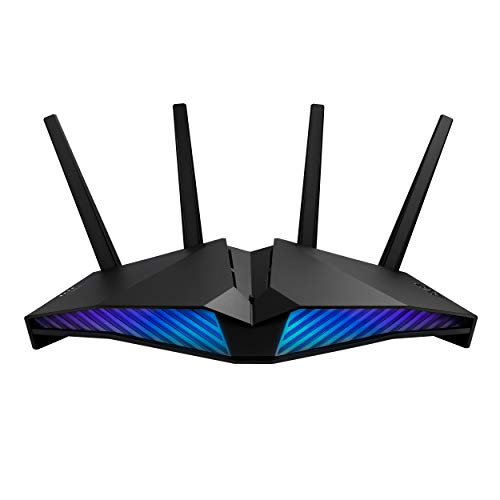
ASUS Dual-Band WiFi 6 Gaming Router
Best for: gamers seeking AiMesh extendability
- Wi-Fi Standard
- WiFi 6
- Speed Rating
- AX5400
- Frequency Bands
- Dual Band
- Use Case
- Gaming
- Features
- VPN
- Dimensions
- 11 × 7.26 × 6.5 inches
This ASUS dual-band WiFi 6 router delivers cumulative wireless throughput up to 5400 Mbps across 160MHz channels and runs on a 1.5 GHz tri-core processor. It features a dedicated gaming port, Mobile Game Mode in the router app, and AiMesh support for multi-node expansion. It suits you if you need low-latency gaming priority, integrated AiProtection Pro network security, and extendable mesh capability without upgrading to tri-band hardware.
Pros
- AX5400 speed rating with 160MHz channel bandwidth
- 1.5 GHz tri-core processor
- AiMesh support for whole-home network expansion
- AiProtection Pro security and Instant Guard VPN inclusion
Cons
- Dual-band design lacks a dedicated wireless mesh backhaul band
- WiFi 6 specification rather than newer WiFi 7 standard
Good fit if
- You prioritize gaming traffic using a dedicated gaming port or Mobile Game Mode.
- You plan to expand coverage over time using AiMesh-compatible hardware.
- You want commercial-grade AiProtection Pro security built into the router.
Skip if
- You need a tri-band configuration to reserve a separate band for mesh backhaul.
- You require the faster maximum throughput of the WiFi 7 standard.
Verdict: ASUS AX5400 Dual-Band WiFi 6 Gaming Router delivers solid WiFi 6 speeds with dedicated traffic prioritization and AiMesh extendability. It functions reliably as a standalone gaming unit or an expandable mesh router.

ASUS Dual-Band WiFi 6 Mesh Router
Best for: standard dual-band WiFi 6 home networks
- Wi-Fi Standard
- WiFi 6
- Speed Rating
- AX3000
- Frequency Bands
- Dual Band
- Dimensions
- 8.82 × 6.06 × 6.3 inches
- Weight
- 1.32 pounds
The ASUS AX3000 Dual-Band WiFi 6 Router provides up to 3000 Mbps of wireless throughput, splitting 575 Mbps on the 2.4 GHz band and 2402 Mbps on the 5 GHz band. It incorporates 160MHz channel bandwidth, OFDMA, and 1024-QAM for modern network efficiency. Built-in AiMesh support allows you to link it with other compatible units, while AiProtection Pro handles network security and parental controls. This setup suits you if you need a standard dual-band WiFi 6 hub.
Pros
- Up to 2402 Mbps on 5 GHz band and 575 Mbps on 2.4 GHz band
- Supports 160MHz channel bandwidth and 1024-QAM
- AiMesh support for linking compatible ASUS routers
- Includes AiProtection Pro security and parental controls
Cons
- Dual-band design lacks a dedicated third band for backhaul
- WiFi 6 standard rather than newer WiFi 7
- No multi-gigabit Ethernet ports listed in specifications
Good fit if
- You need a dual-band WiFi 6 router with up to 3000 Mbps aggregate speed.
- You plan to build a mesh network with other ASUS AiMesh equipment.
- You want built-in parental controls and AiProtection Pro security.
Skip if
- You require a tri-band router with a dedicated wireless backhaul band.
- You need WiFi 7 wireless standards for faster device connections.
- You need multi-gigabit wired Ethernet ports.
Verdict: ASUS AX3000 Dual-Band WiFi 6 Router delivers reliable dual-band WiFi 6 performance with 160MHz bandwidth support. It serves well as a standalone home router or as a node within an AiMesh system.

ASUS ROG Strix GS-BE18000 Tri-Band Router
Best for: tri-band networking with 2.5 Gigabit Ethernet
- Speed Rating
- BE18000
- Frequency Bands
- Tri-Band
- Max Port Speed
- 2.5 Gigabit
- Dimensions
- 8.86 × 3.54 × 8.86 inches
- Weight
- 2.04 pounds
The ASUS ROG Strix GS-BE18000 is a tri-band wireless router designed for multi-device network setups. It features a BE18000 speed rating across three frequency bands, giving you dedicated bandwidth options to manage traffic. For wired devices, it provides 2.5 Gigabit Ethernet port speeds. Measuring 8.86 by 8.86 inches with a 3.54-inch height and weighing 2.04 pounds, this black unit suits you if you need multi-gigabit wired speed and tri-band connectivity.
Pros
- BE18000 wireless speed rating
- Tri-band frequency support
- 2.5 Gigabit Ethernet port speed
- Weighs 2.04 pounds
Cons
- Top wired port speed capped at 2.5 Gigabit
- Footprint measures 8.86 by 8.86 inches
Good fit if
- You need a tri-band router with a BE18000 speed rating.
- You want wired Ethernet connections up to 2.5 Gigabit.
Skip if
- You require 10 Gigabit wired Ethernet ports.
- You need a router footprint smaller than 8.86 by 8.86 inches.
Verdict: ASUS ROG Strix GS-BE18000 Router provides tri-band wireless broadcasting up to BE18000 alongside 2.5 Gigabit Ethernet ports. It offers multi-gigabit wired and high-capacity wireless networking for your home setup.

ASUS ExpertWiFi Multi-WAN Wired Router
Best for: multi-WAN wired routing and cellular backup
- Max Port Speed
- 1 Gbps
- Features
- VPN
- Dimensions
- 0.3 × 4.8 × 0.1 inches
- Weight
- 9.6 ounces
This compact unit is a wired router designed for small business setups and dedicated networks. It features up to three gigabit WAN Ethernet ports with load balancing and supports a fourth backup WAN connection through USB mobile tethering. You get integrated VLAN tagging per port and subscription-free AiProtection Pro security with intrusion prevention. It fits your needs if you require multi-line broadband reliability and routing without integrated wireless radios.
Pros
- Up to three gigabit WAN ports with load balancing
- USB port functions as a backup mobile hotspot WAN
- Per-port VLAN assignment for network segmentation
- Built-in AiProtection Pro with intrusion prevention system
Cons
- No built-in wireless Wi-Fi capability
- Maximum Ethernet port speed capped at 1 Gbps
Good fit if
- You need multi-WAN load balancing across up to three broadband lines.
- You want backup cellular internet connectivity using a USB phone hotspot.
- You manage network traffic using hardware VLAN port assignments.
Skip if
- You need an all-in-one router with integrated Wi-Fi broadcasting.
- You have internet service faster than 1 Gbps.
Verdict: ASUS ExpertWiFi Gigabit Wired VPN Router delivers reliable multi-WAN routing and hardware VLAN controls in a compact wired form factor. It provides business-grade intrusion prevention and cellular backup but requires separate access points for wireless coverage.

ASUS ROG Rapture Tri-Band WiFi 6 Router
Best for: multi-gigabit wired and tri-band wireless gaming setups
- Wi-Fi Standard
- WiFi 6
- Speed Rating
- AX11000
- Frequency Bands
- Tri-Band
- Max Port Speed
- 10 Gbps
- Use Case
- Gaming
- Dimensions
- 13.9 × 13.9 × 7.6 inches
The ASUS ROG Rapture Tri-Band WiFi 6 Gaming Router gives you AX11000 tri-band wireless connectivity powered by a 2.0 GHz quad-core processor. For wired connections, it features dedicated 10 Gbps and 2.5 Gbps multi-gigabit ports that switch between WAN and LAN roles. It also includes 160 MHz channel support and RangeBoost Plus technology. This router fits your setup if you prioritize gaming traffic and need high-bandwidth wired throughput.
Pros
- Tri-band WiFi 6 speeds rated up to 11,000 Mbps with 160 MHz channels
- Configurable 10 Gbps and 2.5 Gbps WAN/LAN Ethernet ports
- 64-bit 2.0 GHz quad-core processor
- Triple-level game acceleration for network prioritization
Cons
- Operates on WiFi 6 rather than the newer WiFi 7 standard
- Large physical footprint measuring 13.9 by 13.9 inches and 4.81 pounds
Good fit if
- You need a dedicated 10 Gbps or 2.5 Gbps port for high-speed wired devices or multi-gig internet.
- You want tri-band WiFi 6 with 160 MHz channel support for high local wireless throughput.
- You want built-in triple-level network prioritization for gaming traffic.
Skip if
- You prefer the newer WiFi 7 standard available on newer models.
- You have limited space on your desk or shelf for a 13.9-inch wide chassis.
Verdict: ASUS ROG Rapture Tri-Band WiFi 6 Gaming Router delivers multi-gigabit wired flexibility alongside high-throughput tri-band wireless capability. It is a solid networking hub if you need 10 Gbps ports and dedicated gaming prioritization without moving to WiFi 7.
ASUS WiFi 7 2.5G Extendable Router
Best for: entry-level WiFi 7 mesh setups
- Wi-Fi Standard
- WiFi 7
- Speed Rating
- BE3600
- Max Port Speed
- 2.5G
- Features
- Parental Controls
- Dimensions
- 7.6 × 2.3 × 9.37 inches
- Weight
- 1.01 pounds
This is an extendable WiFi 7 router designed for modern home setups. You get a BE3600 speed rating with standard WiFi 7 capabilities including 4K-QAM and Multi-Link Operation (MLO). For physical connections, you have one 2.5G port and four standard 1G ports. It suits you if you want a WiFi 7 unit with multi-gigabit input, built-in parental controls, and AiMesh expansion capability.
Pros
- WiFi 7 specification with 4K-QAM and MLO support
- One dedicated 2.5G Ethernet port
- Four 1G Ethernet ports for wired LAN
- AiMesh extendable router functionality
- Integrated parental controls
Cons
- Only one 2.5G port with remaining ports limited to 1G
- BE3600 throughput rating is lower than tri-band alternatives
Good fit if
- You want WiFi 7 standard features with a 2.5G wired input.
- You plan to build or expand an AiMesh network.
- You need parental controls built directly into your router.
Skip if
- You need multiple multi-gigabit LAN ports for wired networking.
- You require tri-band or quad-band wireless capacity.
Verdict: ASUS WiFi 7 BE3600 AiMesh Router gives you basic WiFi 7 connectivity with a single 2.5G port and AiMesh flexibility for home networking.
Specifications side by side
| Spec | ASUS Dual-Band WiFi 7 Dual-WAN Router | ASUS Dual-Band WiFi 6 Router | ASUS Tri-Band WiFi 7 Router with Dual 10G | ASUS ROG Quad-Band WiFi 7 Gaming Router | ASUS ZenWiFi Tri-Band WiFi 7 Mesh Router | ASUS Dual-Band WiFi 6 Gaming Router | ASUS ZenWiFi Quad-Band WiFi 7 Router | ASUS ZenWiFi Outdoor Mesh Router | ASUS ROG Rapture Tri-Band WiFi 6 Router | ASUS Dual-Band WiFi 6 Gaming Router | ASUS Dual-Band WiFi 6 Mesh Router | ASUS ROG Strix GS-BE18000 Tri-Band Router | ASUS ExpertWiFi Multi-WAN Wired Router | ASUS ROG Rapture Tri-Band WiFi 6 Router | ASUS WiFi 7 2.5G Extendable Router |
|---|---|---|---|---|---|---|---|---|---|---|---|---|---|---|---|
| Wi-Fi Standard | Wi-Fi 7 | Wi-Fi 6 | WiFi 7 | WiFi 7 | Wi-Fi 7 | WiFi 6 | WiFi 7 | Wi-Fi 7 | WiFi 6 | WiFi 6 | WiFi 6 | not specified | not specified | WiFi 6 | WiFi 7 |
| Speed Rating | not specified | AX1800 | BE19000 | not specified | not specified | AX5400 | not specified | not specified | not specified | AX5400 | AX3000 | BE18000 | not specified | AX11000 | BE3600 |
| Frequency Bands | Dual-Band | Dual-Band | Tri-Band | Quad-Band | Tri-Band | Dual-Band | Quad-Band | Dual-Band | Tri-Band | Dual Band | Dual Band | Tri-Band | not specified | Tri-Band | not specified |
| Coverage Area | not specified | not specified | not specified | not specified | 3,000 sq ft | not specified | 4,000 sq ft | 2,500 sq ft | not specified | not specified | not specified | not specified | not specified | not specified | not specified |
| Max Port Speed | not specified | 1 Gbps | 10 Gbps | 10G | 10 Gbps | not specified | 10 Gbps | 2.5 Gbps | 2.5G | not specified | not specified | 2.5 Gigabit | 1 Gbps | 10 Gbps | 2.5G |
| Ethernet Ports | not specified | 5 | not specified | not specified | not specified | not specified | not specified | not specified | not specified | not specified | not specified | not specified | not specified | not specified | not specified |
| Frequency Band | not specified | Dual-Band | Tri-Band | Quad-Band | Tri-Band | Dual-Band | Quad-Band | not specified | Tri-Band | Dual-Band | Dual-Band | Tri-Band | not specified | Tri-Band | not specified |
| Pack Size | not specified | not specified | not specified | not specified | 1-Pack | not specified | 1-Pack | not specified | not specified | not specified | not specified | not specified | not specified | not specified | not specified |
| Use Case | not specified | Gaming, Streaming | not specified | Gaming | not specified | Gaming | not specified | not specified | Gaming | Gaming | not specified | not specified | not specified | Gaming | not specified |
| Features | VPN, Dual WAN | VPN, Parental Controls | not specified | not specified | not specified | MU-MIMO | VPN, Parental Controls | not specified | not specified | VPN | not specified | not specified | VPN | not specified | Parental Controls |
| Port Speed | 2.5G | not specified | 10G | not specified | 10G | not specified | 10G | not specified | Gigabit, 2.5G | not specified | not specified | Gigabit | Gigabit | 2.5G, 10G | Gigabit, 2.5G |
| Intended Use | not specified | Home | not specified | not specified | not specified | not specified | Home | Outdoors | not specified | not specified | not specified | not specified | not specified | not specified | not specified |
| Placement | not specified | not specified | not specified | not specified | not specified | not specified | not specified | Outdoor | not specified | not specified | not specified | not specified | not specified | not specified | not specified |
| Dimensions | 7.6 × 2.3 × 9.37 inches | 9.06 × 5.28 × 2.2 inches | 13.8 × 13.8 × 8 inches | 13.7 × 8.6 × 13.7 inches | 2.83 × 7.32 × 6.26 inches | 11 × 7.26 × 6.5 inches | 6.9 × 2.8 × 8.6 inches | 4.2 × 4.2 × 7.9 inches | 11.3 × 4.74 × 14.9 inches | 11 × 7.26 × 6.5 inches | 8.82 × 6.06 × 6.3 inches | 8.86 × 3.54 × 8.86 inches | 0.3 × 4.8 × 0.1 inches | 13.9 × 13.9 × 7.6 inches | 7.6 × 2.3 × 9.37 inches |
| Weight | 1.01 pounds | 13.1 ounces | 4.12 pounds | 4.4 pounds | 1.88 pounds | 1.57 pounds | 2.9 pounds | 3.68 pounds | 4.1 pounds | 1.57 pounds | 1.32 pounds | 2.04 pounds | 9.6 ounces | 4.81 pounds | 1.01 pounds |
| Size | Dual-Band | Router | Tri-Band | Quad-Band | 1-Pack | not specified | 1-Pack | 1-Pack | ax | not specified | not specified | not specified | 1.02 x 4.76 x 2.95 inches | Large | not specified |
| Color | BLACK | BLACK | BLACK | BLACK | WHITE | not specified | WHITE | Black | Black | BLACK | Black | black / white logo | WHITE | BLACK | BLACK |
| Model | RT-BE58U | RT-AX1800S | RT-BE96U | GT-BE98 | BT10 1PK | AX5400 | BQ16 Pro(W-1-PK) | BD5 OUTDOOR (W-1-PK) | GT-AX11000 | RT-AX82U | RT-AX3000 | 90IG09Y0-MO9C00 | ExpertWiFi EBG15 | GT-AX11000 PRO | RT-BE58U |
Choosing the Right ASUS Router
You can divide these models by Wi-Fi standard and frequency bands. Dual-band Wi-Fi 6 units like the ASUS Dual-Band WiFi 6 Router handle everyday streaming across standard setups. If you manage dense wireless traffic, tri-band and quad-band Wi-Fi 7 units like the ASUS ROG Quad-Band WiFi 7 Gaming Router offer wider channel access.
Wired throughput and coverage targets define the rest of the lineup. Routers like the ASUS Dual-Band WiFi 7 Dual-WAN Router include 2.5G connectivity for entry multi-gigabit setups. For maximum wired speed and wide coverage, choices like the ASUS ZenWiFi Tri-Band WiFi 7 Mesh Router provide 10G ports and 3,000 square feet of range.
Where the ASUS Range Fits
You can select hardware ranging from the 9.6-ounce wired unit up to 4.8-pound desktop consoles measuring nearly 14 inches wide. Chassis styles span flat desktop casings, white upright towers, and a weather-resistant outdoor body. Listed colors include black, white, and black with a white logo, with no lighting features detailed in the specifications.
Notable gaps exist across the 15 models. Every mesh option is sold as a single pack rather than bundled multi-packs. None include internal modems, and the wired router provides no built-in wireless radios.
If you plan a wired system build alongside your network setup, you can compare the technical specifications of the best ASUS DDR5 motherboards.
Key Specs for Choosing an ASUS Router
-
Select the Wi-Fi Generation
Examine the wireless standard to match your client hardware. Wi-Fi 6 delivers proven throughput for everyday browsing, media streaming, and standard home smart devices. Wi-Fi 7 introduces Multi-Link Operation and higher theoretical bandwidth, handling denser network traffic and lower latency for compatible hardware. If you run legacy devices, Wi-Fi 6 remains sufficient. If you plan to add modern phones or laptops, choose a unit supporting Wi-Fi 7, such as the ASUS Dual-Band WiFi 7 Dual-WAN Router, to secure forward compatibility without replacing your equipment soon.
-
Match Bands to Device Count
Look at the frequency band specification to prevent signal congestion in busy households. Dual-band routers split traffic between 2.4 GHz and 5 GHz bands, making them suitable for apartments or households with standard device counts. Tri-band and quad-band hardware add extra 5 GHz or 6 GHz channels, isolating intensive gaming or backhaul data from ordinary background traffic. If your network hosts dozens of simultaneous active connections, select an option like the ASUS ROG Quad-Band WiFi 7 Gaming Router to distribute high-bandwidth activities across four distinct wireless spectrum lanes.
-
Verify Wired Port Speeds
Check the Ethernet port ratings if you subscribe to fast broadband or run local network storage. Standard Gigabit ports cap data transfers at 1 Gbps, which can bottleneck multi-gigabit internet tiers or network-attached storage arrays. Routers with 2.5 Gbps or 10 Gbps ports remove these constraints, enabling uncompressed high-speed wired throughput across your home. If you want maximum wired capacity for local servers or ultra-fast fiber feeds, consider the ASUS Tri-Band WiFi 7 Router with Dual 10G, which integrates two dedicated 10 Gbps ports.
-
Review Square Footage Ratings
Evaluate the manufacturer's square footage rating against the size of your living space. Standalone units differ substantially in range, spanning 2,500 square feet up to 4,000 square feet for larger standalone footprints. Choosing a router rated below your floor plan often results in dead spots across distant rooms or multiple stories. If you need extensive single-unit range that can also integrate into an AiMesh system later, the ASUS ZenWiFi Quad-Band WiFi 7 Router provides up to 4,000 square feet of standalone coverage.
-
Assess Redundancy and WAN Options
Check for Dual WAN and backup tethering if maintaining continuous internet access is critical for remote work. Dual WAN functionality allows you to connect two separate internet service provider lines simultaneously, configuring them for automatic failover or load balancing. Some units also permit mobile phone tethering to supply emergency cellular connectivity during wired broadband outages. For dedicated small-office infrastructure that requires load balancing across multiple wired lines rather than built-in wireless antennas, the ASUS ExpertWiFi Multi-WAN Wired Router provides commercial multi-WAN routing.
-
Plan for Outdoor Exposure
Review the placement rating and casing protection if you must extend network signals beyond interior walls. Standard indoor routers degrade quickly when exposed to moisture, temperature fluctuations, and direct sunlight. Exterior installations demand dedicated hardware certified with ingress protection standards like IP65 to resist dust and rain, along with Power over Ethernet support to eliminate exterior electrical outlet requirements. If you need coverage across patios, yards, or detached garages, the ASUS ZenWiFi Outdoor Mesh Router supplies weather-resistant protection and PoE ports.
Frequently asked questions
Which ASUS routers support 10 Gbps wired connections?
Several ASUS models offer 10 Gbps Ethernet ports for multi-gigabit setups. The ROG Rapture GT-BE98 and ZenWiFi BQ16 Pro include dual 10G ports alongside quad-band wireless radios. If you prefer a tri-band Wi-Fi 7 chassis, the RT-BE96U also features dual 10G ports. For Wi-Fi 6 networks, the ROG Rapture GT-AX11000 PRO provides a 10G port paired with a 2.5G port.
Can you use ASUS routers to create a mesh network?
Yes, you can link compatible ASUS hardware into a unified mesh network using AiMesh technology. Routers such as the RT-AX3000, RT-AX82U, and ZenWiFi BQ16 Pro support mesh expansion. This feature allows you to connect multiple units using wireless backhaul or Ethernet cables. You can combine standalone gaming routers with ZenWiFi nodes to expand network coverage across your entire living area without replacing existing gear.
Does ASUS make an outdoor router for yard coverage?
Yes, ASUS offers the ZenWiFi BD5 Outdoor router designed specifically for exterior spaces. It features an IP65 weatherproof casing that resists environmental exposure while providing wireless coverage up to 2,500 square feet. The unit includes dual 2.5 Gbps Power over Ethernet ports, allowing you to deliver both electrical power and wired networking through a single network cable to your outdoor mounting location.
What is the difference between dual-band, tri-band, and quad-band ASUS routers?
The primary difference lies in the number of separate wireless radios operating simultaneously. Dual-band routers like the RT-AX1800S transmit over two frequencies, suitable for standard home devices. Tri-band models like the RT-BE96U broadcast on three channels, reducing device congestion. Quad-band units, including the ROG Rapture GT-BE98 and ZenWiFi BQ16 Pro, supply four distinct wireless bands, maximizing available bandwidth across high-density client environments.
Which ASUS router is built for wired business networks without Wi-Fi?
The ASUS ExpertWiFi EBG15 is built specifically for dedicated wired routing. It omits internal wireless radios in favor of multi-WAN routing, commercial-grade VPN capabilities, and hardware VLAN management. The unit weighs 9.6 ounces and features Gigabit Ethernet ports alongside support for cellular backup connections. You must connect external access points or switches to provide wireless access across your local office network.
What hardware features do ASUS gaming routers offer?
ASUS gaming routers include hardware and firmware enhancements tailored for real-time traffic. Units like the AX5400 and RT-AX82U feature dedicated Mobile Game Mode and MU-MIMO support for efficient transmission. High-end gaming models such as the ROG Rapture GT-BE98 supply quad 2.5G ports and dual 10G ports to ensure high wired bandwidth, preventing latency spikes while managing heavy concurrent data loads across your network.
Do ASUS Wi-Fi 7 routers work with older Wi-Fi devices?
Yes, ASUS Wi-Fi 7 routers maintain backward compatibility with legacy wireless devices. When you deploy a model like the RT-BE58U or ZenWiFi BT10, older Wi-Fi 6, Wi-Fi 5, and earlier client devices connect normally to the wireless bands. While legacy devices will not take advantage of Wi-Fi 7 features such as Multi-Link Operation, they still benefit from the router's overall wired capacity and network management tools.