15 Best Network Switches with PoE, Compared
As an Amazon Associate we earn from qualifying purchases. Links on this page are affiliate links.
Adding a network switch with PoE lets you deliver both data connectivity and electrical power to your devices through single Ethernet cables. We compared 15 models strictly using the specifications published on their listings.
The Goalake 8-Port Smart Managed Gigabit Switch leads the lineup because it provides eight Gigabit ports and smart management in a compact frame powered directly by incoming PoE. This guide helps you choose the right port count, switching speed, and management level for your connected hardware.
Quick picks
The best fit for you
- You need smart traffic management in a compact setup Goalake 8-Port Smart Managed Gigabit Switch It features eight smart managed Gigabit ports and runs directly on incoming PoE power.
- You need high-density port capacity for equipment racks TP-Link 48-Port Gigabit Unmanaged Switch It provides 48 unmanaged Gigabit ports with 96Gbps switching capacity in a rackmount chassis.
- You need high PoE+ wattage with dedicated fiber uplinks NETGEAR 10-Port Fanless Smart Managed PoE+ Switch It offers a 190W power budget and two dedicated SFP ports for fiber connectivity.
- You need dedicated hardware for an IP camera setup Real HD 10-Port Gigabit PoE+ Switch It supplies eight PoE ports alongside dedicated Gigabit uplink ports for surveillance feeds.
Our 15 picks

Goalake 8-Port Smart Managed Gigabit Switch
Best for: compact setups requiring PoE-powered smart management
- PoE Support
- PoE (what this guide is about)
- Port Count
- 8
- Port Speed
- 1 Gbps
- Management Type
- Easy Smart Managed
- Mounting Type
- Desktop, Wall Mount
- Number of Ports
- 8 Ports
The Goalake 8-Port Gigabit Smart Managed Switch expands your wired network using eight gigabit ports within a compact metal casing. You can power the unit directly via its dedicated PoE-in port from an upstream source or deploy it without nearby power outlets. Smart management features give you web and app controls for 802.1Q VLANs and QoS traffic prioritization, making it a capable choice if you need managed network segmentation in flexible locations.
Pros
- Dedicated PoE-in port accepts power directly from an upstream PoE switch
- Smart management supported via web interface and mobile app
- Includes 802.1Q VLAN, QoS prioritization, and port mirroring
- Fanless metal chassis supports desktop or wall mounting
Cons
- No PoE output wattage listed for powering downstream devices
- Lacks SFP or fiber uplink ports
- Limited to eight total network connections
Good fit if
- You need a switch that operates on PoE power without a nearby AC outlet.
- You want smart management capabilities such as VLANs and traffic controls.
- You prefer a silent, fanless switch for desktop or wall mounting.
Skip if
- You need PoE output ports to run devices like access points or IP cameras.
- You require more than eight Ethernet ports for your hardware.
- You need multi-gigabit speeds or fiber connectivity.
Verdict: Goalake 8-Port Gigabit Smart Managed Switch delivers smart network control and silent operation in a compact format that runs directly on incoming PoE power. It provides reliable traffic segmentation and flexible placement options wherever wall outlets are unavailable.

TP-Link 5-Port Fast Ethernet Switch
Best for: basic, silent desktop Fast Ethernet connections
- PoE Support
- PoE (what this guide is about)
- Port Count
- 5
- Port Speed
- 10/100 Mbps
- Management Type
- Unmanaged
- Mounting Type
- Desktop
- Number of Ports
- 5 Ports
This TP-Link 5-Port Fast Ethernet PoE Switch gives you an unmanaged desktop solution for expanding your wired network. It features five 10/100 Mbps auto-negotiating RJ45 ports with PoE support, IEEE 802.3x flow control, and Auto-MDI/MDIX. A compact, fanless build keeps operation silent on a desk. It suits you if you need basic plug-and-play connectivity for low-bandwidth devices without software setup or complex configuration.
Pros
- Five 10/100 Mbps auto-negotiation RJ45 ports
- Quiet fanless desktop design
- Plug-and-play setup without software or configuration
- Auto-MDI/MDIX eliminates crossover cables
Cons
- Fast Ethernet speeds capped at 10/100 Mbps rather than Gigabit
- Unmanaged design with no software controls
- Total capacity limited to five ports
Good fit if
- You need a compact, silent desktop switch for basic wired connections.
- You want a plug-and-play switch with zero configuration required.
- You connect devices that only require 10/100 Mbps transfer speeds.
Skip if
- You need Gigabit (1000 Mbps) network transfer rates.
- You require managed switch features to configure traffic.
- You have more than five wired devices to connect.
Verdict: TP-Link 5-Port Fast Ethernet PoE Switch delivers silent, plug-and-play network expansion across five 10/100 Mbps ports for basic home setups. It provides an unmanaged desktop connection footprint without requiring software configuration.

TP-Link 48-Port Gigabit Unmanaged Switch
Best for: silent high-density rackmount network expansion
- PoE Support
- PoE (what this guide is about)
- Port Count
- 48
- Port Speed
- 10/100/1000 Mbps
- Management Type
- Unmanaged
- Switching Capacity
- 96 Gbps
- Mounting Type
- Rackmount
This unmanaged rackmount network switch gives you 48 Gigabit Ethernet ports with PoE support in a silent, fanless metal housing. It delivers a 96Gbps switching capacity and an 8K MAC address table to handle high-density network traffic without software configuration. If you need to connect dozens of wired devices across a rack setup without fan noise, this unit provides simple plug-and-play deployment.
Pros
- 48 Gigabit RJ45 ports with PoE support
- Fanless design for quiet operation
- 96Gbps non-blocking switching capacity
- Unmanaged plug-and-play setup requires no configuration
Cons
- Unmanaged design provides no VLAN or network management settings
- Large 17.3-inch rackmount footprint weighing over 9 pounds
Good fit if
- You need 48 Gigabit Ethernet ports for high-density wired connections.
- You want a silent, fanless rackmount switch for quiet environments.
- You prefer plug-and-play hardware without software configuration.
Skip if
- You require managed switch capabilities like VLANs or traffic monitoring.
- You need a compact desktop switch rather than a 17.3-inch rackmount chassis.
Verdict: TP-Link 48-Port Gigabit Rackmount Switch delivers high-density connectivity and quiet fanless operation for unmanaged rack installations. Its plug-and-play architecture provides 96Gbps switching capacity without setup overhead.

TP-Link 8-Port Gigabit Switch with 4 PoE+ Ports
Best for: compact desktop setups powering four PoE devices
- PoE Support
- PoE (what this guide is about)
- Port Count
- 8
- Port Speed
- 10/100/1000 Mbps
- Management Type
- Unmanaged
- PoE Power Budget
- 64 W
- Mounting Type
- Desktop, Wall-Mount
View on Amazon: TP-Link 8-Port Gigabit Switch with 4 PoE+ Ports
This unmanaged switch gives you eight Gigabit Ethernet ports in a sturdy metal casing. Four ports support PoE+ power delivery with a shared 64W budget, delivering up to 30W per port for devices like access points or cameras. It uses a fanless build for silent operation on a desk or wall. It suits you if you need reliable plug-and-play wired connectivity and power for a small cluster of PoE hardware.
Pros
- 4 Gigabit PoE+ ports with 64W total power budget
- Fanless design for quiet operation
- Durable metal casing with desktop and wall-mount support
- Plug-and-play setup without software configuration
Cons
- Only 4 of the 8 ports provide PoE power
- Unmanaged design lacks VLAN configuration or web management
- Total PoE budget capped at 64W
Good fit if
- You need to power up to four PoE devices like access points or cameras.
- You want a silent, fanless switch for a desktop or office space.
- You want a plug-and-play switch without management software.
Skip if
- You need PoE delivery on all eight Ethernet ports.
- You require managed switch controls and web configuration.
- You run high-draw devices requiring more than a 64W total budget.
Verdict: TP-Link 8-Port Gigabit Switch with 4 PoE+ Ports delivers straightforward network expansion with 64W of shared power across four ports. It provides reliable, fanless Gigabit connectivity in a compact metal enclosure without configuration hassles.

NETGEAR 10-Port Fanless Smart Managed PoE+ Switch
Best for: silent setups needing high PoE+ and fiber
- PoE Support
- PoE (what this guide is about)
- Port Count
- 10
- Port Speed
- 1.0Gbps
- Management Type
- Smart Managed
- PoE Power Budget
- 190W
- Uplink Ports
- 2 x 1G SFP
View on Amazon: NETGEAR 10-Port Fanless Smart Managed PoE+ Switch
The NETGEAR 10-Port Smart Managed PoE+ Switch provides eight Gigabit Ethernet ports alongside two 1G SFP slots for fiber uplinks. It supplies a 190W total PoE+ power budget across all eight copper ports, running quietly with a fanless design. Smart management capabilities give you setup control and SNMP monitoring. This switch fits your network if you need substantial PoE headroom, fiber expansion, and silent operation in a desktop or rack configuration.
Pros
- 190W total PoE+ power budget across 8 Gigabit ports
- 2 dedicated 1G SFP ports for fiber network expansion
- Fanless design for silent desktop or rack-mounted operation
- Smart management interface supporting SNMP monitoring
Cons
- Restricted to use in the US and Canada only
- Limited to eight copper RJ-45 ports
Good fit if
- You need a 190W PoE+ budget for power-hungry hardware.
- You require fiber connections via 1G SFP slots.
- You want smart managed control without fan noise.
Skip if
- You reside outside the US or Canada.
- You need more than eight standard Ethernet ports.
Verdict: NETGEAR 10-Port Smart Managed PoE+ Switch pairs a 190W power budget with two dedicated SFP uplinks and managed software. It serves deployments needing silent, high-output PoE+ delivery in desktop or rack setups.

TP-Link 8-Port Gigabit Smart Managed PoE Switch
Best for: small managed setups running low-power PoE devices
- PoE Support
- PoE (what this guide is about)
- Port Count
- 8
- Port Speed
- Gigabit
- Management Type
- Easy Smart
- PoE Power Budget
- 57W
- Number of Ports
- 8 Ports
View on Amazon: TP-Link 8-Port Gigabit Smart Managed PoE Switch
This eight-port switch provides Gigabit speeds across all connections, with four ports supplying 802.3af PoE power up to a 57W total budget. You get smart management tools like VLAN segmentation, IGMP snooping, and traffic monitoring directly through a web browser interface. Its compact footprint fits tight desktop spaces or small network cabinets. It suits you if you need basic traffic management alongside power delivery for access points or security cameras.
Pros
- Four 802.3af PoE ports with a 57W total power budget
- Smart management features including VLAN, QoS, and IGMP snooping
- All eight ports support Gigabit Ethernet transfer speeds
- Compact dimensions measuring 6.22 by 3.98 by 0.98 inches
Cons
- PoE delivery capped at four ports rather than all eight
- Limited to 15.4W per port with no 802.3at PoE+ support
- Total PoE budget restricted to 57W
Good fit if
- You need VLAN segmentation and traffic prioritization on a compact switch.
- You power up to four standard 802.3af PoE devices within a 57W pool.
Skip if
- You need PoE power across more than four network drops.
- You deploy high-draw devices requiring PoE+ power delivery.
Verdict: TP-Link 8-Port Gigabit Smart Managed Switch gives you essential traffic controls and four PoE ports in a small desktop-ready frame. It balances managed network segmentation with 57W of reliable device power.
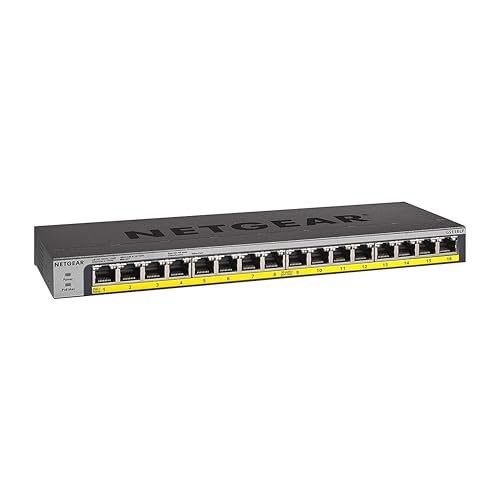
NETGEAR 16-Port Gigabit Fanless PoE+ Switch
Best for: silent 16-port plug-and-play PoE networks
- PoE Support
- PoE (what this guide is about)
- Port Count
- 16
- Port Speed
- 1.0Gbps
- Management Type
- Unmanaged
- PoE Power Budget
- 76W
- Mounting Type
- Desktop, Wall-mount, Rack-mount
This NETGEAR unit gives you 16 gigabit Ethernet ports, with every port supporting PoE+ delivery. It operates without management software, giving you simple plug-and-play deployment across desktop, wall, or rack mounts. The integrated power budget provides 76W out of the box, expandable up to 183W with an optional power supply. Its fanless metal housing ensures completely silent operation, making it suitable for quiet offices needing multiple low-power wired devices.
Pros
- 16 gigabit ports with PoE+ support on every port
- Fanless metal chassis runs completely silent
- Supports desktop, wall, and rack-mount installation
- PoE budget expandable up to 183W with optional adapter
Cons
- 76W baseline budget averages under 5W per port if all are used
- Unmanaged design provides no VLAN or traffic controls
- High-capacity 183W power supply requires a separate purchase
Good fit if
- You need up to 16 wired PoE+ connections in a quiet workspace.
- You want plug-and-play setup without software configuration.
- You plan to start with 76W and upgrade power capacity later.
Skip if
- You require managed switch features like VLANs or QoS.
- You need high wattage across all 16 ports out of the box.
Verdict: NETGEAR 16-Port Gigabit Unmanaged PoE+ Switch provides silent, zero-configuration wired connectivity with flexible mounting for low-power PoE setups. It is an effective hardware choice if you need 16 ports but do not require advanced network management.

BV 8-Port Gigabit PoE+ Switch
Best for: unmanaged PoE+ setups requiring dedicated Gigabit uplinks
- PoE Support
- PoE (what this guide is about)
- Port Count
- 10
- Port Speed
- 10/100/1000 Mbps
- Management Type
- Unmanaged
- PoE Power Budget
- 120W
- Uplink Ports
- 2 x Gigabit
This unmanaged switch gives you eight Gigabit PoE+ ports and two dedicated Gigabit uplink ports inside a compact metal housing. It supplies up to 30 watts per port with a 120-watt total PoE power budget for devices like access points and cameras. An internal power supply eliminates external power bricks entirely. It suits you if you need reliable plug-and-play network expansion without software setup or configuration menus.
Pros
- Ten total Gigabit ports with eight PoE+ ports and two uplinks
- 120W total PoE power budget supporting up to 30W per port
- Built-in internal power supply eliminates external power bricks
- Sturdy metal housing designed for quiet heat dissipation
Cons
- Unmanaged design provides no software management or traffic control options
- Lacks SFP or fiber ports for long-distance uplink connections
Good fit if
- You need to power up to eight PoE+ hardware devices across Gigabit connections.
- You want an internal power supply to keep your installation clean.
- You prefer zero-configuration plug-and-play hardware without software settings.
Skip if
- You need managed features like VLAN configuration or remote port monitoring.
- You require fiber SFP slots for your uplink runs.
Verdict: BV 8-Port Gigabit PoE+ Switch with 2 Uplinks provides ten full Gigabit connections and an internal power supply inside a durable metal enclosure. It is a solid choice for zero-configuration PoE+ networking.

TP-Link 5-Port Fast Ethernet PoE Switch
Best for: small surveillance setups needing long-range PoE
- PoE Support
- PoE (what this guide is about)
- Port Count
- 5
- Port Speed
- 10/100 Mbps
- PoE Power Budget
- 67W
- Mounting Type
- Desktop, Wall-Mount
- Number of Ports
- 5 Ports
This TP-Link switch provides five 10/100 Mbps Fast Ethernet ports, including four 802.3at/af PoE+ ports backed by a 67W total power budget. It gives you up to 30W per port alongside hardware features like PoE auto-recovery, priority ports, and an extend mode that reaches 250 meters at 10 Mbps. It suits you if you need to run low-bandwidth devices like basic IP cameras without complex configuration.
Pros
- 67W total PoE power budget across four PoE+ ports (up to 30W per port)
- Extend mode delivers data and power up to 250 meters at 10 Mbps
- PoE Auto Recovery automatically detects and reboots unresponsive devices
- Fanless metal casing supports desktop or wall mounting
Cons
- Limited to 10/100 Mbps Fast Ethernet speeds rather than Gigabit
- Provides only one non-PoE uplink port
Good fit if
- You need to power up to four PoE devices with a 67W total power budget.
- You run surveillance cameras over long cable runs up to 250 meters.
- You want plug-and-play setup without any software configuration.
Skip if
- You require Gigabit network speeds across your wired connections.
- You need more than four powered PoE ports or more than one uplink.
Verdict: TP-Link 5-Port Fast Ethernet PoE+ Switch delivers dedicated 67W PoE+ output and long-range connectivity in a compact, quiet metal build. It is an effective hardware choice when your setup prioritizes reliable camera power over Gigabit data throughput.

Real HD 10-Port Gigabit PoE+ Switch
Best for: IP camera networks needing dedicated uplinks
- PoE Support
- PoE (what this guide is about)
- Port Count
- 10
- Port Speed
- 10/100/1000Mbps
- PoE Power Budget
- 120W
- Uplink Ports
- 2 x 1000Mbps
- Mounting Type
- Rack Mount
The Real HD 10-Port Gigabit PoE+ Switch gives you eight Gigabit PoE+ ports and two dedicated Gigabit uplink ports inside a metal rackmount chassis. It delivers up to 30W per port with a 120W total power budget across the 802.3af and 802.3at standards. With an internal power supply and automatic device detection, this plug-and-play switch fits setups running multiple IP cameras or network hardware requiring standard PoE.
Pros
- Eight Gigabit PoE+ ports and two Gigabit uplink ports
- 120W total PoE budget with up to 30W per port
- Includes rackmount ears and metal housing
- Built-in internal power adapter
Cons
- Does not support 24V passive PoE hardware
- No software management or VLAN configuration options
Good fit if
- You need to power up to eight standard 802.3af/at PoE IP cameras.
- You want dedicated Gigabit uplink ports for your NVR or router connection.
- You need rack-mounting hardware included in the box.
Skip if
- You use devices that require 24V passive PoE.
- You require managed switch capabilities like traffic prioritization or VLANs.
Verdict: Real HD 10-Port Gigabit PoE+ Switch delivers reliable power and dedicated Gigabit uplink bandwidth for network installations. It provides a simple plug-and-play rackmount design well suited for powering standard IP camera setups.

Real HD 16-Port Fast Ethernet PoE+ Switch
Best for: high-wattage IP camera and surveillance setups
- PoE Support
- PoE (what this guide is about)
- Port Count
- 16
- Port Speed
- 10/100 Mbps
- Management Type
- Unmanaged
- PoE Power Budget
- 300W
- Uplink Ports
- 2 Gigabit Uplink Ethernet Ports
This unmanaged switch gives you 16 Fast Ethernet PoE+ ports alongside two dedicated Gigabit uplink ports. It supplies a total power budget of 300W, offering up to 30W per port for 802.3af/at hardware. A built-in toggle adds an extend mode for cable runs up to 250 meters at reduced speeds, plus port isolation via VLAN mode. It suits you if you run multiple IP cameras or access points requiring high total wattage.
Pros
- 300W total PoE power budget with up to 30W per port
- Two dedicated Gigabit uplink ports for router or NVR links
- Extend mode supports cable distances up to 250 meters
- Fanless metal chassis for silent operation
Cons
- PoE ports operate at 10/100 Mbps Fast Ethernet instead of Gigabit
- Unmanaged design provides no software-based network controls
Good fit if
- You need a high 300W power ceiling across up to 16 PoE devices.
- You run long camera connections reaching up to 250 meters.
- You want a fanless switch with Gigabit uplinks for storage or routing.
Skip if
- You require Gigabit transfer speeds across all downstream PoE ports.
- You need managed software controls to configure network settings.
Verdict: Real HD 16-Port 300W PoE Switch provides a generous 300W power budget and silent operation for surveillance hardware. Its 10/100 Mbps downstream ports fit security cameras better than high-bandwidth data workstations.

Tenda 5-Port Gigabit PoE+ Switch
Best for: small surveillance and access point setups
- PoE Support
- PoE (what this guide is about)
- Port Count
- 5
- Port Speed
- Gigabit
- Management Type
- Unmanaged
- PoE Power Budget
- 63W
- Uplink Ports
- 1 x Gigabit
The Tenda 5-Port Gigabit PoE+ Switch provides four 802.3af/at PoE+ ports alongside one dedicated Gigabit uplink. With a total power budget of 63W, you can deliver up to 30W per port to hardware like IP cameras, access points, and VoIP phones. A hardware VLAN toggle isolates PoE ports to stop broadcast traffic. This compact, fanless metal unit suits desktop or wall-mounted deployments in small offices and home networks requiring silent operation.
Pros
- 63W total PoE budget with up to 30W per port
- Dedicated one-key hardware VLAN isolation toggle
- Silent, fanless metal enclosure with 6kV surge protection
- Desktop and wall-mount compatible compact design
Cons
- Only four ports deliver PoE power
- Unmanaged switch without web-based or software network management
Good fit if
- You need to power up to four PoE devices with a 63W total power budget.
- You want hardware-based VLAN port isolation without configuring software.
- You require a silent, fanless switch for desktop or wall-mounted placement.
Skip if
- You need more than four PoE-capable Ethernet ports.
- You require managed switch software features beyond the physical VLAN switch.
Verdict: Tenda 5-Port Gigabit PoE+ Switch delivers reliable desktop power and Gigabit connectivity for small-scale surveillance and access point installations. Its physical VLAN toggle and fanless metal chassis offer straightforward isolation and silent 24/7 operation.

NETGEAR 24-Port Gigabit Unmanaged Switch with PoE+
Best for: silent 24-port unmanaged PoE+ networks
- PoE Support
- PoE (what this guide is about)
- Port Count
- 24
- Port Speed
- 1.0 Gbps
- Management Type
- Unmanaged
- PoE Power Budget
- 190W
- Mounting Type
- Desktop, Rack-mount
View on Amazon: NETGEAR 24-Port Gigabit Unmanaged Switch with PoE+
The NETGEAR 24-Port Fanless PoE+ Gigabit Switch provides 24 gigabit Ethernet ports, including 16 PoE+ ports with a 190W total power budget. Its fanless metal housing operates silently on a desktop or rack mount. Because this is an unmanaged switch, you get plug-and-play deployment with no configuration or software to install. It suits you if you need silent wired connectivity for power-hungry devices over Cat5e or Cat6 cables.
Pros
- 16 PoE+ ports with 190W total power budget
- Dynamic PoE allocation to redistribute unused power
- Fanless metal chassis for silent operation
- 24 auto-negotiating gigabit Ethernet ports
Cons
- Unmanaged with no software or configuration interface
- PoE+ power limited to 16 of the 24 ports
Good fit if
- You need silent operation across 24 gigabit Ethernet ports.
- You want up to 16 PoE+ ports delivering up to 190W of power.
- You prefer plug-and-play setup without software management.
Skip if
- You need a managed switch with software controls.
- You need PoE power across all 24 ports.
Verdict: NETGEAR 24-Port Fanless PoE+ Gigabit Switch delivers 16 PoE+ ports and a 190W budget in a quiet, unmanaged chassis. It offers straightforward plug-and-play gigabit networking for desktop or rack setups.

YuanLey 8-Port Gigabit 120W PoE Switch
Best for: plug-and-play multi-device Gigabit PoE setups
- PoE Support
- PoE (what this guide is about)
- Port Count
- 8
- Port Speed
- 1000 Mbps
- Management Type
- Unmanaged
- PoE Power Budget
- 120W
- Switching Capacity
- 12 Gbps
This YuanLey switch provides eight Gigabit Ethernet ports that all deliver IEEE 802.3af/at PoE+ power, backed by a 120W total power budget and up to 30W per port. Built with a fanless metal chassis and an internal power supply, it operates silently without requiring an external adapter brick. Because it is completely unmanaged, it suits you if you need straightforward plug-and-play power and data for access points or cameras.
Pros
- All eight ports support Gigabit speeds and 802.3af/at PoE+
- 120W total PoE budget with up to 30W per port
- Fanless metal enclosure ensures silent operation
- Built-in internal power supply eliminates external power bricks
Cons
- Unmanaged design lacks VLAN, QoS, and remote management settings
- No dedicated uplink ports, so connecting an uplink uses one of the PoE ports
Good fit if
- You need up to 120W of combined PoE+ power across up to eight Gigabit devices.
- You want silent, fanless hardware with an internal power supply for quiet spaces.
- You prefer plug-and-play installation without needing to configure network settings.
Skip if
- You require managed switch features such as VLAN tagging or bandwidth control.
- You need dedicated non-PoE uplink ports to keep all eight PoE ports free for endpoints.
Verdict: YuanLey 8-Port Gigabit PoE+ Switch delivers 120W of quiet, plug-and-play power across all eight ports. It is an effective option for powering multiple network endpoints without setup complexity.

YuanLey 10-Port Fast Ethernet PoE+ Switch
Best for: long-distance IP camera and access point deployments
- PoE Support
- PoE (what this guide is about)
- Port Count
- 10
- Port Speed
- 10/100 Mbps
- Management Type
- Unmanaged
- PoE Power Budget
- 120W
- Uplink Ports
- 2 x Gigabit
This unmanaged switch gives you eight 10/100 Mbps PoE+ ports and two dedicated Gigabit uplinks backed by a 120W internal power supply. It delivers up to 30W per port using IEEE 802.3af/at standards, making it suitable for IP cameras, access points, and VoIP hardware. An extend mode supports cable runs up to 250 meters at 10 Mbps with port isolation. It suits setups needing long-distance camera runs without Gigabit speeds on every port.
Pros
- 120W total power budget with up to 30W per PoE+ port
- Two dedicated 1000 Mbps Gigabit uplink ports for router or NVR connections
- Extend mode supports data and power delivery up to 250 meters at 10 Mbps
- Hardware VLAN isolation switch for ports 1 through 8
Cons
- PoE downstream ports are limited to 10/100 Mbps Fast Ethernet speeds
- Does not support 24V passive PoE hardware
Good fit if
- You need to connect IP cameras or access points over cable runs up to 250 meters.
- You want two dedicated Gigabit uplinks to prevent bottlenecks to your main network.
- You require an unmanaged plug-and-play switch with up to 120W of total PoE+ power.
Skip if
- You need Gigabit speeds across all eight connected PoE devices.
- You operate network devices that require 24V passive PoE power.
Verdict: YuanLey 8-Port PoE+ Switch with 2 Gigabit Uplinks provides a reliable 120W power budget and extended transmission reach for camera networks that do not require Gigabit speeds at the edge. Its dual Gigabit uplinks keep your backhaul clear while powering standard 802.3af/at gear.
Specifications side by side
| Spec | Goalake 8-Port Smart Managed Gigabit Switch | TP-Link 5-Port Fast Ethernet Switch | TP-Link 48-Port Gigabit Unmanaged Switch | TP-Link 8-Port Gigabit Switch with 4 PoE+ Ports | NETGEAR 10-Port Fanless Smart Managed PoE+ Switch | TP-Link 8-Port Gigabit Smart Managed PoE Switch | NETGEAR 16-Port Gigabit Fanless PoE+ Switch | BV 8-Port Gigabit PoE+ Switch | TP-Link 5-Port Fast Ethernet PoE Switch | Real HD 10-Port Gigabit PoE+ Switch | Real HD 16-Port Fast Ethernet PoE+ Switch | Tenda 5-Port Gigabit PoE+ Switch | NETGEAR 24-Port Gigabit Unmanaged Switch with PoE+ | YuanLey 8-Port Gigabit 120W PoE Switch | YuanLey 10-Port Fast Ethernet PoE+ Switch |
|---|---|---|---|---|---|---|---|---|---|---|---|---|---|---|---|
| Port Count | 8 | 5 | 48 | 8 | 10 | 8 | 16 | 10 | 5 | 10 | 16 | 5 | 24 | 8 | 10 |
| Port Speed | 1 Gbps | 10/100 Mbps | 10/100/1000 Mbps | 10/100/1000 Mbps | 1.0Gbps | Gigabit | 1.0Gbps | 10/100/1000 Mbps | 10/100 Mbps | 10/100/1000Mbps | 10/100 Mbps | Gigabit | 1.0 Gbps | 1000 Mbps | 10/100 Mbps |
| Management Type | Easy Smart Managed | Unmanaged | Unmanaged | Unmanaged | Smart Managed | Easy Smart | Unmanaged | Unmanaged | not specified | not specified | Unmanaged | Unmanaged | Unmanaged | Unmanaged | Unmanaged |
| PoE Support | not specified | not specified | not specified | PoE+ (802.3at/af) | PoE+ | PoE (802.3af) | PoE+ | PoE+ | PoE+ (802.3at/af) | PoE+ (802.3af/at) | PoE+ (802.3af/at) | PoE+ (IEEE 802.3af/at) | PoE+ | PoE+ (802.3af/at) | PoE+ (802.3af/at) |
| PoE Power Budget | not specified | not specified | not specified | 64 W | 190W | 57W | 76W | 120W | 67W | 120W | 300W | 63W | 190W | 120W | 120W |
| Uplink Ports | not specified | not specified | not specified | not specified | 2 x 1G SFP | not specified | not specified | 2 x Gigabit | not specified | 2 x 1000Mbps | 2 Gigabit Uplink Ethernet Ports | 1 x Gigabit | not specified | not specified | 2 x Gigabit |
| Switching Capacity | not specified | not specified | 96 Gbps | not specified | not specified | not specified | not specified | not specified | not specified | not specified | not specified | not specified | not specified | 12 Gbps | not specified |
| Mounting Type | Desktop, Wall Mount | Desktop | Rackmount | Desktop, Wall-Mount | Desktop, Rack-mount | not specified | Desktop, Wall-mount, Rack-mount | not specified | Desktop, Wall-Mount | Rack Mount | Rack Mount, desktop or a wall | Desktop, Wall-Mount | Desktop, Rack-mount | not specified | not specified |
| Number of Ports | 8 Ports | 5 Ports | 48 Ports | 8 Ports | 10 Ports | 8 Ports | 16 Ports | 8 Ports | 5 Ports | 10 Ports | 16 Ports | 5 Ports | 24 Ports | 8 Ports | 10 Ports |
| Uplink Port Type | not specified | not specified | not specified | not specified | SFP | not specified | not specified | Gigabit Uplink | not specified | not specified | Gigabit Uplink | Gigabit Uplink | not specified | not specified | Gigabit Uplink |
| Recommended Use | not specified | not specified | not specified | not specified | not specified | not specified | not specified | not specified | not specified | IP Cameras | not specified | not specified | not specified | not specified | not specified |
| Dimensions | 5.19 × 3.14 × 1.06 inches | 4.07 × 2.74 × 0.87 inches | 17.3 × 8.66 × 1.73 inches | 3.9 × 6.7 × 1.1 inches | 18 × 9.02 × 3.11 inches | 6.22 × 3.98 × 0.98 inches | 4.02 × 1.06 × 11.3 inches | 11.3 × 1.75 × 7 inches | 3.93 × 3.86 × 0.98 inches | 7.8 × 4.6 × 1.7 inches | not specified | 3.94 × 3.94 × 1.02 inches | 13 × 8.1 × 1.7 inches | 9.06 × 7.48 × 2.76 inches | 7.9 × 4.7 × 1.7 inches |
| Weight | not specified | 3.53 ounces | 9.22 pounds | 1.15 pounds | 1 pounds | 1 pounds | 1.94 pounds | not specified | 8.47 ounces | 2.47 pounds | 4.3 pounds | not specified | 5.38 pounds | 2.16 pounds | 2.12 pounds |
| Size | 8 Ports | 5 Port | 48 Port, 1 Gigabit | 8 Port w/ 4-Port PoE+ | 8 Port, PoE+ @ 190W, 2 x 1G SFP | Easy Smart Managed, 8 Port w/ 4 PoE+ Port | 16 Port, PoE+ @ 76W | not specified | 5 Port w/ 4-Port PoE+ | 8 POE Port | not specified | 5 Port w/4 PoE+ Port | 24 Port, PoE+ @ 190W | 8 Port | 8*PoE+ (120w) | 10 Port | 8*PoE+ (120w) |
| Color | Black | 5 | Black | Black | Black | Black | Silver / black | Black | 5-Port | black | Black | White | silver | Black | Blue |
| Model | 8 Gigabit Ports|Easy Managed | TL-SF1005D | TL-SG1048 | TL-SG1008P | GS510TPP-100NAS | TL-SG108PE | GS116LP-100NAS | POE-SW802G | TL-SF1005P | 8 port poe gigabit switch | 16 port poe switch | TEG1105P | GS324P-100NAS | 8 Port 1G PoE Unmanaged Switch (120W) | 10 Port | 8*PoE+ (120w) |
If you are planning your switch power budget, you can compare hardware wattage needs across the best PoE security cameras to ensure sufficient port power.
How to Choose the Right PoE Switch
-
Total PoE Power Budget
Check the overall PoE power budget listed in watts before connecting your equipment. Each powered device draws a specific amount of electricity, and the total wattage of all attached units cannot exceed what the switch supplies. For example, the Real HD 16-Port Fast Ethernet PoE+ Switch provides a 300W power budget, which accommodates multiple high-draw devices simultaneously. Calculate the maximum wattage required by your access points or cameras to ensure the power supply delivers sufficient wattage across every active port.
-
Number of Powered Ports
Examine the exact count of ports capable of delivering power rather than looking only at total port density. Some hardware builds supply power across every connection, while other models split functionality between standard and powered ports. The TP-Link 8-Port Gigabit Switch with 4 PoE+ Ports allocates power output to four ports while reserving the remaining four for standard data connections. If you plan to power endpoints across your entire layout, confirm that the switch provides enough dedicated PoE interfaces for your current gear.
-
Dedicated Uplink Port Types
Look for dedicated uplink interfaces if you want to connect your switch to a router, gateway, or secondary switch without sacrificing standard device ports. Uplinks can use traditional copper Gigabit connections or fiber-based SFP slots for long-distance transmissions. The NETGEAR 10-Port Fanless Smart Managed PoE+ Switch includes two dedicated SFP ports alongside its standard ports. Choosing a model with dedicated uplink architecture prevents network backhaul traffic from congesting the ports needed for your local powered hardware.
-
Chassis Form Factor and Mounting
Review the physical dimensions and mounting specifications to match your installation space. Compact desktop models fit onto shelves or mount directly against flat walls for discreet home integration. In contrast, rackmount switches feature wider chassis designs engineered for standard 19-inch equipment racks. The TP-Link 48-Port Gigabit Unmanaged Switch measures over 17 inches in length and requires dedicated rack space. Choosing the correct mounting style ensures the switch fits securely in your wiring closet, media cabinet, or office work area.
-
Fanless Acoustic Design
Consider the cooling system of the switch if you plan to install hardware in an open room or office. Switches with active internal fans produce continuous background noise, which can cause distractions in quiet living spaces. Fanless models dissipate heat passively through metal enclosures to ensure silent continuous operation. The NETGEAR 16-Port Gigabit Fanless PoE+ Switch provides fanless architecture across a multi-port frame. Selecting a fanless build ensures your networking equipment operates silently without adding ambient noise to nearby workspaces.
Frequently asked questions
What is the difference between an unmanaged and a smart managed PoE switch?
Unmanaged switches operate as plug-and-play devices without configuration, while smart managed switches provide software controls to segment and monitor network traffic. Models like the TP-Link TL-SG1008P require zero setup for instant connectivity. Smart managed switches like the NETGEAR GS510TPP-100NAS and TP-Link TL-SG108PE give you web interfaces to configure virtual local networks, prioritize bandwidth, and monitor connected devices.
What is the purpose of dedicated uplink ports on a PoE switch?
Dedicated uplink ports connect your switch to a primary router, server, or upstream switch without taking away ports reserved for powered endpoints. Switches like the Real HD 10-Port and BV POE-SW802G provide dedicated Gigabit uplinks to handle core traffic. Additionally, switches such as the NETGEAR GS510TPP-100NAS feature dedicated SFP uplink ports, allowing you to establish high-speed fiber-optic links across longer distances.
Can a PoE switch be powered through an Ethernet cable instead of an outlet?
Yes, certain compact network switches can draw their operating power directly from an incoming PoE cable rather than an electrical wall outlet. The Goalake 8-Port Smart Managed Gigabit Switch uses incoming PoE power to run its internal electronics and smart management features. This capability allows you to install the desktop or wall-mounted unit in attics, closets, or ceilings where electrical outlets are missing.
What is the difference between standard PoE and PoE+?
The primary difference is the electrical wattage delivered to each connected device. Standard PoE delivers up to 15.4 watts per port, whereas PoE+ provides up to 30 watts per port. Switches like the YuanLey 8-Port and NETGEAR GS324P use PoE+ to power higher-draw hardware, including pan-tilt-zoom security cameras, multi-radio wireless access points, and video IP phones that exceed standard PoE limits.
Can you plug non-PoE devices into a PoE switch?
Yes, you can safely connect standard non-PoE equipment to a PoE switch. Modern network switches use active sensing to detect whether a connected device requires power before sending electrical current down the Ethernet cable. If you plug in a regular computer, printer, or smart TV, the switch supplies only data, ensuring non-PoE devices remain fully protected against electrical overload or damage.
What mounting types do PoE switches support?
PoE switches support desktop placement, wall mounting, or rackmount installations depending on their chassis dimensions and thermal design. Compact desktop models like the TP-Link TL-SG1008P and Tenda TEG1105P fit easily on flat surfaces or shelves. Larger models, including the TP-Link TL-SG1048 and Real HD 16-Port Switch, include rackmount hardware designed to install directly into standard server racks or equipment enclosures.
What does a physical VLAN toggle switch do?
A physical VLAN switch isolates downstream Ethernet ports from one another with a manual hardware switch. On switches like the Tenda 5-Port Gigabit Switch (TEG1105P), flipping the VLAN toggle prevents connected devices from communicating directly with each other while still allowing them to reach the uplink port. This hardware isolation stops broadcast storms and improves security for connected IP cameras without requiring web configuration.