How to Choose Network Switches: A Complete Buying Guide for 2026
As an Amazon Associate we earn from qualifying purchases. Links on this page are affiliate links.
This network switch buying guide helps you choose the right hardware for your wired connections. You will learn how to pick between unmanaged and managed options based on port count and speed. The products listed were selected strictly from their published specifications. You can compare size, weight, and mounting types to find a fit for your desk or rack.
You will decide whether you need five ports for a home office or twenty-four for a dense setup. The guide walks through port speed, management type, and physical dimensions. You will see how fanless designs reduce noise for living spaces. Each recommendation focuses on practical specs rather than marketing claims. This approach ensures you select a switch that matches your exact technical requirements without guesswork.
Our top pick: TP-Link 5-Port Gigabit Unmanaged Switch.
Key Switch Buying Factors
Port count and density
The number of ports determines how many devices you can connect directly via Ethernet. Small setups with a console and PC may only need five ports, while home offices or media rooms often require sixteen or more. Higher port counts reduce the need for additional switches but increase physical footprint. You should count your active wired devices plus two or three spare ports for future growth. A 24-port unit suits dense installations, whereas a 5-port model fits compact desks. Choose the lowest count that meets your current and near-future needs to save space and power.
- Count your active wired devices
- Add two to three spare ports
- Check physical footprint for your space
Port speed rating
Port speed defines the maximum data rate per connection. Gigabit ports support up to 1,000 Mbps, which is standard for modern computers, consoles, and smart TVs. Fast Ethernet ports offer only 100 Mbps, suitable only for basic peripherals like printers or legacy devices. If you transfer large files or stream 4K video, Gigabit is essential. The D-Link 24-Port Gigabit Switch provides high-speed expansion for multiple devices. Avoid Fast Ethernet for main devices unless you are strictly on a budget or have very low bandwidth needs. Ensure your router and connected devices also support the speed you select.
- Select Gigabit for modern devices
- Avoid Fast Ethernet for main connections
- Verify router supports same speed
Management type
Unmanaged switches work immediately upon plugging in, requiring no software or configuration. This makes them ideal for home users who want silent, reliable expansion without technical hassle. Managed switches offer advanced features like traffic prioritization and monitoring but require setup knowledge. Most home networks benefit from unmanaged options due to their simplicity. The TP-Link 5-Port Gigabit Unmanaged Switch exemplifies this plug-and-play approach. You should choose unmanaged if you only need to add ports. Only consider managed switches if you have specific network segmentation or quality-of-service requirements that unmanaged hardware cannot address.
- Choose unmanaged for simple setup
- Skip managed unless you need advanced features
- Ensure zero configuration is preferred
Power over Ethernet support
PoE capability allows the switch to deliver power through Ethernet cables to connected devices. This is useful for IP cameras, wireless access points, and VoIP phones, eliminating the need for separate power outlets. If you do not have PoE devices, this feature is unnecessary and may increase cost. The TP-Link 5-Port Fast Ethernet Switch includes PoE support, demonstrating that even basic models can offer it. Check your device requirements before selecting a PoE switch. Ensure the switch provides sufficient total wattage for all connected PoE devices to function correctly without interruption.
- Identify if devices need PoE power
- Check total wattage capacity
- Skip PoE if not needed
Mounting and form factor
Switches come in various sizes and mounting options. Desktop models sit on surfaces, while wall-mountable units save desk space. Compact designs fit easily behind TVs or in tight cabinets. The NETGEAR 5-Port Gigabit Unmanaged Switch supports both desktop and wall mounting, offering flexibility. Consider where you will place the switch and whether you need to hide cables. Larger switches with many ports require more space and may need rack mounting in server environments. Ensure the physical dimensions fit your intended location and that ventilation is not blocked by surrounding objects.
- Measure available space for the switch
- Check for wall-mounting holes
- Ensure adequate ventilation clearance
Acoustic and thermal design
Noise and heat are important for switches placed in living areas or bedrooms. Fanless designs operate silently and generate less heat, making them ideal for home environments. The TP-Link 5-Port Gigabit Metal Switch is fanless, ensuring quiet operation. Fans can fail over time and create noise, so passive cooling is often preferred for residential use. Verify that the switch does not require active cooling if it will be in a quiet room. Fanless units rely on heat sinks and metal casings to dissipate warmth, which is sufficient for typical home networking loads.
- Prefer fanless designs for quiet operation
- Check for metal heat-dissipating casings
- Avoid fans in bedrooms or living rooms
Types of Network Switches
5-Port Gigabit Unmanaged
These compact switches offer five Gigabit ports for basic home expansion. They are silent, plug-and-play, and require no configuration. You get reliable speeds for PCs, consoles, and smart TVs. Models like the TP-Link TL-SG1005D or NETGEAR GS105NA fit easily on desks or mount to walls. They lack advanced features, making them ideal for users who simply need more wired connections without setup hassle.
High-Density Unmanaged
When you need many ports, unmanaged switches like the D-Link DGS-1024D or TP-Link TL-SG1016 provide high density. These units offer 16 or 24 ports, suitable for home offices or media rooms with numerous devices. They deliver straightforward Gigabit throughput without management software. The trade-off is size and weight; they are larger and heavier than desktop models. They are best for fixed installations where port count matters most.
Fast Ethernet Unmanaged
For devices with low bandwidth needs, Fast Ethernet switches like the TP-Link TL-SF1005D remain useful. These provide 10/100 Mbps speeds, which are sufficient for printers, VoIP phones, or legacy hardware. They are smaller and often cheaper than Gigabit options. However, they cannot handle modern high-speed tasks like 4K streaming or large file transfers. Use them only for peripherals that do not require Gigabit performance.
Common Switch Buying Mistakes
Ignoring PoE requirements for cameras and APs
Many users overlook Power over Ethernet needs. If you plan to mount access points or security cameras, you must ensure the switch provides PoE. Standard Gigabit switches only handle data. Choosing a non-PoE model forces you to install separate power outlets for each device, complicating your setup.
Assuming all Gigabit ports are equal
Not all Gigabit ports offer the same throughput. Some budget models limit the total switching capacity, causing bottlenecks when multiple devices transfer large files simultaneously. Check the switching bandwidth spec. Ensure it supports full wire-speed performance across all active ports to maintain consistent speeds for your entire network.
Overlooking future expansion needs
Buying a five-port switch for a growing home office often leads to frustration. You will quickly run out of connections and need additional daisy-chained switches. This adds latency and complexity. Plan for at least two extra ports beyond your current count to accommodate new devices like smart home hubs.
Ignoring heat dissipation in enclosed spaces
Placing a metal-cased switch inside a closed media cabinet can cause overheating. Passive cooling relies on ambient air. If the enclosure is tight, temperatures rise and reduce hardware lifespan. Look for models with ventilation slots or choose plastic housings for enclosed areas. Ensure adequate airflow around the device at all times.
Mixing managed and unmanaged switches incorrectly
Placing a managed switch at the edge of your network without understanding VLANs can isolate devices unnecessarily. Unmanaged switches simply pass traffic. Managed switches allow segmentation. For most homes, a single unmanaged switch suffices. Only add managed features if you need to separate guest Wi-Fi from your main LAN traffic.
Quick picks
Our 8 picks

TP-Link 5-Port Gigabit Unmanaged Switch
Best for: silent plug-and-play home wired network expansion
- Port Count
- 5
- Port Speed
- 10/100/1000 Mbps
- Management Type
- Unmanaged
- Mounting Type
- Desktop, Wall-Mount
- Number of Ports
- 5 Ports
- Dimensions
- 1.1 × 6.5 × 4.3 inches
This TP-Link switch expands your wired home network with five 10/100/1000 Mbps Gigabit Ethernet ports. It operates as an unmanaged, plug-and-play unit with no configuration required. The fanless design ensures silent operation on a desktop or mounted to a wall. It suits you if you need to add basic wired connections for a printer, computer, or gaming console directly from your router without configuring software.
Pros
- Five auto-negotiating 10/100/1000 Mbps Gigabit ports
- Fanless design provides silent operation
- Desktop or wall-mount placement options
- Plug-and-play setup requires no software configuration
Cons
- Plastic housing rather than metal
- Unmanaged operation provides no network management or VLAN controls
- Limited to five total Ethernet ports
Good fit if
- You need extra Gigabit Ethernet ports for home office devices without setup.
- You prefer a silent, fanless switch for desktop or wall-mounted placement.
- You want basic plug-and-play connectivity without managing network settings.
Skip if
- You require managed switch capabilities like VLAN tagging or traffic monitoring.
- You need more than five Ethernet ports for your wired setup.
- You prefer a metal enclosure over a plastic case.
Verdict: TP-Link 5-Port Gigabit Desktop Switch provides simple, silent Gigabit port expansion for compact home or desk setups. It handles basic wired network expansion with zero configuration required.

TP-Link 5-Port Gigabit Metal Switch
Best for: silent plug-and-play wired desktop expansion
- Port Count
- 5
- Port Speed
- 10/100/1000 Mbps
- Management Type
- Unmanaged
- Mounting Type
- Desktop or wall-mounting
- Number of Ports
- 5 Ports
- Dimensions
- 3.9 × 3.9 × 1 inches
This TP-Link unit is an unmanaged five-port network switch designed to expand your wired home setup. You get five auto-negotiating Gigabit RJ45 ports that connect gear like gaming consoles, printers, and computers directly to your router. The switch features a fanless metal enclosure measuring 3.9 inches square, supporting desktop placement or wall mounting. It suits you if you need silent, basic wired expansion without software configuration or management overhead.
Pros
- Five 10/100/1000 Mbps auto-negotiation Gigabit ports
- Fanless quiet design
- Sturdy metal case with desktop or wall-mounting options
- Plug-and-play setup requiring no configuration or software
Cons
- Unmanaged with no traffic management options
- Limited to five network ports
Good fit if
- You need extra Gigabit Ethernet ports for home office or entertainment devices.
- You want a fanless metal switch that can sit on a desk or mount to a wall.
- You prefer plug-and-play hardware that requires zero network configuration.
Skip if
- You need a managed switch to configure advanced network settings.
- You have more than four wired devices to connect to your router.
Verdict: TP-Link 5-Port Gigabit Ethernet Switch provides straightforward plug-and-play expansion in a compact, fanless metal housing. It delivers reliable wired connections without software management.
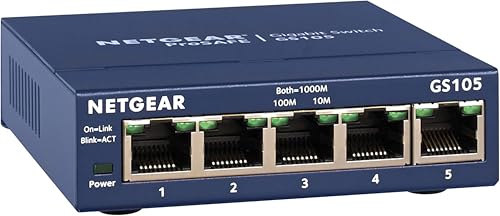
NETGEAR 5-Port Gigabit Unmanaged Switch
Best for: compact desktop and wall-mounted wired network expansion
- Port Count
- 5
- Port Speed
- 1.0 Gbps
- Management Type
- Unmanaged
- Mounting Type
- Desktop, Wall-Mount
- Number of Ports
- 5 Ports
- Dimensions
- 4.02 × 1.06 × 3.9 inches
This NETGEAR unit is an unmanaged desktop switch designed to expand your wired network setup. It gives you five auto-negotiating gigabit Ethernet ports running at up to 1.0 Gbps over standard Cat5e or Cat6 cables. The compact metal housing supports both desktop and wall mounting while operating silently without internal fans. It suits you if you need straightforward, plug-and-play wired connectivity for a home office, media console, or mesh node without software configuration.
Pros
- Five 1.0 Gbps auto-negotiating gigabit ports
- Silent fanless cooling with IEEE 802.3az energy efficiency
- Durable metal housing supporting desktop or wall mounting
- Plug-and-play operation with no software configuration
Cons
- Unmanaged design provides no VLAN, QoS, or software controls
- Offers only five total network ports
- Specified for use in the United States and Canada only
Good fit if
- You need to add up to four wired devices to a single Ethernet drop.
- You want a silent, metal-cased unit that mounts to a wall or desk.
- You prefer instant connectivity without managing network settings.
Skip if
- You require managed switch features like VLAN segmentation or traffic shaping.
- You need more than four available client ports for your equipment.
- You need hardware certified for operation outside the US and Canada.
Verdict: NETGEAR 5-Port Gigabit Unmanaged Switch delivers silent, durable gigabit expansion for small workspaces without setup hassles. Its compact metal enclosure and wall-mount options make it a practical, basic addition to any wired setup.

D-Link 24-Port Gigabit Unmanaged Switch
Best for: silent high-density unmanaged network expansion
- Port Count
- 24
- Port Speed
- 10/100/1000BASE-T
- Management Type
- Unmanaged
- Switching Capacity
- 48 Gbps
- Mounting Type
- Desktop, Rackmount, Wall-Mount
- Number of Ports
- 24 Ports
This D-Link unit gives you 24 Gigabit Ethernet ports inside a metal chassis designed for silent, fanless operation. With a 48 Gbps switching capacity and unmanaged plug-and-play setup, it routes heavy local traffic without configuration. It supports desktop, wall, or rack mounting options. If you need to wire dozens of devices across an office or home network without noise or software setup, this switch fits your layout directly.
Pros
- 24 Gigabit ports deliver 48 Gbps switching capacity
- Fanless metal chassis enables silent operation
- Supports desktop, wall, and rack mounting
- Plug-and-play operation with no software required
Cons
- Unmanaged design provides no remote or web interface
- Larger physical footprint than 5-port or 8-port switches
Good fit if
- You need 24 dedicated Gigabit wired connections
- You require silent hardware for a workspace or rack
- You prefer plug-and-play hardware without software configuration
Skip if
- You need managed switch features like VLANs or software controls
- You only need to connect a few Ethernet devices
Verdict: D-Link 24-Port Gigabit Fanless Switch delivers silent, unmanaged wired expansion for dense local network installations. Its 24-port capacity and versatile mounting options suit setups that require straightforward high-volume hardware.

D-Link 5-Port Gigabit Metal Switch
Best for: silent desktop and media console expansion
- Port Count
- 5
- Port Speed
- 1 Gbps
- Management Type
- Unmanaged
- Switching Capacity
- 10 Gbps
- Mounting Type
- Desktop, Wall-Mount
- Number of Ports
- 5 Ports
This D-Link 5-port Gigabit switch gives you five auto-negotiating Ethernet ports backed by a 10 Gbps non-blocking switching engine. Its fanless all-steel chassis keeps operation completely silent, while built-in 802.1p QoS prioritizes media and voice traffic automatically. With plug-and-play installation and wall-mount slots, it is a practical choice if you need to add wired ports to a desk, media console, or home office setup without complex software configuration.
Pros
- Silent fanless all-steel chassis
- 10 Gbps non-blocking switching capacity across 5 Gigabit ports
- Hardware 802.1p QoS and IGMP snooping support
- Built-in ±4 kV surge and ESD protection
Cons
- Unmanaged design offers no manual VLAN or traffic configuration
- Five total ports limits expansion for larger wired setups
Good fit if
- You need plug-and-play Gigabit expansion for up to five wired devices.
- You want silent, fanless operation in an office or media center.
- You need a compact metal switch with wall-mounting options.
Skip if
- You require managed switch features like port mirroring or custom VLANs.
- You have more than four client devices to connect alongside your uplink.
Verdict: D-Link 5-Port Fanless Gigabit Switch delivers reliable plug-and-play connectivity in a durable steel chassis. It provides a simple way to expand your wired network without fan noise or setup hassle.

TP-Link 5-Port Fast Ethernet Switch
Best for: basic low-bandwidth home networking connections
- Port Count
- 5
- Port Speed
- 10/100 Mbps
- Management Type
- Unmanaged
- Mounting Type
- Desktop
- Number of Ports
- 5 Ports
- PoE Support
- PoE
This TP-Link unit is an unmanaged desktop network switch designed to expand your wired setup. It gives you five 10/100 Mbps Fast Ethernet ports with auto-negotiation and Auto-MDI/MDIX support. The fanless design ensures silent operation on your desk. Because it tops out at 100 Mbps, it suits you best if you only need to connect basic low-bandwidth hardware like printers or smart home adapters.
Pros
- Five 10/100 Mbps auto-negotiation RJ45 ports
- Fanless quiet desktop design
- Auto-MDI/MDIX eliminates the need for crossover cables
- Plug-and-play setup requiring no configuration
Cons
- Maximum throughput capped at 100 Mbps Fast Ethernet
- Unmanaged design provides no traffic control options
Good fit if
- You need additional ports for low-bandwidth devices like networked printers.
- You want a compact, silent switch for your workspace.
Skip if
- You need Gigabit transfer speeds for high-bandwidth local transfers.
- You need managed switch capabilities to configure your network traffic.
Verdict: TP-Link 5-Port Fast Ethernet Desktop Switch delivers basic, silent wired expansion for lightweight office devices. Its fixed 10/100 Mbps speeds keep your simplest peripherals connected without extra setup.

TRENDnet 5-Port Mini Gigabit Switch
Best for: silent, compact desktop or wall-mounted network expansions
- Port Count
- 5
- Port Speed
- Gigabit
- Switching Capacity
- 10Gbps
- Mounting Type
- Desktop, Wall Mount
- Number of Ports
- 5 Ports
- Dimensions
- 4.9 × 2.8 × 1 inches
This compact network switch provides five gigabit Ethernet ports with a 10Gbps switching capacity to handle everyday wired traffic. Its fanless metal housing ensures silent operation on a desk or mounted to a wall. You get an unmanaged design that functions without configuration, alongside built-in power-reduction technology. It suits you if you need a durable, silent, and pocket-sized wired hub for a small home office or media center.
Pros
- Compact metal housing supports desktop or wall mounting
- Fanless design delivers silent operation
- 10Gbps switching capacity across five gigabit ports
- Unmanaged plug-and-play setup requires no configuration
Cons
- Lacks PoE capability to power connected devices
- No management interface for network traffic configuration
Good fit if
- You need a silent, fanless five-port gigabit switch for tight spaces
- You want wall-mount capability combined with a metal chassis
- You require an unmanaged device that works immediately without setup
Skip if
- You need Power over Ethernet to run access points or cameras
- You need managed switch controls for monitoring or configuration
Verdict: TRENDnet 5-Port Compact Gigabit Switch delivers silent, unmanaged wired connectivity inside a small metal enclosure. It provides a reliable five-port expansion for desktop or wall-mounted setups without adding operating noise.

TP-Link 16-Port Gigabit Unmanaged Switch
Best for: High-density wired connections without management needs
- Port Count
- 16
- Port Speed
- Gigabit
- Management Type
- Unmanaged
- Switching Capacity
- 32Gbps
- Number of Ports
- 16 Ports
- Dimensions
- 17.3 × 7.1 × 1.7 inches
The TP-Link TL-SG1016 offers 16 Gigabit Ethernet ports for high-density wired connections. It features a 32Gbps switching capacity and non-blocking architecture to maintain full wire-speed throughput. The plug-and-play design requires no configuration, making it ideal for offices or media setups. You get auto MDI/MDIX support to eliminate crossover cable needs. This unmanaged switch is built for users who need many ports without management complexity.
Pros
- 16 Gigabit Ethernet ports for extensive device connectivity
- 32Gbps switching capacity with non-blocking architecture
- Plug-and-play design requires no configuration
- Auto MDI/MDIX eliminates crossover cable requirements
Cons
- Unmanaged interface lacks remote monitoring or configuration options
- Large physical footprint at 17.3 inches in length
- Heavier build at 4.41 pounds compared to mini switches
Good fit if
- You need to connect 16 wired devices simultaneously
- You want a simple plug-and-play setup without software
- You require high throughput for large file transfers
Skip if
- You need remote management or VLAN configuration
- You have limited desk space for a large chassis
- You only need a few ports for basic connectivity
Verdict: TP-Link 16-Port Gigabit Unmanaged Switch provides high port density and reliable throughput for users who prioritize wired capacity over management features. It suits offices or media rooms needing many connections without configuration overhead.
Specifications side by side
| Spec | TP-Link 5-Port Gigabit Unmanaged Switch | TP-Link 5-Port Gigabit Metal Switch | NETGEAR 5-Port Gigabit Unmanaged Switch | D-Link 24-Port Gigabit Unmanaged Switch | D-Link 5-Port Gigabit Metal Switch | TP-Link 5-Port Fast Ethernet Switch | TRENDnet 5-Port Mini Gigabit Switch | TP-Link 16-Port Gigabit Unmanaged Switch |
|---|---|---|---|---|---|---|---|---|
| Port Count | 5 | 5 | 5 | 24 | 5 | 5 | 5 | 16 |
| Port Speed | 10/100/1000 Mbps | 10/100/1000 Mbps | 1.0 Gbps | 10/100/1000BASE-T | 1 Gbps | 10/100 Mbps | Gigabit | Gigabit |
| Management Type | Unmanaged | Unmanaged | Unmanaged | Unmanaged | Unmanaged | Unmanaged | not specified | Unmanaged |
| Switching Capacity | not specified | not specified | not specified | 48 Gbps | 10 Gbps | not specified | 10Gbps | 32Gbps |
| Mounting Type | Desktop, Wall-Mount | Desktop or wall-mounting | Desktop, Wall-Mount | Desktop, Rackmount, Wall-Mount | Desktop, Wall-Mount | Desktop | Desktop, Wall Mount | not specified |
| Number of Ports | 5 Ports | 5 Ports | 5 Ports | 24 Ports | 5 Ports | 5 Ports | 5 Ports | 16 Ports |
| PoE Support | not specified | not specified | not specified | not specified | not specified | PoE | not specified | not specified |
| Use Case | not specified | not specified | not specified | not specified | Gaming | not specified | not specified | not specified |
| Recommended Use | not specified | not specified | not specified | not specified | Office | not specified | not specified | not specified |
| Dimensions | 1.1 × 6.5 × 4.3 inches | 3.9 × 3.9 × 1 inches | 4.02 × 1.06 × 3.9 inches | 11.1 × 7.1 × 1.75 inches | 3.94 × 3.86 × 1.1 inches | 4.07 × 2.74 × 0.87 inches | 4.9 × 2.8 × 1 inches | 17.3 × 7.1 × 1.7 inches |
| Weight | 4.23 ounces | 7.76 ounces | 7.05 ounces | 2.4 pounds | 9.6 ounces | 3.53 ounces | 3.84 ounces | 4.41 pounds |
| Size | 5 Port Gigabit | 5-Port Gigabit | 5-Port | 24-Port Gigabit | 5-Port Switch | 5 Port | 5-Port | 16 Port |
| Color | Black | Black | Gray | Black | Black | 5 | Black | Black |
| Model | TL-SG1005D | TL-SG105 | GS105NA | DGS-1024D | 124889 | TL-SF1005D | TEG-S50G | TL-SG1016 |
Frequently asked questions
Do I need a managed switch for my home network?
Most home users do not need a managed switch. Unmanaged models like the TP-Link TL-SG1005D or NETGEAR GS105NA work as plug-and-play devices. You get reliable Gigabit speeds without any software configuration. Managed switches offer VLANs and traffic control, which are usually unnecessary for basic wired expansion in homes.
Which switch is best for a silent desktop setup?
Look for fanless, unmanaged switches with metal housings. The TP-Link TL-SG1005D and D-Link DGS-1024D are fanless and silent. These models handle data without generating noise. They are ideal for desks or media consoles where quiet operation matters. The metal chassis also helps with durability and heat dissipation.
Can I mount a network switch on the wall?
Yes, many unmanaged switches support wall mounting. The TP-Link TL-SG1005D and NETGEAR GS105NA explicitly list wall mount as a mounting type. The TRENDnet TEG-S50G also offers compact mounting options. Check the specifications for mounting type before buying to ensure the hardware fits your wall or rack setup.
What is the difference between Fast Ethernet and Gigabit speeds?
Fast Ethernet provides 10/100 Mbps, while Gigabit offers 1000 Mbps. The TP-Link TL-SF1005D uses Fast Ethernet for basic peripherals. Most modern devices, like PCs and consoles, benefit from Gigabit ports found in models like the TP-Link TL-SG1005D. Gigabit ensures faster file transfers and smoother streaming for high-bandwidth tasks.
Do I need PoE for a standard home network?
You only need PoE if you power devices like cameras or access points through the switch. Standard unmanaged switches like the TP-Link TL-SG1005D do not support PoE. The TP-Link TL-SF1005D lists PoE support, but it is Fast Ethernet. Verify your device power requirements before selecting a switch with PoE capabilities.
How many ports do I need for a home office?
Five ports are often sufficient for a single desk with a PC, console, and printer. The TP-Link TL-SG1005D and NETGEAR GS105NA provide this count. If you have multiple workstations or a media room, consider 16-port models like the TP-Link TL-SG1016. High-density switches handle more connections without requiring additional hardware.
Is a metal or plastic switch better for longevity?
Metal housings generally offer better durability and heat dissipation. The TP-Link TL-SG105 and D-Link 124889 feature metal enclosures. Plastic models like the TP-Link TL-SG1005D are also reliable but may feel less robust. Metal switches are often preferred for desktops or wall mounts where physical protection is important.
Can I use a 24-port switch in a small apartment?
You can use a 24-port switch, but it may be overkill. The D-Link DGS-1024D offers 24 ports for high-density needs. It is larger and heavier than 5-port models. If you have fewer than ten wired devices, a 5-port or 8-port switch is more space-efficient and cost-effective.