Best Smart Managed Network Switches in 2026: 15 Picks Ranked by Specs
As an Amazon Associate we earn from qualifying purchases. Links on this page are affiliate links.
A smart managed network switch gives you control over traffic prioritization and virtual network segmentation without enterprise complexity. We compared 15 models based strictly on the specifications published on their product listings. The Goalake 8-Port Smart Managed Gigabit Switch leads the rankings because its PoE-in power capability allows deployment in compact locations without direct AC power.
This guide helps you decide which port density, uplink speed, and Power over Ethernet capabilities best match your wired network requirements.
Quick picks
The best fit for you
- You need a compact switch powered by PoE Goalake 8-Port Smart Managed Gigabit Switch This switch features an eight-port Gigabit design with PoE-in power support and desktop or wall mounting.
- You need many wired connections without PoE power TP-Link 24-Port Gigabit Smart Managed Switch It provides 24 Gigabit ports for high-density wired setups without unneeded PoE hardware.
- You require high-speed 2.5G multi-gigabit network ports TP-Link 24-Port 2.5G Managed PoE Switch This model delivers 24 ports running at 2.5G speeds alongside high-capacity PoE power.
- You want a basic five-port switch for desktops NETGEAR 5-Port Gigabit Smart Managed Switch Its five Gigabit ports deliver essential smart traffic management in a compact chassis.
Our 15 picks

Goalake 8-Port Smart Managed Gigabit Switch
Best for: compact setups needing PoE-in power
- Management Type
- Smart Managed (what this guide is about)
- Port Count
- 8
- Port Speed
- 1 Gbps
- Mounting Type
- Desktop, Wall Mount
- Number of Ports
- 8 Ports
- PoE Support
- PoE
The Goalake 8-Port Gigabit Smart Managed Switch expands your wired network with eight Gigabit ports housed in a fanless metal chassis. It features a designated PoE-in port that accepts power directly over Ethernet, removing the need for an AC outlet. You can configure 802.1Q VLANs, QoS, and bandwidth controls using an app, web interface, or cloud portal. It suits small setups needing versatile power options and quiet operation.
Pros
- Designated PoE-in port accepts power without requiring a local AC outlet
- Fanless metal chassis enables silent desktop or wall-mount deployment
- Management accessible via mobile app, web interface, and cloud portal
- Supports 802.1Q VLANs, QoS traffic optimization, and bandwidth control
Cons
- Provides PoE-in power reception rather than PoE power output for devices
- Limited to eight Gigabit ports with no multi-gigabit capabilities
Good fit if
- You need to power a switch in locations lacking an electrical outlet
- You want a silent, fanless switch with app and web configuration
- You require VLAN segmentation and QoS controls on an eight-port network
Skip if
- You need to provide PoE output power to access points or cameras
- You require more than eight ports or 2.5G network speeds
Verdict: Goalake 8-Port Gigabit Smart Managed Switch provides flexible deployment via its PoE-in port and silent fanless design. It delivers essential smart management features when you need network control without nearby AC power.

TP-Link 24-Port Gigabit Smart Managed Switch
Best for: high-density wired networks without PoE requirements
- Management Type
- Smart Managed (what this guide is about)
- Port Count
- 24
- Port Speed
- Gigabit
- Number of Ports
- 24 Ports
- Dimensions
- 11.6 × 7.1 × 1.7 inches
- Weight
- 3.75 pounds
View on Amazon: TP-Link 24-Port Gigabit Smart Managed Switch
This TP-Link smart managed switch gives you 24 Gigabit Ethernet ports for expanded wired connectivity. It includes essential traffic controls such as VLAN segmentation, port-based and tag-based QoS, IGMP snooping, and 9K jumbo frame support. You also get monitoring tools like port mirroring and cable diagnostics. It suits you if you require many wired connections alongside foundational smart management capabilities.
Pros
- 24 Gigabit Ethernet ports
- 9K jumbo frame support for large data transfers
- Traffic management via VLANs, QoS, and IGMP snooping
- Diagnostic tools including port mirroring, loop prevention, and cable diagnostics
- Backed by a 3-year warranty with technical support
Cons
- No Power over Ethernet (PoE) support
- No multi-gigabit or 10G uplink ports
Good fit if
- You need 24 wired Gigabit ports for a high-density local network.
- You want traffic segmentation and QoS priority controls.
- You require cable diagnostics and port mirroring for network troubleshooting.
Skip if
- You need PoE to power access points or security cameras directly.
- You require network speeds exceeding standard 1 Gbps Gigabit.
Verdict: TP-Link 24-Port Gigabit Smart Managed Switch delivers 24 Gigabit ports with core VLAN and QoS tools for heavy wired setups. It provides capable smart management when you do not need integrated PoE power.
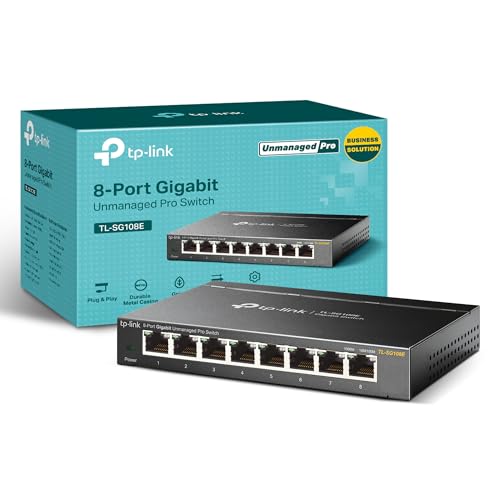
TP-Link 8-Port Smart Managed Gigabit Switch
Best for: compact desktop or wall-mounted network segmentation
- Management Type
- Smart Managed (what this guide is about)
- Port Count
- 8
- Port Speed
- Gigabit
- Mounting Type
- Desktop/Wall-Mount
- Number of Ports
- 8 Ports
- Dimensions
- 6.2 × 4 × 1 inches
This compact switch gives you 8 Gigabit Ethernet ports housed in a sturdy metal casing suitable for desktop or wall mounting. It brings Layer 2 smart management features to your setup, including traffic prioritization via QoS, link aggregation, IGMP snooping, and cable diagnostics. You can configure up to 32 VLANs simultaneously through a web interface or standalone software, making it ideal if you need simple network segmentation.
Pros
- 8 Gigabit Ethernet ports with metal shielding
- Web interface and software-based smart management
- Layer 2 features including link aggregation, QoS, and IGMP snooping
- Cable diagnostics, loop prevention, and port mirroring monitoring tools
Cons
- No Power over Ethernet (PoE) support listed
- Caps simultaneous VLAN configuration at 32 IDs
- Offers only 8 Gigabit ports without higher-speed uplinks
Good fit if
- You need essential Layer 2 management tools like VLANs, QoS, and link aggregation.
- You want a compact metal chassis that mounts to a wall or sits on a desktop.
- You configure your switch using a local web browser interface or dedicated utility.
Skip if
- You need Power over Ethernet to power IP cameras or access points.
- You need more than 8 wired connections on a single switch.
Verdict: TP-Link 8-Port Gigabit Smart Managed Switch provides reliable Layer 2 features and simple VLAN segmentation in an 8-port metal enclosure. It gives you capable smart management without extra hardware bulk.

TP-Link 16-Port Smart Managed Gigabit Switch
Best for: 16-port non-PoE smart wired networks
- Management Type
- Smart Managed (what this guide is about)
- Port Count
- 16
- Port Speed
- Gigabit
- Number of Ports
- 16 Ports
- Dimensions
- 15.8 × 9.84 × 3.15 inches
- Weight
- 2 pounds
View on Amazon: TP-Link 16-Port Smart Managed Gigabit Switch
This TP-Link switch provides 16 Gigabit Ethernet ports with smart management features in a black casing. You get traffic management through port-based and tag-based QoS, network segmentation with VLANs, and multicast handling via IGMP snooping. It also includes 9K jumbo frame support and cable diagnostics. This unit fits your setup if you need to coordinate sixteen wired devices without Power over Ethernet.
Pros
- 16 Gigabit ports with 9K jumbo frame support
- VLAN support, IGMP snooping, and port- and tag-based QoS
- Network monitoring via port mirroring, loop prevention, and cable diagnostics
- Three-year warranty with weekday technical support
Cons
- Lacks Power over Ethernet (PoE) capability
- Technical support hours are restricted to weekdays from 6am to 6pm PST
Good fit if
- You need 16 Gigabit connections with smart traffic segmentation.
- You want built-in monitoring tools such as cable diagnostics and loop prevention.
Skip if
- You need Power over Ethernet to supply power to access points or cameras.
- You require multi-gigabit speeds beyond 1 Gbps.
Verdict: TP-Link 16-Port Gigabit Smart Switch provides sixteen managed Gigabit ports alongside essential traffic segmentation and diagnostics. It is a solid choice when you need wired expansion without PoE requirements.

TP-Link 5-Port Gigabit Smart Managed Switch
Best for: compact desktop setups needing basic VLAN controls
- Management Type
- Smart Managed (what this guide is about)
- Port Count
- 5
- Port Speed
- 10/100/1000 Mbps
- Mounting Type
- Desktop
- Number of Ports
- 5 Ports
- Dimensions
- 6.7 × 4.1 × 4.5 inches
The TP-Link 5-Port Gigabit Smart Switch is a compact desktop switch built for small wired setups. It provides five 10/100/1000 Mbps RJ45 ports housed in a shielded metal casing. You get smart management features, including VLAN separation, QoS traffic prioritization, port mirroring, and IGMP snooping via a web interface. It suits you if you need basic traffic control and wired expansion on a desk or shelf without complex network overhead.
Pros
- Five 10/100/1000 Mbps Gigabit Ethernet ports
- Web-based smart management with QoS, VLAN, and IGMP snooping
- Shielded RJ45 ports inside a durable metal enclosure
- Plug-and-play capability for immediate unmanaged use
Cons
- Five ports limit network expansion for larger setups
- No Power over Ethernet support listed
- Desktop form factor without rackmount support
Good fit if
- You need a compact desktop switch with traffic management tools like VLAN and QoS.
- You want a sturdy metal-cased gigabit switch that works plug-and-play out of the box.
Skip if
- You require Power over Ethernet to power IP cameras or access points.
- You need more than five wired Ethernet connections.
Verdict: TP-Link 5-Port Gigabit Smart Switch provides essential smart management tools and gigabit connectivity in a compact metal chassis. It delivers dependable desktop traffic management without taking up rack space.

NETGEAR 10-Port Fanless Smart Managed PoE+ Switch
Best for: silent high-power PoE+ setups with fiber uplinks
- Management Type
- Smart Managed (what this guide is about)
- Port Count
- 10
- Port Speed
- 1.0Gbps
- PoE Support
- PoE+
- PoE Power Budget
- 190W
- Uplink Ports
- 2 x 1G SFP
View on Amazon: NETGEAR 10-Port Fanless Smart Managed PoE+ Switch
This smart managed switch gives you eight Gigabit Ethernet PoE+ ports alongside two dedicated 1G SFP uplink slots. It delivers a 190W total power budget across all eight copper ports to power demanding network hardware. A fanless metal chassis ensures silent operation on a desk or inside an equipment rack. It suits you if you need dedicated fiber connectivity, SNMP management, and substantial PoE wattage without active cooling noise.
Pros
- 190W total PoE+ power budget across 8 Gigabit ports
- 2 dedicated 1G SFP ports for fiber connectivity
- Fanless metal chassis for silent operation
- Supports both desktop and rack-mount installation
Cons
- Regional compatibility restricted to U.S. and Canada
- Uplink and port speeds capped at 1.0Gbps
Good fit if
- You need up to 190W of PoE+ capacity for power-hungry devices.
- You require dedicated 1G SFP fiber connections for network expansion.
- You want silent, fanless operation in a desktop or rack environment.
Skip if
- You plan to operate the hardware outside the U.S. or Canada.
- You need multi-gigabit Ethernet port speeds above 1.0Gbps.
Verdict: NETGEAR 10-Port Smart Managed PoE+ Switch provides high-wattage power delivery and dual fiber uplinks in a silent, fanless chassis. It is a capable choice for quiet desktop or rack installations requiring SNMP control.

TP-Link 8-Port Gigabit Smart Managed PoE Switch
Best for: small setups needing four basic PoE ports
- Management Type
- Smart Managed (what this guide is about)
- Port Count
- 8
- Port Speed
- Gigabit
- PoE Support
- PoE (802.3af)
- PoE Power Budget
- 57W
- Number of Ports
- 8 Ports
View on Amazon: TP-Link 8-Port Gigabit Smart Managed PoE Switch
This TP-Link 8-port gigabit smart switch provides network control and power delivery in a compact form. You get four standard gigabit ports alongside four 802.3af PoE ports backed by a 57W total power budget. Built-in smart features include VLAN traffic segmentation, QoS prioritization, and IGMP snooping. It suits home or office setups needing to manage and power devices prioritizing voice or video data.
Pros
- Four 802.3af PoE ports supplying up to 15.4W per port with a 57W budget
- VLAN support, Port-based 802.1p/DSCP QoS, and IGMP snooping
- Web-based management interface and smart configuration utility
- Limited lifetime warranty with free 24/7 technical support
Cons
- PoE output is capped at 15.4W per port under 802.3af standard
- Only four of the eight gigabit ports support PoE power
Good fit if
- You need up to four powered Ethernet ports with a 57W total budget.
- You want smart features like VLAN segmentation and QoS without extra software installation.
Skip if
- You need PoE power across all eight ports.
- You operate high-power equipment requiring more than 15.4W per port.
Verdict: TP-Link 8-Port Gigabit Smart Switch with 4 PoE Ports delivers managed network traffic segmentation alongside four dedicated PoE connections. It handles modest power budgets and voice or video traffic prioritization cleanly.

NETGEAR 5-Port Gigabit Smart Managed Switch
Best for: small desks needing basic VLAN management
- Management Type
- Smart Managed (what this guide is about)
- Port Count
- 5
- Port Speed
- 1.0Gbps
- Mounting Type
- Desktop or wall-mount
- Number of Ports
- 5 Ports
- Dimensions
- 3.7 × 3.9 × 1.1 inches
This compact unit is a five-port smart managed Gigabit Ethernet switch built in a metal enclosure. It provides five auto-negotiating 1.0 Gbps ports along with core network controls, including traffic prioritization through QoS, VLAN segmentation, and port monitoring. Its fanless design ensures silent desktop or wall-mounted operation. It suits you if you need entry-level managed traffic separation for a small home office desk without extra noise.
Pros
- Five auto-negotiating 1.0 Gbps Gigabit Ethernet ports
- Essential management features including VLAN, QoS, and port monitoring
- Silent fanless design with IEEE 802.3az Energy Efficient Ethernet
- Compact metal casing with desktop and wall-mount support
Cons
- No Power over Ethernet (PoE) ports provided
- Limited capacity with only five total network ports
- Restricted to use in the US and Canada only
Good fit if
- You need basic VLAN segmentation and QoS controls across a few wired devices.
- You require a silent, fanless switch for desktop or wall mounting.
- You operate your network equipment within the US or Canada.
Skip if
- You need Power over Ethernet (PoE) to run connected devices.
- You require more than four client Ethernet ports for your setup.
Verdict: NETGEAR 5-Port Smart Managed Gigabit Switch provides essential VLAN and QoS controls in a silent, compact metal housing. It is a practical fit when you need basic traffic management across five network connections.

NETGEAR 8-Port Smart Managed Gigabit Switch
Best for: compact networks needing silent remote management
- Management Type
- Smart Managed (what this guide is about)
- Port Count
- 8
- Port Speed
- 1.0Gbps
- Mounting Type
- Desktop, Wall-Mount
- Number of Ports
- 8 Ports
- Dimensions
- 4.13 × 6.22 × 1.06 inches
This compact smart managed switch provides eight auto-negotiating Gigabit Ethernet ports in a silent, fanless metal housing. You get centralized network control through SNMP support alongside one year of remote NETGEAR Insight management. It also features a single power delivery port to run compatible network gear directly over an Ethernet cable. It suits small office or desktop setups where you need quiet operation and smart network visibility without complex rack equipment.
Pros
- Eight auto-negotiating 1.0 Gbps Ethernet ports
- One power delivery port for compatible connected hardware
- Fanless metal chassis for silent desktop or wall-mounted operation
- Includes one year of remote NETGEAR Insight network management
Cons
- Only one port provides power delivery
- Maximum throughput is limited to 1.0 Gbps per port
Good fit if
- You need eight smart managed Gigabit ports in a quiet, fanless chassis.
- You want remote network access through NETGEAR Insight and SNMP.
- You need to power a single compatible device directly from the switch.
Skip if
- You need multi-gigabit Ethernet speeds exceeding 1.0 Gbps.
- You require power delivery on more than one port.
Verdict: NETGEAR 8-Port Smart Managed Gigabit Switch delivers silent desktop networking with eight Gigabit ports, SNMP control, and single-port power delivery. It provides practical remote oversight for compact home or small office networks.

TP-Link 16-Port Smart Managed Gigabit PoE+ Switch
Best for: high-budget PoE networks needing fiber uplinks
- Management Type
- Smart Managed (what this guide is about)
- Port Count
- 16
- Port Speed
- 10/100/1000 Mbps
- PoE Support
- PoE+ (802.3at/af)
- PoE Power Budget
- 250W
- Uplink Ports
- 2 x Gigabit, 2 x Combo SFP
View on Amazon: TP-Link 16-Port Smart Managed Gigabit PoE+ Switch
This switch gives you 16 gigabit PoE+ ports, two gigabit non-PoE ports, and two combo SFP slots for uplinks. A 250W total power budget delivers up to 30W per port, with PoE Auto Recovery to reboot unresponsive devices automatically. You configure traffic through a web-based interface with VLAN segmentation, IGMP snooping, and QoS. It fits networks running numerous powered hardware endpoints like access points alongside dedicated wired connections.
Pros
- 250W total PoE budget with up to 30W output per port across 16 PoE+ ports
- Provides two dedicated non-PoE gigabit ports and two combo SFP slots
- PoE Auto Recovery monitors and automatically restarts unresponsive hardware
- Overload protection disables lower-priority ports if power draw reaches 250W
Cons
- Restricted to 1 Gbps transfer speeds with no 2.5GbE or 10GbE support
- Combo SFP slots share transmission channels with corresponding copper ports
Good fit if
- You need to power up to 16 PoE+ devices under a single 250W budget.
- You require fiber uplink options using SFP modules for longer connection runs.
- You want automatic detection and power cycling for frozen network devices.
Skip if
- You need multi-gigabit or 10G uplink speeds for heavy data transfers.
- You require more than 16 PoE-capable connections on one hardware unit.
Verdict: TP-Link 18-Port Gigabit Smart Switch with PoE+ pairs a 250W power pool with combo SFP uplinks for networks requiring centralized device power. Its automated rebooting and port prioritization features ensure steady power delivery across dense wired installations.

STEAMEMO 8-Port Smart Managed PoE+ Switch
Best for: mixed-speed PoE setups needing silent operation
- Management Type
- Smart Managed (what this guide is about)
- Port Count
- 8
- Port Speed
- 100/1000 Mbps
- PoE Support
- PoE+
- PoE Power Budget
- 120W
- Uplink Ports
- 2 x Gigabit Uplink, 1 x 1.25G SFP
You get an 8-port PoE+ smart managed switch with a 120W power budget and fanless cooling. It features two Gigabit PoE ports, six 100Mbps PoE ports, two Gigabit uplink ports, and one 1.25G SFP slot. Network controls include 802.1Q VLANs, QoS, and dual managed or unmanaged modes. This setup suits you if you need to power low-bandwidth hardware like IP cameras alongside high-speed uplinks.
Pros
- 120W total PoE budget with up to 30W per PoE port
- Dedicated 1.25G SFP port and two Gigabit uplink ports
- Fanless design for silent desktop or wall-mounted operation
- Dual-mode switch toggles between managed and unmanaged operation
Cons
- Six of the eight PoE ports operate at 100Mbps rather than Gigabit speeds
- Total 120W budget cannot supply the maximum 30W load to all eight ports simultaneously
Good fit if
- You run 100Mbps devices like IP security cameras or VoIP phones that need PoE.
- You require an SFP slot alongside standard Gigabit uplinks.
- You need silent operation without cooling fan noise.
Skip if
- You require Gigabit throughput across all connected PoE ports.
- You need more than 120W of aggregate PoE power across your devices.
Verdict: STEAMEMO 8-Port PoE+ Smart Managed Switch provides silent PoE delivery and essential VLAN management for mixed-speed device networks. It pairs six Fast Ethernet and two Gigabit PoE ports with high-speed uplinks.

TP-Link 24-Port Smart Managed PoE+ Switch
Best for: high-density PoE+ deployments needing SFP uplinks
- Management Type
- Smart Managed (what this guide is about)
- Port Count
- 28
- Port Speed
- 10/100/1000 Mbps
- PoE Support
- PoE+ (802.3at/af)
- PoE Power Budget
- 250W
- Uplink Ports
- 2 SFP Slot
This switch expands your wired setup with 24 PoE+ Gigabit ports, two standard Gigabit ports, and two SFP slots for fiber uplinks. It supplies a total power budget of 250W at up to 30W per port. You get web-based management, traffic segmentation via VLANs, and automated device reboots via PoE Auto Recovery. It suits you if you deploy multiple access points and IP cameras across an expanding home network.
Pros
- 24 PoE+ Gigabit ports with a 250W total power budget
- 2 dedicated Gigabit non-PoE ports plus 2 SFP slots
- PoE Auto Recovery automatically reboots dropped devices
- Web-based management utility with VLAN traffic segmentation
Cons
- PoE Auto Recovery requires manual setup before functioning
- Max port speed is Gigabit with no multi-gigabit support
- Chassis is over 17 inches wide and weighs nearly 7 pounds
Good fit if
- You need up to 24 PoE+ ports within a 250W power envelope.
- You require SFP slots for fiber uplinks alongside RJ45 ports.
- You want automatic rebooting for frozen PoE equipment.
Skip if
- You need multi-gigabit transfer rates exceeding 1 Gbps.
- You want a compact desktop unit rather than a wide chassis.
Verdict: TP-Link 28-Port Gigabit Smart PoE+ Switch delivers high-capacity power distribution and SFP uplinks with essential smart management. It provides a dependable foundation for hardware-heavy wired installations.

NETGEAR 5-Port Gigabit PoE+ Smart Switch
Best for: powering up to four PoE+ devices quietly
- Management Type
- Smart Managed (what this guide is about)
- Port Count
- 5
- Port Speed
- 1.0Gbps
- PoE Support
- PoE+
- PoE Power Budget
- 63W
- Mounting Type
- Desktop or wall-mount
This NETGEAR switch gives you five gigabit Ethernet ports in a compact metal housing designed for desktop or wall mounting. Four ports provide PoE+ power with a 63W total budget and per-port controls. Its smart management software lets you configure VLANs, monitor ports, and prioritize packets with QoS. Fanless cooling ensures silent operation, making it a practical fit if you need targeted power delivery for up to four powered hardware units.
Pros
- Four PoE+ ports with a 63W shared power budget
- Fanless design for completely silent operation
- Smart management features include VLAN configuration and QoS prioritization
- Compact metal chassis supports desktop and wall-mount installation
Cons
- Only five total network ports available for connections
- One uplink port lacks PoE+ power capability
Good fit if
- You need to power up to four PoE+ devices from a single compact unit.
- You require silent, fanless operation in your workspace.
- You want basic traffic prioritization and VLAN control on a small network.
Skip if
- You have more than four devices that require PoE power.
- You need more than five total Ethernet ports for your wired gear.
Verdict: NETGEAR 5-Port Gigabit PoE+ Smart Switch provides dedicated 63W PoE+ delivery and traffic management in a silent, compact form factor. It suits small workspaces requiring VLAN isolation and power across four network endpoints.

TP-Link Omada 24-Port Gigabit Switch with 10G SFP+
Best for: wired networks needing 10G uplink aggregation
- Management Type
- Smart Managed (what this guide is about)
- Port Count
- 24
- Port Speed
- 10/100/1000 Mbps
- Uplink Ports
- 4 x 10G SFP+
- Number of Ports
- 24 Ports
- Dimensions
- 17.3 × 7.09 × 1.73 inches
View on Amazon: TP-Link Omada 24-Port Gigabit Switch with 10G SFP+
This switch provides you with 24 Gigabit RJ45 ports alongside four 10 Gbps SFP+ uplink slots for high-bandwidth connections. It supports L2+ static routing to handle internal network traffic efficiently and reduce load on your gateway. You can deploy it in standalone mode or integrate it into the Omada SDN platform for centralized management. It suits environments that require dense wired connections and fast uplink capacity.
Pros
- Four 10 Gbps SFP+ uplink slots
- 24 Gigabit RJ45 Ethernet ports
- L2+ static routing support
- Omada SDN centralized management integration
- 5-year manufacturer warranty
Cons
- No Power over Ethernet support
- RJ45 ports are limited to 1 Gbps
- Cloud-based controller usage requires additional fees
Good fit if
- You need 10 Gbps SFP+ uplinks for high-bandwidth network connectivity.
- You manage your network devices using the Omada SDN platform.
- You require L2+ static routing to manage internal network traffic.
Skip if
- You need Power over Ethernet to supply power to connected hardware.
- You require multi-gigabit speeds on standard RJ45 ports.
Verdict: TP-Link 24-Port Gigabit Smart Switch with 10G SFP+ delivers 24 standard Gigabit ports with high-speed 10 Gbps uplinks for expandable network backbones. It integrates L2+ static routing and centralized Omada SDN management into a single rack-sized unit.

TP-Link 24-Port 2.5G Managed PoE Switch
Best for: high-power multi-gigabit networks requiring 2.5G ports
- Management Type
- Smart Managed (what this guide is about)
- Port Count
- 24
- Port Speed
- 2.5 Gbps
- PoE Support
- PoE+ (802.3at/af), PoE++ (802.3bt)
- PoE Power Budget
- 500W
- Uplink Ports
- 4 x 10G SFP+
This TP-Link Omada switch gives you 24 2.5 Gbps Ethernet ports alongside four 10G SFP+ uplink slots. It supplies up to 500W of total power across 16 PoE+ and eight 60W PoE++ ports. Management options include standalone mode or integration into the Omada SDN controller platform. It suits you if you deploy multi-gigabit access points and high-draw hardware requiring central network control.
Pros
- 24 2.5G Base-T ports and four 10G SFP+ uplink slots
- 500W total PoE budget with eight 60W PoE++ ports
- Omada SDN support for centralized controller or standalone operation
- Hardware security features including 802.1Q VLAN, ACL, and DHCP snooping
Cons
- Large 11.18-pound rack-depth enclosure
- Cloud-based controller support is listed as coming soon
Good fit if
- You need 2.5 Gbps port speeds for multi-gigabit client devices.
- You require up to 60W PoE++ power per port for demanding hardware.
- You manage devices through the TP-Link Omada SDN controller ecosystem.
Skip if
- You only require standard 1 Gbps networking connections.
- You need a compact or lightweight desktop switch.
Verdict: TP-Link Omada 24-Port 2.5G PoE Switch delivers 2.5G Base-T speeds, high-capacity 500W PoE output, and 10G uplinks for demanding network installations.
Specifications side by side
| Spec | Goalake 8-Port Smart Managed Gigabit Switch | TP-Link 24-Port Gigabit Smart Managed Switch | TP-Link 8-Port Smart Managed Gigabit Switch | TP-Link 16-Port Smart Managed Gigabit Switch | TP-Link 5-Port Gigabit Smart Managed Switch | NETGEAR 10-Port Fanless Smart Managed PoE+ Switch | TP-Link 8-Port Gigabit Smart Managed PoE Switch | NETGEAR 5-Port Gigabit Smart Managed Switch | NETGEAR 8-Port Smart Managed Gigabit Switch | TP-Link 16-Port Smart Managed Gigabit PoE+ Switch | STEAMEMO 8-Port Smart Managed PoE+ Switch | TP-Link 24-Port Smart Managed PoE+ Switch | NETGEAR 5-Port Gigabit PoE+ Smart Switch | TP-Link Omada 24-Port Gigabit Switch with 10G SFP+ | TP-Link 24-Port 2.5G Managed PoE Switch |
|---|---|---|---|---|---|---|---|---|---|---|---|---|---|---|---|
| Port Count | 8 | 24 | 8 | 16 | 5 | 10 | 8 | 5 | 8 | 16 | 8 | 28 | 5 | 24 | 24 |
| Port Speed | 1 Gbps | Gigabit | Gigabit | Gigabit | 10/100/1000 Mbps | 1.0Gbps | Gigabit | 1.0Gbps | 1.0Gbps | 10/100/1000 Mbps | 100/1000 Mbps | 10/100/1000 Mbps | 1.0Gbps | 10/100/1000 Mbps | 2.5 Gbps |
| Management Type | Easy Smart Managed | Easy Smart Managed | Easy Smart Managed | Easy Smart Managed | Easy Smart | Smart Managed | Easy Smart | Easy Smart Managed | Smart Managed | Easy Smart | Easy Smart | Easy Smart | Easy Smart Managed | Smart Managed | L2+ Smart Managed |
| PoE Support | not specified | not specified | not specified | not specified | not specified | PoE+ | PoE (802.3af) | not specified | not specified | PoE+ (802.3at/af) | PoE+ | PoE+ (802.3at/af) | PoE+ | not specified | PoE+ (802.3at/af), PoE++ (802.3bt) |
| PoE Power Budget | not specified | not specified | not specified | not specified | not specified | 190W | 57W | not specified | not specified | 250W | 120W | 250W | 63W | not specified | 500W |
| Uplink Ports | not specified | not specified | not specified | not specified | not specified | 2 x 1G SFP | not specified | not specified | not specified | 2 x Gigabit, 2 x Combo SFP | 2 x Gigabit Uplink, 1 x 1.25G SFP | 2 SFP Slot | not specified | 4 x 10G SFP+ | 4 x 10G SFP+ |
| Mounting Type | Desktop, Wall Mount | not specified | Desktop/Wall-Mount | not specified | Desktop | Desktop, Rack-mount | not specified | Desktop or wall-mount | Desktop, Wall-Mount | not specified | Desktop, Wall Mount | not specified | Desktop or wall-mount | not specified | not specified |
| Number of Ports | 8 Ports | 24 Ports | 8 Ports | 16 Ports | 5 Ports | 10 Ports | 8 Ports | 5 Ports | 8 Ports | 16 Ports | 8 Ports | 24 Ports | 5 Ports | 24 Ports | 24 Ports |
| Uplink Port Type | not specified | not specified | not specified | not specified | not specified | SFP | not specified | not specified | not specified | SFP | not specified | not specified | not specified | SFP | not specified |
| Dimensions | 5.19 × 3.14 × 1.06 inches | 11.6 × 7.1 × 1.7 inches | 6.2 × 4 × 1 inches | 15.8 × 9.84 × 3.15 inches | 6.7 × 4.1 × 4.5 inches | 18 × 9.02 × 3.11 inches | 6.22 × 3.98 × 0.98 inches | 3.7 × 3.9 × 1.1 inches | 4.13 × 6.22 × 1.06 inches | 17.3 × 7.09 × 1.73 inches | 7.5 × 5.5 × 1.7 inches | 17.3 × 8.66 × 1.73 inches | 6.2 × 4 × 1.1 inches | 17.3 × 7.09 × 1.73 inches | 17.3 × 13 × 1.73 inches |
| Weight | not specified | 3.75 pounds | 1.12 pounds | 2 pounds | 15.2 ounces | 1 pounds | 1 pounds | 8.8 ounces | 15.2 ounces | 5.34 pounds | 2.28 pounds | 6.83 pounds | 2.2 pounds | 4.3 pounds | 11.2 pounds |
| Size | 8 Ports | 24 Port | Enhanced Features | 8 Port | 16 Port | Enhanced Features | 5 Port w/ Enhanced Features | 8 Port, PoE+ @ 190W, 2 x 1G SFP | Easy Smart Managed, 8 Port w/ 4 PoE+ Port | 5-Port | 8 Port | 18 Port w/ 16-Port PoE+ | 8 Ports|120W 8xPoE+ | 28 Port w/ 24 PoE+ Port | 5 Port, PoE+ @ 63W | 24 Port + 4 10GE SFP+ | 24 Port, 2.5 Gigabit |
| Color | Black | Black | Black | Black | Black | Black | Black | black | Black | Black | Black | black or gray | black | black | black |
| Model | 8 Gigabit Ports|Easy Managed | TL-SG1024DE | TL-SG108E | TL-SG1016DE | TL-SG105E | GS510TPP-100NAS | TL-SG108PE | GS305E-100NAS | GS108Tv3 | TL-SG1218MPE | 11 Ports|100W 8xPoE+ | TL-SG1428PE | GS305EP-100NAS | TL-SG3428X | TL-SG3428XPP-M2 |
If you need smart lighting control, see our guide to the best zigbee smart switches for more options.
How to Choose a Smart Managed Switch
-
Checking Uplink Port Types
Uplink ports allow switches to connect to core network routers or distant switches across higher bandwidth or longer distances. When you plan to link network closets or separate buildings, look for dedicated SFP or SFP+ slots rather than basic RJ45 copper ports. Standard SFP cages handle 1 Gbps fiber modules, while SFP+ ports reach 10 Gbps speeds. For instance, the TP-Link TL-SG3428X includes four 10GE SFP+ ports. If you only run short copper patch cables between adjacent hardware on a single desk, standard RJ45 gigabit ports remain sufficient.
-
Sizing the PoE Power Budget
PoE switches supply electrical power directly across Ethernet lines to access points, security cameras, and VoIP phones. Check both the port standard and the total wattage pool before buying. An 8-port switch might deliver 63W overall, whereas higher-capacity hardware provides larger headroom. For example, the NETGEAR GS510TPP-100NAS provides a 190W power pool across its eight PoE+ ports. Add up the maximum wattage rating of every endpoint you plan to connect. If your total device consumption nears the ceiling, choose a switch with higher wattage to prevent unexpected power drops.
-
Matching Chassis Dimensions and Mounting
Physical enclosure dimensions dictate where you can position your switch. Compact models measuring under five inches long fit neatly on a computer desk or mount flat against drywall using integrated screw slots. Conversely, switches spanning roughly 17 inches wide, such as the TP-Link TL-SG1016DE, are sized to mount in standard server racks or wide network cabinets. Measure your available installation area beforehand. If you place equipment in an open office or bedroom, confirm whether the switch uses passive fanless cooling so operating noise does not become an issue.
-
Verifying Network Management Protocol Support
Smart managed switches vary in their protocol capabilities. Entry-level models provide basic web utility management for creating port-based VLANs to isolate guest traffic and configuring Quality of Service (QoS) priorities for voice calls. Advanced models offer broader administrative tools like Simple Network Management Protocol (SNMP) for automated status polling across your network. For instance, the NETGEAR GS108Tv3 supports SNMP alongside standard L2 switching controls. If you manage multiple devices through centralized oversight software, verify that the switch explicitly lists SNMP or centralized controller compatibility rather than just local web-based configuration.
-
Evaluating Port Transfer Speed Standards
Check the specific throughput rate assigned to each RJ45 port. While most smart switches feature uniform 10/100/1000 Mbps Gigabit ports across all interfaces, some models combine different speed tiers. For example, the STEAMEMO 8-Port PoE+ switch pairs six 100 Mbps Fast Ethernet ports with two Gigabit uplink connections. Fast Ethernet ports handle low-bitrate devices like legacy IP security cameras without bottlenecking, but desktop computers, network storage units, and high-speed Wi-Fi access points demand full Gigabit or multi-gigabit connections. Review the speed specifications on every port to align with your wired devices.
Frequently asked questions
What is a smart managed switch?
A smart managed switch provides basic network configuration tools without requiring complex enterprise setup. It offers essential Layer 2 management controls like VLAN segmentation, Quality of Service traffic prioritization, and port monitoring. Models like the NETGEAR GS305E-100NAS give you these core controls in a simple 5-port metal desktop chassis. You configure settings through an accessible web interface rather than dedicated command-line consoles.
What is the difference between PoE and PoE+ on smart switches?
PoE and PoE+ differ primarily in the electrical wattage delivered to connected network endpoints. Standard PoE provides up to 15.4 watts per port, while PoE+ increases power delivery up to 30 watts. High-draw access points or security cameras require PoE+ to function properly. For instance, the NETGEAR GS510TPP-100NAS delivers PoE+ across its ports with a total power pool of 190W, whereas compact units like the NETGEAR GS305EP-100NAS support PoE+ within a 63W total budget.
Can you power a smart managed switch without an AC power outlet?
You can power certain smart managed switches without an electrical outlet using PoE-in support. Switches equipped with a PoE-in port draw their operating electrical power directly through the incoming Ethernet cable from another upstream PoE device. For example, the Goalake 8-Port Smart Managed Gigabit Switch features PoE-in capability. This design allows you to install the switch in attics, ceilings, or remote desktop locations where standard wall AC power outlets are unavailable.
What are SFP uplink ports used for on a smart switch?
SFP uplink ports connect your switch to distant switches, routers, or server backbones using fiber optic or copper transceivers. These ports allow networks to run longer physical distances than standard Ethernet cables without signal loss. On models like the NETGEAR GS510TPP-100NAS or TP-Link TL-SG1218MPE, SFP uplinks provide dedicated 1G pathways. Advanced units such as the TP-Link TL-SG3428X include 10G SFP+ ports to prevent network bottlenecks during heavy data aggregation.
Why would you choose a fanless smart managed switch?
You choose a fanless smart switch to eliminate operating noise in noise-sensitive work environments. Passive cooling keeps hardware completely silent while reducing internal mechanical parts that could fail over time. Models like the NETGEAR GS510TPP-100NAS and Goalake 8-Port Smart Managed Gigabit Switch utilize fanless designs. This allows you to position managed networking hardware on personal desktops, inside bedrooms, or within quiet open-plan office spaces without distracting acoustic fan hum.
When do you need a 2.5G smart managed switch instead of Gigabit?
You need a 2.5G smart managed switch when your wired clients exceed standard gigabit speeds. Devices such as multi-gigabit broadband routers, network-attached storage servers, and Wi-Fi 6 or Wi-Fi 7 access points benefit from throughput higher than 1 Gbps. The TP-Link TL-SG3428XPP-M2 provides 24 ports running at 2.5G speeds alongside 10G uplinks. This hardware bandwidth prevents local network bottlenecks when multiple devices transfer large media files or high-speed data concurrently.