Wi-Fi 7 or Wi-Fi 6E Mesh Wifi Systems? Compared by Specs
As an Amazon Associate we earn from qualifying purchases. Links on this page are affiliate links.
You are comparing a Wi-Fi 7 vs Wi-Fi 6E mesh wifi system to decide which fits your home. Both TP-Link Deco models offer whole-home coverage and app management. They share similar security commitments and AI-driven roaming features. The main difference lies in their generation and band structure. One uses the newer Wi-Fi 7 standard with dual bands. The other uses Wi-Fi 6E with three bands, including the 6 GHz spectrum. This affects speed, interference, and device capacity.
Key differences
| Aspect | TP-Link Deco WiFi 7 Dual-Band 2-Pack | TP-Link Deco Tri-Band WiFi 6E 2-Pack |
|---|---|---|
| Wi-Fi Standard | Wi-Fi 7 | Wi-Fi 6E |
| Frequency Bands | Dual-Band | Tri-Band |
| Coverage Area | 4,600 sq. ft. | 5,500 sq. ft. |
| Speed Rating | BE5000 (5 Gbps) | AXE5400 (5.4 Gbps) |
| Device Capacity | Over 150 devices | 200 devices |
Which one should you choose?
Choose TP-Link Deco WiFi 7 Dual-Band 2-Pack if
- You want the latest Wi-Fi 7 technology for future-proofing.
- You prefer a dual-band setup to keep the 6 GHz band available for specific high-speed devices.
- You need simultaneous wired and wireless backhaul options via 2.5G Ethernet.
Choose TP-Link Deco Tri-Band WiFi 6E 2-Pack if
- You need coverage for a larger home up to 5,500 sq. ft.
- You connect more than 150 devices and need support for up to 200.
- You want to use the dedicated 6 GHz band as a backhaul to reduce interference.
Verdict: Choose the Wi-Fi 7 model if you prioritize the newest standard and flexible backhaul options. Choose the Wi-Fi 6E model if you need broader coverage and higher device capacity. Both systems offer robust security and easy management through the Deco app.
Wi-Fi 7 or Wi-Fi 6E Mesh Systems
Wi-Fi standard
Product A uses the latest Wi-Fi 7 standard, while Product B relies on Wi-Fi 6E. Wi-Fi 7 introduces new features like MLO, which allows devices to connect on multiple bands simultaneously. This can reduce latency and increase throughput for compatible clients. Wi-Fi 6E is a mature standard that adds the 6 GHz band to the existing 2.4 GHz and 5 GHz options. If you have many new Wi-Fi 7 devices, Product A offers future-proofing. For now, both standards provide excellent performance for most home networks. You should choose based on your current device ecosystem and whether you need the absolute newest technology.
Frequency bands
Product A is a dual-band system, operating only on 2.4 GHz and 5 GHz frequencies. Product B is a tri-band system, adding a dedicated 6 GHz band. The extra band in Product B allows for a dedicated wireless backhaul connection between nodes, which can keep your main network traffic free from interference. This is particularly useful in larger homes or environments with many wireless devices. Product A uses simultaneous wired and wireless backhaul, which is also effective but relies more on your Ethernet infrastructure. If you cannot run Ethernet cables between nodes, Product B’s dedicated 6 GHz backhaul provides a significant advantage for stability.
Speed rating
Product A has a combined speed rating of 5 Gbps, with up to 4324 Mbps on the 5 GHz band and 688 Mbps on the 2.4 GHz band. Product B offers a higher total rating of 5400 Mbps, split across three bands: 2402 Mbps on 6 GHz, 2402 Mbps on 5 GHz, and 574 Mbps on 2.4 GHz. While the raw numbers suggest Product B is faster, real-world speeds depend on your internet plan and device capabilities. The tri-band design of Product B allows it to handle more concurrent high-bandwidth streams without congestion. Product A’s dual-band setup is sufficient for most single-gigabit connections.
Coverage area
Product A covers up to 4,600 square feet with its two-pack configuration. Product B extends coverage to 5,500 square feet. Both systems use mesh technology to eliminate dead zones, but Product B’s larger coverage rating makes it better suited for bigger homes or open floor plans. The difference of 900 square feet is significant for multi-story houses or layouts with many obstacles. If your home is under 4,600 square feet, both will likely perform similarly. For larger spaces, Product B provides a wider safety margin to ensure consistent signal strength in every room.
Device capacity
Product A supports over 150 connected devices. Product B supports up to 200 devices. If you have a smart home with many IoT gadgets, security cameras, and personal electronics, Product B can handle the load more comfortably. The higher capacity is partly due to its tri-band design, which distributes devices across more channels. Product A is still capable of handling a typical household’s needs, but Product B offers more headroom for dense device environments. Consider your total number of connected endpoints when making this choice.
Ethernet ports
Product A features 2.5G Ethernet ports, as indicated by its port speed specification. Product B’s port speed is not listed in the provided data, so we cannot confirm if it includes 2.5G ports or standard 1G ports. If Product A has 2.5G ports, it allows for faster wired connections to devices like gaming consoles or PCs, potentially exceeding the speed of a standard gigabit internet plan. This is a key advantage if you plan to use wired connections for high-performance tasks. Without data on Product B’s ports, Product A holds the edge for wired performance potential.
Which mesh system fits your needs
Users with many devices and large homes
The Deco XE75 supports up to 200 devices and covers 5,500 square feet. Its tri-band design includes a dedicated 6 GHz band for backhaul. This separation reduces congestion and maintains stable connections across a larger area, making it ideal for busy households with extensive coverage requirements.
Buyers wanting the latest Wi-Fi 7 standard
The Deco BE25 features the newer Wi-Fi 7 standard with 2.5G Ethernet ports. It offers simultaneous wired and wireless backhaul to balance traffic between nodes. This setup provides a future-proof network for users prioritizing the latest technology and enhanced wired connectivity options for their mesh system.
Users prioritizing wired backhaul flexibility
This model includes 2.5G Ethernet ports, allowing for faster wired connections to nodes or devices. The dual-band Wi-Fi 7 system uses these ports to balance traffic between units. This feature ensures stable whole-home coverage by leveraging both wireless and wired paths for backhaul data transmission.
Quick picks
| # | Product | Best for | Price |
|---|---|---|---|
| 1 | TP-Link Deco WiFi 7 Dual-Band 2-Pack | Wi-Fi 7 homes needing broad coverage | Check price of TP-Link Deco WiFi 7 Dual-Band 2-Pack on Amazon |
| 2 | TP-Link Deco Tri-Band WiFi 6E 2-Pack | Users needing a 6 GHz backhaul | Check price of TP-Link Deco Tri-Band WiFi 6E 2-Pack on Amazon |
The products compared

TP-Link Deco WiFi 7 Dual-Band 2-Pack
Best for: Wi-Fi 7 homes needing broad coverage
- Wi-Fi Standard
- Wi-Fi 7 (what this guide is about)
- Speed Rating
- BE5000
- Coverage Area
- 4,600 sq. ft.
- Frequency Bands
- Dual-Band
- Pack Size
- 2-Pack
- Port Speed
- 2.5G
View on Amazon: TP-Link Deco WiFi 7 Dual-Band 2-Pack Affiliate link
The TP-Link Deco 7 BE25 is a dual-band Wi-Fi 7 mesh system. It offers a 5 Gbps speed rating and covers 4,600 square feet. This 2-pack supports over 150 devices. It uses simultaneous wired and wireless backhaul with 2.5G Ethernet ports. The system includes AI-driven roaming and VPN support for seamless whole-home coverage.
Pros
- Wi-Fi 7 standard for modern performance
- 5 Gbps aggregate speed rating
- 2.5G Ethernet ports for wired backhaul
- Covers 4,600 square feet of space
- Supports over 150 connected devices
Cons
- Dual-band configuration limits wireless backhaul bandwidth
- No mention of 10G Ethernet ports
- Single 2.5G port per unit restricts high-speed wired connections
Good fit if
- You want the latest Wi-Fi 7 standard
- You need coverage for up to 4,600 square feet
- You plan to connect over 150 devices
Skip if
- You require tri-band wireless backhaul for maximum throughput
- You need 10G Ethernet ports for future-proofing
- You have a home larger than 4,600 square feet
Verdict: The TP-Link Deco 7 BE25 Mesh System suits users seeking Wi-Fi 7 speeds and broad coverage. It is ideal for homes with many devices but may not satisfy those needing tri-band isolation or higher-speed wired ports.
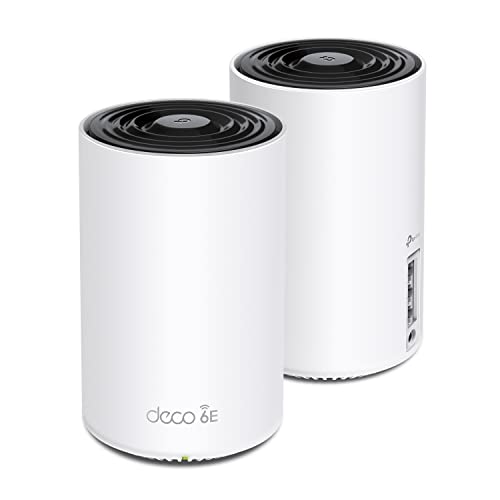
TP-Link Deco Tri-Band WiFi 6E 2-Pack
Best for: Users needing a 6 GHz backhaul
- Wi-Fi Standard
- Wi-Fi 6E (what this guide is about)
- Speed Rating
- AXE5400
- Coverage Area
- up to 5500 Sq.Ft
- Frequency Bands
- Tri-Band
- Pack Size
- 2-Pack
- Device Capacity
- 200 devices
View on Amazon: TP-Link Deco Tri-Band WiFi 6E 2-Pack Affiliate link
The TP-Link Deco XE75 is a Wi-Fi 6E tri-band mesh system in a 2-pack. It covers up to 5,500 square feet and supports 200 devices. The AXE5400 rating includes a dedicated 6 GHz band for stable backhaul. This setup eliminates interference from legacy devices. It suits households needing high capacity and clean spectrum for modern clients.
Pros
- Wi-Fi 6E tri-band architecture
- Dedicated 6 GHz backhaul band
- Covers up to 5,500 square feet
- Supports 200 connected devices
Cons
- Limited to Wi-Fi 6E standard
- No mention of Wi-Fi 7 support
- Physical dimensions are bulky
Good fit if
- You have many Wi-Fi 6E devices
- You need a 6 GHz backhaul
- You want to avoid legacy interference
Skip if
- You require Wi-Fi 7 speeds
- You only have Wi-Fi 6 clients
- You want the latest standard
Verdict: The TP-Link Deco XE75 2-Pack is a solid Wi-Fi 6E solution for users prioritizing a clean 6 GHz backhaul. It fits homes with many modern devices that benefit from reduced interference.
Specifications side by side
| Spec | TP-Link Deco WiFi 7 Dual-Band 2-Pack | TP-Link Deco Tri-Band WiFi 6E 2-Pack |
|---|---|---|
| Wi-Fi Standard | WiFi 7 | WiFi 6E |
| Speed Rating | BE5000 | AXE5400 |
| Coverage Area | 4,600 sq. ft. | up to 5500 Sq.Ft |
| Frequency Bands | Dual-Band | Tri-Band |
| Pack Size | 2-Pack | 2-Pack |
| Port Speed | 2.5G | not stated |
| Device Capacity | over 150 devices | 200 devices |
| Frequency Band | Dual-Band | Tri-Band |
| Use Case | not stated | Gaming, Streaming |
| Features | VPN, Mesh, Seamless Roaming | Mesh, WPA3 |
| Intended Use | not stated | Home |
| Placement | Indoor | not stated |
| Dimensions | 5.91 × 5.91 × 2.44 inches | 4.13 × 4.13 × 6.67 inches |
| Weight | 2.23 pounds | 2.69 pounds |
| Size | 2 Pack | 2 Pack |
| Color | White | Black and White |
| Model | Deco BE25(2-Pack) | Deco XE75(2-pack) |
Frequently asked questions
Is Wi-Fi 7 faster than Wi-Fi 6E for mesh systems?
Yes, Wi-Fi 7 offers higher potential speeds and efficiency. The TP-Link Deco BE25 uses the newer Wi-Fi 7 standard to deliver enhanced performance. Wi-Fi 6E systems like the Deco XE75 provide solid speeds but rely on older technology. The latest standard supports wider channels and better multi-device handling.
Do I need tri-band for Wi-Fi 6E mesh?
Tri-band is highly recommended for Wi-Fi 6E mesh systems. The Deco XE75 uses a dedicated 6 GHz band for backhaul. This separation reduces congestion between client devices and the router nodes. It ensures stable connections for modern devices that benefit from reduced interference in the home environment.
Can Wi-Fi 7 devices connect to Wi-Fi 6E nodes?
Yes, Wi-Fi 7 devices are backward compatible with Wi-Fi 6E nodes. However, they will not utilize Wi-Fi 7 specific features like MLO. To get the full benefits of the newer standard, all nodes in your mesh system must support Wi-Fi 7. Mixing standards limits your speed potential.
Which mesh system is better for large homes?
Both systems cover large areas, but they differ in approach. The Deco BE25 is designed for broad coverage with Wi-Fi 7 speeds. The Deco XE75 covers up to 5,500 square feet with tri-band isolation. Your choice depends on whether you prioritize the latest standard or dedicated backhaul bands for stability.
What is the physical size difference between these mesh nodes?
The nodes have different dimensions and weights. The Deco BE25 measures 5.91 inches in width and length, weighing 2.23 pounds. The Deco XE75 is taller at 6.67 inches but narrower at 4.13 inches, weighing 2.69 pounds. Consider your placement needs when choosing between the white BE25 or the black and white XE75.
Does Wi-Fi 7 support multiple connections simultaneously?
Yes, Wi-Fi 7 introduces Multi-Link Operation (MLO). This allows devices to connect on multiple bands simultaneously. It reduces latency and improves reliability compared to Wi-Fi 6E. The Deco BE25 leverages this technology for better performance in homes with many connected devices and high bandwidth demands.