TP-Link vs Linksys: WiFi Extenders Compared by Specs
As an Amazon Associate we earn from qualifying purchases. Links on this page are affiliate links.
You are comparing the TP-Link vs linksys wifi repeater options to decide which extender fits your home network. Both devices are dual-band Wi-Fi extenders with gigabit Ethernet ports. They aim to eliminate dead zones and improve coverage. The main difference lies in their speed ratings and coverage claims. TP-Link offers higher throughput with AC1750 speeds, while Linksys targets broader coverage with AC750 specs. You need to weigh speed against range for your specific layout.
Key differences
| Aspect | TP-Link AC1750 Dual-Band Wi-Fi Extender | Linksys AC750 Dual-Band Gigabit Extender |
|---|---|---|
| Wi-Fi Standard | Wi-Fi 5 | not listed |
| Speed Rating | AC1750 (Up to 1750Mbps) | AC750 (N300 + AC433 Mbps) |
| Coverage Area | Up to 2000 sq ft | Up to 6,500 sq ft |
| Antenna Count | 3 external | not listed |
| Ethernet Ports | Gigabit Ethernet port | Gigabit |
| Frequency Bands | Dual Band | Dual-Band |
Which one should you choose?
Choose TP-Link AC1750 Dual-Band Wi-Fi Extender if
- You prioritize higher data throughput for streaming or gaming on fewer devices
- You want a device with clearly listed external antennas for signal direction
- You need a Wi-Fi 5 extender with a stated device capacity of 32
Choose Linksys AC750 Dual-Band Gigabit Extender if
- You need to cover a larger area up to 6,500 square feet
- You prefer a lighter and more compact unit weighing 6.4 ounces
- You want simple setup features like Push Button Connect and Spot Finder
Verdict: Choose the TP-Link RE450 if your main goal is maximizing speed for connected devices in a moderate-sized space. Select the Linksys RE6300 if you need to stretch coverage over a much larger area, even at lower speeds. Both provide gigabit wired connections for stationary devices.
TP-Link vs Linksys Extender Specs
speed rating
The TP-Link RE450 offers a higher speed rating of AC1750. This combines 450Mbps on the 2.4GHz band and 1300Mbps on the 5GHz band. The Linksys RE6300 is rated at AC750. It provides 300Mbps on 2.4GHz and 433Mbps on 5GHz. Higher numbers mean faster potential throughput for connected devices. If you stream high-resolution video or game online, the TP-Link’s extra bandwidth reduces congestion. The Linksys handles basic browsing and standard streaming adequately. Choose the TP-Link for speed-critical tasks.
coverage area
Linksys claims a larger coverage area of up to 6,500 square feet. TP-Link lists coverage up to 2,000 square feet. This suggests the Linksys may reach further into large homes or multi-story layouts. However, actual performance depends on your router’s strength and physical obstructions. The TP-Link includes three external antennas, which may help direct signals more effectively than the Linksys internal design. For very large spaces, the Linksys specification is superior. For smaller apartments, both cover the area sufficiently.
wi-fi standard
The TP-Link RE450 uses Wi-Fi 5 technology. This standard supports MU-MIMO and better device handling than older versions. The Linksys RE6300 is an older AC750 model. It likely uses earlier Wi-Fi 5 iterations or legacy standards. Wi-Fi 5 provides more efficient data transmission when multiple devices connect simultaneously. The TP-Link’s modern standard ensures better compatibility with current smartphones and laptops. The Linksys may struggle with heavy device loads. Select the TP-Link for future-proofing your network infrastructure.
device capacity
The TP-Link RE450 supports up to 32 connected devices. The Linksys RE6300 does not list a specific device limit in its specifications. A defined capacity helps you plan for smart home hubs, phones, and tablets. The TP-Link’s 32-device limit covers most household needs without bottlenecking. If you have many IoT devices, the TP-Link provides a clear advantage. The Linksys may handle fewer devices efficiently due to its lower speed rating. Check your total device count before deciding.
build and setup
The TP-Link includes three adjustable external antennas for signal direction. It features a smart indicator light for optimal placement. The Linksys uses Push Button Connect and Spot Finder Technology. The Linksys is smaller and lighter at 6.4 ounces. The TP-Link is heavier at 12.3 ounces. External antennas on the TP-Link may offer better range adjustment. The Linksys’s compact size fits discreetly in tight spaces. Both have gigabit ethernet ports for wired connections. Choose the TP-Link for antenna control or the Linksys for compactness.
Which Extender Fits Your Needs
Users needing high throughput for streaming
The TP-Link RE450 delivers AC1750 speeds. Its 5GHz band offers up to 1300Mbps. This supports bandwidth-heavy tasks like 4K streaming. The three external antennas help maintain strong signals. You get reliable performance for multiple connected devices in a single room.
Those covering large or multi-story homes
The Linksys RE6300 covers up to 6,500 square feet. This is significantly larger than the TP-Link option. It is ideal for larger homes or areas with many obstacles. The Spot Finder technology helps you place it for maximum reach across wide spaces.
Buyers wanting a compact and lightweight unit
The Linksys extender weighs only 6.4 ounces. It is smaller and lighter than the TP-Link model. This makes it easier to hide in tight spaces or plug into wall outlets without blocking adjacent sockets. It fits discreetly into any home decor.
The products compared

TP-Link AC1750 Dual-Band Wi-Fi Extender
Best for: Medium homes needing wired device support
- Speed Rating
- AC1750 (Up to 1750Mbps)
- Frequency Bands
- Dual Band
- Coverage Area
- Up to 2000 sq ft
- Ethernet Ports
- Gigabit Ethernet port
- Antenna Count
- 3 external
- Wi-Fi Standard
- Wi-Fi 5
View on Amazon: TP-Link AC1750 Dual-Band Wi-Fi Extender Affiliate link
This TP-Link RE450 is a dual-band Wi-Fi 5 extender rated for AC1750 speeds. It covers up to 2000 square feet and supports 32 devices. The unit includes three external antennas and a gigabit Ethernet port for wired connections. It uses a smart indicator to help you find the best placement. This model is suitable for homes needing reliable coverage extension rather than raw speed boosts.
Pros
- AC1750 speed rating with 450Mbps on 2.4GHz and 1300Mbps on 5GHz
- Covers up to 2000 square feet of space
- Connects up to 32 devices simultaneously
- Includes one gigabit Ethernet port for wired devices
- Three adjustable external antennas for signal optimization
Cons
- Limited to Wi-Fi 5 standard instead of newer Wi-Fi 6
- Maximum device capacity is 32, which is lower than modern mesh nodes
- No mention of mobile app control in specifications
Good fit if
- You need to extend coverage to a 2000 square foot area
- You require a wired connection for a desktop or console
- You want a simple setup using signal indicator lights
Skip if
- You need support for more than 32 connected devices
- You require Wi-Fi 6 speeds for future-proofing
- You prefer app-based management over physical button setup
Verdict: TP-Link RE450 AC1750 Dual-Band Extender is a solid choice for users who need to cover a medium-sized home with a wired port option. It fits buyers who prioritize stable dual-band coverage over high device capacity or latest Wi-Fi standards.
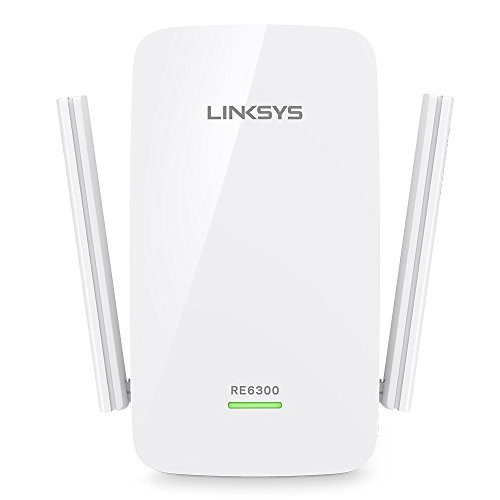
Linksys AC750 Dual-Band Gigabit Extender
Best for: Large homes needing basic dual-band coverage
- Speed Rating
- AC750 (N300 + AC433 Mbps)
- Frequency Bands
- Dual-Band
- Coverage Area
- Up to 6,500 sq ft
- Ethernet Ports
- Gigabit
- Operating Modes
- Range Extender, Repeater
- Dimensions
- 3.43 × 2.36 × 4.76 inches
View on Amazon: Linksys AC750 Dual-Band Gigabit Extender Affiliate link
The Linksys RE6300 is a dual-band AC750 range extender. It offers speeds up to N300 and AC433 Mbps. Coverage reaches up to 6,500 square feet. A single Gigabit Ethernet port connects wired devices. Setup uses Push Button Connect and Spot Finder Technology. This unit suits homes needing basic signal boosting in specific areas. It does not match the higher speed ratings of AC1750 competitors.
Pros
- Dual-band AC750 speeds (N300 + AC433 Mbps)
- Coverage up to 6,500 square feet
- Gigabit Ethernet port for wired connections
- Spot Finder Technology for optimal placement
Cons
- Lower AC750 speed rating compared to AC1750 competitors
- Only one Gigabit Ethernet port
- 90-day warranty on refurbished units
Good fit if
- You need to cover dead zones in a large home
- You want simple push-button setup without complex configuration
- You require a wired connection for a stationary device
Skip if
- You need high-speed AC1750 or AC1900 performance
- You want to manage settings remotely via a mobile app
- You prefer a new unit with a full manufacturer warranty
Verdict: Linksys RE6300 Dual-Band Extender covers large areas with basic dual-band speeds. It fits users who prioritize coverage range over raw throughput and wired port availability.
Specifications side by side
| Spec | TP-Link AC1750 Dual-Band Wi-Fi Extender | Linksys AC750 Dual-Band Gigabit Extender |
|---|---|---|
| Speed Rating | AC1750 (Up to 1750Mbps) | AC750 (N300 + AC433 Mbps) |
| Frequency Bands | Dual Band | Dual-Band |
| Coverage Area | Up to 2000 sq ft | Up to 6,500 sq ft |
| Ethernet Ports | Gigabit Ethernet port | Gigabit |
| Operating Modes | not stated | Range Extender, Repeater |
| Antenna Count | 3 external | not stated |
| Wi-Fi Standard | Wi-Fi 5 | not stated |
| Frequency Band | Dual-Band | Dual-Band |
| Port Speed | not stated | Gigabit |
| Dimensions | 3 × 6.4 × 2.6 inches | 3.43 × 2.36 × 4.76 inches |
| Weight | 12.3 ounces | 6.4 ounces |
| Size | AC1750 | re6300-rm3 For US Only |
| Color | White | For Canada Only |
| Model | RE450 | RE6300-RM |
Frequently asked questions
Which extender covers a larger area?
The Linksys RE6300 is designed for large homes needing basic dual-band coverage. Its AC750 rating prioritizes range over raw throughput. The TP-Link RE450 targets medium-sized homes. It focuses on stable dual-band coverage and wired device support. Choose the Linksys if you need broader reach for basic tasks.
Do both devices have Ethernet ports?
Yes, both extenders include wired connectivity options. The Linksys RE6300 features a Gigabit Ethernet port. This allows you to connect devices like smart TVs or gaming consoles directly. The TP-Link RE450 also includes a wired port. This supports stable connections for devices that benefit from a hardline link.
Which model is more compact?
The Linksys RE6300 is the smaller unit. It measures 2.36 inches wide and weighs 6.4 ounces. The TP-Link RE450 is larger, measuring 6.4 inches wide and weighing 12.3 ounces. If space is limited, the Linksys design fits more easily into tight outlets or small shelves.
Can I use these for 4K streaming?
The TP-Link RE450 is better suited for 4K streaming. It offers AC1750 speeds with 1300Mbps on the 5GHz band. This handles bandwidth-heavy tasks effectively. The Linksys RE6300 provides AC750 speeds. It is rated for basic coverage rather than high throughput, making it less ideal for heavy streaming.
What Wi-Fi standard do they use?
Both extenders use Wi-Fi 5 technology. They operate on dual-band frequencies, supporting both 2.4GHz and 5GHz networks. This ensures compatibility with most modern devices. Neither model supports the newer Wi-Fi 6 standard. You get reliable dual-band performance for everyday internet usage on both devices.
Which is better for wired connections?
The TP-Link RE450 is the better choice for wired device support. It is specifically noted as ideal for users needing to connect wired devices. The Linksys RE6300 also has a Gigabit port but is marketed for large area coverage. If your priority is connecting multiple wired gadgets, the TP-Link fits that need.
Are they dual-band extenders?
Yes, both the TP-Link RE450 and Linksys RE6300 are dual-band Wi-Fi extenders. They broadcast signals on both 2.4GHz and 5GHz bands. This helps reduce interference and provides flexibility for different devices. You can connect older devices to the 2.4GHz band and newer ones to the faster 5GHz band.