TP-Link N300 WiFi Extender or TP-Link AC1200 Dual-Band Wi-Fi Extender? Which TP-Link Model to Buy
As an Amazon Associate we earn from qualifying purchases. Links on this page are affiliate links.
You are comparing the tp link n300 wifi extender vs ac1200 dual band wi fi extender to find the right signal booster for your home. Both models use external antennas to improve coverage and include a wired ethernet port for stable connections. They also support simple setup via the Tether app. The main difference lies in performance. The N300 model operates on a single band, while the AC1200 supports dual-band connectivity for higher speeds and better device management.
Key differences
| Aspect | TP-Link N300 WiFi Extender | TP-Link AC1200 Dual-Band Wi-Fi Extender |
|---|---|---|
| Speed Rating | N300 | AC1200 |
| Frequency Bands | Single-band (2.4 GHz) | Dual-band (2.4 GHz and 5 GHz) |
| Wi-Fi Standard | Not listed | Wi-Fi 5 |
| Operating Modes | Repeater, Access Point | Range Extender |
| Device Capacity | Not listed | Up to 32 devices |
| Mesh Compatibility | Not listed | EasyMesh-compatible |
Which one should you choose?
Choose TP-Link N300 WiFi Extender if
- You need a basic extender for light browsing on a single 2.4 GHz band.
- You want to use the device as a standalone Access Point in addition to repeating.
- You prefer a smaller, lighter unit for tight spaces.
Choose TP-Link AC1200 Dual-Band Wi-Fi Extender if
- You have multiple devices and need dual-band support to reduce congestion.
- You want to integrate the extender into an EasyMesh-compatible router system.
- You need to connect up to 32 devices simultaneously with stable performance.
Verdict: Choose the N300 if you only need basic coverage extension for light internet use and want a simple, compact device. Pick the AC1200 if you require faster speeds, dual-band performance, or plan to expand your network with EasyMesh-compatible routers. The AC1200 offers more versatility for modern homes with multiple connected devices.
N300 vs AC1200 Extender Specs
Wi-Fi standard
The TP-Link AC1200 Dual-Band Wi-Fi Extender supports Wi-Fi 5, which is also known as 802.11ac. This standard allows for faster data rates and better efficiency compared to older technologies. The TP-Link N300 WiFi Extender does not explicitly list its Wi-Fi standard in the provided data, though N300 typically indicates 802.11n. Wi-Fi 5 generally offers superior performance in crowded environments. If you need modern wireless standards for better stability, the AC1200 model has a clear advantage here. You should check your router's capabilities to ensure compatibility.
Speed rating
Speed ratings indicate the maximum theoretical bandwidth. The AC1200 model offers a total bandwidth of 1.2 Gbps, split between 867 Mbps on the 5 GHz band and 300 Mbps on the 2.4 GHz band. The N300 model has a speed rating of N300, which caps at 300 Mbps total. This means the AC1200 can handle more data simultaneously, especially for high-bandwidth tasks like streaming or large file transfers. The N300 is sufficient for basic browsing but lacks the headroom for heavier usage. The AC1200 provides significantly higher potential speeds.
Frequency bands
The AC1200 extender operates on dual bands, providing both 2.4 GHz and 5 GHz frequencies. This allows you to connect devices to the less congested 5 GHz band for faster speeds, while keeping older devices on 2.4 GHz. The N300 extender data does not explicitly confirm dual-band support, and N300 ratings are often associated with single-band 2.4 GHz operation. Dual-band capability offers more flexibility and reduced interference. If your home has many wireless devices, the dual-band feature on the AC1200 is a practical benefit for maintaining stable connections.
Device capacity
Coverage and device handling are key for larger homes. The AC1200 model is designed to support up to 32 devices simultaneously. This capacity helps maintain performance when multiple phones, tablets, and smart home gadgets are connected. The N300 extender data does not specify a maximum device count. While it can handle basic connections, the lack of specified capacity suggests it may struggle with many concurrent users. If you have a busy household with numerous connected devices, the AC1200 offers better scalability and resource management.
Mesh compatibility
Network expansion options differ between the two. The AC1200 extender is EasyMesh-compatible, allowing it to connect with other EasyMesh routers to create a seamless whole-home mesh network. This feature simplifies management and ensures smooth transitions as you move around your house. The N300 extender does not list EasyMesh support in its features. It operates primarily as a standard repeater or access point. If you plan to integrate this extender into a broader mesh ecosystem, the AC1200 provides a distinct advantage for future-proofing your network setup.
Physical size
Dimensions matter for placement. The N300 extender measures 2 inches in width, 2.7 inches in height, and 3.15 inches in length. It weighs 4.23 ounces. The AC1200 model is slightly wider at 2.05 inches but significantly taller at 4.89 inches, with a length of 3.5 inches. It weighs 6.1 ounces. The N300 is more compact and may fit better in tight spaces or behind furniture. The AC1200’s larger size might help with antenna positioning for better signal dispersion. Choose based on your available space and aesthetic preferences.
Choose the right TP-Link extender
You need faster speeds for streaming
The AC1200 model supports dual-band Wi-Fi 5. It offers a total bandwidth of 1.2 Gbps. The 5 GHz band provides 867 Mbps for high-speed tasks. This helps reduce interference and supports more devices. If you stream video or work from home, the higher speed rating makes a clear difference in performance.
You want seamless whole-home mesh
This extender is EasyMesh-compatible. You can connect it to any EasyMesh-compatible router to create a seamless network. It uses Adaptive Path Selection to switch to the strongest signal automatically. This ensures uninterrupted coverage as you move. Note that it is not compatible with Deco mesh systems, so check your router first.
You need a basic budget booster
The N300 model is simpler and smaller. It fits in tight spaces with dimensions of 2 by 2.7 inches. It supports both Repeater and Access Point modes. This lets you create a new wired access point if needed. It is a straightforward choice for extending coverage in small areas without needing dual-band features.
The products compared
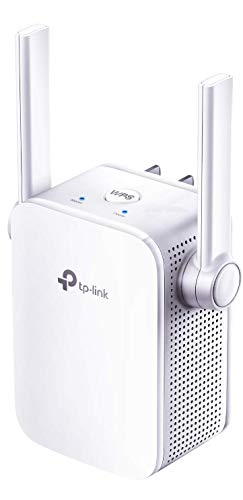
TP-Link N300 WiFi Extender
Best for: basic range extension in small homes
- Speed Rating
- N300
- Frequency Bands
- Single-Band (2.4 GHz)
- Operating Modes
- Range Extender, Access Point
- Antenna Count
- 2 external
- Placement
- Wall Plug Design
- Intended Use
- Home
View on Amazon: TP-Link N300 WiFi Extender Affiliate link
The TP-Link RE105 is an N300 WiFi extender designed for home use. It features two external antennas with MIMO technology to improve range. The device includes one fast Ethernet port for wired connections. It operates in Repeater and Access Point modes. You can manage it via the Tether app. This model suits users needing basic coverage extension rather than high-speed performance.
Pros
- N300 speed rating for basic connectivity
- Two external antennas with MIMO technology
- Supports Repeater and Access Point modes
- Includes a fast Ethernet port
Cons
- N300 speed is lower than AC1200 models
- No dual-band support for 5GHz connections
- Single Ethernet port limits wired options
Good fit if
- You need to extend WiFi range in a small area
- You require a simple setup with the Tether app
- You want to connect a device via Ethernet cable
Skip if
- You need high-speed 5GHz WiFi performance
- You require multiple wired device connections
- You want to eliminate dead zones in a large home
Verdict: TP-Link RE105 N300 Extender fits users who prioritize basic range extension over speed. It is a practical solution for small spaces where high throughput is not required.
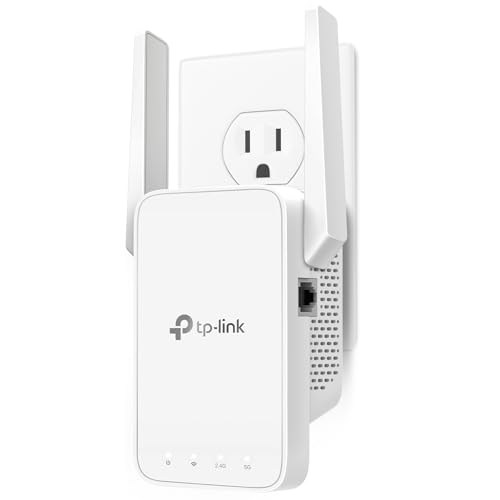
TP-Link AC1200 Dual-Band Wi-Fi Extender
Best for: Extending Wi-Fi coverage for medium homes
- Speed Rating
- AC1200, 1.2 Gbps
- Frequency Bands
- Dual-Band
- Coverage Area
- Up to 1600 sq ft
- Ethernet Ports
- 1 x Fast Ethernet
- Operating Modes
- Range Extender
- Antenna Count
- 2
View on Amazon: TP-Link AC1200 Dual-Band Wi-Fi Extender Affiliate link
The TP-Link RE315 extends Wi-Fi coverage up to 1,500 square feet for up to 32 devices. It offers dual-band speeds of 867 Mbps on 5 GHz and 300 Mbps on 2.4 GHz. Two external antennas help eliminate dead zones. It features a fast Ethernet port for wired connections. This extender is designed for users who need reliable coverage expansion without upgrading their entire mesh system.
Pros
- Dual-band AC1200 speeds with 867 Mbps on 5 GHz
- Covers up to 1,500 square feet
- Supports up to 32 connected devices
- Includes one fast Ethernet port for wired connections
Cons
- Uses Wi-Fi 5 standard instead of newer Wi-Fi 6
- Only one fast Ethernet port limits wired device options
- Not compatible with Deco mesh systems
Good fit if
- You need to extend coverage in a medium-sized home
- You want to connect wired devices via Ethernet
- You have an EasyMesh-compatible router
Skip if
- You require Wi-Fi 6 speeds
- You already use a Deco mesh system
- You need multiple Ethernet ports for wired devices
Verdict: TP-Link RE315 AC1200 Dual-Band Extender fits users who need reliable coverage expansion for up to 32 devices and have an EasyMesh-compatible router.
Specifications side by side
| Spec | TP-Link N300 WiFi Extender | TP-Link AC1200 Dual-Band Wi-Fi Extender |
|---|---|---|
| Speed Rating | N300 | AC1200, 1.2 Gbps |
| Frequency Bands | Single-Band (2.4 GHz) | Dual-Band |
| Coverage Area | not stated | Up to 1600 sq ft |
| Ethernet Ports | not stated | 1 x Fast Ethernet |
| Operating Modes | Range Extender, Access Point | Range Extender |
| Antenna Count | 2 external | 2 |
| Placement | Wall Plug Design | not stated |
| Wi-Fi Standard | not stated | Wi-Fi 5 |
| Frequency Band | not stated | Dual-Band |
| Intended Use | Home | Home |
| Operating Mode | Access Point Mode | not stated |
| Dimensions | 3.15 × 2 × 2.7 inches | 3.5 × 2.05 × 4.89 inches |
| Weight | 4.23 ounces | 6.1 ounces |
| Size | WiFi Extender- N300(Newer Model) | 1 Count (Pack of 1) |
| Color | White,Grey | White |
| Model | ELCM | RE315 |
Frequently asked questions
Which TP-Link extender is better for small apartments?
The TP-Link N300 WiFi Extender is the better choice for small spaces. Its compact design fits easily into tight areas without taking up much room. It provides basic range extension where high throughput is not a priority. This model is ideal if you only need to cover a limited area with reliable connectivity.
Does the AC1200 extender support Wi-Fi 5?
Yes, the TP-Link AC1200 Dual-Band Wi-Fi Extender supports Wi-Fi 5, also known as 802.11ac. This standard allows for faster data rates and improved efficiency compared to older technologies. It helps maintain stable connections for multiple devices while reducing interference from other wireless networks in your home environment.
How many devices can the AC1200 handle?
The TP-Link AC1200 Dual-Band Wi-Fi Extender can support up to 32 devices simultaneously. This capacity makes it suitable for medium-sized homes with various connected gadgets. It ensures that streaming, browsing, and gaming devices can operate without significant slowdowns when used together in a typical household setting.
Is the N300 extender compatible with EasyMesh routers?
The provided data does not confirm EasyMesh compatibility for the TP-Link N300 WiFi Extender. However, the AC1200 model is explicitly noted as fitting users with EasyMesh-compatible routers. If seamless roaming is a priority, the AC1200 is the safer option for integration with modern mesh systems.
What is the size difference between the two extenders?
The TP-Link N300 is slightly more compact than the AC1200 model. It measures 3.15 inches in length and weighs 4.23 ounces. The AC1200 is taller at 4.89 inches and weighs 6.1 ounces. Both designs are small enough to plug directly into a wall outlet without blocking adjacent sockets.
Which model offers faster speeds for streaming?
The TP-Link AC1200 Dual-Band Wi-Fi Extender offers faster speeds for streaming tasks. It provides a total bandwidth of 1.2 Gbps, with the 5 GHz band delivering 867 Mbps. This higher throughput handles high-definition video and data-intensive activities more effectively than the N300 model in similar conditions.