TP-Link AC1750 Dual-Band Wi-Fi Extender or TP-Link N300 WiFi Extender? Which TP-Link Model to Buy
As an Amazon Associate we earn from qualifying purchases. Links on this page are affiliate links.
When you compare the tp link ac1750 wifi extender vs n300 wifi extender, you are looking at two distinct performance tiers. Both models extend your home network and include external antennas for better signal reach. The main difference lies in speed and band support. The AC1750 uses Wi-Fi 5 with dual bands for higher throughput, while the N300 relies on older single-band technology. This affects how many devices each can handle comfortably.
Key differences
| Aspect | TP-Link AC1750 Dual-Band Wi-Fi Extender | TP-Link N300 WiFi Extender |
|---|---|---|
| Wi-Fi Standard | Wi-Fi 5 | Not listed |
| Speed Rating | AC1750 (Up to 1750Mbps) | N300 |
| Frequency Bands | Dual Band | Not listed |
| Coverage Area | Up to 2000 sq ft | Not listed |
| Antenna Count | 3 external | 2 external |
| Ethernet Ports | Gigabit Ethernet port | Fast Ethernet port |
Which one should you choose?
Choose TP-Link AC1750 Dual-Band Wi-Fi Extender if
- You need to support high-bandwidth activities like 4K streaming or online gaming
- You want to connect more devices without slowing down the network
- You require a Gigabit Ethernet port for wired connections
Choose TP-Link N300 WiFi Extender if
- You have a tight budget and only need basic internet access
- You want to use the extender as a dedicated Access Point
- You only need to cover a small area with light usage
Verdict: The AC1750 is the better choice for most homes due to its dual-band support and faster Wi-Fi 5 standard. It handles more devices and provides a more reliable connection for modern demands. The N300 is suitable only for very light users or as a simple access point.
AC1750 vs N300 Specs Comparison
Speed rating
The TP-Link AC1750 Dual-Band Wi-Fi Extender offers significantly higher throughput than the TP-Link N300 WiFi Extender. The AC1750 model, identified as the RE450, supports speeds up to 1750Mbps across its dual bands. Specifically, it provides 450Mbps on the 2.4GHz band and 1300Mbps on the 5GHz band. In contrast, the N300 model, known as the RE105, is rated for N300 speeds. This older standard typically caps total throughput at 300Mbps. If you need fast internet for streaming or gaming, the AC1750 provides much more bandwidth headroom for your devices.
Frequency band
Band support is a major differentiator between these two extenders. The TP-Link AC1750 is a dual-band device, meaning it broadcasts on both 2.4GHz and 5GHz frequencies. This allows you to connect devices to the less congested 5GHz band for better performance. The TP-Link N300 WiFi Extender is a single-band device, operating only on the 2.4GHz frequency. While 2.4GHz has better range through walls, it is slower and more prone to interference. The AC1750 gives you the flexibility to choose the best band for your specific connection needs.
Coverage area
Coverage capabilities differ based on the hardware inside each unit. The TP-Link AC1750 Dual-Band Wi-Fi Extender is designed to boost coverage up to 2000 square feet. This larger footprint is supported by its higher power and dual-band architecture. The TP-Link N300 WiFi Extender does not list a specific square footage rating in its published specifications. However, it features two external antennas with MIMO technology to improve range compared to standard models. For larger homes or offices, the AC1750’s specified 2000 sq ft range is a clear advantage.
Ethernet ports
Both models include a wired connection option for devices that benefit from stability. The TP-Link AC1750 features a Gigabit Ethernet port. This port supports speeds up to 1000Mbps, allowing you to connect gaming consoles or desktops at high speeds. The TP-Link N300 WiFi Extender includes a Fast Ethernet port. This port typically maxes out at 100Mbps. If you have a gigabit internet plan or transfer large files locally, the AC1750’s Gigabit port ensures you do not bottleneck your wired connection. The N300’s port is sufficient for basic web browsing.
Device capacity
Handling multiple devices is important for modern smart homes. The TP-Link AC1750 Dual-Band Wi-Fi Extender can connect up to 32 devices simultaneously. This capacity supports phones, tablets, smart speakers, and streaming sticks without significant slowdowns. The TP-Link N300 WiFi Extender does not specify a maximum device count in its data. Given its lower N300 speed rating and single-band nature, it may struggle more with multiple active connections. The AC1750 is better suited for households with many connected gadgets.
Operating modes
Flexibility in how you use the extender varies between the two. The TP-Link N300 WiFi Extender explicitly supports two operating modes: Repeater mode and Access Point (AP) mode. In AP mode, it creates a new Wi-Fi network, which is useful for wired backhaul setups. The TP-Link AC1750 Dual-Band Wi-Fi Extender is primarily described as a repeater that extends existing coverage. While it likely supports AP mode, the N300 highlights this feature more prominently. If you need to create a separate wired access point, the N300’s documented support is a practical advantage.
Choose based on your speed needs
Users needing high speed for streaming
The AC1750 model supports dual-band Wi-Fi 5, delivering up to 1750Mbps total throughput. It includes a gigabit Ethernet port for wired connections, ensuring stable performance for gaming or 4K streaming. The three external antennas help maintain strong signals across larger areas up to 2000 square feet, making it ideal for modern, bandwidth-heavy households.
Budget buyers with light internet habits
The N300 model offers a simpler solution for basic connectivity needs. It provides N300 speeds via dual-band support and includes two external antennas for improved range. The device supports both repeater and access point modes, allowing flexibility in setup. Its compact size and lightweight design make it suitable for small apartments or rooms requiring extended Wi-Fi coverage.
People connecting multiple wired devices
If you need to connect desktops or consoles via cable, the AC1750 is the better choice. It features a dedicated gigabit Ethernet port, providing higher wired speeds than the N300's standard fast Ethernet port. This spec ensures that wired devices receive the maximum possible throughput from your internet plan, reducing latency for sensitive applications like online gaming.
Those wanting easy setup with an app
The N300 model explicitly supports management via the TP-Link Tether app for Android and iOS. It includes an intelligent signal indicator to help you find the optimal placement. While the AC1750 also has a smart indicator, the N300’s app integration and straightforward repeater or access point modes offer a user-friendly experience for managing your network settings remotely.
The products compared

TP-Link AC1750 Dual-Band Wi-Fi Extender
Best for: Medium homes needing wired device connections
- Speed Rating
- AC1750 (Up to 1750Mbps)
- Frequency Bands
- Dual Band
- Coverage Area
- Up to 2000 sq ft
- Ethernet Ports
- Gigabit Ethernet port
- Antenna Count
- 3 external
- Wi-Fi Standard
- Wi-Fi 5
View on Amazon: TP-Link AC1750 Dual-Band Wi-Fi Extender Affiliate link
This TP-Link RE450 is a dual-band Wi-Fi 5 extender rated at AC1750. It covers up to 2000 square feet and connects up to 32 devices. The unit features three external antennas and a gigabit Ethernet port for wired connections. It includes a smart indicator light to help you find the optimal placement. This model suits users who need reliable coverage for streaming, gaming, and general web browsing in medium-sized homes.
Pros
- AC1750 speed rating with 450Mbps on 2.4GHz and 1300Mbps on 5GHz
- Covers up to 2000 square feet of space
- Includes one gigabit Ethernet port for wired devices
- Three external antennas for improved signal strength
- Supports up to 32 connected devices
Cons
- Wi-Fi 5 standard lacks the efficiency of newer Wi-Fi 6 models
- Maximum capacity limited to 32 connected devices
- No mention of modern security protocols like WPA3 in the data
Good fit if
- You need to cover a medium-sized area up to 2000 square feet
- You want to connect wired devices via the gigabit Ethernet port
- You require strong signal stability for streaming and gaming
Skip if
- You need to support more than 32 devices simultaneously
- You require the latest Wi-Fi 6 or Wi-Fi 6E speeds
- You have a very large home exceeding 2000 square feet
Verdict: TP-Link RE450 AC1750 Extender is a solid choice for users who need to extend coverage to medium-sized rooms and connect a few wired devices. It offers reliable performance for standard internet tasks without requiring complex setup.
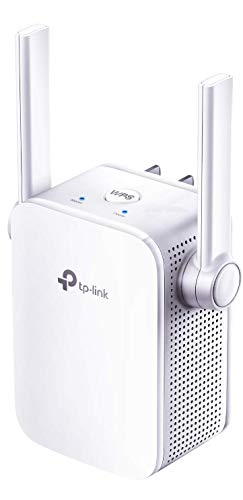
TP-Link N300 WiFi Extender
Best for: small homes needing basic 2.4 GHz boosting
- Speed Rating
- N300
- Frequency Bands
- Single-Band (2.4 GHz)
- Operating Modes
- Range Extender, Access Point
- Antenna Count
- 2 external
- Placement
- Wall Plug Design
- Intended Use
- Home
View on Amazon: TP-Link N300 WiFi Extender Affiliate link
The TP-Link N300 RE105 extends Wi-Fi coverage using two external antennas and MIMO technology. It operates in Repeater or Access Point modes and includes a fast Ethernet port for wired connections. This compact white and grey unit is designed for home use. It suits you if you need basic signal boosting in a small area. The device connects via the Tether app for setup and management.
Pros
- Two external antennas with MIMO for improved range
- Supports Repeater and Access Point operating modes
- Includes a fast Ethernet port for wired devices
- Compact size at 3.15 inches in length
Cons
- N300 speed rating is slower than AC1750 models
- No dual-band capability for 5 GHz networks
- Single fast Ethernet port limits wired connections
Good fit if
- You need a simple extender for a small room
- You only require 2.4 GHz Wi-Fi coverage
- You want a budget-friendly option for basic boosting
Skip if
- You need high-speed 5 GHz connectivity
- You require multiple wired device connections
- You have a large home needing strong range
Verdict: TP-Link N300 RE105 Extender is a basic solution for small spaces. It fits you if you only need 2.4 GHz coverage and simple setup.
Specifications side by side
| Spec | TP-Link AC1750 Dual-Band Wi-Fi Extender | TP-Link N300 WiFi Extender |
|---|---|---|
| Speed Rating | AC1750 (Up to 1750Mbps) | N300 |
| Frequency Bands | Dual Band | Single-Band (2.4 GHz) |
| Coverage Area | Up to 2000 sq ft | not stated |
| Ethernet Ports | Gigabit Ethernet port | not stated |
| Operating Modes | not stated | Range Extender, Access Point |
| Antenna Count | 3 external | 2 external |
| Placement | not stated | Wall Plug Design |
| Wi-Fi Standard | Wi-Fi 5 | not stated |
| Frequency Band | Dual-Band | not stated |
| Intended Use | not stated | Home |
| Operating Mode | not stated | Access Point Mode |
| Dimensions | 3 × 6.4 × 2.6 inches | 3.15 × 2 × 2.7 inches |
| Weight | 12.3 ounces | 4.23 ounces |
| Size | AC1750 | WiFi Extender- N300(Newer Model) |
| Color | White | White,Grey |
| Model | RE450 | ELCM |
Frequently asked questions
Which TP-Link extender is better for a medium-sized home?
The TP-Link AC1750 Dual-Band Wi-Fi Extender is the better choice for medium-sized homes. It supports dual-band Wi-Fi 5, providing higher speeds and better coverage for larger spaces. The N300 model is designed for small homes and basic 2.4 GHz boosting, which may not suffice for larger areas.
Does the TP-Link AC1750 have an Ethernet port?
Yes, the TP-Link AC1750 includes a gigabit Ethernet port. This allows you to connect wired devices directly for stable performance during gaming or 4K streaming. The N300 extender does not feature this port, limiting its use to wireless connections only.
What is the speed difference between the AC1750 and N300?
The AC1750 offers significantly higher throughput, reaching up to 1750Mbps total. It splits this between 450Mbps on the 2.4GHz band and 1300Mbps on the 5GHz band. The N300 model provides much lower speeds, suitable only for basic internet tasks in small spaces.
Can the N300 extender connect to 5GHz networks?
No, the TP-Link N300 WiFi Extender is limited to the 2.4 GHz band. It is intended for small homes needing basic coverage. If you require 5GHz support for faster speeds and less interference, you must choose the dual-band AC1750 model instead.
Which model is smaller and lighter?
The TP-Link N300 is more compact and lighter. It weighs 4.23 ounces and measures 2 by 2.7 by 3.15 inches. The AC1750 is larger, weighing 12.3 ounces with dimensions of 6.4 by 2.6 by 3 inches, making it better suited for permanent placement.
Is the AC1750 good for gaming?
Yes, the AC1750 is suitable for gaming due to its high speed and wired connectivity. It delivers up to 1750Mbps and includes a gigabit Ethernet port for stable connections. The N300 lacks the speed and wired options needed for reliable gaming performance.