Linksys AC750 Dual-Band Gigabit Extender vs Linksys AX1800 Dual-Band Wi-Fi 6: Spec Comparison
As an Amazon Associate we earn from qualifying purchases. Links on this page are affiliate links.
This comparison covers the Linksys AC750 Boost Dual-Band Wi-Fi vs RE7350 Dual-Band Wi-Fi 6. Both devices are certified refurbished range extenders with gigabit Ethernet ports. They share dual-band operation to reduce interference. The main difference is the Wi-Fi standard. The AC750 uses older AC technology for broader coverage. The RE7350 uses modern Wi-Fi 6 for higher speeds in smaller areas. You must choose between range and efficiency.
Key differences
| Aspect | Linksys AC750 Dual-Band Gigabit Extender | Linksys AX1800 Dual-Band Wi-Fi 6 Extender |
|---|---|---|
| Wi-Fi Standard | Wi-Fi 5 (AC) | Wi-Fi 6 (AX) |
| Speed Rating | AC750 (300 + 433 Mbps) | AX1800 (up to 1.8 Gbps) |
| Coverage Area | Up to 6,500 sq ft | Up to 2,000 sq ft |
| Operating Modes | Range Extender, Repeater | Range Extender |
Which one should you choose?
Choose Linksys AC750 Dual-Band Gigabit Extender if
- You need to cover a large home with many dead zones
- You want the flexibility to use the device as a repeater
- Your existing devices do not require Wi-Fi 6 speeds
Choose Linksys AX1800 Dual-Band Wi-Fi 6 Extender if
- You want the latest Wi-Fi 6 standard for better efficiency
- You primarily need to boost signal in a smaller area
- You prefer higher theoretical speeds for nearby devices
Verdict: The AC750 is the better choice for large spaces because its wider coverage area reaches further. The RE7350 suits smaller areas where you want the efficiency and speed of Wi-Fi 6. Choose the AC750 for range and the RE7350 for modern performance.
Spec Comparison: AC750 vs AX1800
Wi-Fi Standard
The Linksys AX1800 uses Wi-Fi 6, a modern standard that improves efficiency in crowded networks. This technology helps manage multiple devices better than older protocols. The Linksys AC750 relies on Wi-Fi 5 (802.11ac). While reliable, it lacks the advanced scheduling and efficiency features of Wi-Fi 6. If you have many connected gadgets, the newer standard provides smoother performance. The older standard is sufficient for basic browsing but may struggle with heavy loads. Choose the AX1800 for future-proofing and better multi-device handling.
Speed Rating
Linksys rates the AX1800 at AX1800, combining speeds up to 1.8 Gbps. This higher theoretical maximum supports faster data transfer for streaming and large file downloads. The AC750 is rated at AC750, offering up to 300 Mbps on the 2.4 GHz band and 433 Mbps on the 5 GHz band. While adequate for HD video, it caps out significantly lower than the AX1800. For users with gigabit internet plans, the AX1800 prevents bottlenecks. The AC750 is best for slower internet connections or light usage tasks.
Coverage Area
The AC750 claims coverage up to 6,500 square feet. This large range makes it suitable for extending signal to distant areas like patios or garages. The AX1800 lists coverage up to 2,000 square feet. This smaller footprint focuses on delivering stronger speeds closer to the main router. If you need to cover a very large property, the AC750 offers greater reach. However, the AX1800 likely provides a more stable connection within its smaller zone due to newer technology. Consider your home size carefully before choosing.
Frequency Band
Both devices operate on dual bands, transmitting on 2.4 GHz and 5 GHz simultaneously. This allows you to connect devices to the band that best fits their needs. The 2.4 GHz band offers better range through walls, while the 5 GHz band provides faster speeds with less interference. Since both products share this feature, neither has an advantage here. You get the flexibility to manage network traffic on both devices equally. This is a standard feature for modern extenders and works well for most households.
Ethernet Ports
Both extenders include a single Gigabit Ethernet port. This allows you to connect wired devices like smart TVs or gaming consoles directly to the extender. The port speed is identical on both models, supporting high-speed wired connections. The AC750 and AX1800 do not list additional ports in their specifications. You can only wire up one device per extender. This limitation applies to both products equally. If you need more wired connections, you will require a separate switch. The port quality is comparable across both units.
Choose the right Linksys extender for your home
Users needing maximum coverage area
The Linksys AC750 extends signal up to 6,500 square feet. This larger coverage area helps eliminate dead zones in bigger homes or multi-story properties. If your main concern is reaching distant rooms or outdoor spaces like patios and garages, this model provides the broader range needed for consistent connectivity across a larger footprint.
Users wanting faster Wi-Fi 6 speeds
The Linksys AX1800 supports Wi-Fi 6 and delivers speeds up to 1.8 Gbps. This modern standard improves efficiency when multiple devices connect simultaneously. If you prioritize higher data rates and better performance in crowded networks, this extender offers the advanced technology required for smoother streaming and faster file transfers.
Users with smaller living spaces
For apartments or smaller homes, the AX1800 covers up to 2,000 square feet. This size is sufficient for most compact layouts while providing Wi-Fi 6 benefits. You get efficient dual-band operation and a gigabit Ethernet port for wired connections, ensuring reliable performance without the excess range of larger models.
The products compared
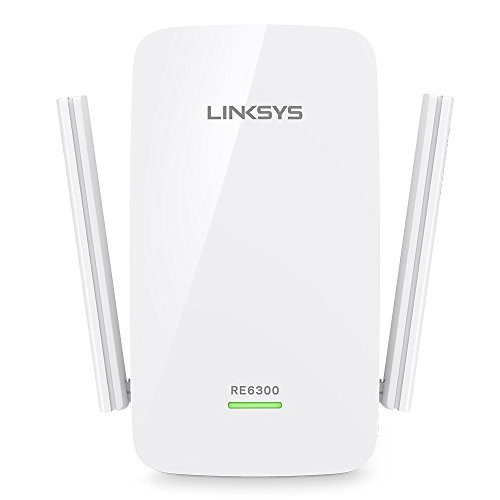
Linksys AC750 Dual-Band Gigabit Extender
Best for: Basic dual-band coverage and wired connections
- Speed Rating
- AC750 (N300 + AC433 Mbps)
- Frequency Bands
- Dual-Band
- Coverage Area
- Up to 6,500 sq ft
- Ethernet Ports
- Gigabit
- Operating Modes
- Range Extender, Repeater
- Dimensions
- 3.43 × 2.36 × 4.76 inches
View on Amazon: Linksys AC750 Dual-Band Gigabit Extender Affiliate link
The Linksys RE6300 is a dual-band range extender rated for AC750 speeds. It combines N300 and AC433 Mbps bands to cover up to 6,500 square feet. The device includes one Gigabit Ethernet port and uses Push Button Connect for setup. It weighs 6.4 ounces and measures 2.36 by 3.43 by 4.76 inches. This unit suits users needing basic signal boosting for older devices.
Pros
- Dual-band AC750 speed rating
- Gigabit Ethernet port
- Push Button Connect setup
- Spot Finder Technology for placement
Cons
- No Wi-Fi 6 support
- 90-day warranty only
- No mobile app mentioned
Good fit if
- You need to cover dead zones in a small to medium home
- You want a simple plug-in extender with a wired port
- You prioritize basic reliability over high-speed standards
Skip if
- You require Wi-Fi 6 speeds
- You need coverage for very large homes
- You want a longer warranty period
Verdict: Linksys RE6300 AC750 Dual-Band Extender fits users who need basic dual-band coverage and a wired port. It is a practical solution for eliminating dead zones in homes with older devices.

Linksys AX1800 Dual-Band Wi-Fi 6 Extender
Best for: Medium spaces needing Wi-Fi 6 boost
- Wi-Fi Standard
- Wi-Fi 6
- Speed Rating
- AX1800
- Frequency Bands
- Dual-Band
- Coverage Area
- Up to 2,000 sq. ft.
- Ethernet Ports
- 1x Gigabit
- Operating Modes
- Range Extender
View on Amazon: Linksys AX1800 Dual-Band Wi-Fi 6 Extender Affiliate link
The Linksys RE7350 is a dual-band Wi-Fi 6 range extender designed to boost signal in areas your main router cannot reach. It supports AX1800 speeds up to 1.8 Gbps across 2.4 GHz and 5 GHz bands. Coverage extends up to 2,000 square feet. A single gigabit Ethernet port allows wired connections for devices. This unit suits users needing reliable Wi-Fi 6 performance in medium-sized spaces without complex setup requirements.
Pros
- Supports Wi-Fi 6 (802.11ax) standard for improved efficiency
- Delivers combined speeds up to 1.8 Gbps
- Extends coverage up to 2,000 square feet
- Includes one gigabit Ethernet port for wired devices
Cons
- Limited to a single gigabit Ethernet port
- Only one band of wired connectivity available
- Sold as a renewed/refurbished item
Good fit if
- You need Wi-Fi 6 speeds in a medium-sized room
- You want to connect a wired device like a smart TV
- You are extending coverage up to 2,000 square feet
Skip if
- You require multiple Ethernet ports for wired connections
- You need tri-band performance for heavy congestion
- You prefer a brand-new unit with full warranty
Verdict: Linksys RE7350 Wi-Fi 6 Extender fits users who need a straightforward Wi-Fi 6 booster for medium spaces. It is best for those prioritizing speed over wired connectivity options.
Specifications side by side
| Spec | Linksys AC750 Dual-Band Gigabit Extender | Linksys AX1800 Dual-Band Wi-Fi 6 Extender |
|---|---|---|
| Wi-Fi Standard | not stated | Wi-Fi 6 |
| Speed Rating | AC750 (N300 + AC433 Mbps) | AX1800 |
| Frequency Bands | Dual-Band | Dual-Band |
| Coverage Area | Up to 6,500 sq ft | Up to 2,000 sq. ft. |
| Ethernet Ports | Gigabit | 1x Gigabit |
| Operating Modes | Range Extender, Repeater | Range Extender |
| Frequency Band | Dual-Band | Dual-Band |
| Port Speed | Gigabit | not stated |
| Dimensions | 3.43 × 2.36 × 4.76 inches | 5.1 × 4 × 2 inches |
| Weight | 6.4 ounces | not stated |
| Size | re6300-rm3 For US Only | RE7350-RM2 For US Only |
| Color | For Canada Only | For Canada Only |
| Model | RE6300-RM | RE7350 |
Frequently asked questions
Which extender is better for older devices?
The Linksys AC750 is the better choice for older devices. It uses Wi-Fi 5 technology, which is widely compatible with legacy hardware. This ensures stable connections for phones and laptops that do not support newer standards. The AX1800 uses Wi-Fi 6, which may offer less optimal performance for very old clients.
Does the Linksys AX1800 have a gigabit port?
Yes, the Linksys AX1800 includes a gigabit Ethernet port. This allows you to connect wired devices like smart TVs or game consoles directly to the extender. It provides a stable, high-speed link for devices that benefit from a physical connection rather than relying solely on wireless signals.
How do the physical sizes compare?
The Linksys AC750 is more compact than the AX1800. It measures 2.36 inches wide and 4.76 inches tall. The AX1800 is larger, with a width of 4 inches and a height of 2 inches. Both are small enough to fit into standard wall outlets, but the AC750 takes up less space.
Which one handles more devices efficiently?
The Linksys AX1800 handles multiple devices more efficiently. It uses Wi-Fi 6 technology, which improves network management in crowded environments. This standard helps reduce congestion when many gadgets are connected. The AC750 uses older Wi-Fi 5, which may become slower as you add more devices to the network.
Can I use these for a home office?
Both extenders work for home offices, but the AX1800 is preferable. Its Wi-Fi 6 standard offers better performance for video calls and large file transfers. The AC750 provides basic coverage and a wired port, which is sufficient for simple tasks. Choose the AX1800 if your work requires consistent high-speed connectivity.
Is the AC750 suitable for large homes?
The AC750 is suitable for larger homes due to its extensive coverage. It can extend signal up to 6,500 square feet. This makes it ideal for eliminating dead zones in bigger properties. The AX1800 is better for medium spaces, focusing on speed rather than maximum range coverage.
What is the main difference between AC750 and AX1800?
The main difference is the Wi-Fi standard. The AC750 uses Wi-Fi 5, while the AX1800 uses Wi-Fi 6. Wi-Fi 6 offers better efficiency and speed in busy networks. The AC750 focuses on basic coverage and wired connectivity. The AX1800 prioritizes modern wireless performance for newer devices.