ASUS vs Tenda Mesh Wifi Systems: Which Brand Fits You?
As an Amazon Associate we earn from qualifying purchases. Links on this page are affiliate links.
When you compare an ASUS vs tenda mesh wifi system, you are looking at two very different approaches to whole-home coverage. Both brands provide mesh networks that eliminate dead zones and support multiple devices. The main difference lies in the technology generation and port speeds. ASUS offers the latest Wi-Fi 7 with 10 Gbps ports, while Tenda provides a standard Wi-Fi 5 setup with Gigabit connections. This guide breaks down the specs to help you decide which fits your home.
Key differences
| Aspect | ASUS ZenWiFi BT10 2-Pack | Tenda 3-Pack Dual-Band Wi-Fi 5 Mesh System |
|---|---|---|
| Wi-Fi Standard | Wi-Fi 7 | Wi-Fi 5 |
| Frequency Band | Tri-Band | Dual-Band |
| Speed Rating | Up to 18 Gbps | AC1200 |
| Port Speed | 10 Gbps | Gigabit |
| Coverage Area | Up to 6,000 sq ft | Up to 3,500 sq ft |
| Pack Size | 2-Pack | 3-Pack |
Which one should you choose?
Choose ASUS ZenWiFi BT10 2-Pack if
- You need the fastest possible speeds for 8K streaming or large file transfers.
- You have a home larger than 3,500 square feet.
- You want future-proof hardware with 10 Gbps Ethernet ports.
Choose Tenda 3-Pack Dual-Band Wi-Fi 5 Mesh System if
- You need more units for a typical 4-6 bedroom house.
- You have a budget-friendly setup with Gigabit internet.
- You want a simple system for up to 90 devices.
Verdict: Choose the ASUS ZenWiFi BT10 if you need maximum speed, wider coverage, and modern Wi-Fi 7 technology. Pick the Tenda Nova MW6 if you prefer a larger pack size for a standard home with Gigabit internet speeds.
ASUS vs Tenda Mesh Specs
Wi-Fi standard
The ASUS ZenWiFi BT10 supports Wi-Fi 7, the latest generation of wireless technology. This standard offers higher efficiency, lower latency, and greater throughput for modern devices. In contrast, the Tenda Nova MW6 relies on Wi-Fi 5, also known as AC1200. While Wi-Fi 5 remains reliable for basic browsing and streaming, it lacks the advanced features of newer standards. If you plan to keep your network for several years, Wi-Fi 7 provides a more future-proof foundation. The Tenda system is adequate for current needs but does not support the latest protocol advancements.
Speed rating
Speed ratings indicate the combined theoretical maximum throughput of the mesh system. The ASUS BT10 boasts speeds up to 18 Gbps. This high number reflects its tri-band design and Wi-Fi 7 capabilities. The Tenda MW6 offers AC1200 speeds, which is typical for dual-band Wi-Fi 5 systems. This means the ASUS system can handle significantly more data simultaneously. For households with many 4K streams or large file transfers, the higher rating of the ASUS unit matters. The Tenda system is sufficient for standard internet usage but offers less headroom for heavy loads.
Coverage area
Coverage area determines how much space the mesh nodes can effectively blanket. The ASUS ZenWiFi BT10 2-Pack covers up to 6,000 square feet. This makes it suitable for larger homes or open floor plans. The Tenda Nova MW6 3-Pack covers up to 3,500 square feet. While it includes an extra node, the total area it can cover is smaller. If you have a home larger than 3,500 square feet, the Tenda system might not provide consistent signal strength in all corners. The ASUS system offers greater reach with fewer units.
Frequency bands
Frequency bands affect how devices communicate with the router. The ASUS BT10 is a tri-band system, meaning it uses three separate bands for communication. This allows one band to be dedicated solely to backhaul, improving stability between nodes. The Tenda MW6 is dual-band, using two bands for both client connections and backhaul. This can lead to congestion when many devices are active. Tri-band systems generally provide better performance in dense environments. The ASUS design reduces interference, while the Tenda system shares its bandwidth more tightly.
Port speed
Port speed determines how fast data moves between your router and wired devices. The ASUS ZenWiFi BT10 features dual 10 Gigabit Ethernet ports. This supports internet plans faster than 1 Gbps and allows for high-speed local transfers. The Tenda MW6 uses Gigabit ports, which cap out at 1,000 Mbps. If your internet service exceeds 1 Gbps, the Tenda system will bottleneck your speed. The ASUS ports ensure you can utilize the full potential of high-speed connections. For standard gigabit plans, both systems perform adequately.
Pack size
Pack size refers to the number of nodes included in the box. The ASUS ZenWiFi BT10 comes as a 2-Pack. This is standard for tri-band systems that cover large areas efficiently. The Tenda Nova MW6 comes as a 3-Pack. This provides more physical units for smaller coverage areas. While the ASUS has fewer units, its higher power and tri-band design cover more ground. The Tenda requires more nodes to achieve similar coverage. The choice depends on your home size and whether you prefer fewer powerful units or more smaller nodes.
Which mesh system fits your needs
Users needing top speed and future proofing
The ASUS ZenWiFi BT10 uses Wi-Fi 7 technology. It delivers speeds up to 18 Gbps with tri-band connectivity. This setup supports 10 Gbps ports for wired devices. You get coverage for up to 6,000 square feet. This system handles heavy data loads efficiently. It is ideal for modern homes with many high-bandwidth devices.
Budget buyers covering smaller homes
The Tenda Nova MW6 is a Wi-Fi 5 system rated at AC1200. It covers up to 3,500 square feet. The 3-pack configuration provides whole-home mesh coverage. It supports up to 90 connected devices simultaneously. Gigabit ports handle standard internet speeds. This option works well for smaller spaces and basic usage needs.
People managing many smart home devices
ASUS includes Smart Home Master for network segmentation. You can create up to three separate SSIDs for IoT management. This isolates smart devices from your main network. The system also offers instant VPN connections and parental controls. These features help you organize and secure a large number of connected gadgets effectively.
Users wanting simple setup and roaming
Tenda uses a dedicated app for easy setup and monitoring. It supports seamless roaming with a single network name. Devices automatically connect to the strongest node as you move. The system uses MU-MIMO and Beamforming for stable connections. This approach simplifies management for users who want a plug-and-play mesh solution.
The products compared

ASUS ZenWiFi BT10 2-Pack
Best for: large homes needing Wi-Fi 7 and 10G ports
- Wi-Fi Standard
- Wi-Fi 7
- Speed Rating
- 18 Gbps
- Coverage Area
- 6,000 sq ft
- Frequency Bands
- Tri-Band
- Pack Size
- 2-Pack
- Port Speed
- 10 Gbps
View on Amazon: ASUS ZenWiFi BT10 2-Pack Affiliate link
The ASUS ZenWiFi BT10 is a two-pack Wi-Fi 7 mesh system. It delivers up to 18 Gbps across tri-band frequencies. Coverage reaches 6,000 square feet. You get dual 10 Gigabit Ethernet ports for high-speed wired connections. The system uses AiMesh for seamless scaling. It includes Smart Home Master for network segmentation. This setup suits large homes needing future-proof speed and extensive range.
Pros
- Wi-Fi 7 standard with up to 18 Gbps speeds
- Dual 10 Gigabit WAN and LAN ports
- Tri-band connectivity for robust backhaul
- Smart Home Master for IoT management
- Covers up to 6,000 square feet
Cons
- Larger physical footprint at 7.3 inches long
- Heavier build at 1.8 pounds per unit
- No mention of built-in cellular backup
Good fit if
- You need coverage for large homes over 3,000 square feet
- You want future-proof Wi-Fi 7 speeds
- You require multiple 10 Gigabit wired connections
Skip if
- You have a small apartment under 1,500 square feet
- You need a compact, low-profile design
- You only require basic Wi-Fi 6 speeds
Verdict: ASUS ZenWiFi BT10 Tri-Band Mesh is ideal for large homes requiring extensive coverage and high-speed wired connectivity. It fits users who prioritize future-proof Wi-Fi 7 performance and robust network management features.
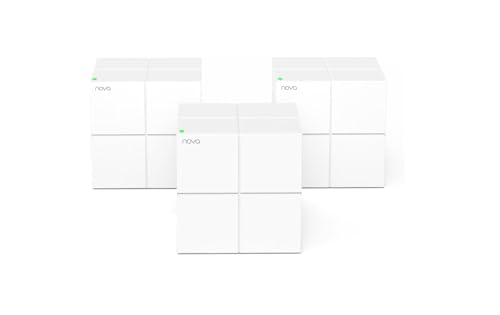
Tenda 3-Pack Dual-Band Wi-Fi 5 Mesh System
Best for: small homes needing stable basic coverage
- Speed Rating
- AC1200
- Coverage Area
- up to 3500 sq.ft.
- Frequency Bands
- Dual-Band
- Pack Size
- 3-Pack
- Device Capacity
- up to 90 devices
- Wi-Fi Standard
- Wi-Fi 5
View on Amazon: Tenda 3-Pack Dual-Band Wi-Fi 5 Mesh System Affiliate link
The Tenda Nova MW6 is a Wi-Fi 5 mesh system designed for homes up to 3,500 square feet. It offers dual-band AC1200 speeds and supports up to 90 connected devices. The three-pack includes gigabit ports for wired connections. You get seamless roaming across a single network name. The included app allows for quick setup and management. This system replaces extenders with a unified whole-home solution.
Pros
- Covers up to 3,500 square feet of home space
- Supports up to 90 connected devices simultaneously
- Includes gigabit ethernet ports for wired backhaul
- Provides seamless roaming with a single network name
- App-based setup and network management
Cons
- Uses older Wi-Fi 5 (AC1200) standard instead of Wi-Fi 6
- Maximum coverage is lower than newer Wi-Fi 7 competitors
- Limited to dual-band frequency operation
Good fit if
- You need reliable coverage for a small to medium home
- You have up to 90 devices to connect
- You prefer a simple app-based setup process
Skip if
- You require the latest Wi-Fi 7 speeds and capacity
- Your home exceeds 3,500 square feet
- You need multi-gigabit port speeds for high-end workstations
Verdict: Tenda Nova MW6 AC1200 3-Pack is a practical mesh solution for smaller homes that prioritize basic stability over cutting-edge speed. It suits users who need to connect dozens of devices without dealing with dead zones, provided they do not require Wi-Fi 6 performance.
Specifications side by side
| Spec | ASUS ZenWiFi BT10 2-Pack | Tenda 3-Pack Dual-Band Wi-Fi 5 Mesh System |
|---|---|---|
| Wi-Fi Standard | Wi-Fi 7 | not stated |
| Speed Rating | 18 Gbps | AC1200 |
| Coverage Area | 6,000 sq ft | up to 3500 sq.ft. |
| Frequency Bands | Tri-Band | Dual-Band |
| Pack Size | 2-Pack | 3-Pack |
| Port Speed | 10 Gbps | not stated |
| Device Capacity | not stated | up to 90 devices |
| Frequency Band | Tri-Band | Dual-Band |
| Features | Parental Controls, Mesh | Mesh |
| Intended Use | not stated | Home |
| Dimensions | 7.3 × 2.8 × 6.26 inches | 3.93 × 3.93 × 3.93 inches |
| Weight | 1.8 pounds | 1.83 pounds |
| Size | 2-Pack | 3 Pack |
| Color | White | white |
| Model | BT10 (W-2-PK) | MW6-3 |
Frequently asked questions
Does ASUS mesh wifi have better coverage than Tenda?
Yes, the ASUS ZenWiFi BT10 offers significantly larger coverage. It provides up to 6,000 square feet of Wi-Fi 7 coverage. This makes it ideal for large homes. The Tenda system is designed for smaller spaces. It focuses on stable basic coverage rather than extensive range.
Is Wi-Fi 7 worth it over Wi-Fi 5 for mesh?
Wi-Fi 7 delivers higher efficiency and lower latency. The ASUS BT10 uses this latest standard for future-proofing. Tenda uses Wi-Fi 5, which is older but stable. If you need top speed and modern device support, Wi-Fi 7 is the better choice for your network.
Which mesh system is better for large homes?
The ASUS ZenWiFi BT10 is better for large homes. It covers up to 6,000 square feet with tri-band connectivity. It also includes 10G ports for wired devices. The Tenda system is suited for smaller homes needing basic stability without the need for high-end speed or range.
Do I need 10G ports in my mesh wifi system?
You need 10G ports if you have high-speed wired devices. The ASUS BT10 includes these ports for robust connectivity. Tenda offers only Gigabit ports. If you do not have devices requiring 10G speeds, Gigabit ports on the Tenda system may be sufficient for your home network needs.
How many units do I need for my home?
The ASUS BT10 comes in a 2-pack for large areas. The Tenda MW6 comes in a 3-pack for smaller spaces. Choose the 2-pack if you have a large home needing Wi-Fi 7. Choose the 3-pack if you have a small home needing stable AC1200 coverage.
Is Tenda mesh wifi suitable for many connected devices?
Yes, the Tenda system supports dozens of devices. It is designed for smaller homes prioritizing basic stability. It works well if you do not require Wi-Fi 6 performance. The ASUS system also supports many devices but focuses on high speed and future-proofing with Wi-Fi 7 technology.