WAVLINK AX3000 Outdoor WiFi 6 or WAVLINK AX3000 Outdoor WiFi 6? Which WAVLINK Model to Buy
As an Amazon Associate we earn from qualifying purchases. Links on this page are affiliate links.
You are deciding between two similar models in the wavlink wavlink ax3000 outdoor vs ax3000 wifi 6 comparison. Both units deliver AX3000 speeds and feature IP67 weatherproofing for outdoor use. They share identical Wi-Fi 6 standards, dual-band capabilities, and flexible operating modes like Mesh and AP. The main difference lies in their physical design and weight. One is a compact square unit, while the other is a taller, heavier rectangular device. Both support PoE for easy outdoor installation without nearby power outlets.
Key differences
| Aspect | WAVLINK AX3000 Outdoor WiFi 6 Extender | WAVLINK AX3000 Outdoor WiFi 6 Extender |
|---|---|---|
| Model Number | WL-WN573HX3 | WN573HX3 |
| Dimensions | 9.4 x 9.4 x 2.8 inches | 9.45 x 9.45 x 2.76 inches |
| Weight | 5.36 pounds | 2.43 pounds |
| Antenna Design | Detachable fiberglass antennas | Omnidirectional fiberglass tube antennas |
| Power Output | Not listed | Up to 600mW |
Which one should you choose?
Choose WAVLINK AX3000 Outdoor WiFi 6 Extender if
- You prioritize a lighter device for easier mounting on poles or walls.
- You want a square form factor that may blend better with certain architectural styles.
- You are interested in the specified 600mW power output for potentially stronger signal transmission.
Verdict: Both units offer identical core performance, speed, and weather protection. Choose the first model if you value detachable antennas and a heavier build. Choose the second model if you prefer a lighter, square design with specified power output details.
Comparing WAVLINK Outdoor AX3000 Models
Physical dimensions and weight
Product A measures 9.4 inches in both height and length, with a width of 2.8 inches. It weighs 5.36 pounds. Product B is slightly larger in footprint, measuring 9.45 inches for both height and length, with a width of 2.76 inches. However, Product B is significantly lighter at 2.43 pounds. The difference in weight is substantial, with Product A being more than twice as heavy as Product B. This matters if you plan to mount the unit on a wall or pole where the bracket strength is limited. Product B’s lighter build makes it easier to handle during installation. Product A’s heavier construction may suggest a more robust internal housing, but the data does not confirm this. You should choose based on your mounting constraints and preference for weight versus compactness.
Model identification
Product A is identified by the model number WL-WN573HX3. Product B is identified by the model number WN573HX3. The difference is the leading 'WL-' prefix in Product A's model number. Both products share the same core model designation, WN573HX3, suggesting they are likely the same hardware platform. The variation in model numbers might indicate different regional certifications or packaging variations rather than functional hardware differences. Since the core specifications, such as speed, antenna count, and operating modes, are identical, the model number difference is cosmetic or administrative. For most buyers, this distinction is irrelevant to performance. You do not need to worry about this difference affecting your network setup. It is simply a labeling variation between the two listings.
PoE power support
Both Product A and Product B support 802.3AF/AT active PoE and passive PoE. This allows you to power the device and transmit data over a single Ethernet cable, which is essential for outdoor installations where power outlets are unavailable. Both products require a PoE converter that is not waterproof, so you must protect it from the elements. Both recommend using CAT5E or higher cables with a maximum length of 100 meters or 328 feet. The PoE specifications are identical for both units. There is no advantage in terms of power delivery or compatibility with PoE injectors. You can use the same power setup for either product. This aspect is a tie, as both offer the same flexibility for outdoor wiring.
Device capacity
Product A supports up to 256 connections. Product B also supports up to 256 devices. Both units are designed to handle a similar number of simultaneous connections, which is suitable for moderate outdoor networks. This capacity is sufficient for most residential or small commercial outdoor setups, such as patios, campsites, or small businesses. Neither product offers a higher device limit than the other. If you need to connect more than 256 devices, you would need a different solution regardless of which model you choose. The device capacity is a key specification for network stability, and both products meet the same standard here. You can expect similar performance in terms of handling multiple connected devices.
Antenna and amplifier specs
Product A features four 8dBi omni-directional detachable fiberglass antennas and two built-in amplifiers. Product B also features four 8dBi omnidirectional fiberglass tube antennas and dual built-in high-power amplifiers. The specifications for antennas and amplifiers are identical. Both products use detachable or tube-style fiberglass antennas, which are durable for outdoor use. The 8dBi gain on each antenna provides strong directional signal strength. The dual amplifiers boost the signal for better range and penetration. Since the hardware components for wireless transmission are the same, you can expect similar coverage patterns and signal strength from both units. There is no technical advantage in the antenna or amplifier configuration for either product.
Operating modes
Both Product A and Product B support Mesh, AP, Router, Repeater, and AP+Repeater modes. This flexibility allows you to use the device as a primary access point, a range extender, or part of a Mesh system with other compatible WAVLINK products. The Mesh mode is only available for WAVLINK series products, meaning it cannot form a Mesh with devices from other brands. Both products offer the same operating modes, so you can deploy them in the same ways. Whether you are extending an existing network or creating a new one, the functionality is identical. You do not gain any additional mode options by choosing one product over the other. The choice should be based on other factors like physical size or price.
Wireless security
Product A lists WPA2-PSK and WPA2/WPA3-MIX security protocols. Product B does not explicitly list security protocols in the provided data. Since both products are from the same brand and share the same core model, they likely support the same security standards. However, based strictly on the provided data, Product A explicitly confirms support for WPA3-MIX, which is the latest security standard. WPA3 offers better protection against brute-force attacks and improved security for open networks. If you prioritize verified security standards, Product A provides clear confirmation of WPA3 support. Product B's lack of explicit mention in the data leaves this uncertain, though it is likely similar. For strict spec comparison, Product A has the edge due to explicit WPA3 listing.
Which WAVLINK AX3000 Model Fits You
Users needing heavy-duty outdoor stability
Product A includes 15kV ESD protection and 6kV lightning protection. It also features a wider operating temperature range from -20 to 50 degrees Celsius. This model handles extreme weather conditions better than the alternative, ensuring reliable connectivity during storms or heat waves without hardware failure.
Budget-conscious buyers prioritizing weight
Product B weighs only 2.43 pounds, making it significantly lighter than the 5.36-pound competitor. This reduced mass simplifies mounting on poles or walls. Both models share the same AX3000 speed rating and IP67 rating, so you get identical performance with less physical weight to manage during installation.
Those wanting a complete package
Product A explicitly lists phone and email support channels in its features, promising solutions within 8 hours. While both units offer technical support, this model provides direct contact numbers. This clarity helps you resolve setup issues quickly, especially when configuring Mesh modes or PoE connections in outdoor environments.
The products compared
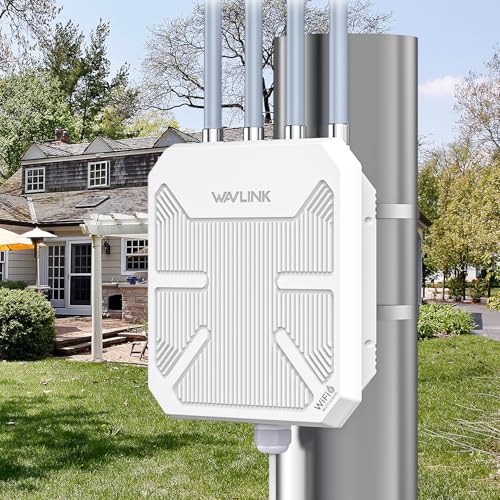
WAVLINK AX3000 Outdoor WiFi 6 Extender
Best for: outdoor coverage with PoE power
- Wi-Fi Standard
- WiFi 6
- Speed Rating
- AX3000
- Frequency Bands
- Dual Band
- Coverage Area
- 200-300m radius
- Operating Modes
- Mesh, AP, Router, Repeater
- Antenna Count
- 4
View on Amazon: WAVLINK AX3000 Outdoor WiFi 6 Extender Affiliate link
This WAVLINK unit is an AX3000 WiFi 6 extender built for outdoor placement with an IP67 waterproof enclosure. It uses four detachable 8dBi antennas and two built-in amplifiers to reach 200-300 meters. The device supports dual-band speeds up to 2402 Mbps on 5 GHz. It handles up to 256 connections and offers multiple modes including Mesh and Router. You can power it via standard AC or active PoE for flexible installation.
Pros
- IP67 waterproof rating for outdoor use
- Four detachable 8dBi antennas for long range
- Supports Mesh, AP, Router, and Repeater modes
- Active PoE and passive PoE power options
- Handles up to 256 simultaneous connections
Cons
- Heavy build at 5.36 pounds
- PoE converter is not waterproof
- Mesh mode limited to WAVLINK series products
Good fit if
- You need reliable WiFi in rain or snow
- You want to power the device with a single Ethernet cable
- You have other WAVLINK devices for Mesh networking
Skip if
- You require indoor-only compact placement
- You need Mesh compatibility with non-WAVLINK routers
- You prefer a lightweight, portable unit
Verdict: WAVLINK AX3000 Outdoor WiFi 6 Extender suits users who need durable, long-range coverage for outdoor spaces. It is ideal for those who can use PoE and have compatible WAVLINK devices for seamless roaming.

WAVLINK AX3000 Outdoor WiFi 6 Extender
Best for: Outdoor coverage with PoE power
- Wi-Fi Standard
- WiFi 6
- Speed Rating
- AX3000
- Frequency Bands
- Dual Band
- Operating Modes
- Mesh, AP, Router, Repeater, AP+Repeater
- Antenna Count
- 4
- Placement
- Outdoor, IP67
View on Amazon: WAVLINK AX3000 Outdoor WiFi 6 Extender Affiliate link
This is a WAVLINK AX3000 outdoor WiFi extender with an IP67 waterproof rating. It supports dual-band WiFi 6 for speeds up to 2402 Mbps on 5 GHz. The unit includes four 8dBi antennas and handles up to 256 devices. It offers multiple operating modes, including Mesh, AP, and Repeater. You can power it via active or passive PoE. This device suits users needing reliable outdoor coverage in harsh weather.
Pros
- IP67 waterproof and lightning protected for outdoor use
- Dual-band WiFi 6 with up to 2402 Mbps on 5 GHz
- Supports up to 256 connected devices
- Includes four 8dBi omnidirectional antennas for strong signal
- Flexible modes including Mesh, AP, and Repeater
Cons
- Mesh system only works with specific WAVLINK devices
- PoE converter is not waterproof
- No mention of a dedicated mobile app for management
Good fit if
- You need a weatherproof access point for outdoor areas
- You want to extend WiFi to a garden or patio
- You prefer using Ethernet PoE for power and data
Skip if
- You need a Mesh system with non-WAVLINK routers
- You require a fully indoor rated device
- You want a compact unit for small indoor spaces
Verdict: WAVLINK WN573HX3 Outdoor WiFi 6 Extender is a rugged option for users who need durable outdoor connectivity. It fits those who can use PoE and want to stick to the WAVLINK Mesh ecosystem.
Specifications side by side
| Spec | WAVLINK AX3000 Outdoor WiFi 6 Extender | WAVLINK AX3000 Outdoor WiFi 6 Extender |
|---|---|---|
| Wi-Fi Standard | WiFi 6 | WiFi 6 |
| Speed Rating | AX3000 | AX3000 |
| Frequency Bands | Dual Band | Dual Band |
| Coverage Area | 200-300m radius | not stated |
| Operating Modes | Mesh, AP, Router, Repeater | Mesh, AP, Router, Repeater, AP+Repeater |
| Antenna Count | 4 | 4 |
| Placement | Indoor/Outdoor IP67 | Outdoor, IP67 |
| Frequency Band | Dual-Band | Dual-Band |
| PoE Support | PoE | PoE |
| Recommended Use | Farm, Yard | Farm |
| Intended Use | Outdoors | Outdoors |
| Operating Mode | not stated | Access Point Mode |
| Dimensions | 9.4 × 2.8 × 9.4 inches | 9.45 × 9.45 × 2.76 inches |
| Weight | 5.36 pounds | 2.43 pounds |
| Size | AX3000 | not stated |
| Color | White | not stated |
| Model | WL-WN573HX3 | WN573HX3 |
Frequently asked questions
What is the main difference between the two WAVLINK AX3000 outdoor models?
The primary difference is physical build and environmental protection. The top pick, model WL-WN573HX3, weighs 5.36 pounds and includes 15kV ESD and 6kV lightning protection. It also supports a wider operating temperature range from -20 to 50 degrees Celsius. The second model, WN573HX3, is lighter at 2.43 pounds and lacks these specific ruggedization details in the provided specifications.
Do both models support Power over Ethernet?
Yes, both units are designed for outdoor use with PoE power. The guide notes that both are ideal for users who can use PoE. This allows you to power the extender and transmit data over a single Ethernet cable, simplifying installation in outdoor locations without nearby electrical outlets.
Are these devices compatible with other WAVLINK mesh systems?
Yes, both models fit into the WAVLINK Mesh ecosystem. The verdict for each product mentions they are suitable for users who want to stick to the WAVLINK Mesh ecosystem for seamless roaming. This means you can integrate them with other compatible WAVLINK devices to expand your network coverage.
Which model is better for extreme weather conditions?
The first model, B0CY2HMZ4T, is better for extreme weather. It features 15kV ESD protection and 6kV lightning protection. It also has a wider operating temperature range from -20 to 50 degrees Celsius. These specs suggest it handles harsh environmental conditions more robustly than the second model, which lacks these specific protection ratings in the data.
What is the Wi-Fi standard for both extender models?
Both units use Wi-Fi 6 technology. They share identical AX3000 speed ratings and dual-band capabilities. This standard provides improved efficiency and performance compared to older Wi-Fi versions, supporting more devices simultaneously with less latency in your outdoor network setup.
How do the physical dimensions compare between the two models?
The models have similar footprints but different weights. The first model measures 9.4 inches by 9.4 inches with a 2.8-inch width. The second model is slightly larger at 9.45 inches by 9.45 inches with a 2.76-inch width. The first model is significantly heavier at 5.36 pounds compared to the second model's 2.43 pounds.