TP-Link or Tenda? Mesh Wifi Systems Compared in 2026
As an Amazon Associate we earn from qualifying purchases. Links on this page are affiliate links.
This TP-Link vs tenda mesh wifi system comparison looks at two popular 3-pack options for whole-home coverage. Both provide Gigabit ports and app-based management. The main difference lies in performance tier. TP-Link offers Wi-Fi 6 with higher speeds and larger coverage. Tenda sticks to Wi-Fi 5 with more modest specs. You need to decide if the newer standard justifies the potential cost difference for your specific home layout.
Key differences
| Aspect | TP-Link Deco X55 3-Pack Wi-Fi 6 | Tenda 3-Pack Dual-Band Wi-Fi 5 Mesh System |
|---|---|---|
| Wi-Fi Standard | Wi-Fi 6 | Wi-Fi 5 |
| Speed Rating | AX3000 | AC1200 |
| Coverage Area | up to 6500 sq ft | up to 3500 sq ft |
| Device Capacity | up to 150 | up to 90 |
| Port Speed | Gigabit | Gigabit |
Which one should you choose?
Choose TP-Link Deco X55 3-Pack Wi-Fi 6 if
- You have a large home over 3500 square feet
- You connect more than 90 devices simultaneously
- You want the latest Wi-Fi 6 technology
Choose Tenda 3-Pack Dual-Band Wi-Fi 5 Mesh System if
- You need coverage for a smaller home under 3500 square feet
- You have fewer than 90 connected devices
- You prefer a simpler, older Wi-Fi 5 standard
Verdict: Choose TP-Link if you need maximum coverage and device capacity for a modern network. Select Tenda if your home is smaller and your device count is lower. The specs show TP-Link is the more robust system for growing needs.
TP-Link vs Tenda Mesh Specs
Wi-Fi Standard
The TP-Link Deco X55 uses Wi-Fi 6 (802.11ax). This newer standard allows for more efficient data handling and better performance in crowded environments. It supports 160 MHz channels on the 5 GHz band for higher peak speeds. The Tenda Nova MW6 relies on Wi-Fi 5 (802.11ac). This is a mature, dual-band standard that works well for basic tasks but lacks the efficiency and throughput of Wi-Fi 6. If you have many modern devices or need faster local transfers, the newer protocol in the TP-Link unit provides a clear technical advantage.
Speed Rating
Speed ratings indicate the combined theoretical maximum throughput across all bands. The TP-Link Deco X55 is rated at AX3000. This combines 2402 Mbps on the 5 GHz band with 574 Mbps on the 2.4 GHz band. The Tenda Nova MW6 is rated at AC1200. This splits into 867 Mbps on 5 GHz and 400 Mbps on 2.4 GHz. The TP-Link system offers significantly higher bandwidth potential. This matters if you stream high-resolution video or move large files between devices on your local network.
Coverage Area
Coverage area determines how much space the mesh system can effectively blanket. The TP-Link Deco X55 3-pack claims coverage up to 6500 square feet. The Tenda Nova MW6 3-pack covers up to 3500 square feet. The TP-Link units are designed for larger homes or multi-story layouts where signals must travel further. The Tenda system is better suited for smaller apartments or modest single-family homes. You should choose the larger coverage rating if your living space exceeds 3500 square feet.
Device Capacity
Device capacity lists the maximum number of connections the system can handle simultaneously. The TP-Link Deco X55 supports up to 150 devices. The Tenda Nova MW6 supports up to 90 devices. Modern homes often have numerous smart lights, cameras, phones, and tablets connected at once. The higher limit in the TP-Link system suggests it can manage a denser network of IoT devices without congestion. If you have a very connected home, the higher capacity is beneficial.
Port Speed
Port speed defines the maximum wired connection rate for devices plugged directly into the mesh nodes. Both the TP-Link Deco X55 and the Tenda Nova MW6 feature Gigabit Ethernet ports. This means wired devices can reach speeds up to 1000 Mbps. Neither system offers 2.5 Gigabit ports in this specific configuration. For most internet plans and local network transfers, this speed is sufficient. This aspect results in a tie, as both provide the same standard wired connectivity tier.
Which mesh system fits your home
Users needing high speed and large coverage
The TP-Link Deco X55 supports Wi-Fi 6 and AX3000 speeds. It covers up to 6500 square feet. You can connect up to 150 devices simultaneously. The 160 MHz channels on the 5 GHz band offer higher peak performance. This system is ideal for larger homes with many connected gadgets.
Budget buyers with smaller homes
The Tenda Nova MW6 covers up to 3500 square feet. It supports AC1200 speeds on dual bands. It handles up to 90 devices with MU-MIMO technology. The compact design fits easily in smaller spaces. This system provides reliable whole-home coverage for modest households without the premium cost of newer standards.
Shoppers prioritizing device capacity and security
TP-Link includes HomeShield for network security and parental controls. It supports up to 150 devices, which exceeds the Tenda limit of 90. The system adheres to CISA Secure-by-Design pledges. Each unit has three Gigabit ports for wired backhaul. This setup ensures robust security and stability for dense device environments.
The products compared

TP-Link Deco X55 3-Pack Wi-Fi 6
Best for: Medium to large homes needing 1 Gbps speeds
- Wi-Fi Standard
- Wi-Fi 6
- Speed Rating
- AX3000
- Coverage Area
- Up to 6,500 sq ft
- Pack Size
- 3-Pack
- Port Speed
- 1 Gbps
- Device Capacity
- Up to 150 devices
View on Amazon: TP-Link Deco X55 3-Pack Wi-Fi 6 Affiliate link
The TP-Link Deco X55 is a Wi-Fi 6 mesh system rated AX3000. The 3-pack covers up to 6500 square feet and supports up to 150 connected devices. Each unit includes three Gigabit Ethernet ports for wired backhaul. It uses AI-driven mesh to optimize signal paths. The Deco app manages setup and includes HomeShield security features. This system suits medium to large homes needing reliable whole-home coverage.
Pros
- Wi-Fi 6 AX3000 speed rating with 2402 Mbps on 5GHz band
- Covers up to 6500 square feet with 3-pack
- Supports up to 150 connected devices simultaneously
- Each node has three Gigabit Ethernet ports
- Includes HomeShield basic security and parental controls
Cons
- Gigabit ports limit speeds for internet plans over 1 Gbps
- Does not support Wi-Fi 6E or 6GHz band
- Lacks dedicated rear tri-band radios for backhaul
Good fit if
- You need coverage for a home up to 6500 square feet
- You have up to 150 devices on your network
- You want wired Ethernet options on each node
Skip if
- You require internet speeds exceeding 1 Gbps
- You need Wi-Fi 6E performance on the 6GHz band
- You have a home larger than 6500 square feet
Verdict: TP-Link Deco X55 AX3000 3-Pack provides solid Wi-Fi 6 coverage for homes up to 6500 square feet. It fits users with moderate device counts who value wired port availability over next-generation 6GHz speeds.
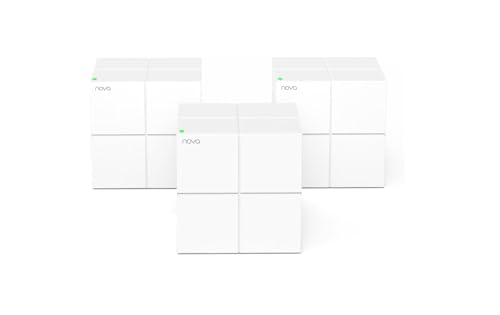
Tenda 3-Pack Dual-Band Wi-Fi 5 Mesh System
Best for: small homes needing basic whole-home coverage
- Speed Rating
- AC1200
- Coverage Area
- up to 3500 sq.ft.
- Frequency Bands
- Dual-Band
- Pack Size
- 3-Pack
- Device Capacity
- up to 90 devices
- Wi-Fi Standard
- Wi-Fi 5
View on Amazon: Tenda 3-Pack Dual-Band Wi-Fi 5 Mesh System Affiliate link
The Tenda Nova MW6 is a Wi-Fi 5 mesh system designed for homes up to 3,500 square feet. It delivers AC1200 speeds on dual bands and supports up to 90 connected devices. The 3-pack includes three white units that create a single network name for seamless roaming. You can manage the network via the Tenda app, which allows easy setup and monitoring. This system is suitable for users needing basic whole-home coverage without the complexity of Wi-Fi 6.
Pros
- Covers up to 3,500 square feet with a 3-pack
- Supports up to 90 connected devices simultaneously
- Features MU-MIMO and Beamforming for stable connections
- Includes Gigabit ports for wired backhaul
Cons
- Uses older Wi-Fi 5 (AC1200) standard instead of Wi-Fi 6
- Lower device capacity compared to modern AX3000 systems
- Limited to dual-band frequency operation
Good fit if
- You need reliable coverage for a small to medium home
- You want a simple setup with app management
- You are connecting fewer than 90 devices
Skip if
- You require Wi-Fi 6 speeds for high-bandwidth tasks
- You have more than 90 devices to connect
- You need coverage larger than 3,500 square feet
Verdict: Tenda Nova MW6 AC1200 Mesh System provides solid basic coverage for homes up to 3,500 square feet. It fits users who prioritize easy setup and app control over the latest Wi-Fi 6 speeds.
Specifications side by side
| Spec | TP-Link Deco X55 3-Pack Wi-Fi 6 | Tenda 3-Pack Dual-Band Wi-Fi 5 Mesh System |
|---|---|---|
| Wi-Fi Standard | Wi-Fi 6 | not stated |
| Speed Rating | AX3000 | AC1200 |
| Coverage Area | Up to 6,500 sq ft | up to 3500 sq.ft. |
| Frequency Bands | not stated | Dual-Band |
| Pack Size | 3-Pack | 3-Pack |
| Port Speed | 1 Gbps | not stated |
| Device Capacity | Up to 150 devices | up to 90 devices |
| Frequency Band | not stated | Dual-Band |
| Features | Mesh | Mesh |
| Intended Use | not stated | Home |
| Placement | Indoor | not stated |
| Dimensions | 4.33 × 4.33 × 4.49 inches | 3.93 × 3.93 × 3.93 inches |
| Weight | 5.07 pounds | 1.83 pounds |
| Size | 3 Pack | 3 Pack |
| Color | Black, White | white |
| Model | Deco X55 | MW6-3 |
Frequently asked questions
Which mesh system covers a larger home area?
The TP-Link Deco X55 covers a significantly larger area. It provides whole-home coverage for spaces up to 6500 square feet. The Tenda Nova MW6 is designed for smaller homes, offering coverage up to 3500 square feet. If you have a medium to large house, the TP-Link option ensures better reach for your signal.
Do both systems support the latest Wi-Fi standard?
No, they use different generations of Wi-Fi technology. The TP-Link Deco X55 utilizes Wi-Fi 6 (802.11ax) for improved efficiency and speed. The Tenda Nova MW6 relies on the older Wi-Fi 5 (802.11ac) standard. Wi-Fi 6 handles multiple devices more effectively in crowded networks compared to Wi-Fi 5.
How do the speed ratings compare between these brands?
The TP-Link system offers higher theoretical speeds with an AX3000 rating. The Tenda system provides an AC1200 rating, which is sufficient for basic browsing and streaming. AX3000 indicates support for 160 MHz channels on the 5 GHz band, allowing for faster peak data transfer rates than the dual-band AC1200 setup.
Are the physical dimensions of the units similar?
The devices have comparable footprints but differ in height and weight. The TP-Link Deco X55 measures 4.33 by 4.49 inches and weighs 5.07 pounds for the pack. The Tenda Nova MW6 is slightly more compact at 3.93 inches square and weighs 1.83 pounds for the pack. Both fit easily in most home environments.
Can I connect many devices to these mesh networks?
Yes, both systems support multiple simultaneous connections. The TP-Link Deco X55 can handle up to 150 devices at once. This makes it suitable for homes with many smart gadgets and users. The Tenda system also supports multiple connections, though it is optimized for basic whole-home coverage rather than high-density device loads.
Is app control available for managing the network?
Yes, both brands provide app-based management for your network. You can use the respective apps to set up the mesh system and monitor connected devices. This feature allows you to adjust settings remotely. Both TP-Link and Tenda include this functionality to help you manage your home Wi-Fi easily from your smartphone.