TP-Link Deco X55 3-Pack Wi-Fi vs TP-Link Deco Tri-Band WiFi 6E: Spec Comparison
As an Amazon Associate we earn from qualifying purchases. Links on this page are affiliate links.
You are comparing the tp link deco x55 ax3000 wifi vs deco xe75 axe5400 tri band mesh systems. Both units share the Deco app, AI-driven mesh technology, and HomeShield security features. They both support gigabit Ethernet ports for wired backhaul. The main difference lies in the generation of Wi-Fi. The X55 uses Wi-Fi 6 on dual bands. The XE75 uses Wi-Fi 6E with a dedicated tri-band setup including the 6 GHz spectrum.
Key differences
| Aspect | TP-Link Deco X55 3-Pack Wi-Fi 6 | TP-Link Deco Tri-Band WiFi 6E 2-Pack |
|---|---|---|
| Wi-Fi Standard | Wi-Fi 6 | Wi-Fi 6E |
| Frequency Bands | Dual-Band | Tri-Band |
| Speed Rating | AX3000 | AXE5400 |
| Coverage Area | Up to 6,500 sq ft | Up to 5,500 sq ft |
| Device Capacity | Up to 150 devices | Up to 200 devices |
| Pack Size | 3-Pack | 2-Pack |
Which one should you choose?
Choose TP-Link Deco X55 3-Pack Wi-Fi 6 if
- You need coverage for a larger home up to 6,500 square feet.
- You want more physical units for a wider area without buying extras.
- You primarily use Wi-Fi 6 devices and do not need the 6 GHz band.
Choose TP-Link Deco Tri-Band WiFi 6E 2-Pack if
- You have many Wi-Fi 6E devices and want access to the 6 GHz band.
- You want a dedicated backhaul band to reduce congestion on other bands.
- You need to connect up to 200 devices simultaneously.
Verdict: Choose the Deco X55 3-Pack if you need broader coverage for a larger space and more units for the price. Choose the Deco XE75 if you want the latest Wi-Fi 6E standard with a dedicated 6 GHz backhaul for high-performance devices. Both offer solid security and easy management through the Deco app.
Wi-Fi 6E vs Wi-Fi 6 Specs
Wi-Fi standard
The TP-Link Deco XE75 uses Wi-Fi 6E, the latest generation that adds the 6 GHz band. This new frequency eliminates interference from legacy devices and offers more capacity. The TP-Link Deco X55 relies on Wi-Fi 6, which operates only on 2.4 GHz and 5 GHz bands. While Wi-Fi 6 is mature and reliable, Wi-Fi 6E provides a cleaner spectrum for high-bandwidth tasks. If you have many modern devices, the 6 GHz band on the XE75 reduces congestion significantly. The X55 is sufficient for standard households without dense 6 GHz device support.
Frequency band
The Deco XE75 is a tri-band system, featuring separate 2.4 GHz, 5 GHz, and 6 GHz radios. The 6 GHz band can serve as a dedicated backhaul, ensuring stable connections between nodes without eating into your device bandwidth. The Deco X55 is a dual-band system, using 2.4 GHz and 5 GHz for both client connections and backhaul communication. This means backhaul traffic shares the same spectrum as your phones and laptops on the X55. For large homes or heavy network loads, the dedicated tri-band architecture of the XE75 offers superior performance and less latency between nodes.
Speed rating
The Deco XE75 boasts an AXE5400 speed rating, combining speeds up to 5,400 Mbps across its three bands. This includes 2,402 Mbps on 6 GHz, 2,402 Mbps on 5 GHz, and 574 Mbps on 2.4 GHz. The Deco X55 has an AX3000 rating, offering 2,402 Mbps on 5 GHz and 574 Mbps on 2.4 GHz. The XE75 provides significantly higher aggregate throughput due to the added 6 GHz band. If you have gigabit internet or faster, the XE75 can handle the load more easily. The X55 is adequate for standard gigabit plans but lacks the extra bandwidth headroom of the XE75.
Device capacity
TP-Link rates the Deco XE75 to support up to 200 devices simultaneously. This higher capacity accommodates smart homes with many IoT gadgets, streaming devices, and computers. The Deco X55 is rated for up to 150 devices. While 150 is plenty for most apartments, larger homes with extensive smart ecosystems may benefit from the XE75’s higher limit. Both systems use AI-driven mesh to manage connections efficiently. However, the XE75’s tri-band design naturally distributes more devices across separate frequencies, reducing contention. For dense device environments, the XE75 offers more headroom.
Pack size
The Deco X55 is sold in a 3-pack configuration, providing three nodes out of the box. The Deco XE75 is sold in a 2-pack, providing only two nodes. Coverage depends on your home layout, but the X55 includes an extra unit for potentially wider area coverage. The XE75 covers up to 5,500 square feet with two units, while the X55 covers up to 6,500 square feet with three. If you need more nodes for a large home, the X55 gives you more hardware. The XE75 may require purchasing additional units separately to match the coverage of the X55 3-pack.
Port count
Each Deco X55 node includes three Gigabit Ethernet ports. In a 3-pack, you have nine ports total for wired connections. Each Deco XE75 node also has three Gigabit Ethernet ports. In a 2-pack, you have six ports total. The X55 provides more wired connection options because it includes an extra node. This is useful if you need to connect multiple wired devices like smart TVs, consoles, or desktops. The XE75 offers fewer ports due to the smaller pack size. If wired backhaul or wired device connections are critical, the X55’s larger pack size gives you more flexibility.
Which Deco Mesh System Fits Your Home
Users needing maximum device capacity and coverage
The Deco X55 3-Pack supports up to 150 devices and covers 6,500 square feet. This larger coverage area and higher device capacity make it ideal for bigger homes or households with many connected gadgets. You get three units for broader whole-home mesh coverage without dead zones.
Tech enthusiasts wanting the latest Wi-Fi 6E standard
The Deco XE75 features Wi-Fi 6E with a dedicated 6 GHz band. This tri-band system offers AXE5400 speeds and reduces interference from legacy devices. The 6 GHz band can serve as a stable backhaul for nodes. It supports up to 200 devices, providing next-generation performance for compatible clients.
Buyers prioritizing wired connectivity options
Each Deco X55 node includes three Gigabit Ethernet ports. This provides more wired connection points for your devices compared to the XE75. You can connect multiple devices directly to each node, facilitating better wired backhaul setups or connecting stationary devices like gaming consoles and smart TVs with reliable Ethernet links.
Users seeking advanced HomeShield security reports
The Deco XE75 includes HomeShield features like IoT device identification and weekly or monthly security reports. These tools help you monitor network health and identify connected devices more precisely. If you value detailed insights into your network's security posture and device behavior, this system offers more granular reporting capabilities.
The products compared

TP-Link Deco X55 3-Pack Wi-Fi 6
Best for: homes up to 6,500 sq ft with wired backhaul needs
- Wi-Fi Standard
- Wi-Fi 6
- Speed Rating
- AX3000
- Coverage Area
- Up to 6,500 sq ft
- Pack Size
- 3-Pack
- Port Speed
- 1 Gbps
- Device Capacity
- Up to 150 devices
View on Amazon: TP-Link Deco X55 3-Pack Wi-Fi 6 Affiliate link
The TP-Link Deco X55 3-Pack delivers AX3000 Wi-Fi 6 coverage for homes up to 6,500 square feet. It supports up to 150 connected devices and includes three gigabit Ethernet ports per unit for wired backhaul. The system uses AI-driven mesh technology to optimize performance. You get HomeShield security features and app management. This setup suits medium to large homes needing reliable whole-home Wi-Fi without tri-band speeds.
Pros
- AX3000 Wi-Fi 6 speed rating
- Covers up to 6,500 square feet
- Supports up to 150 devices
- Three gigabit Ethernet ports per node
- Includes HomeShield security features
Cons
- Limited to Wi-Fi 6, lacking Wi-Fi 6E
- Dual-band only, missing dedicated 6 GHz backhaul
- Lower total throughput than tri-band competitors
Good fit if
- You need coverage for a home up to 6,500 sq ft
- You have fewer than 150 connected devices
- You prefer wired backhaul options over wireless tri-band
Skip if
- You require Wi-Fi 6E speeds on the 6 GHz band
- You need dedicated tri-band backhaul for heavy bandwidth
- You have more than 150 devices on the network
Verdict: TP-Link Deco X55 3-Pack Mesh is a solid choice for users who prioritize wired backhaul flexibility and broad coverage over the latest Wi-Fi 6E standards. It fits homes where dual-band performance is sufficient for daily tasks.
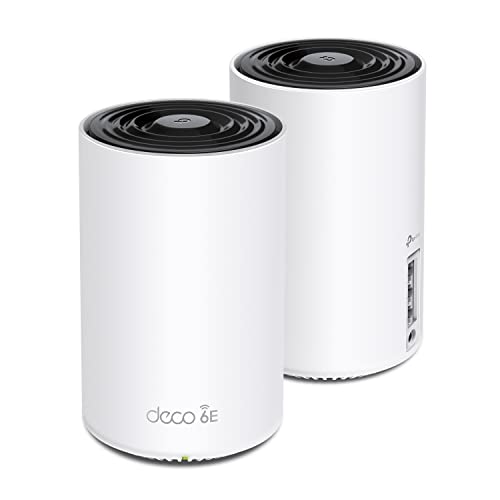
TP-Link Deco Tri-Band WiFi 6E 2-Pack
Best for: Medium homes needing dedicated 6 GHz backhaul
- Wi-Fi Standard
- WiFi 6E
- Speed Rating
- AXE5400
- Coverage Area
- up to 5500 Sq.Ft
- Frequency Bands
- Tri-Band
- Pack Size
- 2-Pack
- Device Capacity
- 200 devices
View on Amazon: TP-Link Deco Tri-Band WiFi 6E 2-Pack Affiliate link
The Deco XE75 is a tri-band Wi-Fi 6E mesh system designed for homes up to 5,500 square feet. It supports up to 200 devices with combined speeds of 5,400 Mbps. The 6 GHz band acts as a dedicated backhaul by default, reducing congestion. This 2-pack setup covers medium to large spaces while maintaining stable connections for multiple users.
Pros
- Wi-Fi 6E tri-band architecture for reduced interference
- 6 GHz band serves as dedicated backhaul by default
- Supports up to 200 connected devices
- Total speed rating of AXE5400 (5,400 Mbps)
Cons
- Only includes two nodes in the 2-pack
- Limited to 5,500 square feet of coverage
- Sold as a 2-pack, requiring separate purchases for larger homes
Good fit if
- You need dedicated 6 GHz backhaul for stable mesh connections
- You have a home under 5,500 square feet
- You require support for many connected devices
Skip if
- You need more than two nodes for coverage
- You only have Wi-Fi 6 devices and do not need 6 GHz
- Your home exceeds 5,500 square feet
Verdict: TP-Link Deco XE75 2-Pack delivers high-capacity Wi-Fi 6E performance for medium-sized homes. It suits users who prioritize dedicated backhaul speeds and device density over extensive square footage coverage.
Specifications side by side
| Spec | TP-Link Deco X55 3-Pack Wi-Fi 6 | TP-Link Deco Tri-Band WiFi 6E 2-Pack |
|---|---|---|
| Wi-Fi Standard | Wi-Fi 6 | WiFi 6E |
| Speed Rating | AX3000 | AXE5400 |
| Coverage Area | Up to 6,500 sq ft | up to 5500 Sq.Ft |
| Frequency Bands | not stated | Tri-Band |
| Pack Size | 3-Pack | 2-Pack |
| Port Speed | 1 Gbps | not stated |
| Device Capacity | Up to 150 devices | 200 devices |
| Frequency Band | not stated | Tri-Band |
| Use Case | not stated | Gaming, Streaming |
| Features | Mesh | Mesh, WPA3 |
| Intended Use | not stated | Home |
| Placement | Indoor | not stated |
| Dimensions | 4.33 × 4.33 × 4.49 inches | 4.13 × 4.13 × 6.67 inches |
| Weight | 5.07 pounds | 2.69 pounds |
| Size | 3 Pack | 2 Pack |
| Color | Black, White | Black and White |
| Model | Deco X55 | Deco XE75(2-pack) |
Frequently asked questions
Which Deco system is better for large homes?
The TP-Link Deco X55 3-Pack is better for large spaces. It covers up to 6,500 square feet and supports up to 150 devices. This makes it ideal for bigger homes or households with many connected gadgets. The Deco XE75 2-Pack is designed for medium-sized homes and offers less total coverage area.
Does the Deco X55 support Wi-Fi 6E?
No, the Deco X55 does not support Wi-Fi 6E. It uses the older Wi-Fi 6 standard, which operates on 2.4 GHz and 5 GHz bands. The Deco XE75 is the model that adds the 6 GHz band for reduced interference and higher capacity. Choose the X55 if you do not have Wi-Fi 6E devices.
What is the difference in pack sizes?
The Deco X55 comes in a 3-Pack, while the Deco XE75 is available as a 2-Pack. The X55 provides more units for wider coverage, suitable for homes up to 6,500 square feet. The XE75 2-Pack is intended for medium homes. You can add more units to either system, but the base packages differ in quantity.
Which system has a higher speed rating?
The Deco XE75 has the higher speed rating. It is rated AXE5400, which includes the new 6 GHz band for tri-band performance. The Deco X55 is rated AX3000, which is dual-band. The XE75 offers higher capacity for data-intensive tasks, while the X55 provides solid performance for standard daily tasks.
Can I use wired backhaul with both systems?
Yes, both systems support wired backhaul via gigabit Ethernet ports. This allows you to connect nodes directly to your router for a stable connection. The Deco X55 is specifically noted as suitable for users who prioritize wired backhaul flexibility. Both models share this feature, ensuring reliable performance regardless of your wireless environment.
Which Deco is smaller and lighter?
The Deco XE75 is smaller and lighter. Each unit weighs 2.69 pounds and measures 4.13 inches wide by 6.67 inches tall. The Deco X55 units are heavier at 5.07 pounds each and measure 4.33 inches on each side. The XE75 has a slimmer profile, while the X55 has a more compact cubic shape.
Is the Deco X55 good for device density?
The Deco X55 supports up to 150 connected devices. This high capacity makes it suitable for households with many smart home gadgets. However, the Deco XE75 offers higher capacity through its tri-band design. If you prioritize device density over raw square footage, the XE75 may be more efficient, but the X55 handles large numbers well.