TP-Link Deco Tri-Band WiFi 6E or TP-Link Deco Tri-Band WiFi 7? Which TP-Link Model to Buy
As an Amazon Associate we earn from qualifying purchases. Links on this page are affiliate links.
You are deciding between the tp link deco tri band wifi 6e vs deco tri band wifi 7. Both systems use tri-band architecture and AI-driven mesh technology to cover large homes. They share similar device capacities and security features like HomeShield. The main difference lies in their Wi-Fi standards and hardware capabilities. One model offers newer Wi-Fi 6E with a 6 GHz band, while the other provides Wi-Fi 7 with faster wired ports. Your choice depends on whether you prioritize wireless frequency updates or wired future-proofing.
Key differences
| Aspect | TP-Link Deco Tri-Band WiFi 6E 2-Pack | TP-Link Deco Tri-Band WiFi 7 Mesh Router |
|---|---|---|
| Wi-Fi Standard | WiFi 6E | WiFi 7 |
| Speed Rating | AXE5400 | BE10000 |
| Coverage Area | Up to 5,500 Sq.Ft | Up to 3,000 sq.ft. |
| Pack Size | 2-Pack | 1 Pack |
| WAN/LAN Ports | not listed | Four 2.5G ports |
| 6 GHz Band Usage | Default backhaul or device connection | not listed |
Which one should you choose?
Choose TP-Link Deco Tri-Band WiFi 6E 2-Pack if
- You need a 2-pack to cover larger areas up to 5,500 sq.ft.
- You want the 6 GHz band to act as a dedicated backhaul by default.
- You prefer a system that includes Alexa voice control for guest networks.
Choose TP-Link Deco Tri-Band WiFi 7 Mesh Router if
- You want the latest Wi-Fi 7 standard for future-proofing.
- You need multiple 2.5G WAN/LAN ports for faster wired connections.
- You require built-in VPN client and server support for secure remote access.
Verdict: Choose the Deco XE75 if you need broader coverage out of the box with a 2-pack and value the 6 GHz band as a default backhaul. Pick the Deco BE63 if you prioritize Wi-Fi 7 speeds and require versatile 2.5G wired ports for future network growth. Both systems offer robust security and seamless roaming for modern homes.
Deco WiFi 6E vs WiFi 7 Specs
Wi-Fi standard
The Deco Tri-Band WiFi 7 uses the newer Wi-Fi 7 standard, while the Deco Tri-Band WiFi 6E relies on Wi-Fi 6E. Wi-Fi 7 introduces features like Multi-Link Operation, which allows devices to transmit data across multiple bands simultaneously for lower latency. This is particularly useful for high-bandwidth tasks like AR/VR gaming. Wi-Fi 6E adds the 6 GHz band to reduce interference from legacy devices, but it lacks the advanced channel bonding capabilities of Wi-Fi 7. If you want the latest technology that future-proofs your network against upcoming device standards, the Wi-Fi 7 model is the superior choice for modern connectivity requirements.
Speed rating
The Deco Tri-Band WiFi 7 boasts a BE10000 speed rating, with specific band speeds of 5,188 Mbps on 6 GHz, 4,324 Mbps on 5 GHz, and 574 Mbps on 2.4 GHz. In contrast, the Deco Tri-Band WiFi 6E offers an AXE5400 rating, providing 2,402 Mbps on 6 GHz, 2,402 Mbps on 5 GHz, and 574 Mbps on 2.4 GHz. The WiFi 7 model delivers significantly higher theoretical throughput on the 6 GHz and 5 GHz bands. This increased capacity supports more demanding activities like 8K streaming without congestion. For users prioritizing maximum raw speed and bandwidth headroom, the higher rated system provides a clear performance advantage.
Coverage area
The Deco Tri-Band WiFi 6E system covers up to 5,500 square feet, whereas the Deco Tri-Band WiFi 7 system covers up to 3,000 square feet. This difference likely stems from the fact that the WiFi 6E listing is for a 2-pack, while the WiFi 7 listing is for a 1-pack. Coverage depends heavily on the number of nodes deployed. If you compare single units, the WiFi 6E node is designed to reach further or the 2-pack is intended for larger spaces. For a small apartment, the WiFi 7 unit may suffice. For a large home, you might need multiple WiFi 7 nodes to match the WiFi 6E 2-pack coverage.
Number of ports
The Deco Tri-Band WiFi 7 includes four 2.5G WAN/LAN ports and a USB 3.0 port. The Deco Tri-Band WiFi 6E data does not explicitly list its port configuration in the provided specifications. However, the WiFi 7 model is highlighted for its future-proofing with 10G WAN/LAN capabilities via the 2.5G ports, which is faster than standard Gigabit Ethernet. The inclusion of USB 3.0 allows for local storage sharing or printer connection. If the WiFi 6E model lacks these specific high-speed ports or USB connectivity, the WiFi 7 system offers more versatile wired expansion options for connecting NAS drives or high-speed internet sources.
Pack size
The Deco Tri-Band WiFi 6E is sold as a 2-Pack, providing two nodes out of the box. The Deco Tri-Band WiFi 7 is listed as a 1 Pack, providing a single node. Starting with two nodes ensures immediate mesh coverage and backhaul capabilities for the WiFi 6E system. The WiFi 7 system requires you to purchase additional units separately to create a mesh network. This affects the initial setup complexity and the immediate coverage area you receive. If you need a complete mesh system immediately, the 2-pack offers a more comprehensive starting solution without needing extra purchases.
Which Deco Mesh System Fits Your Home
Users with fast fiber internet connections
This model includes four 2.5G WAN/LAN ports and a 10G port. These wired interfaces handle speeds exceeding typical gigabit plans. The BE10000 rating and Wi-Fi 7 standard provide higher throughput for demanding tasks. You get future-proof hardware that supports simultaneous wired and wireless backhaul for stable performance across your network.
Buyers needing a larger initial coverage area
The two-pack system covers up to 5,500 square feet. This single purchase supports over 200 devices simultaneously. The included 6 GHz band acts as a dedicated backhaul by default, reducing interference. You get two nodes out of the box, which is ideal for larger homes that need broader immediate coverage without buying additional units separately.
Shoppers looking for a single starter unit
This listing is for a single pack size. It covers up to 3,000 square feet on its own. The Wi-Fi 7 standard and BE10000 speed rating offer high performance in a compact form. You can start with one unit and expand later. The 10G port allows you to connect high-speed internet directly to this single node for maximum efficiency.
The products compared
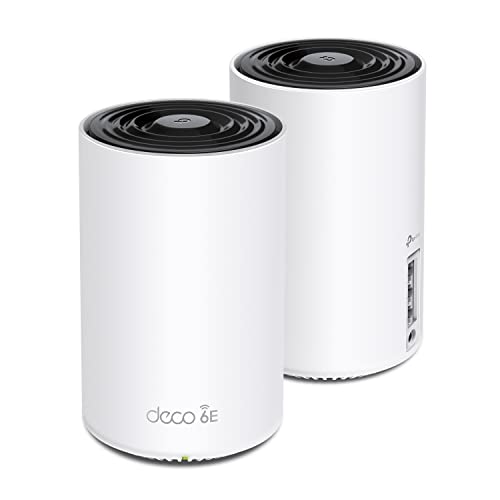
TP-Link Deco Tri-Band WiFi 6E 2-Pack
Best for: homes up to 5,500 sq ft with many devices
- Wi-Fi Standard
- WiFi 6E
- Speed Rating
- AXE5400
- Coverage Area
- up to 5500 Sq.Ft
- Frequency Bands
- Tri-Band
- Pack Size
- 2-Pack
- Device Capacity
- 200 devices
View on Amazon: TP-Link Deco Tri-Band WiFi 6E 2-Pack Affiliate link
This TP-Link Deco XE75 is a tri-band WiFi 6E mesh system designed to cover up to 5,500 square feet. It supports up to 200 devices with a total speed rating of AXE5400. The 6 GHz band operates as the default backhaul, reducing interference from legacy devices. It includes HomeShield for basic security and parental controls. This system suits users who need stable connections for many devices and want to eliminate dead zones in large homes.
Pros
- Tri-band AXE5400 speed rating for high throughput
- 6 GHz band acts as default backhaul for stability
- Supports up to 200 connected devices
- Covers up to 5,500 square feet
- Includes free HomeShield security and parental controls
Cons
- Limited to WiFi 6E standard instead of newer WiFi 7
- 2-pack covers 5,500 sq ft, which may require more nodes for larger spaces
- Device capacity capped at 200 devices
Good fit if
- You have a home up to 5,500 square feet
- You need to connect up to 200 devices simultaneously
- You want the 6 GHz band to handle backhaul traffic
Skip if
- You require the latest WiFi 7 standard
- You have more than 200 devices to connect
- Your home exceeds 5,500 square feet
Verdict: TP-Link Deco XE75 Tri-Band Mesh System is a solid choice for homes up to 5,500 square feet that need to support up to 200 devices on a stable WiFi 6E network.
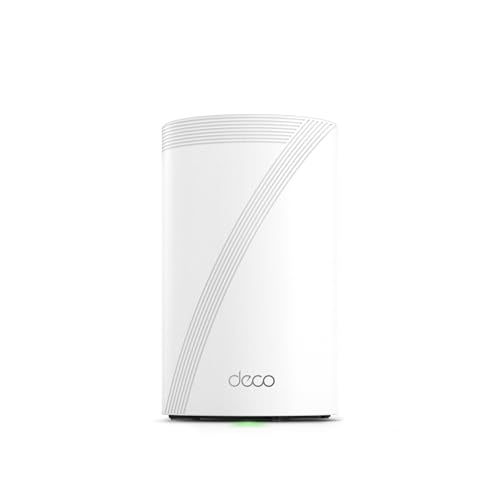
TP-Link Deco Tri-Band WiFi 7 Mesh Router
Best for: Single-node Wi-Fi 7 setups
- Wi-Fi Standard
- Wi-Fi 7
- Speed Rating
- BE10000
- Coverage Area
- 3,000 sq ft
- Frequency Bands
- Tri-Band
- Pack Size
- 1-Pack
- Port Speed
- 2.5 Gbps
View on Amazon: TP-Link Deco Tri-Band WiFi 7 Mesh Router Affiliate link
The Deco 7 Pro is a Wi-Fi 7 tri-band mesh system rated at BE10000. It covers up to 3,000 square feet and supports over 200 devices. You get four 2.5G ports and a 10G WAN/LAN port for high-speed wired connections. This unit suits you if you want future-proof hardware with dedicated backhaul bands for stable whole-home coverage.
Pros
- Wi-Fi 7 standard with BE10000 speed rating
- 10G WAN/LAN port for future internet upgrades
- Four 2.5G WAN/LAN ports for wired devices
- Supports over 200 connected devices
- Tri-band design with simultaneous wired and wireless backhaul
Cons
- Sold as a single pack unit
- Coverage limited to 3,000 square feet per node
- No mention of USB port usage for storage sharing
Good fit if
- You have a gigabit or multi-gigabit internet plan
- You need a single node for a small apartment or office
- You want Wi-Fi 7 features without buying a multi-pack
Skip if
- You need to cover more than 3,000 square feet with one unit
- You require a multi-pack bundle for whole-home coverage
- You are on a budget requiring older Wi-Fi 6E hardware
Verdict: The TP-Link Deco 7 Pro BE63 offers high-end Wi-Fi 7 specs in a single node. It fits you if you need a powerful starter unit for a small space or a wired backhaul node for a larger system.
Specifications side by side
| Spec | TP-Link Deco Tri-Band WiFi 6E 2-Pack | TP-Link Deco Tri-Band WiFi 7 Mesh Router |
|---|---|---|
| Wi-Fi Standard | WiFi 6E | Wi-Fi 7 |
| Speed Rating | AXE5400 | BE10000 |
| Coverage Area | up to 5500 Sq.Ft | 3,000 sq ft |
| Frequency Bands | Tri-Band | Tri-Band |
| Pack Size | 2-Pack | 1-Pack |
| Port Speed | not stated | 2.5 Gbps |
| Device Capacity | 200 devices | 200+ |
| Frequency Band | Tri-Band | Tri-Band |
| Use Case | Gaming, Streaming | not stated |
| Features | Mesh, WPA3 | VPN, Mesh |
| Intended Use | Home | Home |
| Dimensions | 4.13 × 4.13 × 6.67 inches | 4.23 × 4.23 × 6.93 inches |
| Weight | 2.69 pounds | 1.66 pounds |
| Size | 2 Pack | 1 Pack |
| Color | Black and White | White |
| Model | Deco XE75(2-pack) | Deco BE63(1-Pack) |
Frequently asked questions
Can I mix WiFi 6E and WiFi 7 Deco nodes together?
Yes, you can mix these models in a single mesh system. The Deco app manages compatibility between different Wi-Fi standards. You can use the Deco Tri-Band WiFi 7 as a main node and add the WiFi 6E units as extenders. This allows you to upgrade gradually without replacing your entire setup at once.
Which system is better for a large home over 5,000 square feet?
The TP-Link Deco Tri-Band WiFi 6E 2-Pack is designed for homes up to 5,500 square feet. It supports up to 200 connected devices on a stable network. The Deco Tri-Band WiFi 7 comes as a single node. You would need to purchase additional units to cover the same large area effectively.
Does the WiFi 7 model have more wired ports for fast internet?
The Deco Tri-Band WiFi 7 includes four 2.5G WAN/LAN ports and one 10G port. These interfaces handle speeds exceeding typical gigabit plans. The WiFi 6E model data does not specify port counts in the provided attributes. You should check the specific port configuration for the WiFi 6E unit if wired speed is critical.
Is the WiFi 7 system suitable for a small apartment?
The Deco Tri-Band WiFi 7 is ideal for small spaces as a single-node setup. It offers high-end Wi-Fi 7 specs in one unit. The Deco Tri-Band WiFi 6E comes in a 2-Pack. This is better for larger homes. You only need the WiFi 7 model if you want a powerful starter unit for a compact area.
What is the physical size difference between the two Deco models?
The Deco Tri-Band WiFi 7 node is slightly larger and lighter. It measures 4.23 inches wide and weighs 1.66 pounds. The Deco Tri-Band WiFi 6E unit is 4.13 inches wide and weighs 2.69 pounds. Both have a similar vertical height around 6.7 inches. They fit easily in most home environments without taking up much space.
Do both systems use the same mobile app for management?
Both systems are managed through the TP-Link Deco app. You can set up, monitor, and control your network from a smartphone. The app provides features like HomeShield for security and parental controls. This unified interface makes it easy to manage mixed networks or separate systems with consistent settings.