Tenda or DBIT? Mesh Wifi Systems Compared in 2026
As an Amazon Associate we earn from qualifying purchases. Links on this page are affiliate links.
When you compare the Tenda Nova MW6 against the DBIT AX1800 mesh wifi system, you see two distinct approaches to whole-home coverage. Both offer a three-pack setup with gigabit ports and dual-band connectivity to eliminate dead zones. The main difference lies in their generation and capacity. Tenda sticks to Wi-Fi 5 standards, while DBIT utilizes the newer Wi-Fi 6 technology. This impacts speed, efficiency, and how many devices each system can handle simultaneously in your home.
Key differences
| Aspect | Tenda 3-Pack Dual-Band Wi-Fi 5 Mesh System | DBIT AX1800 WiFi 6 Mesh System 3-Pack |
|---|---|---|
| Wi-Fi Standard | Wi-Fi 5 | Wi-Fi 6 |
| Speed Rating | AC1200 | AX1800 |
| Coverage Area | up to 3500 sq.ft. | 6500 sq. ft. |
| Device Capacity | up to 90 devices | 150+ devices |
| Security | WPA2-PSK | WPA3 |
Which one should you choose?
Choose Tenda 3-Pack Dual-Band Wi-Fi 5 Mesh System if
- You have a smaller home under 3500 sq.ft. with fewer than 90 connected devices.
- You prefer a simpler, established Wi-Fi 5 setup that is often more affordable.
- You want a compact node design that fits easily into tight spaces.
Choose DBIT AX1800 WiFi 6 Mesh System 3-Pack if
- You need coverage for a large home up to 6500 sq.ft. or multiple stories.
- You have many smart home devices or stream 4K content and need Wi-Fi 6 efficiency.
- You prioritize the latest WPA3 security standard and higher device capacity.
Verdict: The DBIT AX1800 is the better choice for larger homes and users with many connected devices due to its Wi-Fi 6 standard and double the coverage area. The Tenda Nova MW6 remains a practical option for smaller spaces where Wi-Fi 5 performance is sufficient. Choose based on your square footage and device count.
Tenda vs DBIT Mesh Comparison
Wi-Fi Standard
The DBIT system uses Wi-Fi 6 (802.11ax), while the Tenda Nova MW6 relies on the older Wi-Fi 5 (802.11ac) standard. Wi-Fi 6 introduces technologies like OFDMA and MU-MIMO that manage multiple data streams more efficiently. This allows the DBIT unit to handle high-demand tasks with reduced latency. Wi-Fi 5 is still capable for basic browsing and streaming, but it lacks the modern efficiency features found in the newer generation. If you have many smart devices or need consistent performance during heavy usage, the newer standard offers a clear technical advantage.
Speed Rating
DBIT provides an AX1800 speed rating, combining 574 Mbps on the 2.4 GHz band and 1201 Mbps on the 5 GHz band. Tenda offers an AC1200 rating, which typically splits bandwidth differently across its dual bands. The higher aggregate speed of the AX1800 standard means more potential throughput for activities like 4K streaming or large file downloads. While real-world speeds depend on your internet plan and distance from the node, the DBIT system has a higher theoretical ceiling. This extra bandwidth helps maintain performance when multiple devices are active simultaneously.
Coverage Area
DBIT claims coverage for up to 6,500 square feet with its three-pack setup. Tenda Nova MW6 covers up to 3,500 square feet. Both systems use mesh technology to eliminate dead zones, but the DBIT units are designed for significantly larger floor plans. If you have a multi-story home or a large open layout, the DBIT system provides more headroom. The Tenda system is suitable for smaller to medium-sized homes. You should choose the larger coverage area if your home exceeds 3,500 square feet to ensure consistent signal strength throughout.
Device Capacity
The DBIT mesh system supports over 150 connected devices. Tenda Nova MW6 supports up to 90 devices. This capacity matters if you have a busy smart home with many sensors, cameras, and phones. Higher device capacity ensures that your network does not slow down when many gadgets connect at once. The DBIT system handles a denser network more effectively due to its Wi-Fi 6 architecture. If you plan to expand your smart home ecosystem significantly, the higher limit on the DBIT unit provides better long-term scalability.
Security Features
DBIT includes WPA3 encryption for stronger security against modern hacking attempts. Tenda Nova MW6 uses WPA2-PSK encryption. WPA3 is the latest security standard, offering better protection for open networks and improved resistance to brute-force attacks. Both systems offer guest networks to isolate visitors from your main devices. However, the DBIT system also mentions automatic firmware updates to keep security patches current. If network security is a top priority, the newer encryption standard on the DBIT unit provides a more robust defense.
Physical Dimensions
Tenda Nova MW6 units measure 3.93 inches on each side and weigh 1.83 pounds. DBIT units are larger at 4.33 inches wide and 4.41 inches high, weighing 2.58 pounds. The Tenda units are more compact and lighter, making them easier to place in tight spaces or on small shelves. The DBIT units are bulkier, which may require more floor or desk space. If you have limited space for your networking equipment, the smaller footprint of the Tenda system is a practical advantage for discreet placement.
Which Mesh System Fits Your Home Best
Users with large homes needing wide coverage
The DBIT AX1800 covers up to 6,500 square feet, which is nearly double the Tenda Nova MW6 capacity of 3,500 square feet. If you have a large property or multiple floors, the DBIT system provides broader whole-home coverage to eliminate dead zones effectively without requiring additional nodes.
Buyers wanting modern Wi-Fi 6 efficiency
The DBIT system supports Wi-Fi 6 (802.11ax) with AX1800 speeds, offering better bandwidth allocation through OFDMA and MU-MIMO. This standard handles high-demand tasks and multiple connections more efficiently than the Tenda Nova MW6, which uses the older Wi-Fi 5 (802.11ac) standard for AC1200 speeds.
Shoppers prioritizing compact device dimensions
The Tenda Nova MW6 units are slightly smaller, measuring 3.93 inches in height and width compared to the DBIT D-MAX5 units at 4.41 inches high and 4.33 inches wide. If you prefer a more compact footprint for your networking gear, the Tenda system offers a smaller physical profile.
The products compared
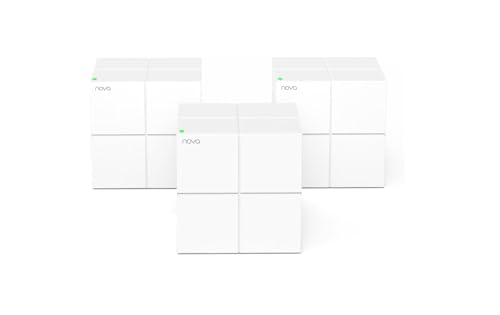
Tenda 3-Pack Dual-Band Wi-Fi 5 Mesh System
Best for: Small homes needing basic reliable coverage
- Speed Rating
- AC1200
- Coverage Area
- up to 3500 sq.ft.
- Frequency Bands
- Dual-Band
- Pack Size
- 3-Pack
- Device Capacity
- up to 90 devices
- Wi-Fi Standard
- Wi-Fi 5
View on Amazon: Tenda 3-Pack Dual-Band Wi-Fi 5 Mesh System Affiliate link
The Tenda Nova MW6 is a three-pack AC1200 Wi-Fi 5 mesh system designed for homes up to 3,500 square feet. It supports up to 90 devices using dual-band connectivity and gigabit ports. You get seamless roaming across a single network name. The system includes app-based management for easy setup and monitoring. It is suitable for smaller to medium-sized homes that do not require Wi-Fi 6 speeds.
Pros
- Covers up to 3,500 square feet of space
- Supports up to 90 connected devices simultaneously
- Includes gigabit ethernet ports for wired connections
- App-based setup and network management
- Seamless roaming with a single network name
Cons
- Uses Wi-Fi 5 (AC1200) instead of Wi-Fi 6
- Lower coverage area compared to Wi-Fi 6 competitors
- Limited to 90 device capacity
Good fit if
- You have a home under 3,500 square feet
- You need a budget-friendly mesh system for basic streaming and browsing
- You want a simple app-controlled setup
Skip if
- You require Wi-Fi 6 speeds for heavy bandwidth tasks
- You have more than 90 devices on your network
- You need coverage for a home larger than 3,500 square feet
Verdict: The Tenda Nova MW6 AC1200 Mesh System provides reliable whole-home coverage for smaller households. It is a practical option for users who prioritize affordability and ease of use over the latest Wi-Fi 6 standards.
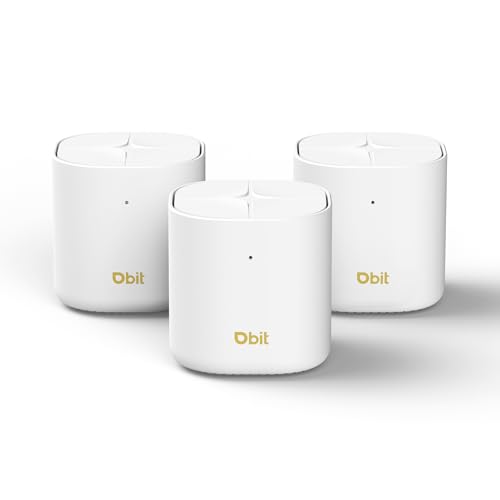
DBIT AX1800 WiFi 6 Mesh System 3-Pack
Best for: large homes with many devices
- Wi-Fi Standard
- WiFi 6
- Speed Rating
- AX1800
- Coverage Area
- 6,500 sq. ft.
- Frequency Bands
- Dual-Band
- Pack Size
- 3-Pack
- Port Speed
- Gigabit
View on Amazon: DBIT AX1800 WiFi 6 Mesh System 3-Pack Affiliate link
The DBIT AX1800 is a WiFi 6 mesh system designed for large spaces. It covers up to 6,500 square feet and supports over 150 devices. The 3-pack includes three units with dual-band speeds totaling 1.8 Gbps. Each unit has two Gigabit Ethernet ports. You get whole-home coverage with seamless roaming. The system uses OFDMA and MU-MIMO to reduce latency. It includes WPA3 security and parental controls.
Pros
- Covers up to 6,500 square feet
- Supports 150+ connected devices
- Includes 6 Gigabit Ethernet ports total
- WiFi 6 with OFDMA and MU-MIMO
- WPA3 encryption and automatic updates
Cons
- Dual-band only, lacks WiFi 7 speeds
- No dedicated backhaul band specified
- Heavier build at 2.58 pounds per unit
Good fit if
- You need coverage for large homes
- You have many smart devices
- You want wired Gigabit ports
Skip if
- You require WiFi 7 performance
- You need tri-band speeds
- You prefer lightweight units
Verdict: DBIT AX1800 3-Pack Mesh System offers solid WiFi 6 coverage for large homes. It suits users with many devices who need wired connections. It is not ideal for those seeking the latest WiFi 7 speeds.
Specifications side by side
| Spec | Tenda 3-Pack Dual-Band Wi-Fi 5 Mesh System | DBIT AX1800 WiFi 6 Mesh System 3-Pack |
|---|---|---|
| Wi-Fi Standard | not stated | WiFi 6 |
| Speed Rating | AC1200 | AX1800 |
| Coverage Area | up to 3500 sq.ft. | 6,500 sq. ft. |
| Frequency Bands | Dual-Band | Dual-Band |
| Pack Size | 3-Pack | 3-Pack |
| Port Speed | not stated | Gigabit |
| Device Capacity | up to 90 devices | 150+ devices |
| Frequency Band | Dual-Band | Dual-Band |
| Features | Mesh | Mesh, Seamless Roaming |
| Intended Use | Home | not stated |
| Dimensions | 3.93 × 3.93 × 3.93 inches | 4.33 × 4.33 × 4.41 inches |
| Weight | 1.83 pounds | 2.58 pounds |
| Size | 3 Pack | not stated |
| Color | white | White |
| Model | MW6-3 | D-MAX5 |
Frequently asked questions
Which mesh system is better for large homes with many connected devices?
The DBIT AX1800 is the better choice for large homes. It supports Wi-Fi 6, which handles multiple devices more efficiently than Wi-Fi 5. It also covers up to 6,500 square feet, nearly double the Tenda Nova MW6 capacity of 3,500 square feet. This makes it ideal for properties with many gadgets.
Does the Tenda Nova MW6 support the latest Wi-Fi standard?
No, the Tenda Nova MW6 uses Wi-Fi 5 (802.11ac). It does not support Wi-Fi 6 or Wi-Fi 7. The DBIT AX1800 offers Wi-Fi 6 for better performance with modern devices. If you need the newest standard, the Tenda system is not the right fit.
Are both mesh systems available in a three-pack configuration?
Yes, both systems come in a three-pack. The Tenda Nova MW6 includes three nodes for whole-home coverage. The DBIT AX1800 also provides a three-pack setup. This allows you to place multiple units in your home to eliminate dead zones effectively.
What is the speed rating of the Tenda mesh system?
The Tenda Nova MW6 has an AC1200 speed rating. It operates on dual-band frequencies to provide reliable connectivity. This rating is suitable for basic internet tasks and smaller homes. It is not designed for high-bandwidth activities like 4K streaming on many devices simultaneously.
Is the DBIT AX1800 suitable for homes with many connected devices?
Yes, the DBIT AX1800 is suitable for homes with many devices. It uses Wi-Fi 6 technology to manage multiple data streams efficiently. This reduces congestion and maintains speed even when numerous gadgets are connected. It is a practical option for busy households.
How does the coverage area compare between Tenda and DBIT?
The DBIT AX1800 covers a larger area than the Tenda Nova MW6. DBIT reaches up to 6,500 square feet, while Tenda covers 3,500 square feet. If you have a large property, the DBIT system provides more comprehensive coverage. The Tenda system is better for smaller spaces.
Does the Tenda Nova MW6 have gigabit ports?
Yes, the Tenda Nova MW6 includes gigabit ports. These ports allow for fast wired connections to devices like gaming consoles or smart TVs. This ensures stable performance for stationary devices. The DBIT system also offers wired connectivity options for similar use cases.
Which system is better for users prioritizing affordability over speed?
The Tenda Nova MW6 is better for users prioritizing affordability. It provides reliable coverage for smaller homes without the premium cost of newer standards. It is a practical option if you do not need Wi-Fi 6 speeds. The DBIT system offers more advanced features for a higher performance level.