Tenda vs Cudy: Mesh Wifi Systems Compared by Specs
As an Amazon Associate we earn from qualifying purchases. Links on this page are affiliate links.
When comparing a tenda vs cudy mesh wifi system, you look at how each brand handles coverage and speed. Both offer three-pack configurations with gigabit ports for stable wired connections. The main difference lies in their wireless technology. Tenda uses older Wi-Fi 5 standards, while Cudy adopts the newer Wi-Fi 6 protocol. This choice affects how each system manages multiple devices and bandwidth efficiency in your home.
Key differences
| Aspect | Tenda 3-Pack Dual-Band Wi-Fi 5 Mesh System | Cudy AX1500 3-Pack Gigabit Mesh System |
|---|---|---|
| Wi-Fi Standard | Wi-Fi 5 | Wi-Fi 6 |
| Speed Rating | AC1200 | AX1500 |
| Coverage Area | up to 3500 sq.ft. | 2500 sq ft |
| Device Capacity | up to 90 devices | 128 devices |
| Port Speed | Gigabit | Gigabit |
Which one should you choose?
Choose Tenda 3-Pack Dual-Band Wi-Fi 5 Mesh System if
- You need the largest possible coverage area for a bigger home.
- You prioritize raw range over the latest wireless efficiency standards.
- You have fewer than 90 devices and want a simpler setup.
Choose Cudy AX1500 3-Pack Gigabit Mesh System if
- You want the efficiency of Wi-Fi 6 for multiple connected devices.
- You need support for up to 128 devices simultaneously.
- You value built-in VPN features for secure remote access.
Verdict: Choose Tenda if your primary goal is maximum square footage coverage for a larger property. Choose Cudy if you want the performance benefits of Wi-Fi 6 and higher device capacity for a busy household. Both provide gigabit wired ports for stable connections.
Tenda vs Cudy Mesh Specs
Wi-Fi standard
Tenda Nova MW6 uses Wi-Fi 5, also known as 802.11ac. This is a mature standard that offers reliable performance for most home tasks. Cudy M1500 upgrades to Wi-Fi 6, or 802.11ax. This newer standard introduces OFDMA and better multi-device handling. Wi-Fi 6 reduces congestion when many devices connect at once. It also improves battery life for mobile devices. If you have modern phones and laptops, Wi-Fi 6 provides a more future-proof foundation. The older Wi-Fi 5 standard works well but lacks these efficiency gains. For newer hardware, the Cudy option is technically superior.
Speed rating
The Tenda system is rated AC1200. This combines speeds from the 2.4 GHz and 5 GHz bands to a total of 1200 Mbps. The Cudy system is rated AX1500. It offers 300 Mbps on the 2.4 GHz band and 1201 Mbps on the 5 GHz band. This results in higher potential throughput, especially on the less crowded 5 GHz band. Higher numbers generally mean faster data transfer for large files or 4K streaming. The Cudy AX1500 rating indicates a faster wireless connection capability than the Tenda AC1200 rating. This speed difference is noticeable in bandwidth-heavy environments.
Coverage area
Tenda claims coverage up to 3500 square feet for the entire 3-pack. This suggests the units are optimized to cover larger floor plans with fewer nodes. Cudy states 2500 square feet per unit. For a 3-pack, the total potential coverage is significantly larger, likely around 7500 square feet if expanded. However, the base 3-pack claim for Cudy is listed as 2500 square feet in the summary, which seems to refer to a single unit or a specific configuration. If we compare the single unit coverage, Cudy offers more. Tenda’s 3500 sq ft claim for the whole set is a conservative estimate. Cudy offers more scalable coverage potential.
Device capacity
Tenda Nova MW6 supports up to 90 connected devices. This is sufficient for most average homes with smart lights, phones, and tablets. Cudy M1500 supports up to 128 devices. It also mentions support for 60+ simultaneous clients. This higher capacity is better for homes with many smart home gadgets, multiple streaming devices, and users. If you have a dense network of IoT devices, the Cudy system can handle the load better. The Tenda system is adequate for standard use but has a lower limit. The Cudy advantage is clear for heavy users.
Security features
Tenda uses WPA2-PSK encryption for network security. It also includes a guest network for visitors. This is a standard security setup that protects your main network from unauthorized access. Cudy goes further by including a built-in VPN client. It supports PPTP, L2TP, and WireGuard protocols. This allows you to create secure tunnels for remote access or privacy. WireGuard is a modern, fast, and secure protocol. This feature is rare in consumer mesh systems. If you need secure remote management or enhanced privacy, Cudy provides tools that Tenda lacks. Tenda’s security is basic but functional.
Which mesh system fits your home best
Users needing maximum device capacity
The Cudy M1500 supports up to 128 connected devices, which exceeds the Tenda Nova MW6 limit of 90 units. This higher capacity ensures stable performance for homes with many smart gadgets. The Wi-Fi 6 standard also improves efficiency when multiple devices stream 4K video or game simultaneously without lag.
Buyers prioritizing wide coverage area
The Tenda Nova MW6 3-pack covers up to 3500 square feet. This exceeds the Cudy M1500 coverage of 2500 square feet. If you have a larger home or more floors, the Tenda system provides broader whole-home Wi-Fi reach. This makes it ideal for eliminating dead zones in spacious properties.
Shoppers wanting built-in security features
The Cudy M1500 includes a built-in VPN client supporting PPTP, L2TP, and WireGuard protocols. This allows for secure remote access and enhanced privacy without extra hardware. The Tenda Nova MW6 relies on standard WPA2-PSK encryption and a guest network but lacks these advanced integrated VPN capabilities for secure remote management.
The products compared
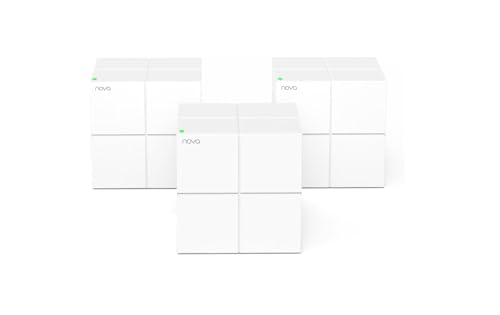
Tenda 3-Pack Dual-Band Wi-Fi 5 Mesh System
Best for: Large homes needing broad coverage
- Speed Rating
- AC1200
- Coverage Area
- up to 3500 sq.ft.
- Frequency Bands
- Dual-Band
- Pack Size
- 3-Pack
- Device Capacity
- up to 90 devices
- Wi-Fi Standard
- Wi-Fi 5
View on Amazon: Tenda 3-Pack Dual-Band Wi-Fi 5 Mesh System Affiliate link
The Tenda Nova MW6 is a Wi-Fi 5 mesh system designed for homes up to 3,500 square feet. This 3-pack covers large areas with dual-band AC1200 speeds. It supports up to 90 devices using MU-MIMO and beamforming. The system uses gigabit ports for wired connections. You can manage the network through the Tenda Wi-Fi app. It offers seamless roaming for connected devices.
Pros
- Covers up to 3,500 square feet
- Supports up to 90 connected devices
- Includes gigabit ethernet ports
- Dual-band Wi-Fi 5 standard
- MU-MIMO and beamforming technology
Cons
- Uses older Wi-Fi 5 standard instead of Wi-Fi 6
- Lower AC1200 speed rating compared to modern AX1500 systems
- No mention of Wi-Fi 6E or tri-band support
Good fit if
- You need coverage for a 4-6 bedroom home
- You have up to 90 devices to connect
- You want a simple app-based setup
Skip if
- You require Wi-Fi 6 speeds
- You need coverage beyond 3,500 square feet
- You want the latest AX1500 performance
Verdict: Tenda Nova MW6 AC1200 3-Pack covers large homes with reliable Wi-Fi 5 speeds. It fits users with many devices who prioritize coverage over cutting-edge standards.
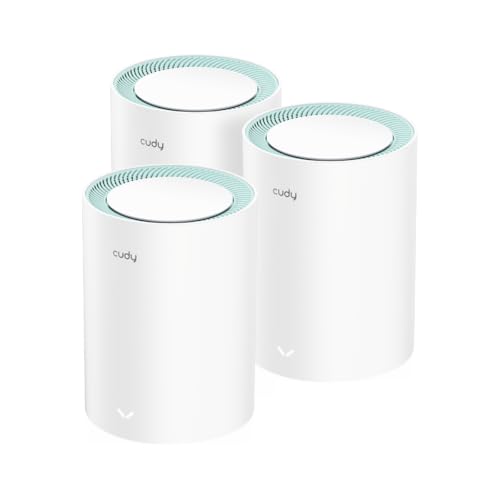
Cudy AX1500 3-Pack Gigabit Mesh System
Best for: Gigabit homes needing wired ports and VPN
- Wi-Fi Standard
- Wi-Fi 6
- Speed Rating
- AX1500
- Coverage Area
- 2,500 sq. ft.
- Frequency Bands
- Dual-Band
- Pack Size
- 3-Pack
- Port Speed
- 1 Gbps
View on Amazon: Cudy AX1500 3-Pack Gigabit Mesh System Affiliate link
The Cudy M1500 is a Wi-Fi 6 mesh system with three units. It provides AX1500 speeds and covers 2,500 square feet per node. Each unit includes three gigabit ports for wired connections. It supports up to 128 devices and includes built-in VPN client features. This setup suits homes with gigabit internet plans and multiple streaming or gaming devices.
Pros
- Wi-Fi 6 standard with AX1500 speed rating
- Three gigabit ports per unit for wired stability
- Supports 128 devices and 60+ simultaneous clients
- Built-in VPN client with WireGuard support
- Covers 2,500 square feet per unit
Cons
- Dual-band only, lacking tri-band or Wi-Fi 7
- Lower speed rating than Wi-Fi 7 competitors
- No mention of Ethernet aggregation ports
Good fit if
- You have a gigabit internet plan
- You need wired connections for key devices
- You want whole-home VPN privacy
Skip if
- You require Wi-Fi 7 speeds
- You need tri-band performance
- You have a home larger than 7,500 square feet
Verdict: Cudy M1500 3-Pack Wi-Fi 6 Mesh is a solid choice for gigabit users who value wired ports and VPN features over raw speed.
Specifications side by side
| Spec | Tenda 3-Pack Dual-Band Wi-Fi 5 Mesh System | Cudy AX1500 3-Pack Gigabit Mesh System |
|---|---|---|
| Wi-Fi Standard | not stated | Wi-Fi 6 |
| Speed Rating | AC1200 | AX1500 |
| Coverage Area | up to 3500 sq.ft. | 2,500 sq. ft. |
| Frequency Bands | Dual-Band | Dual-Band |
| Pack Size | 3-Pack | 3-Pack |
| Port Speed | not stated | 1 Gbps |
| Device Capacity | up to 90 devices | 128 (60 recommended) |
| Frequency Band | Dual-Band | Dual-Band |
| Features | Mesh | VPN, Mesh, Seamless Roaming |
| Intended Use | Home | not stated |
| Dimensions | 3.93 × 3.93 × 3.93 inches | 4.33 × 4.33 × 6.1 inches |
| Weight | 1.83 pounds | 1.98 pounds |
| Size | 3 Pack | not stated |
| Color | white | White |
| Model | MW6-3 | M1500 3-Pack |
Frequently asked questions
Is Cudy or Tenda better for Wi-Fi 6?
Cudy is the better choice if you need Wi-Fi 6. The Cudy M1500 system uses the 802.11ax standard, which offers improved efficiency and performance. Tenda relies on Wi-Fi 5 technology, which is older and lacks these modern advancements. If you want the latest wireless standard, Cudy is the clear winner.
Do both brands offer gigabit Ethernet ports?
Yes, both mesh systems include gigabit Ethernet ports. The Tenda Nova MW6 and the Cudy M1500 both feature gigabit ports for wired connections. This ensures you can connect devices like smart TVs or gaming consoles with stable, high-speed wired links. Both brands prioritize reliable wired connectivity for home networks.
Which system supports more connected devices?
The Cudy M1500 supports more connected devices than the Tenda Nova MW6. Cudy allows up to 128 connected devices, while Tenda supports a maximum of 90 units. If you have a home filled with smart gadgets and many users, the Cudy system provides the necessary capacity for stable performance.
What is the coverage area for the Cudy M1500?
The Cudy M1500 3-Pack covers up to 2,500 square feet. This coverage is suitable for medium to large homes. The three units work together to eliminate dead zones and provide consistent Wi-Fi throughout the space. You get reliable wireless coverage across a significant portion of your house with this configuration.
Are there VPN features in the Cudy system?
Yes, the Cudy M1500 includes VPN features. This allows you to secure your internet traffic and access remote networks safely. The Tenda Nova MW6 does not list VPN capabilities in its specifications. If online privacy and secure remote access are important to you, the Cudy system offers this specific functionality.
Which mesh system is better for large homes?
Tenda is often recommended for large homes needing broad coverage. The Tenda Nova MW6 3-Pack is designed to cover extensive areas with reliable Wi-Fi 5 speeds. While Cudy offers Wi-Fi 6, Tenda’s configuration is ideal for users who prioritize wide coverage over the newest wireless standards. It fits homes with many devices well.