Tenda 3-Pack Dual-Band Wi-Fi 5 vs Tenda Nova AX3000 3-Pack Mesh (2026): Key Differences
As an Amazon Associate we earn from qualifying purchases. Links on this page are affiliate links.
You are looking at the tenda 3 pack dual band wi fi 5 vs nova ax3000 3 pack mesh comparison. Both systems use a three-pack layout to cover your home with a single network name. They both support gigabit ports and manage devices via a mobile app. The main difference is the generation. One uses older Wi-Fi 5 technology, while the other uses the newer Wi-Fi 6 standard. This change affects speed, capacity, and coverage area significantly for your specific home needs.
Key differences
| Aspect | Tenda 3-Pack Dual-Band Wi-Fi 5 Mesh System | Tenda Nova AX3000 3-Pack Mesh System |
|---|---|---|
| Wi-Fi Standard | Wi-Fi 5 | Wi-Fi 6 |
| Speed Rating | AC1200 | AX3000 |
| Coverage Area | up to 3,500 sq.ft. | up to 7,000 sq.ft. |
| Device Capacity | up to 90 devices | 160+ devices |
| Processor | not listed | 1.7 GHz Quad-Core CPU |
Which one should you choose?
Choose Tenda 3-Pack Dual-Band Wi-Fi 5 Mesh System if
- You have a smaller home under 3,500 square feet.
- You are on a tighter budget and need basic coverage.
- You have fewer than 90 connected devices.
Choose Tenda Nova AX3000 3-Pack Mesh System if
- You need coverage for a larger home up to 7,000 square feet.
- You have many smart home devices or heavy bandwidth users.
- You want the efficiency and lower latency of Wi-Fi 6.
Verdict: The Tenda Nova AX3000 is the better choice for most modern homes due to its double coverage area and higher device capacity. Choose the Wi-Fi 5 model only if your space is small and your device count is low. The newer standard offers more headroom for future growth.
Tenda Wi-Fi 5 vs Wi-Fi 6 Mesh
Wi-Fi standard
The Tenda 3-Pack Dual-Band Wi-Fi 5 uses the older Wi-Fi 5 (802.11ac) standard. This technology has been the home networking baseline for years. In contrast, the Tenda Nova AX3000 3-Pack Mesh System adopts Wi-Fi 6 (802.11ax). Wi-Fi 6 introduces modern efficiency improvements like OFDMA and better handling of multiple data streams. This newer standard allows for more stable connections when many devices are active. You get future-proofing with the AX3000 model, while the MW6 relies on established, older technology.
Speed rating
Speed ratings define the theoretical maximum throughput for each system. The Tenda 3-Pack Dual-Band Wi-Fi 5 offers an AC1200 speed rating. This combines slower 2.4GHz and 5GHz bands. The Tenda Nova AX3000 3-Pack Mesh System provides an AX3000 speed rating. This represents a significant jump in potential bandwidth. The AX3000 rating supports higher data rates, which helps when streaming high-resolution video or transferring large files. If you need faster raw speeds for heavy internet usage, the AX3000 model has a clear advantage in this category.
Coverage area
Coverage area determines how much space each three-pack can effectively blanket. The Tenda 3-Pack Dual-Band Wi-Fi 5 covers up to 3,500 square feet. This is suitable for smaller to medium-sized homes. The Tenda Nova AX3000 3-Pack Mesh System covers up to 7,000 square feet. This doubles the coverage area compared to the Wi-Fi 5 option. If you have a large house, multiple floors, or thick walls, the AX3000 system is designed to reach further. You get more square footage per pack with the newer model.
Device capacity
Device capacity indicates how many gadgets can connect simultaneously. The Tenda 3-Pack Dual-Band Wi-Fi 5 supports up to 90 devices. This is sufficient for basic smart homes with a few phones and laptops. The Tenda Nova AX3000 3-Pack Mesh System supports over 160 devices. This higher capacity handles dense environments with many smart bulbs, cameras, and phones. If you have a heavily connected home, the AX3000 model manages traffic better. It reduces congestion when multiple users are online at the same time.
Processor
The processor inside the router affects how quickly it handles data. The Tenda Nova AX3000 3-Pack Mesh System includes a 1.7 GHz Quad-Core CPU. This powerful chip processes network traffic efficiently. The Tenda 3-Pack Dual-Band Wi-Fi 5 does not list a specific processor speed or core count in its specifications. Without this data, we cannot compare processing power directly. However, the AX3000 explicitly highlights its high-performance processor for stable, low-latency performance. You get a known powerful chip with the newer system.
Which Tenda Mesh System Fits Your Home
Users with small to medium homes
The Tenda 3-Pack Dual-Band Wi-Fi 5 covers up to 3,500 square feet. This capacity suits smaller residences or apartments where extensive range is not required. Its AC1200 speed rating provides stable connectivity for basic browsing and streaming. The compact cube design fits easily into tight spaces without dominating your decor.
Owners of large multi-story houses
The Tenda Nova AX3000 3-Pack Mesh offers coverage up to 7,000 square feet. This doubled range ensures strong signals reach distant rooms in larger layouts. The Wi-Fi 6 standard and AX3000 speed rating handle more data traffic efficiently. You get reliable performance across a significantly wider physical area with this system.
Households with many connected devices
This system supports over 160 devices simultaneously. The Wi-Fi 6 standard includes OFDMA technology, which manages multiple connections more efficiently than older methods. If you have numerous smart home gadgets, phones, and laptops, the higher device capacity prevents network congestion. The quad-core processor further ensures smooth operation under heavy loads.
The products compared
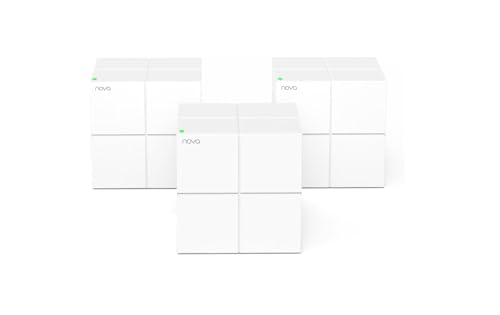
Tenda 3-Pack Dual-Band Wi-Fi 5 Mesh System
Best for: smaller homes needing stable Wi-Fi 5 coverage
- Speed Rating
- AC1200
- Coverage Area
- up to 3500 sq.ft.
- Frequency Bands
- Dual-Band
- Pack Size
- 3-Pack
- Device Capacity
- up to 90 devices
- Wi-Fi Standard
- Wi-Fi 5
View on Amazon: Tenda 3-Pack Dual-Band Wi-Fi 5 Mesh System Affiliate link
The Tenda Nova MW6 is a 3-pack mesh system using Wi-Fi 5 (AC1200) on dual bands. It covers up to 3500 square feet and supports up to 90 connected devices. The units feature gigabit ports and MU-MIMO technology for stable performance. You get seamless roaming with a single network name and app-based setup. This system suits homes needing reliable whole-home coverage without the complexity of newer Wi-Fi 6 standards.
Pros
- Wi-Fi 5 AC1200 dual-band standard
- Covers up to 3500 square feet
- Supports up to 90 connected devices
- Gigabit Ethernet ports on each node
- MU-MIMO and Beamforming technology
Cons
- Uses older Wi-Fi 5 standard instead of Wi-Fi 6
- Lower speed rating (AC1200) compared to AX3000 competitors
- Smaller coverage area (3500 sq ft) than larger mesh systems
Good fit if
- You need reliable coverage for up to 3500 square feet
- You have up to 90 devices to connect simultaneously
- You prefer a simple setup via the Tenda Wi-Fi APP
Skip if
- You require Wi-Fi 6 (AX) speeds for future-proofing
- Your home exceeds 3500 square feet in size
- You need more than 90 simultaneous device connections
Verdict: Tenda Nova MW6 3-Pack AC1200 Mesh is a solid choice for smaller homes needing stable Wi-Fi 5 coverage. It fits users who prioritize device capacity and easy app management over the latest Wi-Fi 6 speeds.

Tenda Nova AX3000 3-Pack Mesh System
Best for: large homes with many connected devices
- Wi-Fi Standard
- Wi-Fi 6
- Speed Rating
- AX3000
- Coverage Area
- up to 7,000 sq.ft.
- Frequency Bands
- Dual-Band
- Pack Size
- 3-Pack
- Port Speed
- Gigabit
View on Amazon: Tenda Nova AX3000 3-Pack Mesh System Affiliate link
The Tenda Nova MX12-3 is a 3-pack Wi-Fi 6 mesh system rated at AX3000. It covers up to 7,000 square feet with dual-band speeds of 2976Mbps. The units feature a quad-core processor and support over 160 devices. You get gigabit ports and seamless roaming. This setup suits large homes needing stable, high-capacity coverage without dead zones.
Pros
- Wi-Fi 6 (802.11ax) standard for improved speed and stability
- Covers up to 7,000 square feet of home space
- Supports over 160 connected devices simultaneously
- Equipped with gigabit Ethernet ports on each node
- Quad-core 1.7GHz processor for low latency performance
Cons
- Dual-band architecture lacks a dedicated third backhaul band
- Physical dimensions are bulkier than compact single-node routers
- Maximum speed rating is lower than Wi-Fi 7 systems
Good fit if
- You need whole-home coverage for a large house
- You connect many devices to a single network
- You want gigabit wired connections for your nodes
Skip if
- You require the latest Wi-Fi 7 speeds
- You prefer a compact design for small apartments
- You need tri-band dedicated backhaul for heavy streaming
Verdict: Tenda Nova MX12-3 AX3000 Mesh delivers reliable AX3000 coverage for large homes with many devices. It fits buyers who prioritize capacity and wired connectivity over next-generation wireless speeds.
Specifications side by side
| Spec | Tenda 3-Pack Dual-Band Wi-Fi 5 Mesh System | Tenda Nova AX3000 3-Pack Mesh System |
|---|---|---|
| Wi-Fi Standard | not stated | Wi-Fi 6 |
| Speed Rating | AC1200 | AX3000 |
| Coverage Area | up to 3500 sq.ft. | up to 7,000 sq.ft. |
| Frequency Bands | Dual-Band | Dual-Band |
| Pack Size | 3-Pack | 3-Pack |
| Port Speed | not stated | Gigabit |
| Device Capacity | up to 90 devices | 160+ Devices |
| Frequency Band | Dual-Band | Dual-Band |
| Features | Mesh | Mesh |
| Intended Use | Home | Home |
| Dimensions | 3.93 × 3.93 × 3.93 inches | 3.39 × 3.39 × 7.48 inches |
| Weight | 1.83 pounds | not stated |
| Size | 3 Pack | 3 Pack |
| Color | white | white |
| Model | MW6-3 | MX12-3 |
Frequently asked questions
Which Tenda mesh system handles more connected devices?
The Tenda Nova AX3000 3-Pack Mesh System supports over 160 devices. This high capacity suits large homes with many smart gadgets. The older Tenda 3-Pack Dual-Band Wi-Fi 5 system does not list a specific device limit in its published specifications. You should choose the AX3000 if you have a crowded network of phones, tablets, and IoT devices.
Do both systems include gigabit Ethernet ports?
Yes, both mesh systems feature gigabit port speeds. This allows you to connect wired devices like gaming consoles or desktop computers at full standard Ethernet speeds. This specification is consistent across the Tenda 3-Pack Dual-Band Wi-Fi 5 and the Tenda Nova AX3000 3-Pack Mesh System. You can rely on wired connections for stable performance in either setup.
How do the physical sizes of the nodes compare?
The Tenda Nova AX3000 nodes are taller and narrower, measuring 7.48 inches in height and 3.39 inches in width. The Tenda 3-Pack Dual-Band Wi-Fi 5 nodes are more compact cubes, measuring 3.93 inches on each side. The Wi-Fi 5 units also weigh 1.83 pounds each. You may find the smaller Wi-Fi 5 nodes easier to place in tight spaces.
Which system is better for a large home with many devices?
The Tenda Nova AX3000 3-Pack Mesh System is the better choice for large homes with many connected devices. It uses Wi-Fi 6 technology and supports over 160 devices simultaneously. The Tenda 3-Pack Dual-Band Wi-Fi 5 is rated for smaller homes needing stable coverage. It lacks the advanced capacity features found in the newer AX3000 model.
Are both mesh systems dual-band?
Yes, both the Tenda 3-Pack Dual-Band Wi-Fi 5 and the Tenda Nova AX3000 3-Pack Mesh operate on dual bands. This means they use both 2.4 GHz and 5 GHz frequencies to balance range and speed. You will get consistent coverage throughout your home with either system. Both are designed for general home use rather than specialized industrial applications.
What is the speed rating difference between the two systems?
The Tenda 3-Pack Dual-Band Wi-Fi 5 has an AC1200 speed rating. The Tenda Nova AX3000 3-Pack Mesh carries an AX3000 rating. The AX3000 designation indicates faster theoretical wireless speeds due to the newer Wi-Fi 6 standard. The AC1200 rating reflects the older Wi-Fi 5 technology. You will see a clear performance gap in raw throughput between these two models.