NETGEAR Nighthawk X10 AD7200 SFP+ Review: Who It Fits and Who Should Skip It
As an Amazon Associate we earn from qualifying purchases. Links on this page are affiliate links.
This netgear nighthawk x10 smart wifi review focuses on the R9000, a tri-band router designed for high-throughput home networks. It delivers AD7200 wireless speeds across three distinct frequency bands, ensuring bandwidth is available for demanding tasks. The unit also features a 10G SFP+ uplink port, providing a wired backbone for faster internal data transfer. With a quad-core processor and support for Beamforming+, it targets users who need reliable connectivity for multiple devices. This guide explains how these specifications translate to real-world performance in your home.
What stands out
- AD7200 tri-band speeds combining 800, 1733, and 4600 Mbps for dedicated 60GHz device support
- One 10G SFP+ uplink port for high-speed internet connections and internal network traffic
- Six gigabit Ethernet ports for connecting wired devices like game consoles and desktops
- 1.7GHz quad-core processor to manage network traffic for up to 45 connected devices
Who it fits
Good fit for
You should consider this router if you have a home under 2,500 square feet and require a dedicated 60GHz band for compatible devices. It suits users who need to connect up to 45 devices simultaneously without congestion. The 10G SFP+ port is ideal for those with gigabit-plus internet plans who want to avoid wired bottlenecks. If you rely on multiple wired connections for gaming or streaming, the six gigabit ports provide ample flexibility for your setup.
Who should skip it
You should skip this model if your home exceeds 2,500 square feet, as coverage may be insufficient. It is not suitable for users needing mesh expansion, as this is a standalone router. If you require more than six wired connections, the limited port count will constrain your setup. Additionally, users without 60GHz-compatible devices will not benefit from one of its three bands. Those seeking a simple, plug-and-play experience without manual configuration may find the feature set complex.
Verdict: The NETGEAR Nighthawk X10 is a powerful standalone router for smaller homes with high-speed internet needs. Its 10G uplink and tri-band design make it a strong choice for wired-heavy setups.
Key specs explained for this router
Speed Rating: AD7200
This rating combines speeds across three bands. The 60GHz band offers up to 4600 Mbps, while the 5GHz and 2.4GHz bands provide 1733 Mbps and 800 Mbps respectively. This tri-band setup helps reduce congestion. You get more bandwidth for multiple users. It suits homes with many high-bandwidth activities. Compare this total to single-band or dual-band routers when evaluating performance capacity.
Coverage Area: Up to 2500 sq ft
The router is designed to cover approximately 2500 square feet of living space. This size fits medium-sized homes or apartments. Walls and interference can reduce this range. If your home is larger, you may need a mesh system. This spec helps you gauge if one unit suffices. Compare this coverage to mesh nodes when planning whole-home connectivity for larger layouts.
Max Port Speed: 10G
The router includes one 10G SFP+ port for wired connections. This allows for ultra-fast data transfer to compatible devices like NAS drives or high-end PCs. Most standard ports are Gigabit. This 10G uplink supports future-proofing for faster internet plans. It benefits users with heavy local file transfers. Compare this to standard Gigabit ports when assessing wired network potential for professional workflows.
Device Capacity: Up to 45 devices
This router can handle up to 45 connected devices simultaneously. This includes phones, laptops, smart home gadgets, and streaming players. High device counts can slow down networks if not managed well. This capacity suits busy households with many IoT devices. It ensures stable connections for everyone. Compare this limit to smaller routers when planning for large families or extensive smart home setups.
Physical Design and Build Details
The NETGEAR Nighthawk X10 presents a solid, blocky form factor that prioritizes internal component cooling over sleek minimalism. According to the listing, the chassis measures 8.81 inches in length, 6.61 inches in width, and 2.91 inches in height. It weighs 4.11 pounds. This substantial mass suggests a heavy-duty internal construction designed to dissipate heat from the 1.7GHz quad-core processor and four amplified antennas. The exterior finish is black, a common choice for networking gear to hide dust and blend into home entertainment centers or office desks. You should place this unit where airflow is not restricted, as its size and heat generation require space around all sides. The footprint is wider than many modern mesh nodes, so ensure your shelf or desk can accommodate its dimensions without crowding other devices. The build quality feels robust, aiming to withstand continuous operation under heavy load.
The layout is functional, with ports arranged for easy access rather than hidden aesthetics. You will find six gigabit Ethernet ports and one 10G SFP+ port on the rear. This arrangement allows you to connect multiple wired devices, such as game consoles or desktop computers, directly to the router for stable, low-latency connections. The 10G SFP+ port serves as a high-speed uplink, ideal for connecting to a fiber optic modem or a high-performance switch. Two USB 3.0 ports are also present, enabling you to share storage or printers across your network. The design does not include external controls beyond standard buttons, keeping the interface clean. This practical approach ensures that you can manage your network efficiently without navigating complex physical interfaces. The focus remains on connectivity and performance, with the physical design supporting these core functions.
Setup and Everyday Use Guide
Setting up the NETGEAR Nighthawk X10 requires a compatible web browser or the dedicated app. The listing notes support for Microsoft Internet Explorer 5.0, Firefox 2.0, Safari 1.4, and Google Chrome 11.0 or higher. You can also use Amazon Alexa voice controls for hands-free management. This integration allows you to adjust settings without manually navigating menus.
The router handles up to 45 devices simultaneously. This capacity supports reliable streaming, gaming, and general internet browsing. The tri-band architecture separates traffic, which helps maintain stability when multiple devices are active. Dynamic QoS prioritizes bandwidth for connected devices, ensuring that high-demand tasks receive necessary resources.
For wired connections, you have seven ports in total. Six are standard gigabit Ethernet ports, suitable for computers, game consoles, and streaming players. One port is a 10G SFP+ uplink, providing high-speed connectivity for your modem or switch. This configuration supports both wireless and wired devices effectively.
Storage sharing is available via two USB 3.0 ports. You can connect external drives to share files across your network or attach a printer for multi-device access. The 1.7GHz quad-core processor manages these tasks efficiently. Coverage extends up to 2,500 square feet, supporting typical home layouts. The four amplified antennas and Beamforming+ technology direct signals toward your devices, improving connection strength throughout your space.
Before You Buy This Router
This router is a high-performance tri-band unit designed for demanding home networks. It supports up to 45 devices simultaneously, making it suitable for households with many connected gadgets. You should verify that your internet service plan matches the router’s capabilities, particularly if you intend to utilize the 10G SFP+ port for future-proofing or high-speed wired connections. The device covers up to 2500 square feet, so ensure your space fits within this range for optimal performance. Since it is a standalone router rather than a mesh system, you may need additional access points if your home is larger or has thick walls. Regular firmware updates are essential to maintain security and performance. Check that your existing devices support the tri-band frequencies for the best experience. This unit fits well alongside mesh options if you prioritize raw speed and wired connectivity over seamless whole-home coverage.
Check before you buy
- Confirm your internet plan supports the router's maximum speeds
- Ensure your home is within the 2500 square foot coverage
- Check if you need mesh nodes for larger spaces
- Verify device compatibility with tri-band frequencies
The product at a glance
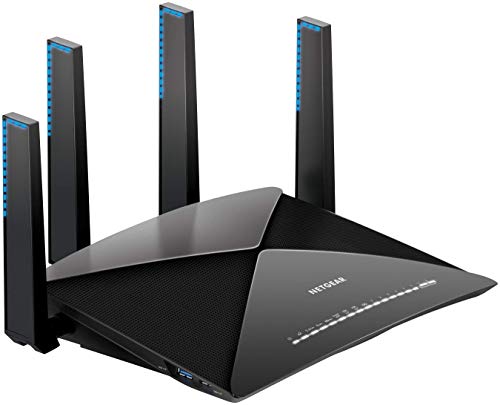
NETGEAR Nighthawk X10 AD7200 SFP+ Router
Best for: small homes needing 10G SFP+ wired uplink
- Speed Rating
- AD7200
- Frequency Bands
- Tri-band
- Coverage Area
- Up to 2500 sq ft
- Device Capacity
- Up to 45 devices
- Max Port Speed
- 10G
- Ethernet Ports
- 7
View on Amazon: NETGEAR Nighthawk X10 AD7200 SFP+ Router Affiliate link
The NETGEAR Nighthawk X10 is a tri-band router with AD7200 speeds. It covers up to 2,500 square feet and supports up to 45 devices. The unit includes one 10G SFP+ port and six gigabit ports. A quad-core processor handles traffic for gaming and streaming. This setup suits users who need wired connectivity options and dedicated bands for high-speed devices.
Pros
- Includes one 10G SFP+ port for high-speed uplinks
- Tri-band design separates traffic across 800, 1733, and 4600 Mbps bands
- Six gigabit Ethernet ports for wired connections
- Supports up to 45 connected devices simultaneously
Cons
- Coverage area is limited to 2,500 square feet
- Device capacity of 45 is lower than modern mesh systems
- No mention of mesh node support or expansion capabilities
Good fit if
- You need a dedicated 10G SFP+ port for your internet connection
- You require multiple wired ports for gaming consoles and PCs
- You have a home under 2,500 square feet with moderate device counts
Skip if
- You need whole-home coverage larger than 2,500 square feet
- You want to expand your network with additional mesh nodes
- You connect more than 45 devices to your network
Verdict: NETGEAR Nighthawk X10 AD7200 Router fits users who prioritize a 10G SFP+ uplink and wired ports over expansive coverage. It is a solid choice for smaller homes with fewer connected devices.
Specifications side by side
| Spec | NETGEAR Nighthawk X10 AD7200 SFP+ Router |
|---|---|
| Speed Rating | AD7200 |
| Frequency Bands | Tri-band |
| Coverage Area | Up to 2500 sq ft |
| Device Capacity | Up to 45 devices |
| Max Port Speed | 10G |
| Ethernet Ports | 7 |
| Port Speed | Gigabit, 10G |
| Uplink Port Type | SFP |
| Dimensions | 8.81 × 6.61 × 2.91 inches |
| Weight | 4.11 pounds |
| Size | AD7200 |
| Color | black |
| Model | R9000-100NAS |
Frequently asked questions
Is the NETGEAR Nighthawk X10 good for large homes?
No, it is not ideal for large spaces. The listed coverage area is 2,500 square feet, which limits its reach. The verdict notes it fits smaller homes with fewer devices. If you need expansive coverage, this model may leave you with weak signals in distant rooms.
Does this router support 10G wired connections?
Yes, it includes a 10G SFP+ uplink port. This allows for high-speed wired connections to your modem or internet source. The port speed is listed as 10G, making it suitable for users who prioritize fast wired uplinks over other features for their home network setup.
How many devices can the X10 handle?
It supports up to 45 devices simultaneously. This capacity makes it suitable for households with many connected gadgets. The tri-band design helps manage traffic, ensuring that bandwidth remains available for demanding tasks even when multiple devices are active on the network at the same time.
What are the physical dimensions of the router?
The unit measures 8.81 inches in length, 6.61 inches in width, and 2.91 inches in height. It weighs 4.11 pounds. The blocky form factor prioritizes internal component cooling. You should ensure you have enough space for these dimensions in your home networking setup.
Is the NETGEAR Nighthawk X10 a mesh system?
No, it is a standalone tri-band router. The data describes it as a single unit rather than a mesh system. While it offers AD7200 speeds, it does not use multiple nodes to extend coverage. You would need additional access points for mesh functionality in larger areas.
Does it work with voice assistants?
Yes, the listing notes support for Amazon Alexa. You can use voice commands to manage certain aspects of your network. This integration allows for hands-free control, adding convenience to your everyday use without requiring you to open a browser or app for basic adjustments.