GL.iNet or Google? Wifi Routers Compared in 2026
As an Amazon Associate we earn from qualifying purchases. Links on this page are affiliate links.
You are comparing the gl inet vs google wifi router options for different needs. Both provide reliable wireless connectivity for your devices. The GL.iNet Opal is a compact travel router designed for portability and secure connections on the go. Google Nest Wifi is a whole-home mesh system built for large spaces. One focuses on mobility and privacy tools, while the other prioritizes broad coverage and smart home integration.
Key differences
| Aspect | GL.iNet Opal Dual-Band Travel Router | Google Nest Wifi 3-Pack with Smart Speaker Points |
|---|---|---|
| Use Case | Travel | Whole-home mesh |
| Speed Rating | AC1200 | Not listed |
| Coverage Area | Not listed | Up to 5400 sq ft |
| Device Capacity | Not listed | Up to 100 connected devices |
| Pack Size | Single unit | 3-Pack (Router and 2 Points) |
| Ethernet Ports | 3 Gigabit ports | 2 per router |
Which one should you choose?
Choose GL.iNet Opal Dual-Band Travel Router if
- You need a portable router for travel or public Wi-Fi use
- You want built-in VPN support with physical toggle switches
- You prefer a lightweight, pocket-friendly device for on-the-go networking
Choose Google Nest Wifi 3-Pack with Smart Speaker Points if
- You need to cover a large home with multiple rooms
- You want to connect up to 100 devices simultaneously
- You value smart speaker features with Google Assistant integration
Verdict: Choose the GL.iNet Opal if you prioritize portability, security features, and mobile use. Select the Google Nest Wifi system if you need extensive coverage for a large home and want to manage many connected devices. Each product serves a distinct networking purpose.
GL.iNet Opal vs Google Nest Wifi
Frequency Band
The GL.iNet Opal is a dual-band AC1200 router. It offers simultaneous connections on 2.4GHz and 5GHz bands. The 2.4GHz band reaches 300 Mbps for basic tasks like email. The 5GHz band provides up to 867 Mbps for heavy loads. Google Nest Wifi is also a dual-band system. It supports both 2.4GHz and 5GHz frequencies for whole-home coverage. Both products use dual-band technology to reduce interference. This allows you to separate light browsing from high-bandwidth streaming. The GL.iNet Opal focuses on portable dual-band performance. Google Nest Wifi uses dual-band for extensive home coverage. Neither product offers tri-band capabilities in this comparison.
Speed Rating
The GL.iNet Opal carries an AC1200 speed rating. This combines the 300 Mbps from the 2.4GHz band and 867 Mbps from the 5GHz band. It is designed for local network speed tests. Real-world speeds may vary based on your configuration. The Google Nest Wifi system does not list a specific AC rating in the provided data. It emphasizes handling multiple 4K streams and 100 connected devices. The Nest Wifi router prioritizes consistent throughput across a large area. The GL.iNet Opal specifies its theoretical maximum wireless speeds. This makes its performance metrics clear for travel or point-to-point links. Google relies on system-level performance descriptions rather than a single number.
Ethernet Ports
The GL.iNet Opal includes three gigabit ports. It has two LAN ports and one WAN port. These ports support internet plans and wired device connections. The Google Nest Wifi router includes two Ethernet ports. Each port is likely gigabit, though not explicitly stated as such in the specs. The Nest Wifi points do not list port counts in the key specs. The GL.iNet Opal provides more wired options on a single device. It allows you to connect multiple wired devices directly. Google requires the router for its wired connections. The points extend wireless coverage without listed ports. The GL.iNet Opal offers better flexibility for wired setups.
Coverage Area
The Google Nest Wifi system covers up to 5400 square feet. This coverage comes from the three-pack configuration. It includes one router and two points. The points extend the wireless network to eliminate buffering in every room. The GL.iNet Opal is a travel router. Its data does not list a specific square footage coverage area. It is designed for portable use and public Wi-Fi conversion. The Opal uses retractable antennas for signal reception. It is not built to blanket a large home. Google Nest Wifi is clearly superior for large home coverage. The GL.iNet Opal is intended for smaller, temporary spaces.
Device Capacity
The Google Nest Wifi system can handle up to 100 connected devices. This capacity applies to each router and point in the system. It supports streaming multiple 4K videos simultaneously. The GL.iNet Opal does not list a maximum device capacity in the provided data. It is a single-device router focused on travel and security. It supports IPv6 and VPN features for privacy. The Google system is built for high-density environments. It intelligently manages connections to keep Wi-Fi fast. The GL.iNet Opal is better suited for fewer devices on the go. Google is designed for many devices in a home.
Which mesh wifi router fits you
Frequent travelers needing portable secure wifi
The GL.iNet Opal weighs only 10.6 ounces and features a compact design for easy transport. It converts public networks into private secure connections. You can enable OpenVPN or WireGuard via a physical switch. The AC1200 dual-band speeds handle basic browsing and streaming while on the move.
Homeowners seeking whole home coverage
Google Nest Wifi covers up to 5400 square feet with a three-pack system. The router and two points work together to blanket your home in reliable signal. This setup eliminates buffering in every room, ensuring consistent performance throughout your living space without dead zones.
Users managing many connected devices
Each Nest Wifi device handles up to 100 connected devices simultaneously. This capacity supports streaming multiple 4K videos at once. The system intelligently maintains speed for all your gadgets. You get stable performance even when many users are online in the same household.
The products compared
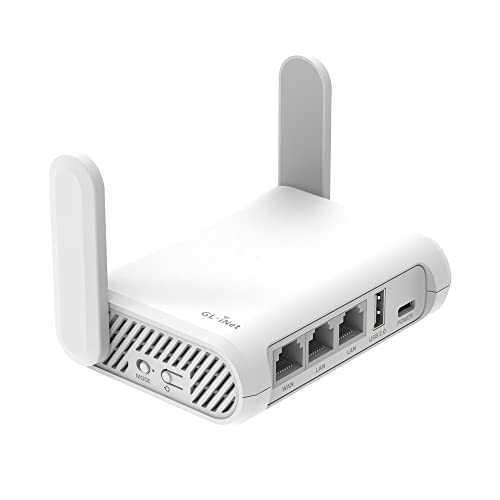
GL.iNet Opal Dual-Band Travel Router
Best for: Portable secure internet for travelers
- Speed Rating
- AC1200
- Frequency Bands
- Dual-Band
- Max Port Speed
- Gigabit
- Ethernet Ports
- 3
- Use Case
- Travel
- Features
- VPN, OpenWrt
View on Amazon: GL.iNet Opal Dual-Band Travel Router Affiliate link
This compact AC1200 dual-band router is built for travel. It offers 300 Mbps on 2.4GHz and 867 Mbps on 5GHz. The device includes one Gigabit WAN and two Gigabit LAN ports. You can connect it to public Wi-Fi to create a secure private network. It supports OpenVPN and WireGuard for encrypted connections. The lightweight design fits easily in your bag.
Pros
- Dual-band AC1200 speeds up to 867 Mbps on 5GHz
- Full Gigabit ports for wired connections
- Built-in OpenVPN and WireGuard support
- Compact and lightweight at 10.6 ounces
Cons
- Limited to AC1200 speeds, slower than modern standards
- No support for easy tethering from mobile devices
- Physical toggle switch requires prior admin panel setup
Good fit if
- You travel frequently and need a portable router
- You want to secure public Wi-Fi connections
- You require VPN encryption on the go
Skip if
- You need a whole-home mesh system
- You require Wi-Fi 6 or higher speeds
- You want a primary home internet router
Verdict: GL.iNet SFT1200 Travel Router is a specialized tool for travelers who need secure, portable internet access. It suits those prioritizing VPN features and portability over high-speed home networking.

Google Nest Wifi 3-Pack with Smart Speaker Points
Best for: Large homes needing smart speaker points
- Coverage Area
- Up to 5400 sq ft
- Device Capacity
- Up to 100 connected devices
- Ethernet Ports
- 2 per router
- Pack Size
- 3-Pack
- Dimensions
- 4.33 × 4.33 × 3.56 inches
- Weight
- 2.38 pounds
View on Amazon: Google Nest Wifi 3-Pack with Smart Speaker Points Affiliate link
This Google Nest WiFi 3-Pack covers up to 5400 square feet with a router and two points. It supports up to 100 connected devices and includes two Ethernet ports per router. Each point functions as a smart speaker with Google Assistant. The system integrates with the Google Home app for setup and management. It suits large homes needing broad coverage and smart home voice control.
Pros
- Covers up to 5400 square feet
- Supports up to 100 connected devices
- Includes two Ethernet ports per router
- Points act as Google Assistant smart speakers
Cons
- No mention of Wi-Fi 6 support
- Points lack Ethernet ports for wired connections
- Requires internet connection for smart speaker features
Good fit if
- You need coverage for a large home
- You want smart speaker integration in each point
- You already use the Google Home app
Skip if
- You require dedicated wired connections for all points
- You prefer Wi-Fi 6 speeds
- You want a router without smart speaker features
Verdict: Google Nest WiFi 3-Pack covers large spaces with integrated smart speakers, but its lack of Wi-Fi 6 and wired ports on points limits advanced setups.
Specifications side by side
| Spec | GL.iNet Opal Dual-Band Travel Router | Google Nest Wifi 3-Pack with Smart Speaker Points |
|---|---|---|
| Speed Rating | AC1200 | not stated |
| Frequency Bands | Dual-Band | not stated |
| Coverage Area | not stated | Up to 5400 sq ft |
| Device Capacity | not stated | Up to 100 connected devices |
| Max Port Speed | Gigabit | not stated |
| Ethernet Ports | 3 | 2 per router |
| Frequency Band | Dual-Band | not stated |
| Pack Size | not stated | 3-Pack |
| Use Case | Travel | not stated |
| Features | VPN, OpenWrt | not stated |
| Port Speed | Gigabit | not stated |
| Dimensions | 4.65 × 1.18 × 3.35 inches | 4.33 × 4.33 × 3.56 inches |
| Weight | 10.6 ounces | 2.38 pounds |
| Size | Compact | Three Pack |
| Color | White | Snow |
| Model | SFT1200 | H2E, H2E, and H2D |
Frequently asked questions
Is GL.iNet better than Google Wifi for travel?
Yes, if you need portability. The GL.iNet Opal is a compact travel router weighing just 10.6 ounces. It fits easily in a bag. Google Nest Wifi is a whole-home system. It is not designed for transport. Choose GL.iNet for on-the-go secure connections.
Does Google Nest Wifi include smart speakers?
Yes, the 3-pack includes smart speaker points. These points integrate audio features into the mesh system. They help cover large spaces while providing sound. The GL.iNet Opal does not have built-in speakers. It focuses solely on networking and security for travelers.
Can I use GL.iNet Opal at home?
You can, but it is not ideal. The Opal is an AC1200 dual-band router. It is built for portable use. It covers small areas. Google Nest Wifi is designed for whole-home coverage. It uses multiple points to eliminate dead zones in larger spaces effectively.
Which router supports Wi-Fi 6?
Neither product in this comparison supports Wi-Fi 6. The GL.iNet Opal uses the older AC1200 standard. The Google Nest Wifi also lacks Wi-Fi 6 technology. Both operate on dual-band frequencies. You will need a newer model for the latest wireless standard.
How portable is the GL.iNet Opal?
It is highly portable. The device measures 1.18 by 3.35 by 4.65 inches. It weighs only 10.6 ounces. Its small size allows you to carry it easily. Google Nest Wifi points are larger and heavier. They are meant to stay in fixed locations.
Is Google Nest Wifi good for large homes?
Yes, it is designed for large spaces. The 3-pack system uses multiple points to extend coverage. It helps maintain strong signals across bigger areas. The GL.iNet Opal is a single unit. It is not intended to provide whole-home mesh coverage like the Google system.
What is the main difference between these two?
The main difference is use case. GL.iNet Opal is a travel router for secure, portable internet. Google Nest Wifi is a whole-home mesh system. One is for movement, the other is for stationary home coverage. Your choice depends on whether you travel or stay home.