Eero Amazon eero 6+ 4-Pack or Eero Amazon eero 7 Dual-Band? Which Eero Model to Buy
As an Amazon Associate we earn from qualifying purchases. Links on this page are affiliate links.
You are deciding between the eero amazon eero 6 mesh wifi system vs amazon eero 7 dual band for your home network. Both systems cover up to 6,000 square feet and use Eero’s TrueMesh technology to reduce dead spots. The main difference lies in performance and hardware. The eero 6+ uses Wi-Fi 6 with gigabit ports, while the eero 7 uses newer Wi-Fi 7 with faster 2.5 Gbps ports. You need to weigh these specs against your internet plan and device count.
Key differences
| Aspect | Amazon eero 6+ 4-Pack Mesh System | Amazon eero 7 Dual-Band Mesh 3-Pack |
|---|---|---|
| Wi-Fi Standard | Wi-Fi 6 | Wi-Fi 7 |
| Speed Rating | up to a Gigabit | up to 1.8 Gbps |
| Port Speed | Gigabit | 2.5 GbE |
| Device Capacity | 75+ devices | 120+ devices |
| Pack Size | 4-pack | 3-pack |
Which one should you choose?
Choose Amazon eero 6+ 4-Pack Mesh System if
- You have an internet plan under 1 Gbps and want more nodes for larger coverage.
- You need a built-in smart home hub for Thread and Zigbee devices.
- You want the most affordable gigabit mesh system available.
Choose Amazon eero 7 Dual-Band Mesh 3-Pack if
- You have a 2.5 Gbps internet plan and need faster wired backhaul.
- You have 120 or more devices connected to your network.
- You want the latest Wi-Fi 7 features like multi-link operation.
Verdict: Choose the eero 6+ if you prioritize node count and smart home integration for a standard gigabit connection. Pick the eero 7 if you need higher speed ratings, more device capacity, and future-proof 2.5 Gbps ports. Your internet plan speed and device count should drive this choice.
Eero 6+ vs Eero 7 Specs
Wi-Fi standard
The eero 7 uses the latest Wi-Fi 7 standard, while the eero 6+ relies on Wi-Fi 6. Wi-Fi 7 introduces multi-link operation, allowing devices to connect across multiple frequency bands simultaneously. This reduces latency and improves reliability for high-bandwidth tasks. The eero 6+ supports 160 MHz channels for increased bandwidth on Wi-Fi 6, but it lacks the advanced features of Wi-Fi 7. If you have newer devices that support Wi-Fi 7, the eero 7 will handle them better. For older devices, both standards work well, but the eero 7 offers more future-proofing for your network infrastructure.
Speed rating
Wireless speeds differ significantly between the two models. The eero 7 supports wireless speeds up to 1.8 Gbps, whereas the eero 6+ supports speeds up to a gigabit. This means the eero 7 can deliver faster throughput for activities like 4K streaming or large file transfers. The eero 6+ is sufficient for gigabit internet plans, but the eero 7 handles higher tiers. Both systems support internet plans up to their respective limits, but the eero 7 provides a higher ceiling for performance. If your internet plan exceeds 1 Gbps, the eero 7 is the necessary choice to avoid bottlenecks.
Device capacity
Network capacity varies based on the number of units in the pack. The eero 7 3-pack supports over 120 connected devices, while the eero 6+ 4-pack supports over 75 devices. More units in the eero 6+ pack might suggest broader coverage, but the eero 7 handles more simultaneous connections per unit. If you have a smart home with many IoT devices, the eero 7 offers higher capacity. The eero 6+ is adequate for typical households with fewer connected gadgets. Consider your total device count when choosing, as exceeding capacity can lead to slower speeds and dropped connections.
Pack size
The physical number of routers included in each box differs. The eero 6+ comes in a 4-pack, providing an extra node compared to the eero 7 3-pack. More nodes can help fill larger spaces or overcome more obstacles, potentially improving coverage in complex layouts. However, both systems claim coverage up to 6,000 square feet. The eero 7 achieves this with fewer units, likely due to its stronger signal and Wi-Fi 7 efficiency. If you need more nodes for a very large or multi-story home, the eero 6+ offers more hardware for the same coverage claim.
Frequency band
The eero 7 is explicitly labeled as a dual-band system. The eero 6+ does not specify its band configuration in the provided data, though Wi-Fi 6 systems often use dual-band or tri-band. The eero 7 supports two auto-sensing 2.5 GbE ports, which can handle both LAN and WAN traffic at high speeds. Dual-band operation uses 2.4 GHz and 5 GHz bands to balance range and speed. Without explicit tri-band data for the eero 6+, the eero 7 offers a clear dual-band advantage with higher port speeds. This ensures better handling of wired backhaul or high-speed internet connections.
Smart home hub
Built-in smart home hubs are a key feature for some users. The eero 6+ contains a hub for Thread and Zigbee devices, allowing direct connection to compatible smart home gadgets without separate hubs. The eero 7 data does not mention a built-in Thread or Zigbee hub. This means the eero 6+ is better for users with a large number of Zigbee or Thread devices who want to simplify their setup. If you rely on these protocols for lighting or sensors, the eero 6+ offers integrated support. The eero 7 may require separate hubs for these specific device types.
Which eero mesh system fits you
Users needing future-proof 2.5 Gbps speeds
The eero 7 supports internet plans up to 2.5 Gbps and features two auto-sensing 2.5 GbE ports. It uses Wi-Fi 7 with multi-link operation for lower latency. This model handles 120+ devices across 6,000 square feet. Choose this if you have high-speed fiber plans or want the latest wireless standard for demanding tasks.
Buyers wanting a 4-pack with smart hub
The eero 6+ includes four routers for broader coverage. It features a built-in smart home hub for Thread and Zigbee devices. It supports up to 75 devices and covers 6,000 square feet. This pack is ideal if you need more nodes for a larger layout or want to consolidate smart home hubs without extra hardware.
Users on a budget seeking gigabit performance
The eero 6+ supports speeds up to a gigabit and is noted as the most affordable gigabit system. It uses Wi-Fi 6 with 160 MHz channels for reliable connectivity. It covers 6,000 square feet with four units. Pick this if you have gigabit internet plans and prefer a lower-cost entry point for mesh networking.
The products compared
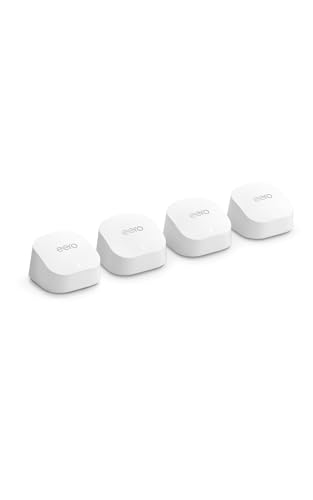
Amazon eero 6+ 4-Pack Mesh System
Best for: large homes with gigabit internet plans
- Wi-Fi Standard
- Wi-Fi 6
- Speed Rating
- up to a gigabit
- Coverage Area
- up to 6,000 sq. ft.
- Pack Size
- 4-pack
- Device Capacity
- 75+ devices
- Features
- Mesh
View on Amazon: Amazon eero 6+ 4-Pack Mesh System Affiliate link
The Eero 6+ 4-Pack delivers Wi-Fi 6 speeds up to a gigabit across 6,000 square feet. It supports 75+ devices and includes a built-in smart home hub for Thread and Zigbee gear. This system uses TrueMesh technology to manage traffic and reduce dead spots. It is designed for homes needing reliable gigabit coverage without premium pricing.
Pros
- Wi-Fi 6 standard with 160 MHz channel support
- Built-in Thread and Zigbee smart home hub
- Covers up to 6,000 square feet
- Supports 75+ connected devices simultaneously
Cons
- Limited to Wi-Fi 6, not the newer Wi-Fi 7
- Maximum speed capped at 1 gigabit
- Advanced security features require a subscription
Good fit if
- You need coverage for a large home up to 6,000 sq ft
- You want to connect Thread or Zigbee smart devices without extra hubs
- You have internet plans up to 1 gigabit
Skip if
- You require Wi-Fi 7 speeds for future-proofing
- You have an internet plan faster than 1 gigabit
- You want advanced security features included without a subscription
Verdict: Eero 6+ 4-Pack Mesh System offers solid Wi-Fi 6 performance and a built-in smart hub for homes needing gigabit speeds. It is a practical choice for users prioritizing wide coverage and device capacity over the latest Wi-Fi 7 standard.

Amazon eero 7 Dual-Band Mesh 3-Pack
Best for: homes up to 6,000 sq. ft. needing 2.5 Gbps
- Wi-Fi Standard
- Wi-Fi 7
- Speed Rating
- 1.8 Gbps
- Coverage Area
- 6,000 sq. ft.
- Frequency Bands
- Dual-Band
- Pack Size
- 3-Pack
- Port Speed
- 2.5 Gbps
View on Amazon: Amazon eero 7 Dual-Band Mesh 3-Pack Affiliate link
The Eero 7 is a Wi-Fi 7 mesh system designed for homes up to 6,000 square feet. It supports internet plans up to 2.5 Gbps using two auto-sensing 2.5 GbE ports. The three-pack setup handles over 120 connected devices. This dual-band router uses Multi-Link Operation for improved performance. It suits users who want future-proof speeds and reliable coverage throughout their home.
Pros
- Supports internet plans up to 2.5 Gbps
- Wi-Fi 7 standard with Multi-Link Operation
- Handles 120+ devices on 6,000 sq. ft.
- Two auto-sensing 2.5 GbE ports included
Cons
- Only dual-band frequency support
- Security features require an optional subscription
- Limited to 1.8 Gbps wireless speeds
Good fit if
- You need Wi-Fi 7 performance for future-proofing
- You have an internet plan up to 2.5 Gbps
- You want coverage for up to 6,000 square feet
Skip if
- You require tri-band speeds for large homes
- You need advanced security without a subscription
- Your internet plan exceeds 2.5 Gbps
Verdict: Eero 7 Dual-Band 3-Pack delivers solid Wi-Fi 7 speeds and 2.5 Gbps wired support for medium to large homes. It is the right choice if you want modern standards without tri-band complexity.
Specifications side by side
| Spec | Amazon eero 6+ 4-Pack Mesh System | Amazon eero 7 Dual-Band Mesh 3-Pack |
|---|---|---|
| Wi-Fi Standard | Wi-Fi 6 | Wi-Fi 7 |
| Speed Rating | up to a gigabit | 1.8 Gbps |
| Coverage Area | up to 6,000 sq. ft. | 6,000 sq. ft. |
| Frequency Bands | not stated | Dual-Band |
| Pack Size | 4-pack | 3-Pack |
| Port Speed | not stated | 2.5 Gbps |
| Device Capacity | 75+ devices | 120+ |
| Frequency Band | not stated | Dual-Band |
| Features | Mesh | Mesh |
| Dimensions | not stated | 5.12 × 2.52 × 5.12 inches |
| Weight | not stated | 1.34 pounds |
| Size | 4 routers | not stated |
| Color | not stated | WHITE |
| Model | not stated | PA10001 |
Frequently asked questions
Does the eero 6+ 4-Pack cover my whole house?
Yes, the eero 6+ 4-Pack covers up to 6,000 square feet. It supports 75 or more connected devices simultaneously. This makes it suitable for larger homes with many gadgets. The four routers work together to provide consistent signal strength throughout your space.
Can the eero 7 handle a 2.5 Gbps internet plan?
Yes, the eero 7 Dual-Band supports internet speeds up to 2.5 Gbps. It features auto-sensing 2.5 GbE ports to handle this bandwidth. This ensures your wired devices get the full speed from your high-tier internet service without bottlenecking.
Which system is better for future-proofing my network?
The eero 7 is better for future-proofing because it uses Wi-Fi 7. This standard offers multi-link operation for lower latency and better reliability. The eero 6+ uses Wi-Fi 6, which is solid but older technology without these newer efficiency features.
How many routers come with the eero 6+ package?
The eero 6+ comes as a 4-Pack. You receive four routers to place around your home. This configuration helps maximize coverage area and device capacity. It is designed for users who need extensive reach and high device density.
Is the eero 7 a tri-band mesh system?
No, the eero 7 is a dual-band mesh system. It does not include a dedicated tri-band radio. This simplifies the setup while still delivering high Wi-Fi 7 speeds. You get modern performance without the complexity of three separate frequency bands.
Which eero model supports more connected devices?
The eero 7 supports 120 or more devices. The eero 6+ supports 75 or more devices. If you have many smart home gadgets, the eero 7 handles the higher load better. Both systems manage connections efficiently using TrueMesh technology.
Does the eero 6+ have a built-in smart hub?
Yes, the eero 6+ includes a built-in smart hub. This allows you to connect compatible smart home devices directly to the mesh system. It simplifies your network by reducing the need for separate hubs or bridges for certain smart gadgets.