DBIT vs Cudy: Mesh Wifi Systems Compared by Specs
As an Amazon Associate we earn from qualifying purchases. Links on this page are affiliate links.
You are comparing the DBIT vs cudy mesh wifi system to find the best fit for your home. Both are Wi-Fi 6 3-packs with gigabit ports and dual-band support. The main difference lies in coverage and speed ratings. The DBIT system offers AX1800 speeds and covers up to 6,500 square feet. The Cudy system provides AX1500 speeds and covers 2,500 square feet. This affects how many devices each can handle simultaneously.
Key differences
| Aspect | DBIT AX1800 WiFi 6 Mesh System 3-Pack | Cudy AX1500 3-Pack Gigabit Mesh System |
|---|---|---|
| Speed Rating | AX1800 | AX1500 |
| Coverage Area | 6,500 sq. ft. | 2,500 sq ft |
| Device Capacity | 150+ | 128 |
| Ports Per Unit | 2 | 3 |
| Wi-Fi Standard | Wi-Fi 6 | Wi-Fi 6 |
| VPN Support | not listed | Built-in VPN Client |
Which one should you choose?
Choose DBIT AX1800 WiFi 6 Mesh System 3-Pack if
- You need coverage for a large home or multi-story layout.
- You connect over 128 devices simultaneously.
- You prioritize higher theoretical throughput for 4K streaming.
Choose Cudy AX1500 3-Pack Gigabit Mesh System if
- You want built-in VPN support for remote access.
- You prefer more wired ports per unit for stable backhaul.
- You have a smaller home under 2,500 square feet.
Verdict: Choose the DBIT system if your priority is maximum coverage and handling a large number of connected devices. Select the Cudy system if you need built-in VPN functionality and more ethernet ports per node. Both provide reliable Wi-Fi 6 performance for standard home use.
DBIT vs Cudy Mesh Specs
speed rating
The DBIT system uses AX1800 technology, delivering 1201 Mbps on the 5 GHz band and 574 Mbps on the 2.4 GHz band. This higher aggregate speed supports heavy tasks like 4K streaming and large file downloads with reduced latency. In contrast, the Cudy system is rated AX1500, offering 1201 Mbps on 5 GHz but only 300 Mbps on 2.4 GHz. While both utilize Wi-Fi 6 standards for efficiency, the DBIT unit provides significantly more bandwidth on the lower frequency band. This makes the DBIT better suited for environments with many legacy devices or where the 2.4 GHz range is critical for stability.
coverage area
Coverage claims differ substantially between the two options. The DBIT 3-pack is rated to cover up to 6,500 square feet. This large footprint is designed for multi-story homes or properties with complex layouts, ensuring whole-home reliability. The Cudy 3-pack, however, is rated for 2,500 square feet. This smaller coverage area suggests it is optimized for compact apartments or smaller houses. If you have a large property, the DBIT specification offers more headroom for expansion. The Cudy unit may require additional nodes to achieve similar coverage in larger spaces, which could impact setup complexity.
device capacity
Handling multiple connected devices is a key factor for modern smart homes. The DBIT system supports over 150 devices simultaneously. This high capacity ensures that smart home hubs, security cameras, and personal electronics do not congest the network. The Cudy system supports up to 128 devices. While this is sufficient for most standard households, the DBIT provides a higher ceiling for device density. If you plan to expand your smart home ecosystem significantly, the DBIT specification offers more headroom. Both systems use OFDMA to manage traffic, but the higher limit on the DBIT unit reduces potential bottlenecks in dense environments.
number of ports
Wired connectivity options vary in quantity. The DBIT 3-pack includes two Gigabit Ethernet ports per unit, totaling six ports across the set. This allows for multiple wired connections per node, such as connecting a gaming console and a smart TV to the same extender. The Cudy 3-pack features three Gigabit RJ45 ports per unit, totaling nine ports across the set. One port serves as the WAN input, while two are LAN outputs. Both systems provide Gigabit speeds for wired backhaul and device connections. The Cudy offers more total ports, which may benefit users with many wired devices, while the DBIT offers flexibility in port placement per node.
build
Physical dimensions and weight differ between the two brands. The DBIT units measure 4.33 inches in width and length, with a height of 4.41 inches. Each unit weighs 2.58 pounds, indicating a sturdier build. The Cudy units are slightly taller at 6.1 inches but narrower in height profile, measuring 4.33 inches in width and length. Each Cudy unit weighs 1.98 pounds, making it lighter and potentially easier to mount or place discreetly. The DBIT design is more compact vertically, while the Cudy has a taller cylindrical shape. Both are white, allowing them to blend into most home decors without drawing attention.
Which mesh system fits your needs
Large home owners needing wide coverage
The DBIT system covers up to 6,500 square feet across its three-pack configuration. This makes it suitable for larger properties or multi-story buildings where signal reach is critical. The AX1800 rating provides higher aggregate bandwidth, helping maintain stability when connecting over 150 devices simultaneously without performance drops.
Users requiring built-in VPN support
The Cudy M1500 includes a built-in VPN client supporting PPTP, L2TP, and WireGuard protocols. This allows for secure remote access and enhanced privacy across your entire network. You can manage these settings directly through the Cudy app, ensuring your data remains protected without needing additional hardware or complex configurations.
Buyers wanting compact and lightweight units
Each Cudy unit weighs just 1.98 pounds and measures 6.1 inches in height. This sleek cylinder design blends into modern decor while taking up less space than bulkier alternatives. The lighter weight and smaller footprint make these nodes easier to place in tight spaces or on shelves without dominating the room.
The products compared
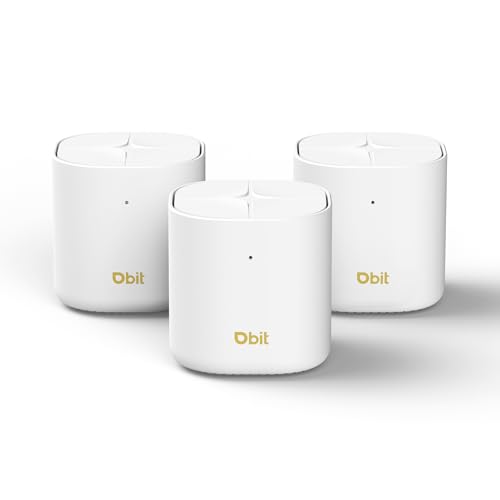
DBIT AX1800 WiFi 6 Mesh System 3-Pack
Best for: Large homes with many connected devices
- Wi-Fi Standard
- WiFi 6
- Speed Rating
- AX1800
- Coverage Area
- 6,500 sq. ft.
- Frequency Bands
- Dual-Band
- Pack Size
- 3-Pack
- Port Speed
- Gigabit
View on Amazon: DBIT AX1800 WiFi 6 Mesh System 3-Pack Affiliate link
The DBIT D-MAX5 is a Wi-Fi 6 mesh system with three units. It covers 6,500 square feet and supports over 150 devices. The AX1800 rating provides speeds up to 1.8 Gbps. Each unit has two Gigabit ports. You get app management and WPA3 security. This 3-pack suits larger homes needing wide coverage and high device capacity.
Pros
- Covers up to 6,500 square feet
- Supports 150+ connected devices
- Includes six total Gigabit Ethernet ports
- Uses Wi-Fi 6 for efficiency
Cons
- Dual-band only, lacks Wi-Fi 6E
- No dedicated 2.5G WAN/LAN ports
- Bulky 2.58-pound build per unit
Good fit if
- You need coverage for large homes
- You connect many smart devices
- You want wired Gigabit ports
Skip if
- You need tri-band performance
- You require 2.5G port speeds
- You prefer compact, lightweight units
Verdict: DBIT D-MAX5 AX1800 3-Pack Mesh delivers solid whole-home coverage for large spaces. It fits households with many connected devices who value wired port availability.
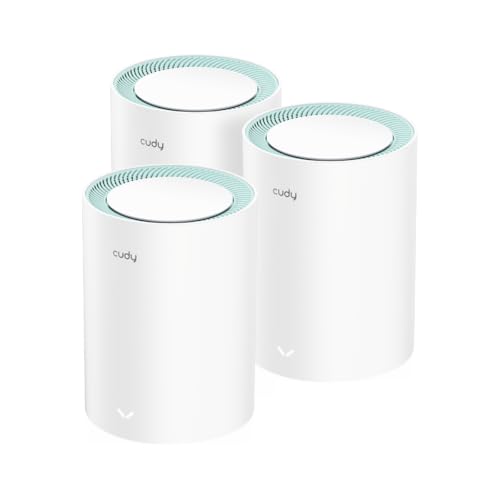
Cudy AX1500 3-Pack Gigabit Mesh System
Best for: small homes with Gigabit internet
- Wi-Fi Standard
- Wi-Fi 6
- Speed Rating
- AX1500
- Coverage Area
- 2,500 sq. ft.
- Frequency Bands
- Dual-Band
- Pack Size
- 3-Pack
- Port Speed
- 1 Gbps
View on Amazon: Cudy AX1500 3-Pack Gigabit Mesh System Affiliate link
The Cudy M1500 is a Wi-Fi 6 mesh system with a 3-pack configuration. It offers AX1500 speeds and covers up to 2500 square feet per unit. The system supports 128 devices and includes three Gigabit ports for wired connections. You get built-in VPN client support and dual-band connectivity. This setup suits homes needing stable streaming and gaming on Gigabit internet plans.
Pros
- Wi-Fi 6 standard with OFDMA and beamforming
- Three Gigabit RJ45 ports per unit
- Built-in VPN Client support (PPTP, L2TP, WireGuard)
- Supports 128 devices with 60+ simultaneous clients
- Covers up to 2500 sq ft per unit
Cons
- Lower AX1500 speed rating compared to AX1800 competitors
- Smaller coverage area (2500 sq ft) than the 6500 sq ft alternative
- Dual-band only, lacking tri-band capability
Good fit if
- You have Gigabit internet and need wired stability
- You want whole-home coverage for up to 2500 sq ft per unit
- You require built-in VPN support for secure remote access
Skip if
- You need coverage larger than 2500 sq ft per unit
- You require higher AX1800 or AX3000 speed ratings
- You need tri-band connectivity for dedicated backhaul
Verdict: Cudy M1500 AX1500 Mesh System is a solid choice for smaller homes with Gigabit internet. It fits users who prioritize wired stability and VPN features over maximum speed or coverage area.
Specifications side by side
| Spec | DBIT AX1800 WiFi 6 Mesh System 3-Pack | Cudy AX1500 3-Pack Gigabit Mesh System |
|---|---|---|
| Wi-Fi Standard | WiFi 6 | Wi-Fi 6 |
| Speed Rating | AX1800 | AX1500 |
| Coverage Area | 6,500 sq. ft. | 2,500 sq. ft. |
| Frequency Bands | Dual-Band | Dual-Band |
| Pack Size | 3-Pack | 3-Pack |
| Port Speed | Gigabit | 1 Gbps |
| Device Capacity | 150+ devices | 128 (60 recommended) |
| Frequency Band | Dual-Band | Dual-Band |
| Features | Mesh, Seamless Roaming | VPN, Mesh, Seamless Roaming |
| Dimensions | 4.33 × 4.33 × 4.41 inches | 4.33 × 4.33 × 6.1 inches |
| Weight | 2.58 pounds | 1.98 pounds |
| Color | White | White |
| Model | D-MAX5 | M1500 3-Pack |
Frequently asked questions
Which mesh system is better for large homes?
The DBIT AX1800 3-Pack is the better choice for large homes. It covers up to 6,500 square feet across its three units. This wide coverage suits multi-story buildings or large properties. The higher AX1800 speed rating also helps manage many connected devices simultaneously without slowing down.
Does Cudy offer Gigabit ports for wired connections?
Yes, the Cudy AX1500 3-Pack includes Gigabit Ethernet ports. These ports provide stable wired connections for devices like gaming consoles or smart TVs. This feature is ideal for users who prioritize wired stability over maximum wireless speed or larger coverage areas in smaller homes.
What is the difference between AX1800 and AX1500?
AX1800 offers higher aggregate speeds than AX1500. The DBIT system uses AX1800 technology for faster data transfer. The Cudy system uses AX1500, which is sufficient for smaller spaces. The higher rating on the DBIT unit supports heavy tasks like 4K streaming more effectively than the Cudy model.
Is the DBIT system suitable for homes with many devices?
Yes, the DBIT AX1800 system is designed for households with many connected devices. Its higher speed rating and wider coverage help maintain performance across multiple connections. This makes it a solid option for families with numerous smartphones, tablets, and smart home gadgets using the network simultaneously.
How does the Cudy system fit small homes?
The Cudy AX1500 system is optimized for smaller homes with Gigabit internet. It covers up to 2,500 square feet with its three-pack configuration. This size is ideal for apartments or small houses where maximum reach is not required. Users get stable wired connections through its Gigabit ports.
Do both systems support Wi-Fi 6 standards?
Both the DBIT and Cudy mesh systems support Wi-Fi 6. This standard provides improved efficiency and capacity for modern devices. You get better performance in congested areas with both options. The choice between them depends on your home size and required speed rating rather than the wireless standard.
Which system is better for users needing VPN features?
The Cudy AX1500 system is noted for including VPN features. This makes it a solid choice for users who prioritize security and wired stability. If you need these specific features over maximum speed or large coverage, the Cudy model fits your needs better than the DBIT alternative.