DBIT AX3000 Dual-Band Mesh WiFi vs DBIT AX1800 WiFi 6 Mesh: Spec Comparison
As an Amazon Associate we earn from qualifying purchases. Links on this page are affiliate links.
You are comparing the dbit ax3000 wifi 6 mesh vs ax1800 wifi 6 whole home systems. Both units offer identical coverage, device capacity, and physical dimensions. They share the same port configuration and app features. The main difference lies in their speed ratings. The AX3000 provides higher throughput on the 5GHz band, while the AX1800 offers a lower maximum speed. This spec comparison helps you decide which performance level fits your internet plan.
Key differences
| Aspect | DBIT AX3000 Dual-Band Mesh WiFi 6 System 3-Pack | DBIT AX1800 WiFi 6 Mesh System (3-Pack) |
|---|---|---|
| Speed Rating | AX3000 | AX1800 |
| 5GHz Band Speed | 2402Mbps | 1201Mbps |
| Total Speed | Up to 3 Gbps | Up to 1.8 Gbps |
| Model Number | D-MAX6 | D-MAX5 |
Which one should you choose?
Choose DBIT AX3000 Dual-Band Mesh WiFi 6 System 3-Pack if
- You have a gigabit internet plan and need higher 5GHz throughput for large file transfers.
- You want the maximum possible wireless speed within the AX3000 dual-band standard.
- You prefer the D-MAX6 model for its higher rated combined bandwidth.
Choose DBIT AX1800 WiFi 6 Mesh System (3-Pack) if
- You have internet speeds below 1 Gbps and do not need the extra 5GHz bandwidth.
- You want identical coverage and features but prefer the lower AX1800 speed rating.
- You are satisfied with 1.8 Gbps combined speed for streaming and gaming.
Verdict: Choose the AX3000 if your internet service provider delivers speeds above 1 Gbps or if you frequently transfer large files over Wi-Fi. The AX1800 is sufficient for most households with standard gigabit plans or slower connections. Both systems provide the same coverage area and smart home capacity.
DBIT AX3000 vs AX1800 Specs
Speed Rating
The DBIT AX3000 system carries an AX3000 speed rating, combining 574Mbps on the 2.4GHz band with 2402Mbps on the 5GHz band for a total theoretical throughput of 3Gbps. The DBIT AX1800 system holds an AX1800 rating, pairing 574Mbps on 2.4GHz with 1201Mbps on 5GHz for 1.8Gbps total. Both support WiFi 6, but the AX3000 offers significantly higher bandwidth on the 5GHz band, which is critical for high-resolution streaming and large file transfers. You get faster speeds with the AX3000 if your internet plan exceeds 1Gbps.
Coverage Area
Both mesh systems are rated to cover up to 6,500 square feet when using the three-pack configuration. The manufacturer states that adding satellite units can extend this coverage further to eliminate dead zones in larger or multi-story homes. Since both models share this identical coverage specification, you will not see a difference in the physical size of the area each system can effectively blanket. The AX3000 and AX1800 perform equally regarding the square footage they are designed to serve.
Device Capacity
Each system is specified to support up to 150 connected devices simultaneously. This capacity relies on WiFi 6 technologies like OFDMA and MU-MIMO, which optimize bandwidth allocation and reduce latency for multiple connections. Whether you are running smart home sensors, phones, laptops, or streaming devices, both the AX3000 and AX1800 handle the same maximum number of clients. Your network load will not favor one model over the other based on connection count alone.
Port Configuration
Every unit in both the AX3000 and AX1800 3-packs includes two Gigabit Ethernet ports, providing six ports total for the entire system. These ports allow you to connect wired devices like gaming consoles or smart TVs for a more stable connection. The port speed is identical across both models, meaning you do not gain or lose wired performance by choosing one over the other. Any unit in either system can also function as the main Wi-Fi router.
Physical Dimensions
The physical build is identical for both models. Each node measures 4.33 inches in width, 4.33 inches in length, and 4.41 inches in height, weighing 2.58 pounds. They share the same white color and compact design, making them easy to place in corners or on shelves without drawing attention. Since the AX3000 and AX1800 use the same chassis, your aesthetic preference or space constraints will not influence your choice between the two.
Which DBIT Mesh System Fits You
Users needing higher 5GHz throughput for heavy media
The AX3000 model offers 2402Mbps on the 5GHz band, compared to 1201Mbps on the AX1800. If you stream 4K or 8K content frequently, this extra bandwidth reduces buffering. Both systems handle 150 devices, but the faster 5GHz speed provides a smoother experience for high-demand tasks and large file downloads.
Budget-conscious buyers wanting identical coverage and features
The AX1800 system provides the same 6,500 sq ft coverage and 150-device capacity as the more expensive AX3000. You get identical gigabit ports, parental controls, and seamless roaming. If you do not require the higher 5GHz speeds, this model delivers the same whole-home reliability at a lower cost.
Homeowners with complex layouts or multiple floors
Both systems cover 6,500 sq ft, but the AX3000’s higher total throughput of 3Gbps handles congestion better in large spaces. With OFDMA and MU-MIMO, it optimizes bandwidth for many connected devices. This ensures stable connections across multiple floors, attics, or outdoor areas without lag during peak usage times.
The products compared

DBIT AX3000 Dual-Band Mesh WiFi 6 System 3-Pack
Best for: Large homes with many connected devices
- Wi-Fi Standard
- WiFi 6
- Speed Rating
- AX3000
- Coverage Area
- 6,500 Sq Ft
- Frequency Bands
- Dual-Band
- Pack Size
- 3-Pack
- Port Speed
- Gigabit
View on Amazon: DBIT AX3000 Dual-Band Mesh WiFi 6 System 3-Pack Affiliate link
This DBIT AX3000 mesh system uses three units to cover up to 6,500 square feet. It supports WiFi 6 with dual-band speeds up to 3 Gbps. The system handles up to 150 connected devices. Each node includes two Gigabit Ethernet ports. You get seamless roaming and parental controls via a mobile app. It fits large homes needing stable whole-home coverage.
Pros
- AX3000 WiFi 6 speeds up to 3 Gbps
- Covers 6,500 square feet with a 3-pack
- Supports 150 connected devices
- Includes 2 Gigabit Ethernet ports per node
- App-based parental controls and guest networks
Cons
- Dual-band only, lacking a dedicated tri-band backhaul
- No mention of WiFi 6E or 6GHz band support
- Gigabit ports limit wired speeds to 1 Gbps
Good fit if
- You need coverage for a large home up to 6,500 sq ft
- You connect many smart home devices simultaneously
- You want easy setup via a mobile app
Skip if
- You require tri-band performance for heavy wireless backhaul
- You need wired speeds above 1 Gbps
- You want WiFi 6E for less congested 6GHz bands
Verdict: DBIT AX3000 3-Pack Mesh System covers large spaces with strong WiFi 6 speeds. It suits homes with many devices that do not need tri-band or 10-gigabit wired connections.
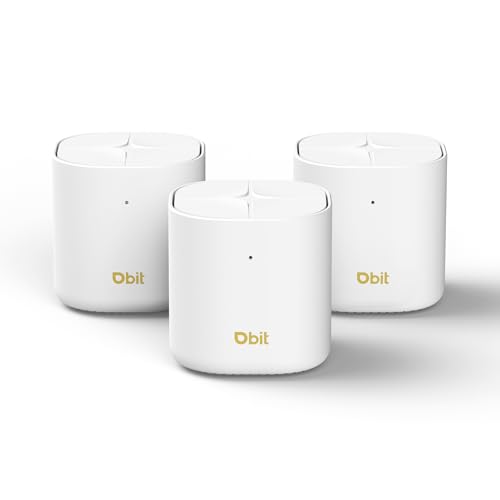
DBIT AX1800 WiFi 6 Mesh System (3-Pack)
Best for: Large homes needing 6,500 sq. ft. coverage
- Wi-Fi Standard
- WiFi 6
- Speed Rating
- AX1800
- Coverage Area
- 6,500 sq. ft.
- Frequency Bands
- Dual-Band
- Pack Size
- 3-Pack
- Port Speed
- Gigabit
View on Amazon: DBIT AX1800 WiFi 6 Mesh System (3-Pack) Affiliate link
This DBIT AX1800 mesh system uses three units to cover up to 6,500 square feet. It supports dual-band WiFi 6 with speeds up to 1.8 Gbps. The system handles 150 connected devices and includes gigabit Ethernet ports. You get seamless roaming and parental controls. It fits large homes needing stable whole-home coverage for streaming and gaming.
Pros
- AX1800 dual-band WiFi 6 speeds up to 1.8 Gbps
- Three-pack covers 6,500 square feet
- Supports 150 connected devices
- Gigabit Ethernet ports on each unit
Cons
- Lower AX1800 speed rating compared to AX3000 competitors
- Dual-band only, lacking a dedicated tri-band backhaul
- No mention of a dedicated wireless backhaul band
Good fit if
- You need coverage for large homes up to 6,500 sq. ft.
- You have many smart home devices to connect
- You want gigabit wired ports for stable connections
Skip if
- You require the highest AX3000 speed ratings
- You need tri-band performance for heavy backhaul traffic
- You prefer single-unit setups over multi-node systems
Verdict: DBIT AX1800 3-Pack Mesh System offers solid AX1800 coverage for large homes with many devices. It suits buyers prioritizing broad area coverage and device capacity over maximum theoretical speed.
Specifications side by side
| Spec | DBIT AX3000 Dual-Band Mesh WiFi 6 System 3-Pack | DBIT AX1800 WiFi 6 Mesh System (3-Pack) |
|---|---|---|
| Wi-Fi Standard | WiFi 6 | WiFi 6 |
| Speed Rating | AX3000 | AX1800 |
| Coverage Area | 6,500 Sq Ft | 6,500 sq. ft. |
| Frequency Bands | Dual-Band | Dual-Band |
| Pack Size | 3-Pack | 3-Pack |
| Port Speed | Gigabit | Gigabit |
| Device Capacity | 150 | 150 |
| Frequency Band | Dual-Band | Dual-Band |
| Features | Parental Controls, Mesh, Seamless Roaming | Mesh |
| Intended Use | not stated | Home |
| Dimensions | 4.33 × 4.33 × 4.41 inches | 4.33 × 4.33 × 4.41 inches |
| Weight | 2.58 pounds | 2.58 pounds |
| Size | 4.33 x 4.33 x 4.41 inches | 4.33 x 4.33 x 4.41 inches |
| Color | White | White |
| Model | D-MAX6 | D-MAX5 |
Frequently asked questions
Does the DBIT AX3000 support Wi-Fi 6?
Yes, the DBIT AX3000 system supports Wi-Fi 6 technology. This standard allows for more efficient data handling and better performance when multiple devices connect simultaneously. The system operates on dual bands to provide balanced coverage throughout your home network.
What is the coverage area for the 3-pack?
Both systems are designed to cover large spaces effectively. The AX1800 model specifically targets homes needing up to 6,500 square feet of coverage. The AX3000 model is also recommended for large homes with many connected devices, ensuring broad connectivity.
Do both mesh systems have the same physical size?
Yes, the physical dimensions are identical for both models. Each unit measures 4.33 inches in width, 4.33 inches in length, and 4.41 inches in height. They also share the same weight of 2.58 pounds and a white color finish.
Is parental control available on the DBIT mesh systems?
Parental controls are explicitly listed as a feature for the AX3000 system. This allows you to manage access and set restrictions for connected devices. The AX1800 system data does not explicitly mention this feature, so you should verify its inclusion in the app interface.
What port speed do these routers provide?
Both the AX3000 and AX1800 systems feature gigabit port speeds. This ensures that wired connections can handle high-speed internet plans without bottlenecking. It supports fast data transfer for devices connected via Ethernet cables to the mesh nodes.
Which model is better for heavy media streaming?
The AX3000 model is better for heavy media streaming due to its higher 5GHz throughput. It offers 2402Mbps on the 5GHz band, compared to 1201Mbps on the AX1800. This extra bandwidth helps reduce buffering when watching high-resolution video content on multiple devices.
Are both systems dual-band or tri-band?
Both the DBIT AX3000 and AX1800 systems are dual-band. They operate on 2.4GHz and 5GHz frequencies to provide reliable coverage. Neither system includes a third band, which keeps the design simpler and suitable for most standard home networking needs.
What is the difference between the D-MAX6 and D-MAX5 models?
The D-MAX6 is the model number for the AX3000 system, while the D-MAX5 is for the AX1800 system. The primary technical difference is the speed rating. The D-MAX6 offers higher theoretical throughput, whereas the D-MAX5 focuses on broad coverage capacity.