DBIT AX1800 WiFi 6 Mesh vs DBIT AX3000 3-Pack Mesh System: Spec Comparison
As an Amazon Associate we earn from qualifying purchases. Links on this page are affiliate links.
Comparing the dbit ax1800 wifi 6 mesh vs ax3000 3 pack mesh system reveals two similar whole-home solutions. Both units share identical coverage, port counts, and device capacity. They both use WiFi 6 and dual-band technology. The main difference lies in their speed ratings. The AX1800 offers AX1800 speeds, while the AX3000 provides AX3000 speeds. You need to decide if the higher bandwidth of the AX3000 justifies its selection over the standard AX1800 model.
Key differences
| Aspect | DBIT AX1800 WiFi 6 Mesh System 3-Pack | DBIT AX3000 3-Pack Mesh System |
|---|---|---|
| Speed Rating | AX1800 | AX3000 |
| 5GHz Band Speed | 1201Mbps | 2402Mbps |
| Model Number | D-MAX5 | D-MAX6 |
Which one should you choose?
Choose DBIT AX1800 WiFi 6 Mesh System 3-Pack if
- You want a network that handles standard 4K streaming and general browsing without needing extra bandwidth headroom.
- You prefer the lower-cost option when prices are available, as the AX1800 covers the same square footage and device count.
Choose DBIT AX3000 3-Pack Mesh System if
- You plan to stream 8K video or transfer large files frequently, where the doubled 5GHz speed reduces congestion.
- You want the maximum possible throughput for your connected devices, even if your internet plan does not exceed 1Gbps.
Verdict: The AX1800 is sufficient for most homes due to its identical coverage and device capacity. Choose the AX3000 only if you require the higher 5GHz bandwidth for heavy data tasks. Both systems provide the same whole-home reliability and management features.
AX1800 vs AX3000 Spec Breakdown
Speed rating
The DBIT AX1800 WiFi 6 Mesh System offers a total speed rating of AX1800. This breaks down to 574Mbps on the 2.4GHz band and 1201Mbps on the 5GHz band. The DBIT AX3000 3-Pack Mesh System provides a higher AX3000 rating. It also uses 574Mbps on the 2.4GHz band but increases the 5GHz band to 2402Mbps. This doubling of 5GHz throughput allows for faster data transfers. You will notice this difference during large file downloads or 8K video streaming. The AX3000 model handles high-bandwidth tasks more efficiently due to its superior wireless capacity.
Wi-Fi standard
Both systems utilize the same underlying technology for efficiency. The DBIT AX1800 WiFi 6 Mesh System and the DBIT AX3000 3-Pack Mesh System both support WiFi 6. This standard introduces OFDMA and MU-MIMO technologies. These features help manage multiple connections simultaneously without slowing down the network. You can connect up to 150 devices on either system without significant performance loss. The efficiency gains from WiFi 6 are present in both models. This means reduced latency for gaming and smoother video calls on both units.
Coverage area
Coverage specifications are identical for both mesh systems. The DBIT AX1800 WiFi 6 Mesh System claims to cover up to 6,500 square feet. The DBIT AX3000 3-Pack Mesh System also covers up to 6,500 square feet. Each package includes three units designed to eliminate dead zones in large homes. You get seamless roaming between rooms and floors on both setups. The physical dimensions and weight of the units are also the same. This suggests the radio power and antenna design are comparable. Your whole-home coverage expectations should be similar for either choice.
Port count
Wired connectivity options are consistent across both models. Each unit in the DBIT AX1800 WiFi 6 Mesh System comes with two Gigabit Ethernet ports. This totals six ports for the entire three-pack. The DBIT AX3000 3-Pack Mesh System offers the same configuration. You get two Gigabit ports per unit, totaling six ports. This allows for stable wired backhaul connections or linking devices like smart TVs and consoles. The port speed is Gigabit on all units. You have the same flexibility to set up one main router and two extenders on either system.
Device capacity
Both systems are built to handle dense smart home environments. The DBIT AX1800 WiFi 6 Mesh System supports over 150 connected devices. The DBIT AX3000 3-Pack Mesh System also supports over 150 devices. This capacity is managed through the WiFi 6 efficiency features mentioned earlier. You can run multiple smart lights, cameras, and phones simultaneously. The device limit is not a differentiating factor here. Both units are designed to maintain performance even when the network is heavily loaded with IoT gadgets and personal electronics.
Which DBIT Mesh System Fits You
Users needing higher 5GHz throughput
The AX3000 model delivers 2402Mbps on the 5GHz band, compared to 1201Mbps on the AX1800. This higher speed rating supports faster data transfer for 8K streaming and large file downloads. If your internet plan exceeds 1Gbps or you have many high-bandwidth devices, the AX3000 provides more headroom for heavy usage.
Budget-conscious buyers with moderate needs
The AX1800 system offers the same 6,500 sq ft coverage and 150+ device capacity as the AX3000. It includes the same gigabit ports and WiFi 6 features like OFDMA. If your internet speed is under 1Gbps or you primarily stream 4K content, the AX1800 provides sufficient performance for whole-home connectivity without extra cost.
Those wanting maximum speed potential
With a total speed rating of AX3000, this system maximizes wireless capacity across dual bands. The 5GHz band speed of 2402Mbps ensures minimal congestion during peak hours. This is ideal for households with many simultaneous connections, online gaming, or 4K/8K video streaming where bandwidth demand is consistently high.
The products compared
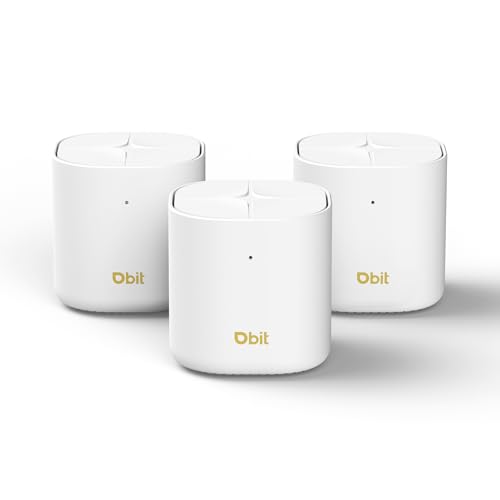
DBIT AX1800 WiFi 6 Mesh System 3-Pack
Best for: large homes with many connected devices
- Wi-Fi Standard
- WiFi 6
- Speed Rating
- AX1800
- Coverage Area
- 6,500 sq. ft.
- Frequency Bands
- Dual-Band
- Pack Size
- 3-Pack
- Port Speed
- Gigabit
View on Amazon: DBIT AX1800 WiFi 6 Mesh System 3-Pack Affiliate link
The DBIT AX1800 3-Pack covers up to 6,500 square feet with WiFi 6 technology. It supports over 150 devices using dual-band speeds up to 1.8 Gbps. Each unit includes two gigabit Ethernet ports for wired connections. You can manage the network via a mobile app or the mesh button. This system replaces your existing router and works with any ISP modem.
Pros
- AX1800 dual-band WiFi 6 speeds
- Covers 6,500 square feet with three units
- Supports 150+ connected devices
- Six gigabit Ethernet ports total
- WPA3 encryption and automatic updates
Cons
- Dual-band only, lacking a dedicated tri-band backhaul
- Heavier build at 2.58 pounds per unit
- No mention of 2.5G WAN port
Good fit if
- You need whole-home coverage for large spaces
- You have many smart home devices to connect
- You want simple app-based management
Skip if
- You require tri-band performance for heavy wired backhaul
- You prefer compact, lightweight mesh nodes
- You need 2.5G internet speeds
Verdict: DBIT AX1800 3-Pack Mesh System offers reliable coverage for large homes with many devices. It suits users who prioritize capacity and ease of setup over high-end tri-band speeds.

DBIT AX3000 3-Pack Mesh System
Best for: Large homes with high device counts
- Wi-Fi Standard
- WiFi 6
- Speed Rating
- AX3000
- Coverage Area
- 6,500 sq. ft.
- Frequency Bands
- Dual-band
- Pack Size
- 3-Pack
- Port Speed
- Gigabit
View on Amazon: DBIT AX3000 3-Pack Mesh System Affiliate link
The DBIT AX3000 3-Pack delivers dual-band WiFi 6 speeds up to 3 Gbps across 6,500 sq ft. It supports 150+ devices using OFDMA and MU-MIMO for efficient bandwidth allocation. Each unit includes two gigabit Ethernet ports for stable wired connections. The system manages mesh expansion and parental controls via a mobile app. This setup suits large homes needing whole-home coverage without dead zones.
Pros
- AX3000 dual-band speeds up to 3 Gbps
- Covers up to 6,500 sq ft with three units
- Supports 150+ connected devices simultaneously
- Includes six gigabit Ethernet ports total
- WPA3 encryption and automatic firmware updates
Cons
- Only dual-band WiFi, lacking tri-band performance
- No mention of WiFi 6E or 6GHz support
- Physical dimensions are bulky at 4.41 inches tall
Good fit if
- You need coverage for a home over 3,000 sq ft
- You have many smart devices connecting to the network
- You prefer wired connections for stationary devices
Skip if
- You require tri-band speeds for heavy local transfers
- You want the latest WiFi 6E standard
- You have a small apartment under 1,500 sq ft
Verdict: DBIT AX3000 3-Pack Mesh System provides reliable whole-home coverage for large households with many connected devices. It is best for users prioritizing broad area coverage and wired port availability over maximum wireless speed tiers.
Specifications side by side
| Spec | DBIT AX1800 WiFi 6 Mesh System 3-Pack | DBIT AX3000 3-Pack Mesh System |
|---|---|---|
| Wi-Fi Standard | WiFi 6 | WiFi 6 |
| Speed Rating | AX1800 | AX3000 |
| Coverage Area | 6,500 sq. ft. | 6,500 sq. ft. |
| Frequency Bands | Dual-Band | Dual-band |
| Pack Size | 3-Pack | 3-Pack |
| Port Speed | Gigabit | Gigabit |
| Device Capacity | 150+ devices | 150+ |
| Frequency Band | Dual-Band | Dual-Band |
| Features | Mesh, Seamless Roaming | Mesh, Seamless Roaming |
| Dimensions | 4.33 × 4.33 × 4.41 inches | 4.33 × 4.33 × 4.41 inches |
| Weight | 2.58 pounds | 2.58 pounds |
| Color | White | White |
| Model | D-MAX5 | D-MAX6 |
Frequently asked questions
Does the DBIT AX3000 support tri-band connectivity?
No. Both systems use dual-band technology. The data shows they share the same Wi-Fi standard and band configuration. You get two frequency bands for device connection on both units. The AX3000 label refers to its total speed rating, not an extra band. It does not include a dedicated 5GHz backhaul channel.
What is the physical size of a DBIT mesh node?
Each node measures 4.33 inches in width, 4.41 inches in height, and 4.33 inches in length. The units are white and weigh 2.58 pounds. The dimensions are identical for both the AX1800 and AX3000 models. This compact form factor allows them to fit easily into most home environments without taking up significant space.
Are the AX1800 and AX3000 models physically different?
No. Both systems use the same physical housing dimensions and weight. The AX1800 uses model D-MAX5, while the AX3000 uses model D-MAX6. These model numbers indicate internal hardware variations for speed, not external design changes. You will find no difference in the casing size or color between the two packs.
Which system handles more connected devices?
Both systems are designed for large homes with many connected devices. The AX3000 offers higher throughput on the 5GHz band, which can help manage dense device loads. However, the AX1800 also targets large homes with many devices. Both utilize Wi-Fi 6 technology to improve efficiency and capacity for multiple simultaneous connections.
Is the AX1800 suitable for large homes?
Yes. The AX1800 3-Pack is rated for large homes with many connected devices. It provides reliable coverage across broad areas. The three-node pack ensures whole-home coverage. You get consistent connectivity throughout your house. It prioritizes capacity and ease of setup over the higher speed tiers found in the AX3000 model.
What is the difference between D-MAX5 and D-MAX6?
D-MAX5 is the model number for the AX1800 system. D-MAX6 is the model number for the AX3000 system. The difference lies in their speed ratings. The AX3000 provides higher wireless throughput. The physical hardware and design remain the same for both model numbers. You choose based on speed needs, not form factor.