DBIT AX1800 WiFi 6 Mesh vs DBIT AC1200 Dual-Band Mesh System: Spec Comparison
As an Amazon Associate we earn from qualifying purchases. Links on this page are affiliate links.
Choosing between the dbit ax1800 wifi 6 mesh vs ac1200 dual band mesh system depends on your specific needs. Both are 3-pack mesh networks designed for whole-home coverage with gigabit ports and app management. They share dual-band architecture and ISP compatibility. The main difference lies in the Wi-Fi standard. The AX1800 uses Wi-Fi 6 for higher efficiency and capacity, while the AC1200 relies on older Wi-Fi 5 technology. Your choice hinges on whether you prioritize modern throughput or basic reliability.
Key differences
| Aspect | DBIT AX1800 WiFi 6 Mesh System (3-Pack) | DBIT AC1200 Dual-Band Mesh System |
|---|---|---|
| Wi-Fi Standard | Wi-Fi 6 | Wi-Fi 5 (AC) |
| Speed Rating | AX1800 (1.8 Gbps) | AC1200 (1.2 Gbps) |
| Device Capacity | 150 devices | 90 devices |
| Coverage Area | 6,500 sq. ft. | 6,000 sq. ft. |
| Ports Per Unit | 2 Gigabit | 4 Gigabit |
Which one should you choose?
Choose DBIT AX1800 WiFi 6 Mesh System (3-Pack) if
- You need higher speeds for 4K streaming and gaming
- You have many smart home devices to connect
- You want the latest Wi-Fi 6 efficiency
Choose DBIT AC1200 Dual-Band Mesh System if
- You require more wired Ethernet ports per node
- You need WPA3 encryption for enhanced security
- You prefer a simpler setup for basic internet use
Verdict: The AX1800 is the better choice for modern homes with high device counts and bandwidth demands. The AC1200 suits users who need more physical ports and basic reliable coverage. Select the model that matches your specific port and speed requirements.
DBIT AX1800 vs AC1200 Spec Breakdown
Wi-Fi Standard
The DBIT AX1800 uses Wi-Fi 6 technology, while the DBIT AC1200 relies on the older Wi-Fi 5 (AC) standard. Wi-Fi 6 introduces OFDMA and MU-MIMO, which allow the router to communicate with multiple devices simultaneously rather than sequentially. This reduces latency and improves efficiency in crowded networks. If you have many smart home gadgets or stream 4K video, the AX1800 handles the traffic more efficiently. The AC1200 lacks these modern efficiency features, which may cause slowdowns during peak usage times.
Speed Rating
The AX1800 offers a combined speed rating of AX1800, splitting into 574Mbps on the 2.4GHz band and 1201Mbps on the 5GHz band. The AC1200 provides a combined 1200Mbps, with 300Mbps on 2.4GHz and 867Mbps on 5GHz. The AX1800 delivers significantly higher throughput on the faster 5GHz band, which is crucial for high-bandwidth activities like gaming and large file transfers. You will notice a tangible difference in raw speed potential with the AX1800, especially when multiple devices are active on the 5GHz band.
Coverage Area
Both systems are sold as 3-packs and designed for large spaces. The AX1800 covers up to 6,500 square feet, while the AC1200 covers up to 6,000 square feet. The difference is 500 square feet, which is minimal in practical terms for most homes. Both systems use smart roaming to help devices switch between nodes seamlessly. Unless you have an exceptionally large property, both units will likely provide adequate coverage. The slight edge in square footage for the AX1800 is negligible for typical living spaces.
Device Capacity
The AX1800 supports up to 150 connected devices, whereas the AC1200 supports 90 devices. This capacity matters if you have a dense smart home with many IoT sensors, cameras, and phones. The higher number on the AX1800 aligns with its Wi-Fi 6 efficiency, allowing it to manage more connections without degrading performance. If you plan to add more devices over time, the AX1800 has more headroom. The AC1200 is sufficient for smaller households with fewer connected gadgets.
Number of Ports
Port configuration differs between the two models. Each AX1800 unit includes two Gigabit Ethernet ports, totaling six ports for the three-pack. Each AC1200 unit includes four Gigabit Ethernet ports, totaling twelve ports for the three-pack. If you need to connect many wired devices like gaming consoles, smart TVs, or desktop PCs, the AC1200 offers more physical connection points per node. The AX1800 may require a separate switch if you have many wired devices.
Which DBIT Mesh System Fits You
Heavy multi-device households
The AX1800 supports 150 devices and uses Wi-Fi 6 with OFDMA and MU-MIMO. These features allow simultaneous communication with multiple devices, reducing latency. This makes it ideal for homes with many smart devices, ensuring stable performance under heavy load without bottlenecking.
Users needing wired connections
Each AC1200 node includes four Gigabit Ethernet ports. The AX1800 only has two ports per unit. If you need to connect more wired devices like consoles or PCs directly to each node, the AC1200 offers double the wired connectivity options per unit.
Budget-conscious home users
The AC1200 covers 6,000 sq ft with standard Wi-Fi 5 speeds. It provides reliable dual-band coverage and 90-device capacity. This system handles typical streaming and browsing needs effectively. It is a practical choice for smaller networks or users who do not need Wi-Fi 6 efficiency.
The products compared
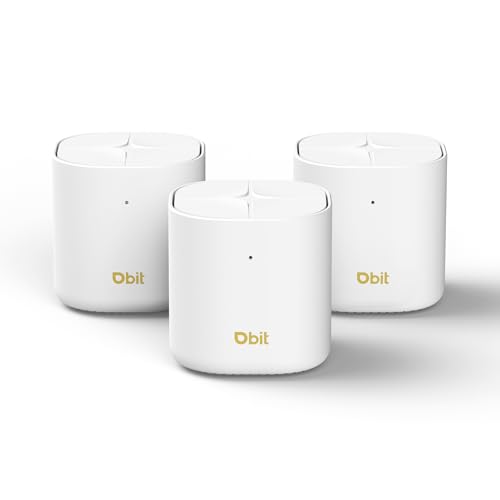
DBIT AX1800 WiFi 6 Mesh System (3-Pack)
Best for: large homes with 150+ devices
- Wi-Fi Standard
- WiFi 6
- Speed Rating
- AX1800
- Coverage Area
- 6,500 sq. ft.
- Frequency Bands
- Dual-Band
- Pack Size
- 3-Pack
- Port Speed
- Gigabit
View on Amazon: DBIT AX1800 WiFi 6 Mesh System (3-Pack) Affiliate link
This DBIT AX1800 mesh system uses WiFi 6 to deliver speeds up to 1.8 Gbps across dual bands. The three-pack setup covers up to 6,500 square feet and supports 150 connected devices. It includes gigabit Ethernet ports and OFDMA technology for better efficiency. You get whole-home coverage with seamless roaming. This system suits homes needing high device capacity and modern wireless standards.
Pros
- WiFi 6 AX1800 dual-band speeds up to 1.8 Gbps
- Covers up to 6,500 square feet with three units
- Supports up to 150 connected devices
- Includes gigabit Ethernet ports on each node
- OFDMA and MU-MIMO for optimized bandwidth
Cons
- Limited to dual-band frequencies
- No mention of WiFi 6E or 6GHz support
- Device capacity capped at 150 units
Good fit if
- You need WiFi 6 efficiency for many smart devices
- You require coverage for large areas up to 6,500 sq ft
- You want gigabit wired connections for key devices
Skip if
- You need tri-band speeds for heavy congestion
- You plan to connect more than 150 devices
- You require WiFi 6E for the 6GHz band
Verdict: DBIT AX1800 3-Pack Mesh offers solid WiFi 6 coverage for large homes with many devices. It fits users who prioritize modern standards and broad area coverage over tri-band performance.
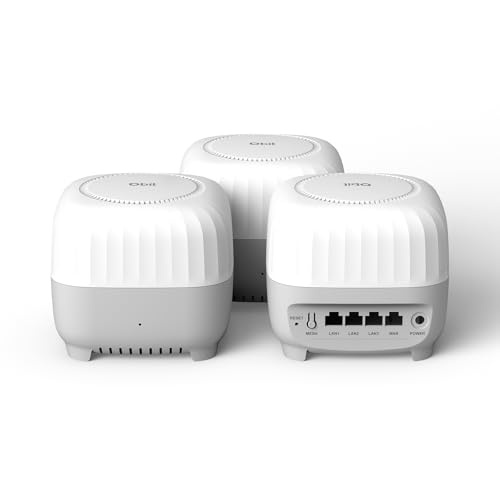
DBIT AC1200 Dual-Band Mesh System
Best for: Large homes needing stable dual-band coverage
- Speed Rating
- AC1200 (1200Mbps)
- Coverage Area
- up to 6,000 Sq Ft
- Frequency Bands
- Dual-Band
- Pack Size
- 3-Pack
- Port Speed
- Gigabit
- Device Capacity
- 90 Devices
View on Amazon: DBIT AC1200 Dual-Band Mesh System Affiliate link
The DBIT AC1200 3-Pack covers up to 6,000 square feet with dual-band speeds of 1200Mbps. It supports 90 simultaneous devices and includes four Gigabit Ethernet ports per node. This system uses smart roaming to eliminate dead zones and features WPA3 encryption for security. It is designed for large homes needing stable connectivity for streaming and gaming without upgrading to Wi-Fi 6.
Pros
- Covers up to 6,000 square feet with a 3-pack
- Supports 90+ simultaneous device connections
- Includes four Gigabit Ethernet ports per node
- Features WPA3-SAE encryption and guest network isolation
Cons
- Limited to dual-band AC1200 speeds instead of Wi-Fi 6
- No mention of Wi-Fi 6E or tri-band capability
- Heavier build at 2.22 pounds per node
Good fit if
- You need whole-home coverage for large spaces up to 6,000 square feet
- You have many connected devices requiring stable dual-band performance
- You want wired Gigabit ports for consoles and smart TVs
Skip if
- You require the latest Wi-Fi 6 speeds or lower latency
- You live in a very large home exceeding 6,000 square feet
- You need tri-band performance to avoid congestion on the 5GHz band
Verdict: DBIT AC1200 3-Pack Mesh System provides reliable dual-band coverage for large homes with many devices. It suits buyers who prioritize wired connectivity and broad area coverage over next-generation Wi-Fi 6 speeds.
Specifications side by side
| Spec | DBIT AX1800 WiFi 6 Mesh System (3-Pack) | DBIT AC1200 Dual-Band Mesh System |
|---|---|---|
| Wi-Fi Standard | WiFi 6 | not stated |
| Speed Rating | AX1800 | AC1200 (1200Mbps) |
| Coverage Area | 6,500 sq. ft. | up to 6,000 Sq Ft |
| Frequency Bands | Dual-Band | Dual-Band |
| Pack Size | 3-Pack | 3-Pack |
| Port Speed | Gigabit | Gigabit |
| Device Capacity | 150 | 90 Devices |
| Frequency Band | Dual-Band | Dual-Band |
| Features | Mesh | Mesh |
| Intended Use | Home | Home |
| Dimensions | 4.33 × 4.33 × 4.41 inches | 5.08 × 5.08 × 4.53 inches |
| Weight | 2.58 pounds | 2.22 pounds |
| Size | 4.33 x 4.33 x 4.41 inches | 5.08 x 5.08 x 4.53 inches |
| Color | White | White and Gray |
| Model | D-MAX5 | D-MAC3 |
Frequently asked questions
Which DBIT mesh system is better for large homes with many devices?
The DBIT AX1800 is the better choice for large homes with 150 or more devices. It uses Wi-Fi 6 technology, which includes OFDMA and MU-MIMO to handle multiple connections efficiently. The AC1200 is also designed for large homes but relies on the older Wi-Fi 5 standard. If you prioritize modern standards and broad coverage for many devices, the AX1800 fits your needs best.
Do both mesh systems include gigabit Ethernet ports?
Yes, both the DBIT AX1800 and the DBIT AC1200 feature gigabit Ethernet ports. This allows you to connect wired devices like gaming consoles or desktop computers at high speeds. Both systems are designed for home use and support wired connectivity for stable internet access. You can rely on these ports for consistent performance regardless of which model you select.
What is the physical size difference between the two units?
The DBIT AX1800 units measure 4.33 by 4.33 by 4.41 inches and weigh 2.58 pounds. The DBIT AC1200 units are slightly larger at 5.08 by 5.08 by 4.53 inches but weigh less at 2.22 pounds. Both are white, with the AC1200 also featuring gray accents. You should consider these dimensions when deciding where to place the nodes in your home.
Is the AX1800 tri-band or dual-band?
The DBIT AX1800 is a dual-band system, despite its AX1800 speed rating. It does not offer a dedicated 5GHz backhaul band. The AC1200 is also dual-band. If you require tri-band performance for faster wireless backhaul, neither of these specific models provides that feature. Both systems rely on dual-band architecture for communication between nodes.
Can these mesh systems handle 6,000 square feet of coverage?
The DBIT AC1200 explicitly lists a coverage area of 6,000 square feet. The AX1800 is designed for large homes with many devices, implying broad coverage, though a specific square footage is not listed in its attributes. Both are 3-pack systems intended for whole-home coverage. You can expect both to cover large areas effectively based on their design.
What models are these DBIT mesh systems?
The DBIT AX1800 WiFi 6 Mesh System corresponds to model D-MAX5. The DBIT AC1200 Dual-Band Mesh System corresponds to model D-MAC3. Both are part of the DBIT brand lineup. You can use these model numbers to identify the specific hardware when checking compatibility or setup instructions for your network.