DBIT AC1200 Dual-Band Mesh System or DBIT AX1500 WiFi 6 Mesh? Which DBIT Model to Buy
As an Amazon Associate we earn from qualifying purchases. Links on this page are affiliate links.
This guide compares the dbit ax1500 wifi 6 mesh vs ac1200 whole home mesh wifi system to help you choose the right setup. Both units offer whole-home coverage, gigabit ports, and WPA3 security. The main difference lies in the wireless standard and capacity. The AX1500 uses Wi-Fi 6 for higher efficiency and supports more devices. The AC1200 relies on the older AC standard but covers a slightly larger area. You will see how these specs affect your daily network performance.
Key differences
| Aspect | DBIT AX1500 WiFi 6 Mesh System 3-Pack | DBIT AC1200 Dual-Band Mesh System |
|---|---|---|
| Wi-Fi Standard | Wi-Fi 6 (802.11ax) | Wi-Fi 5 (802.11ac) |
| Speed Rating | AX1500 (1500Mbps combined) | AC1200 (1200Mbps combined) |
| Device Capacity | 120 devices | 90 devices |
| Coverage Area | 5,600 sq ft | 6,000 sq ft |
| Model Number | D-MAX4 | D-MAC3 |
Which one should you choose?
Choose DBIT AX1500 WiFi 6 Mesh System 3-Pack if
- You have many smart devices or stream 4K content simultaneously
- You want the efficiency and lower latency of Wi-Fi 6
- You prefer a newer wireless standard for future-proofing
Choose DBIT AC1200 Dual-Band Mesh System if
- You need maximum coverage for a very large floor plan
- You have fewer than 90 devices on your network
- You prioritize raw coverage area over the latest Wi-Fi generation
Verdict: Choose the AX1500 if you have a dense network of devices and want the performance benefits of Wi-Fi 6. Pick the AC1200 if your primary goal is covering the largest possible square footage with fewer connected devices. Both systems provide reliable gigabit connectivity and seamless roaming for typical home use.
AX1500 vs AC1200 Mesh Comparison
Wi-Fi Standard
The DBIT AX1500 uses the newer Wi-Fi 6 standard, while the DBIT AC1200 relies on the older Wi-Fi 5 (AC) technology. Wi-Fi 6 introduces more efficient data handling and better performance in crowded environments. This means the AX1500 is better equipped to manage multiple devices simultaneously without slowing down. If you want the latest wireless technology for future-proofing your home network, the AX1500 is the clear choice. The AC1200 is a solid option if you do not need the latest standard, but it lacks the efficiency improvements of Wi-Fi 6.
Speed Rating
Wireless speeds differ between the two models. The AX1500 offers a combined speed of up to 1500Mbps, split between 300Mbps on the 2.4GHz band and 1201Mbps on the 5GHz band. The AC1200 provides up to 1200Mbps total, with 300Mbps on 2.4GHz and 867Mbps on 5GHz. The higher 5GHz speed on the AX1500 allows for faster data transfer rates, which is beneficial for high-bandwidth activities like 4K streaming or large file downloads. The AC1200 is sufficient for standard internet use but offers less headroom for heavy usage.
Coverage Area
Both systems are designed for large homes, but they cover different maximum areas. The DBIT AC1200 claims coverage up to 6,000 square feet. The DBIT AX1500 covers up to 5,600 square feet. Both numbers are based on the 3-pack configuration. The AC1200 has a slight edge in maximum stated coverage area. However, real-world performance depends on your home layout and materials. If you have a very large, open space, the AC1200 might reach further. For most typical homes, both will provide adequate whole-home coverage.
Device Capacity
The number of devices you can connect at once varies. The AX1500 supports up to 120 simultaneous connections. The AC1200 supports up to 90 devices. This is a significant difference for smart homes with many connected gadgets. If you have dozens of smart lights, cameras, phones, and tablets, the AX1500 handles the load better. The AC1200 is suitable for smaller households with fewer connected devices. For a busy household, the higher capacity of the AX1500 prevents congestion and keeps speeds stable.
Build and Size
Physical dimensions and weight are nearly identical. The AX1500 node measures 5.04 x 5.04 x 4.02 inches and weighs 2.08 pounds. The AC1200 node is slightly larger at 5.08 x 5.08 x 4.53 inches and weighs 2.22 pounds. Both are white and gray with a similar design. The difference is negligible for placement. You can place either unit on a shelf or mount it on a wall without issue. The AX1500 is slightly more compact and lighter, but this does not impact performance. Both fit well in modern home decor.
Port Configuration
Both mesh systems include the same port configuration for wired connections. Each node on the AX1500 and the AC1200 has four Gigabit Ethernet ports. This allows you to connect wired devices like smart TVs, gaming consoles, or desktop PCs with high-speed stability. There is no difference in port speed or quantity between the two models. You can use these ports for backhaul or direct device connections. The consistent port layout means your wiring setup will work with either system without modification.
Which DBIT Mesh System Fits Your Home
Users with many connected devices
The AX1500 supports up to 120 simultaneous connections. This capacity handles smart homes and offices better than the AC1200, which supports 90 devices. If you have many gadgets, the higher device limit ensures stable performance without lag for everyone.
Those needing wider coverage
The AC1200 covers up to 6,000 square feet. This is larger than the AX1500, which covers 5,600 square feet. If you have a very large home or complex layout, the AC1200 provides slightly more extensive whole-home coverage for your wired and wireless devices.
Buyers wanting modern Wi-Fi 6
The AX1500 uses the Wi-Fi 6 standard. This offers more efficient data handling and better performance in crowded environments compared to the AC1200's Wi-Fi 5. You get faster combined wireless speeds of 1500Mbps, which is ideal for 4K streaming and gaming.
The products compared

DBIT AX1500 WiFi 6 Mesh System 3-Pack
Best for: large homes with many connected devices
- Wi-Fi Standard
- WiFi 6
- Speed Rating
- AX1500
- Coverage Area
- 5,600 Sq Ft
- Frequency Bands
- Dual-Band
- Pack Size
- 3-Pack
- Port Speed
- Gigabit
View on Amazon: DBIT AX1500 WiFi 6 Mesh System 3-Pack Affiliate link
The DBIT AX1500 is a WiFi 6 mesh system with three nodes. It covers up to 5,600 square feet and supports 120 devices. Each node has four Gigabit Ethernet ports. The system uses dual-band frequencies for stable connections. You get seamless roaming and WPA3 encryption. This setup suits large homes with many connected devices.
Pros
- WiFi 6 AX1500 standard for faster speeds
- Covers up to 5,600 square feet
- Supports 120 simultaneous device connections
- Four Gigabit Ethernet ports per node
Cons
- Lower coverage area than the DBIT AC1200 model
- Dual-band only, lacks tri-band capability
- Heavier build at 2.08 pounds per node
Good fit if
- You need whole-home coverage for large spaces
- You have many smart home devices to connect
- You want Gigabit wired ports for stability
Skip if
- You require the maximum possible coverage area
- You need tri-band speeds for heavy congestion
- You prefer a lighter, more compact design
Verdict: DBIT AX1500 WiFi 6 Mesh 3-Pack offers solid WiFi 6 performance for homes needing broad coverage. It fits users with many devices who prioritize wired port availability over maximum square footage.
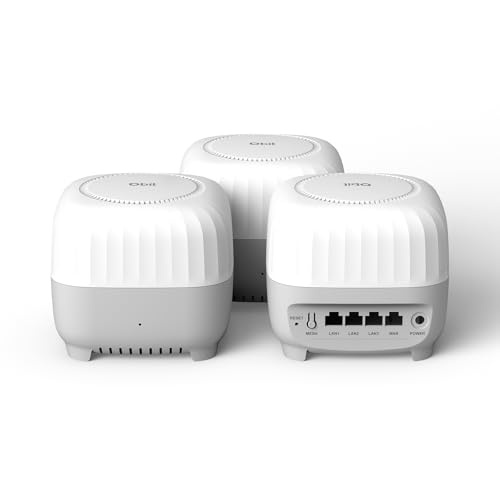
DBIT AC1200 Dual-Band Mesh System
Best for: Large homes with moderate device counts
- Speed Rating
- AC1200 (1200Mbps)
- Coverage Area
- up to 6,000 Sq Ft
- Frequency Bands
- Dual-Band
- Pack Size
- 3-Pack
- Port Speed
- Gigabit
- Device Capacity
- 90 Devices
View on Amazon: DBIT AC1200 Dual-Band Mesh System Affiliate link
The DBIT AC1200 3-Pack covers up to 6,000 square feet with dual-band speeds up to 1200Mbps. It supports 90 connected devices and includes four gigabit Ethernet ports per node. This system uses WPA3 encryption and offers app-based management. It suits homes needing broad coverage for multiple users without requiring WiFi 6 hardware.
Pros
- Covers up to 6,000 square feet with a 3-pack
- Supports 90 simultaneous device connections
- Each node has four gigabit Ethernet ports
- Uses WPA3-SAE encryption for network security
Cons
- Limited to dual-band AC1200 speeds
- No mention of WiFi 6 (802.11ax) support
- Higher latency potential compared to WiFi 6 models
Good fit if
- You need coverage for large homes up to 6,000 sq ft
- You have under 90 devices connecting simultaneously
- You prefer wired gigabit connections for key devices
Skip if
- You require WiFi 6 speeds and lower latency
- You have more than 90 devices on the network
- You need coverage beyond 6,000 square feet
Verdict: DBIT AC1200 3-Pack Mesh System provides reliable whole-home coverage for standard households. It is a practical option for users who prioritize wide area coverage and wired port availability over next-generation WiFi speeds.
Specifications side by side
| Spec | DBIT AX1500 WiFi 6 Mesh System 3-Pack | DBIT AC1200 Dual-Band Mesh System |
|---|---|---|
| Wi-Fi Standard | WiFi 6 | not stated |
| Speed Rating | AX1500 | AC1200 (1200Mbps) |
| Coverage Area | 5,600 Sq Ft | up to 6,000 Sq Ft |
| Frequency Bands | Dual-Band | Dual-Band |
| Pack Size | 3-Pack | 3-Pack |
| Port Speed | Gigabit | Gigabit |
| Device Capacity | 120 | 90 Devices |
| Frequency Band | Dual-Band | Dual-Band |
| Features | Parental Controls, Mesh, Seamless Roaming | Mesh |
| Intended Use | not stated | Home |
| Dimensions | 5.04 × 5.04 × 4.02 inches | 5.08 × 5.08 × 4.53 inches |
| Weight | 2.08 pounds | 2.22 pounds |
| Size | 5.04 x 5.04 x 4.02 inches | 5.08 x 5.08 x 4.53 inches |
| Color | White and Gray | White and Gray |
| Model | D-MAX4 | D-MAC3 |
Frequently asked questions
Which DBIT mesh system is better for large homes with many devices?
The DBIT AX1500 is the better choice for large homes with many devices. It supports up to 120 simultaneous connections, compared to the AC1200’s limit of 90 devices. This higher capacity ensures stable performance even when many gadgets are connected. The AX1500 also uses the newer Wi-Fi 6 standard, which handles crowded networks more efficiently.
Does the DBIT AX1500 offer faster speeds than the AC1200?
Yes, the DBIT AX1500 offers faster theoretical speeds. It carries an AX1500 rating, while the AC1200 is rated at AC1200. The AX1500 uses Wi-Fi 6 technology, which provides more efficient data handling and better performance in crowded environments. This makes it suitable for users who prioritize next-generation WiFi speeds over basic coverage.
Do both DBIT mesh systems include gigabit ethernet ports?
Yes, both systems include gigabit ethernet ports. This allows you to connect wired devices like gaming consoles or smart TVs at high speeds. The AX1500 and AC1200 both feature these ports, making them practical options for users who need reliable wired connections alongside wireless coverage. This feature is consistent across both models in the DBIT lineup.
Is parental control available on the DBIT AC1200 mesh system?
Parental controls are explicitly listed as a feature for the DBIT AX1500. The provided specifications do not mention parental controls for the DBIT AC1200. You should verify the app capabilities for the AC1200 separately if this feature is essential for your household. The AX1500 includes this functionality as a standard attribute in its feature set.
What is the coverage area for the DBIT AC1200 3-pack?
The DBIT AC1200 3-pack provides coverage for up to 6,000 square feet. This makes it a practical option for large homes requiring wide area coverage. The system is designed for standard households with moderate device counts. If you need broad coverage without the latest Wi-Fi standard, this model fits your needs well.
How do the physical sizes of the two DBIT mesh nodes compare?
The DBIT AX1500 measures 5.04 x 5.04 x 4.02 inches and weighs 2.08 pounds. The DBIT AC1200 is slightly larger at 5.08 x 5.08 x 4.53 inches and weighs 2.22 pounds. Both units come in white and gray colors. The AX1500 is slightly more compact and lighter, which may matter for tight spaces.
Can I use the DBIT AX1500 for a smart home with many gadgets?
Yes, the DBIT AX1500 is ideal for smart homes with many gadgets. It supports up to 120 simultaneous connections, which handles the load of multiple smart devices better than the AC1200. The Wi-Fi 6 standard also improves performance in crowded environments. This makes it a solid choice for users prioritizing device capacity and modern connectivity.
Does the DBIT AC1200 support Wi-Fi 6 technology?
No, the DBIT AC1200 does not support Wi-Fi 6. It relies on the older Wi-Fi 5 (AC) technology. The AX1500 is the model that uses the newer Wi-Fi 6 standard. If you require Wi-Fi 6 benefits like better efficiency and capacity, you must choose the AX1500. The AC1200 is limited to dual-band AC speeds.