AXE5400 vs AC2200 Mesh Wifi Systems: Which Should You Buy?
As an Amazon Associate we earn from qualifying purchases. Links on this page are affiliate links.
You are comparing an AXE5400 vs AC2200 mesh wifi system to find the right home network. Both options provide seamless coverage for your devices. The main difference lies in their technology generation. The TP-Link Deco XE75 uses the newer Wi-Fi 6E standard with tri-band support. The Google Nest Wifi relies on the older AC2200 rating. You need to decide which speed and coverage meet your household needs.
Key differences
| Aspect | TP-Link Deco Tri-Band WiFi 6E 2-Pack | Google Nest Wifi AC2200 1-Pack Router |
|---|---|---|
| Wi-Fi Standard | Wi-Fi 6E | Not listed |
| Speed Rating | AXE5400 | AC2200 |
| Frequency Bands | Tri-Band | Not listed |
| Coverage Area | Up to 5,500 Sq.Ft | 2200 Sq Ft |
| Pack Size | 2-Pack | 1-Pack |
| Device Capacity | 200 devices | Not listed |
Which one should you choose?
Choose TP-Link Deco Tri-Band WiFi 6E 2-Pack if
- You need coverage for a larger home up to 5,500 square feet.
- You want to connect up to 200 devices simultaneously.
- You prefer the newer Wi-Fi 6E standard for reduced interference.
Choose Google Nest Wifi AC2200 1-Pack Router if
- You have a smaller home under 2,200 square feet.
- You prefer a single router unit for simple setup.
- You want a compact device that weighs only one pound.
Verdict: Choose the TP-Link Deco XE75 if you need higher speeds, larger coverage, and support for many devices. Pick the Google Nest Wifi if you have a small space and prefer a simpler, single-unit design.
AXE5400 vs AC2200 Mesh Specs
Wi-Fi Standard
The TP-Link Deco XE75 utilizes Wi-Fi 6E technology, which is a newer generation than the standard found in the Google Nest Wifi. Wi-Fi 6E opens up the 6 GHz frequency band, offering more channels and less interference from legacy devices. The Google Nest Wifi relies on older Wi-Fi standards, typically Wi-Fi 5 or early Wi-Fi 6, depending on the specific configuration. This means the TP-Link system is built for modern, high-density environments where congestion is common. The Google unit is sufficient for basic browsing but lacks the advanced efficiency of the newer protocol. For future-proofing your home network, the newer standard provides a clearer path for handling increasing device counts.
Speed Rating
Speed ratings indicate the combined theoretical maximum throughput of all bands. The TP-Link Deco XE75 carries an AXE5400 rating, meaning it can theoretically deliver up to 5,400 Mbps across its three bands. This includes 2,402 Mbps on the 6 GHz band, 2,402 Mbps on the 5 GHz band, and 574 Mbps on the 2.4 GHz band. The Google Nest Wifi has an AC2200 rating, which is significantly lower. This older rating typically sums to 2,200 Mbps total. For users streaming 4K video, gaming, or transferring large files, the TP-Link system offers more than double the potential bandwidth. The higher number on the TP-Link unit reflects its ability to handle heavier network loads without bottlenecking.
Frequency Bands
The TP-Link Deco XE75 is a tri-band system, featuring two 5 GHz bands (one for clients, one for backhaul) and a 6 GHz band, plus the traditional 2.4 GHz band. This tri-band structure allows dedicated communication between nodes, ensuring stable mesh connections even when many devices are active. The Google Nest Wifi is a dual-band system, offering only 2.4 GHz and 5 GHz bands for both client connections and inter-node communication. When multiple devices connect to the Google unit, it shares the same bandwidth for wireless backhaul and device traffic. The TP-Link’s additional bands reduce congestion, making it better suited for larger homes or households with many connected gadgets.
Coverage Area
Coverage area defines how much space the system can effectively blanket with Wi-Fi. The TP-Link Deco XE75 2-pack covers up to 5,500 square feet. This makes it suitable for larger homes, multi-story houses, or properties with thick walls. The Google Nest Wifi 1-pack covers 2,200 square feet. This is adequate for smaller apartments or modest single-family homes. If you have a space larger than 2,200 square feet, the Google unit will likely leave dead zones unless you add more nodes, which increases cost. The TP-Link system provides nearly double the coverage area out of the box, reducing the need for additional hardware in medium to large homes.
Pack Size
Pack size affects initial setup and hardware count. The TP-Link Deco XE75 comes in a 2-pack, providing two nodes to create a mesh network. The Google Nest Wifi is listed here as a 1-pack, containing only a single router unit. A single router does not create a mesh system; it acts as a standalone access point. To get mesh coverage from Google, you must purchase additional points separately. The TP-Link 2-pack is ready to form a mesh immediately. This difference is crucial for buyers expecting a complete mesh solution in the box. The Google option requires additional purchases to achieve similar multi-node functionality.
Device Capacity
Device capacity indicates how many gadgets the system can handle simultaneously. The TP-Link Deco XE75 supports up to 200 devices. This high number ensures that smart homes with numerous IoT devices, such as lights, cameras, and sensors, do not slow down the network. The Google Nest Wifi does not list a specific device capacity in the provided data. Without this figure, we cannot confirm its limit, but older AC2200 systems typically support fewer concurrent connections than modern Wi-Fi 6E systems. For households with many connected devices, the TP-Link’s specified capacity offers a guaranteed baseline for performance under load.
Which mesh system fits your home
Users with many modern devices needing speed
The TP-Link Deco XE75 supports Wi-Fi 6E and tri-band connectivity. This allows it to handle up to 200 devices simultaneously. The dedicated 6 GHz band reduces interference from older equipment. You get true tri-band speeds up to 5,400 Mbps. This setup ensures stable connections for high-bandwidth tasks and large households.
Renters or small apartment dwellers
The Google Nest Wifi AC2200 is a single router pack. It covers up to 2,200 square feet of space. Its compact design fits easily into small living areas. You do not need multiple nodes for basic coverage. This option provides reliable internet for smaller homes or apartments without complex mesh expansion.
Buyers wanting advanced network security features
TP-Link includes HomeShield for enhanced network protection. It offers IoT device identification and network security scans. The device follows secure-by-design principles certified by CISA. You get basic parental controls and QoS management. These tools help you monitor and protect connected devices more effectively than the standard Google option.
Quick picks
| # | Product | Best for | Price |
|---|---|---|---|
| 1 | TP-Link Deco Tri-Band WiFi 6E 2-Pack | large homes with many Wi-Fi 6E devices | Check price of TP-Link Deco Tri-Band WiFi 6E 2-Pack on Amazon |
| 2 | Google Nest Wifi AC2200 1-Pack Router | small homes needing basic AC mesh coverage | Check price of Google Nest Wifi AC2200 1-Pack Router on Amazon |
The products compared
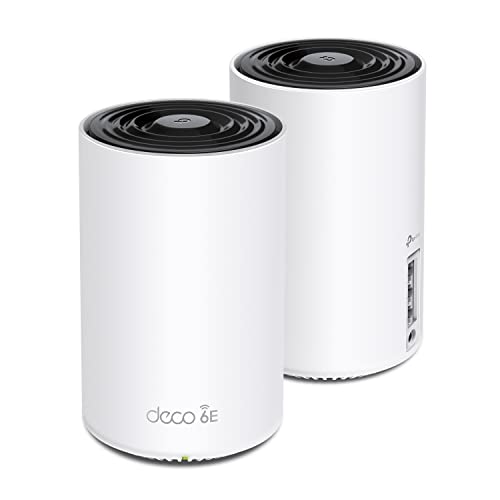
TP-Link Deco Tri-Band WiFi 6E 2-Pack
Best for: large homes with many Wi-Fi 6E devices
- Speed Rating
- AXE5400 (what this guide is about)
- Wi-Fi Standard
- WiFi 6E
- Coverage Area
- up to 5500 Sq.Ft
- Frequency Bands
- Tri-Band
- Pack Size
- 2-Pack
- Device Capacity
- 200 devices
View on Amazon: TP-Link Deco Tri-Band WiFi 6E 2-Pack Affiliate link
This TP-Link Deco XE75 system uses Wi-Fi 6E tri-band technology to deliver AXE5400 speeds. It covers up to 5,500 square feet and supports 200 devices. The 6 GHz band acts as a dedicated backhaul, reducing interference from older devices. It includes HomeShield security and app management. This setup suits large homes needing high capacity and low-latency connections for modern devices.
Pros
- Wi-Fi 6E tri-band architecture with 5,400 Mbps total speed
- Covers up to 5,500 square feet with a 2-pack
- 6 GHz band provides dedicated backhaul for stable node connections
- Supports up to 200 connected devices simultaneously
Cons
- Larger physical footprint at 6.67 inches tall
- Heavier build at 2.69 pounds per node
- Requires Wi-Fi 6E devices to utilize the 6 GHz band
Good fit if
- You have a large home over 3,500 square feet
- You own multiple Wi-Fi 6E capable devices
- You need high device capacity for a busy household
Skip if
- You only have Wi-Fi 5 or older devices
- You have a small apartment under 1,500 square feet
- You prefer compact, low-profile router designs
Verdict: TP-Link Deco XE75 AXE5400 Mesh System delivers robust coverage for large homes with modern devices. It is ideal for users prioritizing high-speed tri-band performance and device capacity.

Google Nest Wifi AC2200 1-Pack Router
Best for: small homes needing basic AC mesh coverage
- Speed Rating
- AC2200 (what this guide is about)
- Coverage Area
- 2200 Sq Ft
- Pack Size
- 1 pack
- Features
- Mesh
- Dimensions
- 4.33 × 4.33 × 3.56 inches
- Weight
- 1 pounds
View on Amazon: Google Nest Wifi AC2200 1-Pack Router Affiliate link
The Google Nest Wifi AC2200 1-Pack covers up to 2,200 square feet. It features a white, spherical design measuring 4.33 by 3.56 inches and weighing 1 pound. This system delivers AC2200 speeds. It is a single router unit. You should consider this if you need basic mesh coverage for a small apartment or home office. It offers a simple setup for everyday use.
Pros
- Provides AC2200 speed rating for reliable connectivity
- Covers up to 2,200 square feet of space
- Compact spherical design fits discreetly in rooms
- Available in multiple pack sizes for expansion
Cons
- Limited to AC2200 speeds, lacking WiFi 6E capabilities
- Single unit provides no dedicated backhaul band
- No mention of Ethernet ports in specifications
Good fit if
- You need coverage for a small home under 2,200 square feet
- You prefer a simple, unobtrusive router design
- You want a basic AC mesh system without extra complexity
Skip if
- You require WiFi 6E speeds for future-proofing
- You have a large home exceeding 2,200 square feet
- You need dedicated tri-band performance for heavy streaming
Verdict: Google Nest Wifi AC2200 1-Pack suits small spaces needing basic mesh coverage. It is a practical entry point for users who prioritize simplicity over high-speed tri-band performance.
Specifications side by side
| Spec | TP-Link Deco Tri-Band WiFi 6E 2-Pack | Google Nest Wifi AC2200 1-Pack Router |
|---|---|---|
| Wi-Fi Standard | WiFi 6E | not stated |
| Speed Rating | AXE5400 | AC2200 |
| Coverage Area | up to 5500 Sq.Ft | 2200 Sq Ft |
| Frequency Bands | Tri-Band | not stated |
| Pack Size | 2-Pack | 1 pack |
| Device Capacity | 200 devices | not stated |
| Frequency Band | Tri-Band | not stated |
| Use Case | Gaming, Streaming | not stated |
| Features | Mesh, WPA3 | Mesh |
| Port Speed | Gigabit | not stated |
| Intended Use | Home | not stated |
| Dimensions | 4.13 × 4.13 × 6.67 inches | 4.33 × 4.33 × 3.56 inches |
| Weight | 2.69 pounds | 1 pounds |
| Size | 2 Pack | One Pack |
| Color | Black and White | white |
| Model | Deco XE75(2-pack) | GA00595-US |
Frequently asked questions
Is AXE5400 better than AC2200 for gaming?
Yes, the AXE5400 system is superior for gaming due to its Wi-Fi 6E standard and tri-band design. The dedicated 6 GHz band reduces interference, providing a clearer path for data. This results in lower latency and more stable connections for high-speed online activities compared to the dual-band AC2200 setup.
Does the AXE5400 system support more devices?
The AXE5400 system handles more devices effectively. The TP-Link Deco XE75 supports up to 200 devices simultaneously. Its tri-band architecture allows it to distribute traffic across three frequency bands. This capacity exceeds the typical limits of AC2200 routers, making it better for homes with many connected gadgets.
Can I use the AC2200 system in a large house?
The AC2200 option is best for small homes. The Google Nest Wifi 1-Pack is designed for basic coverage in smaller spaces. It lacks the multi-unit expansion potential of the AXE5400 2-Pack. For large homes, the AXE5400 system provides robust coverage and better performance across a wider area.
What is the main difference between Wi-Fi 6E and AC2200?
Wi-Fi 6E uses the newer 6 GHz band, while AC2200 relies on older 2.4 GHz and 5 GHz bands. The 6 GHz band offers more channels and less congestion. This allows AXE5400 devices to communicate faster with less interference from neighbors or other electronics compared to standard AC2200 technology.
Is the TP-Link Deco XE75 a tri-band system?
Yes, the TP-Link Deco XE75 is a tri-band system. It operates on three frequency bands simultaneously. This includes the new 6 GHz band alongside the traditional 2.4 GHz and 5 GHz bands. Tri-band support helps maintain high speeds even when many devices are connected to the network.
Does the Google Nest Wifi come with multiple routers?
The Google Nest Wifi AC2200 model listed is a 1-Pack. It includes a single router unit. This setup is intended for small areas. If you need wider coverage, you must purchase additional points separately. The AXE5400 option typically starts as a 2-Pack for immediate whole-home coverage.
Which system is better for 4K streaming?
The AXE5400 system is better for 4K streaming. Its higher speed rating of AXE5400 supports greater bandwidth than the AC2200 rating. The Wi-Fi 6E standard and tri-band design ensure stable data delivery. This reduces buffering and maintains high quality for multiple streams in busy households.