AX1500 vs AC1200 Wifi Routers in 2026: Key Differences
As an Amazon Associate we earn from qualifying purchases. Links on this page are affiliate links.
You are comparing the AX1500 vs AC1200 wifi router options for travel networking. Both devices are portable travel routers designed for dual-band Wi-Fi connectivity on the go. They share gigabit Ethernet ports and VPN support for secure connections. The main difference lies in their Wi-Fi generation and maximum device capacity. The AX1500 model uses newer Wi-Fi 6 technology, while the AC1200 relies on the older Wi-Fi 5 standard. This impacts speed and efficiency for connected devices.
Key differences
| Aspect | TP-Link Roam 6 Portable Wi-Fi 6 Router | GL.iNet Opal Dual-Band Travel Router |
|---|---|---|
| Wi-Fi Standard | Wi-Fi 6 | Wi-Fi 5 |
| Speed Rating | AX1500 | AC1200 |
| Device Capacity | Up to 60 devices | not listed |
| Antennas | Internal | Retractable |
Which one should you choose?
Choose TP-Link Roam 6 Portable Wi-Fi 6 Router if
- You need to connect more than 30 devices simultaneously
- You want faster speeds on the 5 GHz band up to 1,201 Mbps
- You prefer a compact design without external antennas
Choose GL.iNet Opal Dual-Band Travel Router if
- You want to physically adjust antenna positions for better signal
- You prefer a white color option for the device
- You need a physical toggle switch to enable VPN features
Verdict: Choose the AX1500 if you prioritize higher theoretical speeds and support for a larger number of connected devices. The AC1200 is a suitable alternative if you value physical antenna adjustment and a dedicated hardware switch for VPN toggling. Both routers offer reliable portable connectivity for travel.
AX1500 vs AC1200 Wi-Fi Speeds
Speed Rating
The TP-Link Roam 6 carries an AX1500 speed rating, while the GL.iNet Opal is rated AC1200. This rating reflects the combined maximum wireless data rates across both frequency bands. The Roam 6 offers up to 1,201 Mbps on the 5 GHz band and 300 Mbps on the 2.4 GHz band. The Opal provides up to 867 Mbps on the 5 GHz band and 300 Mbps on the 2.4 GHz band. You get higher peak throughput with the Roam 6, especially on the faster 5 GHz band. This matters if you stream high-resolution video or transfer large files over Wi-Fi.
Wi-Fi Standard
The Roam 6 uses the Wi-Fi 6 standard, whereas the Opal relies on the older Wi-Fi 5 (802.11ac) standard. Wi-Fi 6 introduces technical improvements like OFDMA and better power management. These features help the router manage multiple connections more efficiently. You will notice less congestion when many devices are active. The Opal lacks these modern efficiency gains. It still handles basic tasks well, but Wi-Fi 6 provides a more future-proof foundation for your travel network.
Device Capacity
The Roam 6 supports up to 60 devices simultaneously. The Opal does not list a specific device capacity limit in its published specifications. This means you cannot verify how many connections the Opal handles before buying. The Roam 6 explicitly states it can manage a larger number of connected gadgets. If you travel with a laptop, phone, tablet, and smartwatch, the Roam 6 ensures you stay within its known limit. You get clearer expectations with the Roam 6.
Number of Ports
Both routers include gigabit Ethernet ports for wired connections. The Roam 6 provides two ports total: one WAN/LAN port and one LAN port. The Opal offers three gigabit ports: one WAN port and two LAN ports. The Opal gives you one extra physical connection for wired devices. This helps if you need to connect a laptop and a console simultaneously. The Roam 6 limits you to two wired connections. The Opal wins slightly for users who need more wired outlets.
Build
The Opal features retractable antennas that extend for better signal reception. The Roam 6 does not mention external antennas in its data. Internal antennas are common in portable routers, but retractable ones allow you to adjust orientation. This can improve signal strength in difficult environments like hotel rooms with thick walls. The Roam 6 relies on its internal design. The Opal gives you more control over antenna positioning. This is a practical advantage for optimizing your Wi-Fi range on the go.
Which Travel Router Fits Your Needs
Users needing high speed for many devices
The Roam 6 supports Wi-Fi 6 with an AX1500 rating. It handles up to 60 devices simultaneously. The 5 GHz band offers 1,201 Mbps for faster data transfer. This standard improves efficiency when multiple gadgets connect to the same network. You get better performance for streaming and heavy uploads compared to older standards.
Travelers wanting physical VPN control
The Opal includes a physical toggle switch for VPN activation. You can enable OpenVPN or WireGuard instantly without opening an app. It also features retractable antennas for better signal reception. This hardware control offers convenience for users who frequently switch between secure and open connections while on the road.
Users preferring a lighter, compact design
The Opal weighs 10.6 ounces and features a compact white design. It includes three gigabit ports for flexible wired connections. While slightly heavier than the Roam 6, its retractable antennas provide improved signal strength. This setup suits travelers who prioritize antenna performance and multiple port options in a pocket-friendly form factor.
Quick picks
| # | Product | Best for | Price |
|---|---|---|---|
| 1 | TP-Link Roam 6 Portable Wi-Fi 6 Router | Secure portable Wi-Fi for travel | Check price of TP-Link Roam 6 Portable Wi-Fi 6 Router on Amazon |
| 2 | GL.iNet Opal Dual-Band Travel Router | travelers needing secure, portable AC1200 connectivity | Check price of GL.iNet Opal Dual-Band Travel Router on Amazon |
The products compared

TP-Link Roam 6 Portable Wi-Fi 6 Router
Best for: Secure portable Wi-Fi for travel
- Speed Rating
- AX1500 (what this guide is about)
- Wi-Fi Standard
- Wi-Fi 6
- Frequency Bands
- Dual-Band
- Device Capacity
- 60 devices
- Max Port Speed
- 1 Gbps
- Ethernet Ports
- 2
View on Amazon: TP-Link Roam 6 Portable Wi-Fi 6 Router Affiliate link
The TP-Link Roam 6 is a pocket-sized travel router with AX1500 Wi-Fi 6 speeds. It offers dual-band connectivity up to 1,201 Mbps on 5 GHz and 300 Mbps on 2.4 GHz. The device supports up to 60 devices and includes two 1 Gbps Ethernet ports. You can power it via USB-C or a standard adapter. It is designed for secure connections on public networks or as a portable home router.
Pros
- Wi-Fi 6 standard for improved efficiency and speed
- Two 1 Gbps Ethernet ports for wired connections
- Supports OpenVPN and WireGuard for secure encryption
- Compact dimensions of 4.09 x 3.54 x 1.1 inches
Cons
- Limited to 60 simultaneous device connections
- No dedicated external antenna ports listed
- Requires USB-C power source or included adapter
Good fit if
- You need a secure network while traveling
- You want Wi-Fi 6 speeds in a small form factor
- You require wired Ethernet ports for gaming or streaming
Skip if
- You need to connect more than 60 devices
- You prefer a larger desktop router with more ports
- You do not have access to USB-C power
Verdict: The TP-Link Roam 6 Portable Wi-Fi 6 Router is a compact solution for travelers needing secure, fast Wi-Fi. It fits users who prioritize portability and modern Wi-Fi 6 standards over high device capacity.
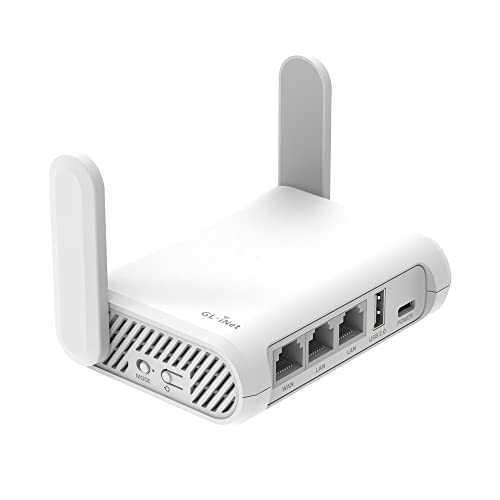
GL.iNet Opal Dual-Band Travel Router
Best for: travelers needing secure, portable AC1200 connectivity
- Speed Rating
- AC1200 (what this guide is about)
- Frequency Bands
- Dual-Band
- Max Port Speed
- Gigabit
- Ethernet Ports
- 3
- Use Case
- Travel
- Features
- VPN, OpenWrt
View on Amazon: GL.iNet Opal Dual-Band Travel Router Affiliate link
The GL.iNet Opal is a compact AC1200 dual-band travel router designed for portability. It offers simultaneous speeds of 300 Mbps on 2.4GHz and 867 Mbps on 5GHz. The device features full gigabit ports for wired connections and supports IPv6. It includes pre-installed OpenVPN and WireGuard for secure networking. Its lightweight, pocket-friendly design makes it suitable for travelers needing reliable internet access on the go.
Pros
- AC1200 dual-band Wi-Fi with 867 Mbps on 5GHz
- Full gigabit WAN and LAN ports for wired devices
- Pre-installed OpenVPN and WireGuard for secure connections
- Retractable antennas for improved signal reception
- Lightweight 10.6-ounce design for easy portability
Cons
- AC1200 speed rating is lower than Wi-Fi 6 AX1500 options
- Physical toggle switch requires initial admin panel configuration
- Does not support easytethering for mobile data sharing
Good fit if
- You need a portable router for travel or public Wi-Fi
- You require built-in VPN support for secure browsing
- You want to connect wired devices via gigabit ports
Skip if
- You need the highest possible Wi-Fi 6 speeds
- You want a device that works out of the box without configuration
- You plan to share mobile data via tethering
Verdict: The GL.iNet Opal AC1200 Travel Router is a secure, portable solution for travelers who need reliable wired and wireless connectivity. It best suits users who prioritize privacy features and portability over maximum wireless speed.
Specifications side by side
| Spec | TP-Link Roam 6 Portable Wi-Fi 6 Router | GL.iNet Opal Dual-Band Travel Router |
|---|---|---|
| Wi-Fi Standard | Wi-Fi 6 | not stated |
| Speed Rating | AX1500 | AC1200 |
| Frequency Bands | Dual-Band | Dual-Band |
| Device Capacity | 60 devices | not stated |
| Max Port Speed | 1 Gbps | Gigabit |
| Ethernet Ports | 2 | 3 |
| Frequency Band | Dual-Band | Dual-Band |
| Use Case | Travel | Travel |
| Features | not stated | VPN, OpenWrt |
| Port Speed | not stated | Gigabit |
| Dimensions | 4.09 × 1.1 × 3.54 inches | 4.65 × 1.18 × 3.35 inches |
| Weight | 6.72 ounces | 10.6 ounces |
| Size | Portable | Compact |
| Color | Black | White |
| Model | TL-WR1512X | SFT1200 |
Frequently asked questions
Is AX1500 faster than AC1200 for travel?
Yes, AX1500 offers higher theoretical speeds. The TP-Link Roam 6 provides up to 1,201 Mbps on the 5 GHz band. The GL.iNet Opal AC1200 has lower combined maximum rates. You get faster data transfer with the AX1500 model.
Does Wi-Fi 6 improve travel connectivity?
Wi-Fi 6 improves efficiency in crowded areas. The TP-Link Roam 6 uses this standard for better device handling. It supports up to 60 devices simultaneously. The GL.iNet Opal uses older AC technology, which is less efficient with multiple connections.
Which router handles more devices?
The TP-Link Roam 6 handles more devices. It supports up to 60 simultaneous connections. The GL.iNet Opal is designed for fewer devices. It prioritizes privacy features over high device capacity. Choose the Roam 6 for larger groups.
Are both routers portable for trips?
Both are designed for travel use. The TP-Link Roam 6 weighs 6.72 ounces. The GL.iNet Opal weighs 10.6 ounces. Both fit in bags easily. They provide secure Wi-Fi on the go. The Roam 6 is slightly lighter to carry.
Do they support VPN for security?
Yes, both devices support VPN connections. This ensures secure data transfer on public networks. The GL.iNet Opal emphasizes privacy features. The TP-Link Roam 6 also includes VPN support. Both protect your data while traveling through untrusted networks.
Is dual-band necessary for these routers?
Dual-band provides flexibility for different devices. Both routers operate on dual bands. The 5 GHz band offers higher speeds. The 2.4 GHz band offers better range. You get the best of both worlds for varied travel needs.
Which is better for secure travel?
Both offer secure portable Wi-Fi. The GL.iNet Opal focuses on privacy features. The TP-Link Roam 6 focuses on speed and modern standards. If security is your main concern, the Opal is a strong choice. Both provide reliable encrypted connections.