4,500 Sq ft or 5,000 Sq ft Mesh Wifi Systems? Compared by Specs
As an Amazon Associate we earn from qualifying purchases. Links on this page are affiliate links.
Choosing between a 4500 sq ft vs 5000 sq ft mesh wifi system depends on your home size and device needs. Both setups provide whole-home coverage, but they target different performance levels. The eero 6 offers Wi-Fi 6 with high device capacity, while the ASUS ZenWiFi delivers Wi-Fi 7 speeds. You must decide if you prioritize connection stability or raw throughput. This comparison highlights the key spec differences to help you pick the right hardware.
Key differences
| Aspect | Amazon eero 6 3-Pack Mesh System | ASUS ZenWiFi 2-Pack WiFi 7 Mesh |
|---|---|---|
| Wi-Fi Standard | Wi-Fi 6 | Wi-Fi 7 |
| Speed Rating | Up to 900 Mbps | 5 Gbps |
| Coverage Area | 4,500 sq. ft. | 5,000 sq. ft. |
| Device Capacity | 75+ devices | not listed |
| Pack Size | 3-pack | 2-pack |
Which one should you choose?
Choose Amazon eero 6 3-Pack Mesh System if
- You have over 75 devices connected to your network simultaneously.
- You want a built-in smart home hub for Zigbee devices.
- You prefer a three-unit setup for broader coverage distribution.
Choose ASUS ZenWiFi 2-Pack WiFi 7 Mesh if
- You need the latest Wi-Fi 7 speeds and MLO support.
- Your home is larger than 4,500 sq. ft. but under 5,000 sq. ft.
- You want commercial-grade security with AiProtection Pro.
Verdict: Choose the eero 6 if you value high device capacity and smart home integration over raw speed. Pick the ASUS ZenWiFi if you require the newest Wi-Fi 7 technology and higher theoretical bandwidth for a slightly larger footprint.
Coverage, Speed, and Standards Compared
Coverage Area
You need to match the mesh system to your floor plan size. The Amazon eero 6 3-Pack covers up to 4,500 square feet. This 3-pack includes three routers to ensure consistent signal strength across that area. The ASUS ZenWiFi 2-Pack covers up to 5,000 square feet. It achieves this larger range with only two units. If your home is near 5,000 square feet, the ASUS unit provides the necessary reach. The eero system is better suited for spaces up to 4,500 square feet. Choose the ASUS if you have a larger footprint.
Wi-Fi Standard
The wireless generation determines how efficiently data moves through your network. The Amazon eero 6 uses Wi-Fi 6 technology. This standard improves performance over older Wi-Fi 5 by handling multiple devices more efficiently. The ASUS ZenWiFi BD5 uses Wi-Fi 7. This is the latest standard, offering faster theoretical speeds and lower latency. Wi-Fi 7 includes features like MLO and 4K-QAM for better performance. If you want the most modern technology, the ASUS wins. The eero is still capable for most homes, but it is an older generation.
Speed Rating
Maximum speed ratings indicate how much data the system can handle. The Amazon eero 6 supports speeds up to 900 Mbps. This is sufficient for streaming 4K video and general browsing on many devices. The ASUS ZenWiFi BD5 supports speeds up to 5 Gbps. This is significantly higher than the eero. The ASUS uses dual-band Wi-Fi 7 to achieve this throughput. If you have high-bandwidth activities like large file transfers or multiple 4K streams, the ASUS offers much more bandwidth. The eero is adequate for standard use.
Device Capacity
The number of connected devices affects network stability. The Amazon eero 6 supports 75 or more connected devices. This is a high capacity for a home network. The ASUS ZenWiFi BD5 does not list a specific device capacity in the provided data. Without this number, you cannot compare the limits directly. However, Wi-Fi 7 generally handles more devices efficiently. Since the eero explicitly states 75+ devices, it has a clear advantage in stated capacity. The ASUS data is incomplete on this point.
Pack Size
The number of units in the box affects setup and coverage. The Amazon eero 6 comes in a 3-pack. You get three routers to place throughout your home. The ASUS ZenWiFi BD5 comes in a 2-pack. You get only two routers. Having three units can help fill dead zones in larger homes more effectively. The ASUS relies on two units to cover 5,000 square feet. If you prefer more nodes for better distribution, the eero is better. The ASUS is more compact in terms of unit count.
Which Mesh System Fits Your Needs
Smart home users with many devices
The eero 6 supports over 75 connected devices, making it ideal for homes with numerous gadgets. It includes a built-in Zigbee hub, allowing you to connect compatible devices directly without extra hardware. This simplifies your setup and keeps your network organized while maintaining stability for all your connected products.
Users seeking highest speed performance
The ASUS ZenWiFi BD5 delivers speeds up to 5 Gbps using Wi-Fi 7 technology. This dual-band system uses MLO and 4K-QAM for faster data transfer. If you need maximum throughput for high-bandwidth activities, this 2-pack offers significantly higher rated speeds than the eero 6, ensuring efficient data handling.
Those needing maximum coverage area
The ASUS ZenWiFi BD5 covers up to 5,000 square feet, providing slightly larger whole-home coverage than the eero 6. Its four internal antennas and high-power front-end modules help eliminate dead zones. This makes it a strong choice for larger homes where you need to reach the furthest corners of your floor plan.
Quick picks
| # | Product | Best for | Price |
|---|---|---|---|
| 1 | Amazon eero 6 3-Pack Mesh System | 4,500 sq. ft. homes with smart devices | Check price of Amazon eero 6 3-Pack Mesh System on Amazon |
| 2 | ASUS ZenWiFi 2-Pack WiFi 7 Mesh | homes up to 5,000 sq ft needing WiFi 7 speeds | Check price of ASUS ZenWiFi 2-Pack WiFi 7 Mesh on Amazon |
The products compared
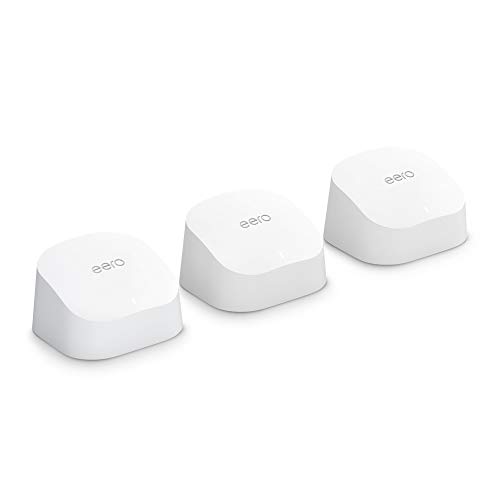
Amazon eero 6 3-Pack Mesh System
Best for: 4,500 sq. ft. homes with smart devices
- Coverage Area
- 4,500 Sq Ft (what this guide is about)
- Wi-Fi Standard
- Wi-Fi 6
- Speed Rating
- up to 900 Mbps
- Pack Size
- 3-pack
- Device Capacity
- 75+ devices
- Features
- Mesh
View on Amazon: Amazon eero 6 3-Pack Mesh System Affiliate link
The eero 6 3-pack delivers Wi-Fi 6 coverage for spaces up to 4,500 square feet. It supports speeds up to 900 Mbps and handles 75+ connected devices. This system includes a built-in Zigbee smart home hub, removing the need for separate hubs. You get whole-home optimization for streaming and video calls. It is a practical choice for homes within this size range.
Pros
- Covers up to 4,500 sq. ft. with three units
- Supports 75+ connected devices on Wi-Fi 6
- Includes built-in Zigbee smart home hub
- Speeds up to 900 Mbps
Cons
- Lower speed rating of 900 Mbps compared to Wi-Fi 7 alternatives
- Older Wi-Fi 6 standard instead of Wi-Fi 7
- Smaller coverage area than 5,000 sq. ft. systems
Good fit if
- You need coverage for up to 4,500 square feet
- You want a built-in Zigbee hub for smart devices
- You have 75 or fewer connected devices
Skip if
- You require Wi-Fi 7 speeds and lower latency
- Your home exceeds 4,500 square feet
- You need support for more than 75 devices
Verdict: eero 6 3-Pack Mesh System fits homes up to 4,500 square feet that value integrated smart home features over raw speed. It is a solid option for moderate device counts.

ASUS ZenWiFi 2-Pack WiFi 7 Mesh
Best for: homes up to 5,000 sq ft needing WiFi 7 speeds
- Coverage Area
- 5,000 Sq Ft (what this guide is about)
- Wi-Fi Standard
- WiFi 7
- Speed Rating
- 5 Gbps
- Frequency Bands
- Dual-band
- Pack Size
- 2 Pack
- Port Speed
- 2.5G
View on Amazon: ASUS ZenWiFi 2-Pack WiFi 7 Mesh Affiliate link
The ASUS ZenWiFi BD5 is a dual-band WiFi 7 mesh system designed for homes up to 5,000 square feet. It delivers combined speeds of 5 Gbps using MLO and 4K-QAM technology. The two-pack includes four internal antennas and high-power front-end modules to reduce dead zones. It features 2.5G ports and commercial-grade security. This system suits users needing strong coverage and modern WiFi standards for larger residences.
Pros
- WiFi 7 standard with MLO and 4K-QAM for up to 5 Gbps speeds
- Covers up to 5,000 square feet with a 2-pack configuration
- Four internal antennas and high-power front-end modules to eliminate dead zones
- Includes 2.5G port speed for high-bandwidth wired connections
Cons
- Limited to dual-band operation instead of tri-band
- No mention of USB ports for local storage or printer sharing
- Relies on 2.5G ports rather than 10G Ethernet for backhaul
Good fit if
- You need reliable coverage for a home up to 5,000 square feet
- You want the latest WiFi 7 features like MLO for reduced latency
- You prefer a dual-band system with high-speed 2.5G wired ports
Skip if
- You require tri-band performance for heavy wireless backhaul traffic
- You need coverage exceeding 5,000 square feet with just two units
- You prefer WiFi 6E or WiFi 6 systems for lower cost
Verdict: The ASUS ZenWiFi BD5 Dual-Band WiFi 7 is a solid choice for medium-to-large homes needing modern WiFi 7 speeds and reliable coverage up to 5,000 square feet. It fits users who value high-speed wired ports and strong signal penetration over tri-band flexibility.
Specifications side by side
| Spec | Amazon eero 6 3-Pack Mesh System | ASUS ZenWiFi 2-Pack WiFi 7 Mesh |
|---|---|---|
| Wi-Fi Standard | Wi-Fi 6 | WiFi 7 |
| Speed Rating | up to 900 Mbps | 5 Gbps |
| Coverage Area | up to 4,500 sq. ft. | 5,000 sq. ft. |
| Frequency Bands | not stated | Dual-band |
| Pack Size | 3-pack | 2 Pack |
| Port Speed | not stated | 2.5G |
| Device Capacity | 75+ devices | not stated |
| Features | Mesh | Parental Controls, Mesh |
| Dimensions | 3.91 × 3.82 × 2.42 inches | 5.5 × 2.8 × 5.5 inches |
| Weight | 1.98 pounds | 1.2 pounds |
| Size | 3 routers | 2 Pack Indoor |
| Color | WHITE | WHITE |
| Model | N010111 | BD5 (W-2-PK) |
Frequently asked questions
Can I use a 4500 sq ft mesh system in a 5000 sq ft home?
You can, but coverage may suffer in distant corners. The Amazon eero 6 3-Pack is rated for 4,500 square feet. Using it in a larger space might leave weak spots. You would need to add extra nodes or choose a system rated for 5,000 square feet for reliable whole-home signal.
Which system supports more connected devices?
The Amazon eero 6 3-Pack supports over 75 devices. This makes it suitable for homes with many smart gadgets. The ASUS ZenWiFi 2-Pack does not list a specific device capacity in its published specs. If you have a high number of connected devices, the eero 6 offers clearer capacity data.
Do I need three routers for 5000 square feet?
Not necessarily. The ASUS ZenWiFi 2-Pack covers up to 5,000 square feet with just two units. It uses Wi-Fi 7 technology to maintain speed. The eero 6 requires a 3-Pack for its 4,500 square foot rating. You should match the pack size to your specific square footage needs.
Is Wi-Fi 7 better than Wi-Fi 6 for home use?
Wi-Fi 7 offers higher potential speeds and efficiency. The ASUS ZenWiFi 2-Pack features Wi-Fi 7 for modern performance. The Amazon eero 6 uses Wi-Fi 6, which is still very capable. Choose Wi-Fi 7 if you want the latest standard. Stick with Wi-Fi 6 if you prioritize device capacity and smart home integration.
How many wired ports does the ASUS ZenWiFi have?
The ASUS ZenWiFi 2-Pack includes 2.5G port speed capabilities. This allows for faster wired connections to devices like gaming consoles or PCs. The Amazon eero 6 3-Pack does not list specific port speeds in its attributes. You should check the physical ports on the unit if wired speed is critical for your setup.
Which mesh system is better for smart home devices?
The Amazon eero 6 3-Pack is designed for smart homes. It supports over 75 devices and includes a built-in Zigbee hub. This lets you connect compatible smart gadgets directly. The ASUS ZenWiFi 2-Pack focuses on Wi-Fi 7 speeds. It does not mention a built-in smart home hub in its published specifications.
What is the physical size difference between these two systems?
The Amazon eero 6 3-Pack consists of three white routers. Each unit measures 3.82 inches wide and 2.42 inches high. The ASUS ZenWiFi 2-Pack has two white units. Each measures 2.8 inches wide and 5.5 inches high. The eero units are shorter and wider, while the ASUS units are taller and narrower.
Can I add more nodes to the ASUS ZenWiFi 2-Pack?
The data shows the ASUS ZenWiFi 2-Pack covers 5,000 square feet. It does not list expansion options in its attributes. The Amazon eero 6 3-Pack is rated for 4,500 square feet. You can often add nodes to eero systems, but you must verify compatibility. Check the manufacturer's website for expansion details on the ASUS model.