1,500 Sq. Ft. or 10,000 Sq. Ft. WiFi Extenders? Compared by Specs
As an Amazon Associate we earn from qualifying purchases. Links on this page are affiliate links.
Choosing between a 1,500 sq ft vs 10,000 sq ft wifi repeater depends on your home layout and device count. Both units offer AC1200 dual-band speeds and extend existing router signals to eliminate dead zones. The main difference lies in their coverage claims and physical design. One plugs directly into a wall outlet for compact placement, while the other uses external antennas and an Ethernet port for greater range and wired connectivity. You need to match these specs to your space.
Key differences
| Aspect | NETGEAR AC1200 Dual-Band WiFi Extender | Rooxis AC1200 Dual-Band WiFi Extender |
|---|---|---|
| Coverage Area | Up to 1,500 sq. ft. | Up to 10,000 sq. ft. |
| Wi-Fi Standard | WiFi 5 | 802.11 a/b/g/n/ac |
| Antenna Design | Internal (wall-plug) | 2 external 3dBi antennas |
| Ethernet Port | Not listed | 1 port |
| Setup Method | App or WPS | WPS only |
Which one should you choose?
Choose NETGEAR AC1200 Dual-Band WiFi Extender if
- You live in a small apartment or condo under 1,500 sq. ft.
- You want a compact device that plugs directly into a wall outlet.
- You prefer using a mobile app for guided setup.
Choose Rooxis AC1200 Dual-Band WiFi Extender if
- You need to cover a large home up to 10,000 sq. ft.
- You require an Ethernet port for wired connections to gaming consoles or TVs.
- You want external antennas for potentially stronger signal direction.
Verdict: The NETGEAR EX5000 is best for small spaces where space-saving wall-plug design matters. The Rooxis extender suits larger homes due to its higher coverage claim and external antennas. Choose based on your square footage and need for wired ports.
1500 vs 10000 Sq Ft Extender Specs
Coverage Area
The NETGEAR EX5000 provides up to 1,500 square feet of added coverage. This size suits small apartments or single rooms where the router signal is already strong but has a weak spot. The Rooxis RXE01 claims coverage for up to 10,000 square feet. This large range targets bigger homes or open floor plans. You need to place the Rooxis carefully to hit that maximum claim. The NETGEAR is designed for tighter spaces. If you have a large house, the NETGEAR will not reach far enough. The Rooxis offers significantly more ground to cover.
Wi-Fi Standard
Both units support Wi-Fi 5, also known as 802.11ac. The NETGEAR explicitly lists this standard. The Rooxis lists 802.11 a/b/g/n/ac, which includes the ac standard. This means both devices operate on the same generation of wireless technology. You get similar theoretical maximum speeds and channel widths on both. Neither device offers the newer Wi-Fi 6 standard. This is a tie for modern relevance. You will get comparable performance for streaming and browsing on both. The underlying technology is identical for your everyday tasks.
Speed Rating
Both extenders offer AC1200 speed ratings. The NETGEAR lists 1.2 Gbps. The Rooxis also lists AC1200, which breaks down to 867 Mbps on the 5 GHz band and 300 Mbps on the 2.4 GHz band. These numbers are combined totals. Real-world speeds will be lower for both. You should expect similar throughput for video calls and web browsing. Neither device provides a speed advantage over the other. The data confirms they are matched in this category. You get the same bandwidth potential from either unit.
Ethernet Ports
The Rooxis includes one Ethernet port. You can plug a game console, smart TV, or desktop computer directly into it. This creates a stable wired connection without running a cable back to your router. The NETGEAR EX5000 data does not list an Ethernet port. It relies entirely on wireless connections. If you need to connect a device via cable, the Rooxis is the only choice. The NETGEAR cannot provide a wired link. This makes the Rooxis more versatile for stationary devices.
Antenna Count
The Rooxis features two external 3dBi high-gain antennas. These are visible on the device. External antennas can help direct signal better in specific directions. The NETGEAR EX5000 is a wall-plug design. It does not list external antennas. Its antennas are likely internal. This makes the NETGEAR less visible but potentially less directional. The Rooxis antennas may offer better range in cluttered environments. The NETGEAR relies on its internal design. The Rooxis has the edge for antenna visibility and potential gain.
Which Extender Fits Your Home Size
Small apartment or single room user
The NETGEAR EX5000 covers up to 1,500 square feet. Its compact wall-plug design saves space. It supports up to 25 devices on WiFi 5. This model fits well in smaller layouts where you only need to eliminate one or two dead zones near your existing router.
Large home needing wide coverage
The Rooxis RXE01 claims coverage for up to 10,000 square feet. It uses two external high-gain antennas to boost signal range. This large coverage area helps reach distant rooms or floors. You get dual-band speeds to maintain stability across a much larger physical footprint.
Gamer or wired device owner
The Rooxis unit includes one Ethernet port for wired connections. You can plug in a console or desktop directly. This provides a stable link without running cables back to the router. The NETGEAR model lacks this port, making the Rooxis better for devices needing wired reliability.
Quick picks
| # | Product | Best for | Price |
|---|---|---|---|
| 1 | NETGEAR AC1200 Dual-Band WiFi Extender | Small homes under 1,500 sq ft | Check price of NETGEAR AC1200 Dual-Band WiFi Extender on Amazon |
| 2 | Rooxis AC1200 Dual-Band WiFi Extender | Large homes needing wide range coverage | Check price of Rooxis AC1200 Dual-Band WiFi Extender on Amazon |
The products compared

NETGEAR AC1200 Dual-Band WiFi Extender
Best for: Small homes under 1,500 sq ft
- Coverage Area
- 1,500 Sq. Ft. (what this guide is about)
- Wi-Fi Standard
- WiFi 5
- Speed Rating
- 1.2 Gbps (AC1200)
- Frequency Bands
- Two bands
- Placement
- Wall outlet
- Intended Use
- Home
View on Amazon: NETGEAR AC1200 Dual-Band WiFi Extender Affiliate link
The NETGEAR EX5000 adds up to 1,500 square feet of WiFi 5 coverage. It delivers AC1200 speeds across two bands to support up to 25 devices. You plug it directly into a wall outlet, which saves space. The Nighthawk app guides setup, or you can use WPS. It extends your existing router’s signal rather than replacing it. This unit suits small to medium homes needing reliable expansion.
Pros
- Covers up to 1,500 square feet
- Dual-band AC1200 speeds up to 1.2 Gbps
- Supports up to 25 connected devices
- Plugs directly into wall outlets
- Includes WPA3 security protection
Cons
- Limited to WiFi 5 standard
- Supports only 25 devices
- No Ethernet ports for wired connections
Good fit if
- You need to cover up to 1,500 square feet
- You want a simple plug-in setup
- You have up to 25 devices to connect
Skip if
- You require WiFi 6 or later
- You need to cover more than 1,500 square feet
- You want to connect more than 25 devices
Verdict: NETGEAR EX5000 WiFi 5 Extender fits small homes needing basic expansion. It covers 1,500 square feet for up to 25 devices. Choose this if you prioritize easy wall-plug installation over higher speeds.
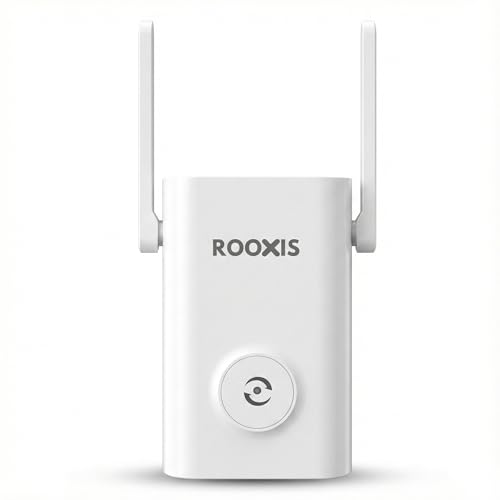
Rooxis AC1200 Dual-Band WiFi Extender
Best for: Large homes needing wide range coverage
- Coverage Area
- 10,000 Sq. Ft. (what this guide is about)
- Wi-Fi Standard
- 802.11 a/b/g/n/ac
- Speed Rating
- AC1200
- Frequency Bands
- Dual Band
- Ethernet Ports
- 1 Ethernet port
- Operating Modes
- Repeater, Access Point
View on Amazon: Rooxis AC1200 Dual-Band WiFi Extender Affiliate link
The Rooxis AC1200 extender covers up to 10,000 square feet using dual-band Wi-Fi. It offers 867 Mbps on 5 GHz and 300 Mbps on 2.4 GHz. Two 3dBi external antennas help push the signal into dead zones. You get one Ethernet port for wired devices. Setup uses WPS buttons, so no app is needed. It works with any router.
Pros
- Covers up to 10,000 square feet
- AC1200 speeds with 867 Mbps on 5 GHz
- Includes one Ethernet port for wired connections
- Two 3dBi high-gain external antennas
- Simple WPS setup without an app
Cons
- Only one Ethernet port limits wired devices
- No dedicated mobile app for management
- Single unit may struggle in very large homes
Good fit if
- You need to cover a large area up to 10,000 sq ft
- You want a simple WPS setup without installing software
- You need a wired port for a console or TV
Skip if
- You require multiple Ethernet ports for wired devices
- You prefer app-based network management and monitoring
- You need tri-band speeds for heavy gaming
Verdict: Rooxis AC1200 Dual-Band Extender fits users who need wide coverage for large spaces without the hassle of app configuration. It is a practical solution for extending range to 10,000 square feet with basic wired connectivity.
Specifications side by side
| Spec | NETGEAR AC1200 Dual-Band WiFi Extender | Rooxis AC1200 Dual-Band WiFi Extender |
|---|---|---|
| Wi-Fi Standard | WiFi 5 | 802.11 a/b/g/n/ac |
| Speed Rating | 1.2 Gbps (AC1200) | AC1200 |
| Frequency Bands | Two bands | Dual Band |
| Coverage Area | 1,500 sq ft | 10,000 sq ft |
| Ethernet Ports | not stated | 1 Ethernet port |
| Operating Modes | not stated | Repeater, Access Point |
| Antenna Count | not stated | 2 |
| Placement | Wall outlet | not stated |
| Frequency Band | not stated | Dual-Band |
| Intended Use | Home | Home |
| Dimensions | 2.55 × 2.85 × 2.85 inches | 2.7 × 3.5 × 7.5 inches |
| Weight | 5.44 ounces | 10 ounces |
| Size | 1.2 Gbps, 1000 sq.ft. | not stated |
| Color | White,Grey | White |
| Model | EX5000-1AZNAS | RXE01 |
Frequently asked questions
Can a 1,500 sq ft extender cover a large house?
No. The NETGEAR EX5000 is designed for small homes under 1,500 square feet. It supports up to 25 devices and fits single rooms or small apartments. For larger spaces, this unit will not provide adequate signal strength throughout the entire property. You need a higher-coverage model for big homes.
Is the 10,000 sq ft extender faster than the smaller one?
Both units share the same AC1200 dual-band speed rating. Neither offers higher throughput than the other based on published specs. The difference lies in coverage area, not speed. You get identical data rates on both the NETGEAR EX5000 and the Rooxis RXE01, despite their different size claims.
How much space does the 1,500 sq ft extender take up?
The NETGEAR EX5000 is very compact. It measures 2.85 inches wide and 2.85 inches high. It weighs only 5.44 ounces. This small form factor allows you to plug it directly into a wall outlet without blocking adjacent sockets. It is ideal for tight spaces in small homes.
What is the size of the 10,000 sq ft extender?
The Rooxis RXE01 is larger and heavier. It stands 7.5 inches tall and weighs 10 ounces. Its base is 3.5 inches wide. This bigger footprint accommodates its wider coverage claims. You will need a floor stand or a dedicated shelf location for this unit, as it is not a simple wall plug.
Do both extenders use dual-band WiFi?
Yes. Both the NETGEAR EX5000 and the Rooxis RXE01 operate on dual bands. This allows them to connect to your router on one band and broadcast to devices on another. This feature helps reduce interference and maintains better performance for connected devices in both small and large home environments.
Which extender is better for a single room?
The NETGEAR EX5000 is the better choice for a single room. It covers up to 1,500 square feet, which is more than enough for most individual rooms or small apartments. Its compact design saves space. The Rooxis unit is overkill for such a small area and takes up more physical room.
Can I use the 10,000 sq ft extender in a small apartment?
You can, but it is not optimal. The Rooxis RXE01 is designed for large spaces up to 10,000 square feet. It is physically larger and heavier than necessary for a small apartment. You would pay for coverage you do not need. The smaller NETGEAR model fits the use case better.